5 best AI-powered incident management platforms 2026
December 5, 2025 — 21 min read
Updated December 5, 2025
TL;DR: The best AI-powered incident management platforms automate response, not just summarize alerts. incident.io leads with Investigations, which automates up to 80% of incident response. PagerDuty remains strong for enterprise alerting but charges extra for AI. Rootly and FireHydrant offer competitive Slack workflows. OpsGenie serves teams needing flexible alerting and on-call management but sunsets in 2027.
Site Reliability Engineering (SRE) teams lose significant incident time to context switching between monitoring tools, chat platforms, ticketing systems, and alerting servicebefore troubleshooting even begins. That coordination tax is why modern engineering teams are adopting AI-powered incident management platforms that eliminate tool sprawl and automate toil.
A recent study shows that teams using AI-powered incident management platforms report reducing MTTR by 17.8% on average, with leading implementations achieving 30-70% reductions through deep automation. The difference comes down to how deeply AI integrates into the incident lifecycle. Does it just summarize Slack threads, or does it autonomously investigate root causes, suggest fixes, and draft post-mortems?
We tested and analyzed the top platforms heading into 2026 to separate genuine AI capabilities from marketing hype. This guide helps SRE teams evaluate which tools deliver measurable MTTR reduction and which ones waste your time.
What is AI-powered incident management?
AI-powered incident management platforms use machine learning and large language models to automate the incident response lifecycle. When we talk about genuine AI capabilities, we mean systems that go beyond basic automation like alert routing. True AI incident management platforms act as an "AI SRE" teammate that investigates issues, identifies root causes, and suggests fixes.
The difference between AI-washing and Investigations
Generic AI features summarize chat logs or search knowledge bases. Investigations analyzes your observability data, correlates recent deployments with error spikes, and generates environment-specific fix PRs. The distinction matters because one saves you 5 minutes of reading, the other saves you 30 minutes of investigation.
Operational vs. Security incident response
We focus on operational incident management for SRE and DevOps teams in this guide. Your goal is restoring service quickly while capturing learnings. Security incident response (SecOps) has different requirements like forensic evidence preservation and compliance documentation. The platforms we cover are tools built for operational speed: incident.io, PagerDuty, Rootly, FireHydrant, and OpsGenie.
Evaluation criteria for AI incident tools
When evaluating AI-powered incident management platforms, we focused on capabilities that directly reduce MTTR and engineering toil.
AI utility and accuracy
Does the platform just summarize, or does it identify root causes? incident.io's Investigations achieves high precision for identifying code changes that caused incidents, with the system designed to show its work by citing specific pull requests and data sources. Look for platforms that cite their sources and show their work, not black-box "AI magic."
Slack and Teams native architecture
Can you run the entire incident without opening a browser? True chat-native platforms feel like using Slack, not like using a web tool that posts to Slack. Three alternative incident management platforms, incident.io, Rootly, and FireHydrant, embed the full workflow in chat. PagerDuty offers Slack integration but remains web-first.
Toil reduction through automation
Does it auto-draft post-mortems from captured timeline data? Favor reduced MTTR by 37% using incident.io, largely by eliminating manual coordination overhead. We prioritized platforms that capture timelines automatically, transcribe incident calls, and generate documentation without dedicated note-takers.
Integration depth and setup time
How long until you're operational? PagerDuty offers 700+ integrations but complex setup. incident.io offers 70+ integrations with faster time-to-value. We evaluated both breadth and depth of integrations with Datadog, Prometheus, New Relic, and Grafana.
Quick comparison: Top AI incident management tools
| Platform | Best For | Core AI Capabilities | Pricing Model | Slack-Native? |
|---|---|---|---|---|
| incident.io | SRE teams wanting autonomous AI investigation | Investigations: root cause identification, automated fix PRs, post-mortem generation | $15-25/user/month base + $10-20 on-call | Yes (Slack + Teams) |
| PagerDuty | Enterprise alerting with complex routing | AIOps for noise reduction, event intelligence, AI summaries (add-ons) | Per-user with costly add-ons | No (integration only) |
| Rootly | Teams focused on workflow automation | AI summaries, timeline generation, workflow orchestration | Per-user/month | Yes (Slack) |
| FireHydrant | Service catalog-driven process enforcement | AI-assisted runbooks, retrospective generation | Per-user/month | Yes (Slack) |
| OpsGenie | Teams needing flexible alerting and on-call management | Alert prioritization, AI-powered recommendations | Per-user/month | No (integration only) |
5 best AI-powered incident management platforms
1. incident.io
Best for: SRE teams wanting a fully Slack-native AI teammate that autonomously investigates incidents.
incident.io's Investigations represents the current state-of-the-art for autonomous incident investigation. Unlike platforms that bolt AI onto existing workflows, we built our entire architecture around an AI SRE agent that acts as an always-on teammate.
Key AI features:
- Autonomous Investigation: The AI SRE connects telemetry, code changes, and past incidents to surface root causes without manual prompting. It analyzes logs, metrics, and traces from your observability stack.
- Environment-Specific Fix Generation: Intercom Engineering documented a case where the AI generated the exact fix their team would have implemented, but in 30 seconds instead of 30 minutes.
- Scribe real-time note taking: Our Scribe feature automatically transcribes incident calls and captures key decisions without requiring a dedicated note-taker.
- Automated Post-Mortems: The platform instantly drafts post-mortems complete with timeline, contributing factors, and resolution, saving hours of manual write-up time.
Quantified outcomes:
Favor reduced MTTR by 37% after implementing incident.io. Buffer saw a 70% reduction in critical incidents. Engineering teams achieve high organic adoption rates due to the intuitive Slack-native interface.
Pros:
- Deepest Slack and Microsoft Teams integration eliminates context-switching
- AI handles up to 80% of incident response, freeing engineers to focus on fixes
- Support velocity measured in hours, not days (source: incident.io customers)
- Unified platform features covering on-call, response, status pages, and post-mortems
Cons:
- On-call scheduling is an add-on cost ($10-20/user/month)
- Opinionated defaults may frustrate teams wanting infinite customization
Pricing: $15-25/user/month for incident response, plus $10-20/user/month for on-call capabilities. Free plan available for basic features.
Verdict: The modern standard for teams serious about reducing MTTR through AI automation.
2. PagerDuty
Best for: Large enterprises needing complex legacy routing requirements.
PagerDuty remains the 800-pound gorilla in incident management. Their strength is reliability at scale and an integration ecosystem of 700+ tools. The challenge is that their AI capabilities often come as expensive add-ons.
Key AI features:
- AIOps and Event Intelligence: Uses machine learning to group related alerts, suppress noise, and reduce alert fatigue. Available as an add-on to all paid plans.
- Generative AI Summaries: Automates status updates and post-mortem drafting for customer service operations.
- PagerDuty Copilot: An AI assistant that helps users create automation rules and summarize incidents.
Pros:
- Most mature and extensive integration library
- Proven reliability for enterprise-scale alert routing
- Strong mobile apps (iOS rated 4.8 stars)
- Sophisticated rules engine for alert customization
Cons:
- Expensive per-seat pricing that escalates with add-ons
- Web-first architecture requires context-switching during incidents
- AI features often gated behind premium tiers
- User reviews frequently cite complex, cluttered UI
Pricing: Per-user/month with multiple tiers. AIOps and advanced AI capabilities require add-ons that significantly increase costs.
Verdict: The safe choice for traditional IT organizations with budget and patience for complexity. Not ideal for teams prioritizing chat-native workflows.
3. Rootly
Best for: Teams looking for highly configurable Slack-based incident workflows.
Rootly competes directly with us in the Slack-native space.
Key AI features:
- AI-Generated Summaries and Timelines: Automatically creates incident summaries and reconstructs event sequences.
- AI-Assisted Post-Mortems: Drafts post-mortem reports by pulling relevant incident data.
- Workflow Orchestration: Allows creation of automated workflows triggered by incident conditions.
Pros:
- Good Slack integration
- Customizable workflows for codifying processes
- Competitive pricing
Cons:
- Some users find initial setup and configuration complex
- Less emphasis on autonomous AI investigation compared to incident.io
- Smaller company with fewer customer references
Pricing: Per-user/month model with various tiers. Free plan available.
Verdict: Strong contender for teams that want to build custom workflows in Slack but don't need the autonomous investigation depth of incident.io.
4. FireHydrant
Best for: Teams that prioritize a well-defined service catalog and process structure.
FireHydrant's differentiator is its robust service catalog that maps services, dependencies, and ownership. This forms the foundation for context-aware incident response.
Key AI features:
- AI-Assisted Runbooks: Automation tied to service catalog enables intelligent, context-aware runbook execution.
- Retrospective Generation: Compiles incident timeline data to assist in creating post-incident reviews.
- Analytics and Insights: Provides data-driven insights into incident patterns.
Pros:
- Good service catalog implementation
- Strong runbook automation capabilities
- Good for enforcing consistent incident processes
- Solid observability integrations
Cons:
- User experience can feel split between web UI and Slack
- AI capabilities focus more on runbook automation than autonomous investigation
- Service catalog setup requires upfront investment
Pricing: Per-user/month with multiple tiers.
Verdict: Best fit for process-heavy engineering cultures that value structure and service catalog visibility.
5. OpsGenie
Best for: Teams needing flexible alerting and on-call management with Atlassian integration.
OpsGenie (acquired by Atlassian) focuses on alerting, on-call scheduling, and escalation management. It's a strong alternative for teams already in the Atlassian ecosystem or those wanting more alerting control than incident coordination.
Important note: Atlassian announced that Opsgenie will sunset by April 2027. Current users face mandatory migration to Jira Service Management, creating an opportunity to evaluate modern Opsgenie alternatives like incident.io instead of staying within the Atlassian ecosystem.
Key AI features:
- Alert Prioritization: Machine learning analyzes alert patterns to determine priority and reduce noise.
- AI-Powered Recommendations: Suggests on-call schedules and escalation policies based on historical data.
- Smart Routing: Uses AI to route alerts to the right team based on service ownership and availability.
Pros:
- Integrates seamlessly with Jira, Confluence, and other Atlassian tools
- Flexible on-call scheduling with rotation management
- Strong mobile apps for on-call engineers
- Competitive pricing for alerting-focused needs
Cons:
- Platform sunset scheduled for April 2027 - Atlassian is discontinuing OpsGenie, forcing migration
- Limited incident coordination compared to Slack-native platforms
- Requires web UI for most configuration and incident management
- AI features less developed than specialized incident management platforms
- Post-mortem generation not a core strength
Pricing: Per-user/month with various tiers based on features.
Verdict: Best for teams prioritizing alerting and on-call management, especially those already using Atlassian products. Not ideal for teams wanting full incident lifecycle management in Slack.
How AI reduces MTTR and burnout
According to a 2025 SolarWinds report, AI-powered incident management platforms save an average of 4.87 hours per incident. The MTTR reduction comes from three areas: cognitive load reduction, speed of investigation, and consistent post-incident learning.
Cognitive load reduction
Alert fatigue impairs decision-making during incidents. AI filters noise so you focus on the actual fix. AIOps features that reduce noise and group related alerts prevent engineers from being overwhelmed by non-actionable notifications. The difference between 200 alerts and 3 meaningful alerts is the difference between panic and focus.
Investigation speed
incident.io's Investigations cuts downtime by starting investigations instantly. Instead of spending 15 minutes context-switching between Datadog, GitHub, and Slack to correlate a deployment with an error spike, the AI surfaces that correlation in 30 seconds.
Consistent post-incident learning
The hardest part of post-mortems isn't writing them, it's remembering what happened three days later. AI automation of post-mortem creation saves teams hours per incident by capturing the timeline in real-time.
"The simplicity of incident.io led to more proactive incident creation, catching issues before they impacted customers." - Thrive Learning customer story
When post-mortems take 10 minutes instead of 90, you actually complete them.
Impact on SRE burnout
Alert fatigue, context switching, and toil are the top contributors to SRE burnout. Watch this walkthrough of Investigations to see how automation addresses each factor. When engineers spend less time coordinating and more time fixing, on-call becomes less draining.
90-day success plan for adopting AI SRE
Adopting an AI-powered incident management platform requires a phased approach to build trust and measure impact.
Day 1-30: Shadow mode and integration
Connect your observability tools (Datadog, Prometheus, Grafana) and run the AI in shadow mode alongside your existing process. Let it analyze incidents without taking action. Tools like incident.io can be operational in days, not weeks. Validate that the AI's root cause suggestions match your team's conclusions. Aim for 70%+ correlation.
Track baseline metrics during this period: current MTTR, time spent on post-mortems, number of tools engineers switch between during incidents. These become your comparison points.
Day 31-60: Single team rollout with measurement
Move one team (8-15 engineers) to full AI-assisted response. Have them declare incidents in Slack, use AI-suggested runbooks, and let the platform auto-draft post-mortems. Compare their MTTR against baseline.
Watch for adoption signals: Are engineers using /inc commands naturally? Are they referencing the AI's suggestions in incident channels? High-performing engineering teams often achieve over 50% adoption within the first few months when the Slack-native workflow feels intuitive.
Day 61-90: Full rollout with insights
Expand to your full on-call rotation. By now you should have 20-30 incidents worth of data. Pull your Insights dashboard and look for patterns: Which services generate the most incidents? What's your MTTR trend? Are post-mortems completing within 24 hours?
Present the data to leadership: "We reduced MTTR from 45 minutes to 28 minutes, saving 17 minutes per incident. At 15 incidents per month, that's 255 minutes (4.25 hours) of engineering time reclaimed monthly." That's your ROI story. Demonstrating measurable MTTR improvements positions you as the reliability expert who delivers results.
Watch this demo of incident.io's on-call end-to-end workflow to see what success looks like at Day 90.
Which platform is right for your team
The best AI-powered incident management platform depends on your specific needs and constraints.
Choose incident.io if:
- You live in Slack or Microsoft Teams and want the entire incident lifecycle there
- You need autonomous AI investigation, not just summaries
- Support responsiveness matters (we fix bugs in hours, not weeks)
- You want unified on-call, response, status pages, and post-mortems
Choose PagerDuty if:
- You need maximum alerting flexibility and customization
- You have enterprise budget and existing PagerDuty investment
- Mobile app quality is critical
- You're willing to pay for AIOps add-ons
Choose Rootly or FireHydrant if:
- Service catalog and runbook automation are priorities
- You prefer to build custom workflows
Choose OpsGenie if (noting April 2027 sunset):
- You're already in the Atlassian ecosystem and planning to migrate to Jira Service Management
- You need strong alerting and on-call management without full incident coordination
- Mobile app quality for on-call engineers is critical
- You have a short-term need (less than 2 years) before planned migration
Note: With Opsgenie sunsetting in April 2027, teams evaluating new platforms should consider migration costs and whether alternatives like incident.io offer better long-term value.
The shift to AI-powered incident management is no longer optional. Modern incident management demands AI investigation, integrated on-call, and chat-native collaboration. Teams adopting these platforms now gain measurable advantages in MTTR, engineer productivity, and on-call sustainability.
Book a demo of incident.io to learn more, or start a free trial to see it in action.
Key terminology
AI SRE: An AI agent that functions as an automated Site Reliability Engineer, autonomously investigating incidents, identifying root causes, and suggesting or implementing fixes.
MTTR (Mean Time To Resolution): The average time from when an incident is detected to when service is fully restored. Lower MTTR indicates more efficient incident response.
RCA (Root Cause Analysis): The systematic process of identifying the fundamental cause of an incident to prevent recurrence.
Toil: Manual, repetitive, automatable work that provides no enduring value and scales linearly with service growth. AI incident management aims to eliminate toil.
AIOps (AI for IT Operations): The application of AI and machine learning to IT operations for event correlation, anomaly detection, and predictive analytics to prevent issues before they impact users.
Slack-native: An architecture where the entire application workflow operates within Slack using slash commands and bot interactions, rather than requiring users to switch to a web interface.
Service Catalog: A centralized repository of services, their dependencies, owners, and runbooks that provides context during incident response.
Post-mortem: A blameless document created after an incident analyzing what happened, impact, actions taken, root cause, and prevention measures for future learning.
FAQs

Tom Wentworth
Chief Marketing Officer
See related articles
Introducing Investigations, powered by Nexus.
Today we're launching Investigations: agentic root cause analysis that starts the moment you're paged, figures out what broke and why, and works with your team through to resolution. Here's what we built, what's powering it, and why it took some time to get right.

August 5, 2026
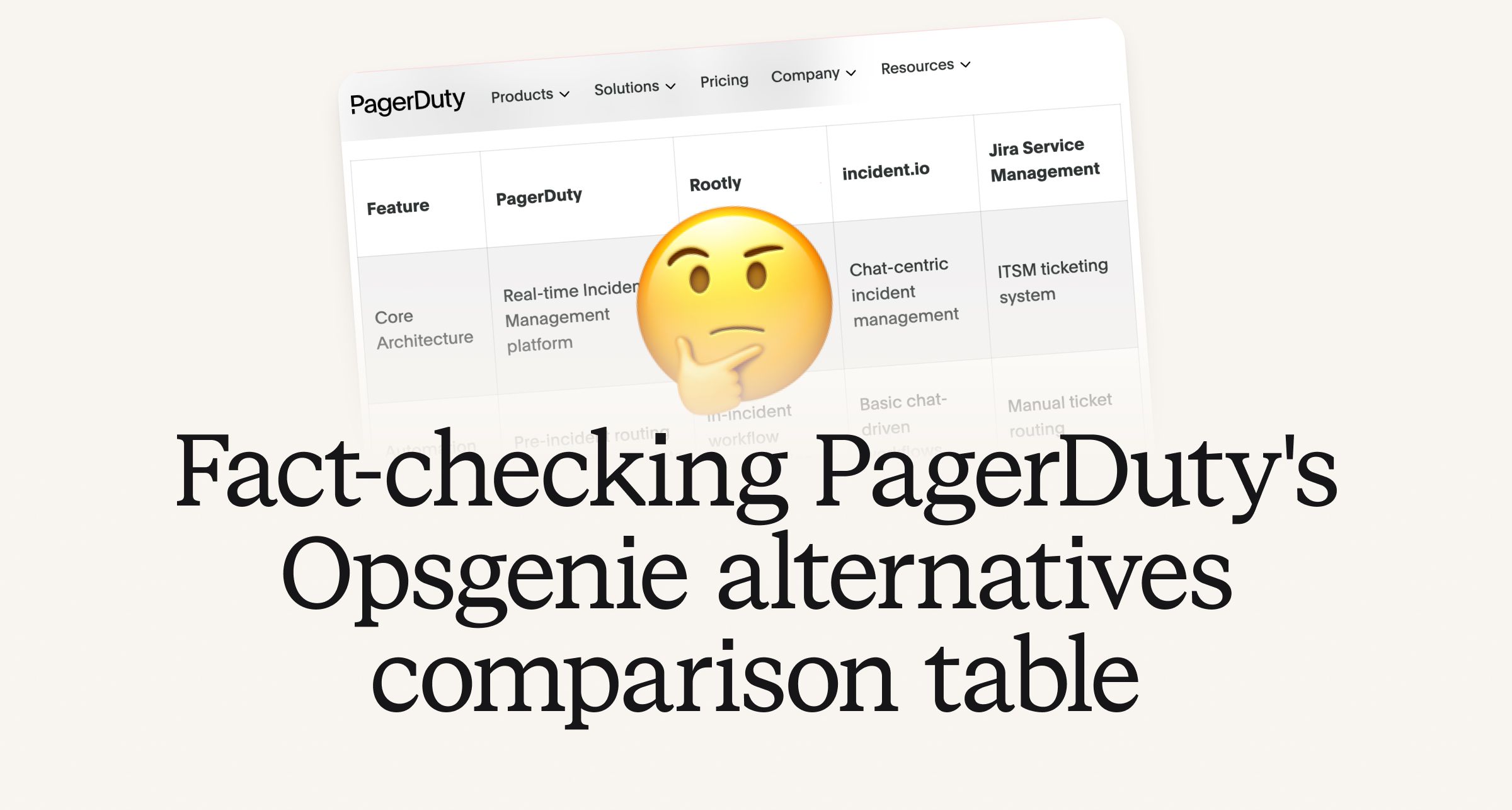
Fact-checking PagerDuty's Opsgenie alternatives comparison table
PagerDuty published a new comparison table about incident.io. Once again, it describes a product we don't recognize. So once again, we're correcting the record, row by row, with receipts.

July 28, 2026
Your genie is vanishing: introducing the Opsgenie rescue program
Today, we're launching the Opsgenie Rescue Program to make that landing soft: simplified migration and free overlap so you never pay two vendors at once.
July 9, 2026
So good, you’ll break things on purpose
Ready for modern incident management? Book a call with one of our experts today.
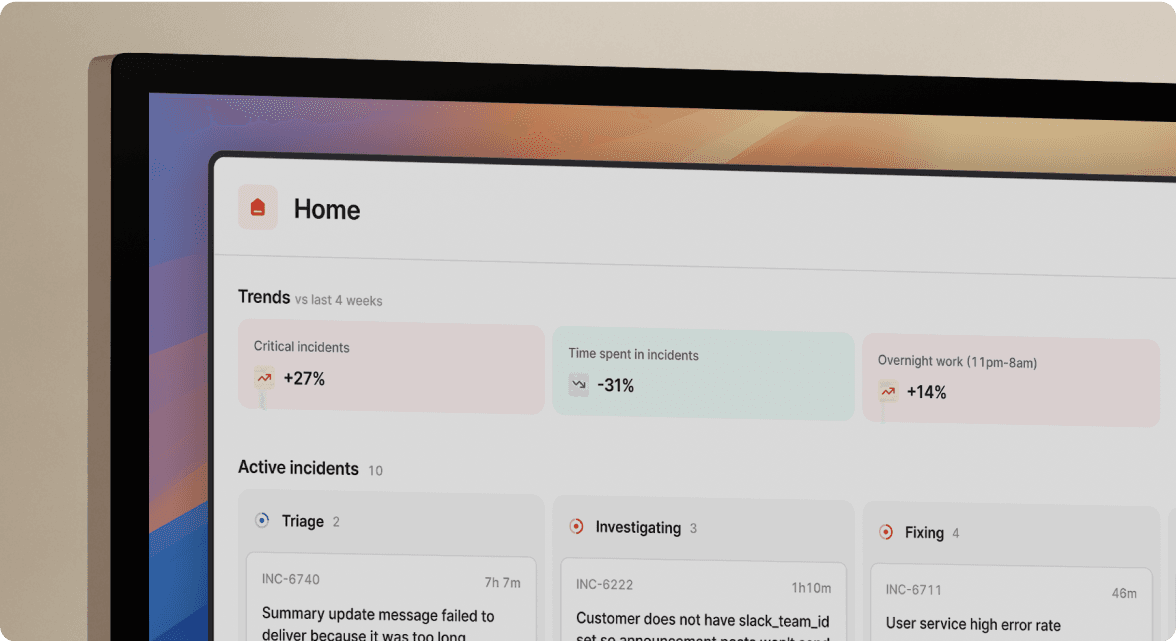
We’d love to talk to you about
- All-in-one incident management
- Our unmatched speed of deployment
- Why we’re loved by users and easily adopted
- How we work for the whole organization