Join live: What happens when your AI goes down?
Keeping it boring: the incident.io technology stack
February 26, 2026 — 8 min read
At incident.io we run a deliberately simple technology stack. Keeping things boring has allowed us to scale from a few hundred customers to several thousand, while having only two platform engineers. In this post I'll walk through the stack, explain some of the choices we've made, and touch on the challenges we're facing as we grow.
Our cloud provider
Historically, parts of the stack ran on Heroku, but as we scaled it made sense to move to Google Cloud Platform (GCP). We chose GCP because many of our early engineers had familiarity with it, and many of the core primitives it provides are simpler, nicer abstractions than those found elsewhere, e.g. running containerized workloads..
Our compute stack
Kubernetes
Our default for compute is GCP's Kubernetes offering: GKE Autopilot.
We chose GKE Autopilot as it manages the underlying nodes for us. We don't have to worry about scaling, forecasting, or patching, which lets us focus on deploying the workloads that keep incident.io running.
We chose Kubernetes over other methods of running containers in GCP, as it provided a better experience around the debugging and observability of our applications.
There are trade-offs, of course. Since GCP manages the nodes, we have no control over their lifespan, and by extension, the lifespan of our pods. There is a 10 minute grace period when a node is removed from service. You can apply an annotation to extend it, but it isn't a silver bullet.
We also don't have access to some of the sensitive system namespaces, so we're reliant on whatever software GCP chooses for core parts of Kubernetes. This bit us recently: we couldn't change the default DNS settings for GKE Autopilot and had to implement a workaround in the workload itself.
While GKE Autopilot has some limitations, it has overall been a net positive which has allowed us to focus on more impactful work.
Virtual machines
Not everything runs in Kubernetes. Some workloads have specific requirements that make Kubernetes an unattractive option, so we run them on virtual machines instead using plain Google Compute Engine instances.
These requirements vary, but fall into a few broad categories (and often workloads will dictate more than one of these): long lived processes, large storage requirements, or large resource requirements.
Our virtual machines are configured with Cloud Init, as opposed to more complex configuration management tools, meaning that hosts are treated as immutable and short-lived, rather than long-lived with changes continually applied across its lifetime. Applying or reverting a change is as simple as merging a pull request.
Database
Postgres is our choice for application database, so the natural choice here is GCP's Cloud SQL. Other databases are available on GCP's platform, but often come with various tradeoffs or higher complexity, and are not as simple and battle-tested as a plain Postgres instance.
For our Cloud SQL deployments, at least in production, we use the "Enterprise Plus" tier. This gives us much higher availability guarantees and less downtime for maintenance events, which reduces the amount that we need to architect these concerns into our application logic .
Much like GKE Autopilot, Cloud SQL lets us focus on what matters rather than the minutiae of managing database servers.
Queuing
Our application architecture is highly event-driven, and so a large proportion of the compute workload is driven through asynchronous tasks. We use GCP Pub/Sub as our message queue that powers this.
Unlike most of our other infrastructure, we manage our Pub/Sub topics and subscriptions in application code rather than traditional infrastructure-as-code like Terraform. This means a product engineer can create and start using a new topic or subscription with a single code change, rather than needing to coordinate across multiple systems.
Deployments
Argo CD
We use Argo CD to deploy our Kubernetes resources. It fits nicely into the GitOps workflow that we follow for our Kubernetes resources: all of these are managed in code, alongside "snapshots" to show the templated-out manifests, and when a pull request is merged, Argo CD automatically applies any changes.
We chose Argo CD as it has one job, and it does it well: it's quick, well-architected and has a nice UI too. It is also a widely used tool, so there is a lot of community support and ongoing development.
Buildkite
Buildkite is our CI/CD tool. That means it orchestrates tasks like building our app, running tests, triggering deploys, etc.
We run large virtual machines in our GCP account, and Buildkite's control plane assigns jobs to the agents on those machines. If you want the full story on this, we wrote about it in The quest for the five minute deploy.
Keeping CI/CD fast is an ongoing project. As our engineering organization grows, and AI tooling allows engineers to be more productive, the amount of work our pipeline has to handle keeps increasing.
Terraform
Terraform manages our cloud infrastructure. Defining infrastructure in code lets us preview changes before we make them, and gives us an audit trail to review when things go wrong.
To deploy Terraformed changes, and ensure good separation of privileges, we utilize Spacelift as the deployment runner. Of course we could just build our own processes for this around existing CI/CD infrastructure, but Spacelift provides a load of useful primitives like access control, queuing and a developer-friendly UI, making it well worth the money.
Monitoring
Grafana Cloud is our monitoring provider, covering metrics, logs, traces, and profiles. Running a full observability stack takes a lot of work, and using Grafana Cloud allows us to run a lean platforming team.
While we store our metrics, logs and profiles in Grafana Cloud, we store our traces ourselves.
Tempo is Grafana's trace storage engine, and we run it ourselves on a virtual machine. We self-host because the size and volume of our traces would be prohibitively expensive to keep in Grafana Cloud.
To ship telemetry data to Grafana (and Tempo), we use Grafana Alloy. Our application and other components are configured to emit data in Prometheus or OpenTelemetry format which Alloy natively handles.
We configure Grafana to alert on the data we collect. Important alerts get forwarded to incident.io (naturally), and lower priority alerts go to Slack.
We manage our alert definitions in code, as these are just as critical to get right as application logic. We've chosen to use Jsonnet here, which abstracts away the complexity of Grafana's alert configuration, making it straightforward for engineers to define alerts. Terraform then deploys the alerting resources in Grafana from the Jsonnet output.
Conclusion
For the most part, our stack is boring and that's by design. We use the fewest pieces of technology needed to get the job done. We lean on third-party providers for things outside our core competencies, which lets a small platform team support a growing engineering organization. But as you can see, there are areas where we've taken different approaches in order to tailor the platform towards the needs of our workloads and engineering team.
As incident.io continues to grow, we're going to run into more of these challenges, and we'll need more platform engineers to tackle them. If that sounds like your kind of problem, take a look at our open roles.

Matthew Barrington
Platform Engineer
See related articles
Building Investigations: what it takes to build an AI SRE
We spent the last two years building Investigations, our AI SRE. In this post, go behind the scenes of the work done and why build vs. buy is one of the most important decisions engineering teams are making right now.

October 1, 2026

Introducing Investigations, powered by Nexus.
Today we're launching Investigations: agentic root cause analysis that starts the moment you're paged, figures out what broke and why, and works with your team through to resolution. Here's what we built, what's powering it, and why it took some time to get right.

August 5, 2026
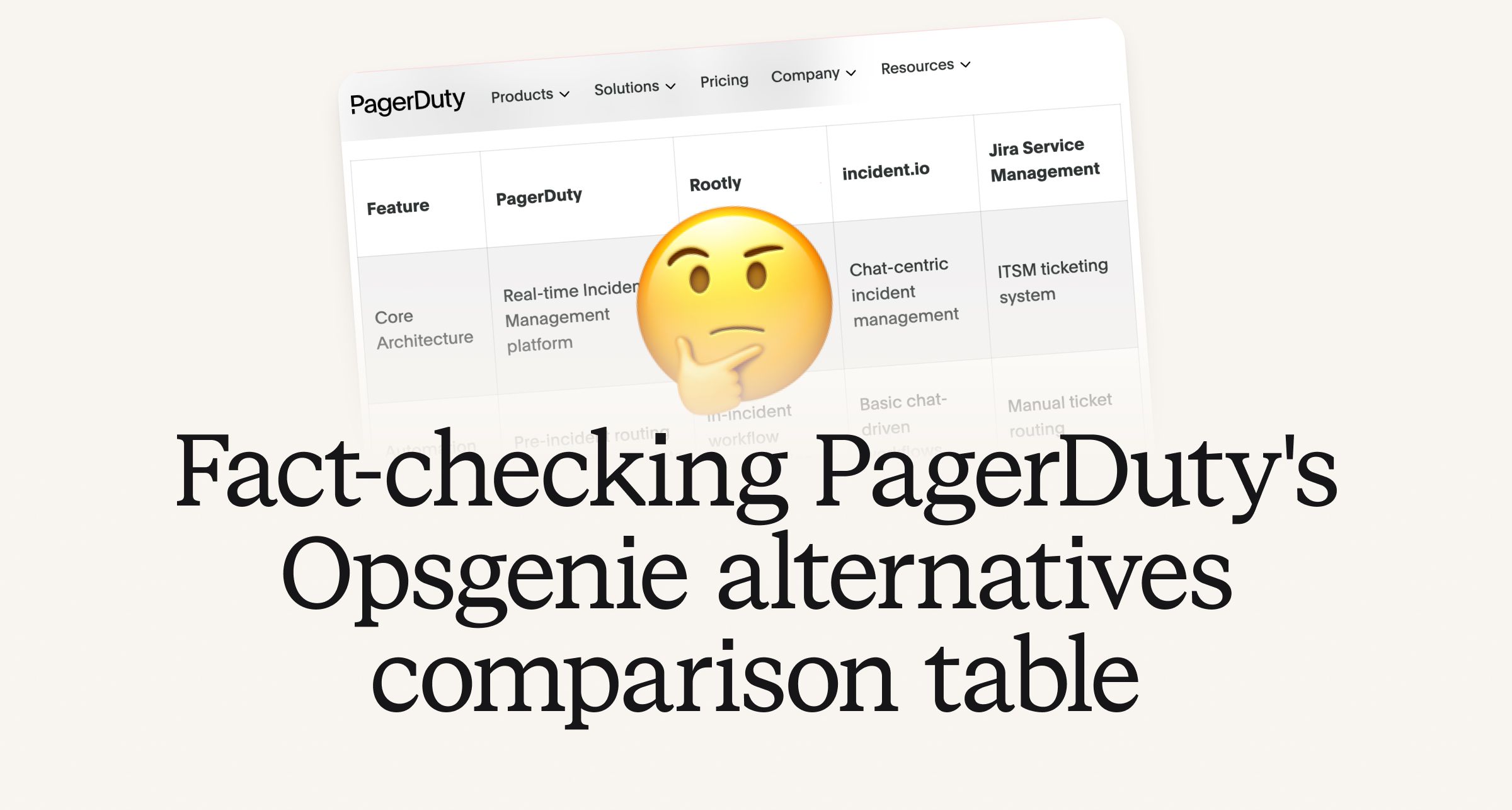
Fact-checking PagerDuty's Opsgenie alternatives comparison table
PagerDuty published a new comparison table about incident.io. Once again, it describes a product we don't recognize. So once again, we're correcting the record, row by row, with receipts.

July 28, 2026
So good, you’ll break things on purpose
Ready for modern incident management? Book a call with one of our experts today.
We’d love to talk to you about
- All-in-one incident management
- Our unmatched speed of deployment
- Why we’re loved by users and easily adopted
- How we work for the whole organization