Join live: What happens when your AI goes down?
How Catalog changes the game for long-term maintenance
March 18, 2026 — 6 min read
Every incident platform needs to know who owns what. Which team owns which service. Which backlog to send follow-ups to. Which escalation path to page when something breaks.
The problem is that most platforms encode this ownership logic separately in every configuration: alert routing, workflows, ITSM ticket syncing, and more. Each one maintains its own copy of the same information, in its own format. At scale, that can mean thousands of lines of hardcoded rules spread across dozens of places, all encoding the same underlying information.
And when organizations change, for example adding new services or creating teams, those changes cascade across all of those configurations. Miss one update, and the wrong team gets paged at 3am, follow-ups vanish into the wrong backlog, or reports misattribute incidents. All risk you can’t afford to take.
With incident.io Catalog, we take a different, and much simpler, approach. You model your organization once, and every part of the platform references that model dynamically. The rules and logic stay the same whether you have 5 services or 5,000. Simply sync the data from your source of truth and you’re done.
Let’s walk through a concrete example to see how this works in practice.
A simple engineering organization
Imagine a (laughably simple!) engineering org. It has three teams, each of which owns services, has a Linear project for their backlog, and an escalation path so they can be paged:
| Team | Services | Linear Project | Escalation Path |
|---|---|---|---|
| Payments | payments-api, billing-worker | PAY | Payments On-Call |
| Search | search-api, recommendations-api | SEARCH | Search On-Call |
| Platform | auth-service | PLAT | Platform On-Call |
              ┌── Services: payments-api, billing-worker
  Payments ───┼── Linear: PAY
              └── Escalation: Payments On-Call

              ┌── Services: search-api, recommendations-api
  Search ─────┼── Linear: SEARCH
              └── Escalation: Search On-Call

              ┌── Services: auth-service
  Platform ───┼── Linear: PLAT
              └── Escalation: Platform On-Call
Now let's put it to work.
Some standard incident automations
Now let's imagine the organization wants to configure a couple of simple incident management workflows:
1. Exporting follow-up actions to the right backlog When a follow-up action is created after an incident, send it to the owning team's Linear project.
2. Routing alerts to the right escalation path When an alert fires for a service, page the team that owns it.
On most platforms, you'd configure these with static conditional logic:
Follow-up export:
IF team = Payments
  THEN export to PAY
ELSE IF team = Search
  THEN export to SEARCH
ELSE IF team = Platform
  THEN export to PLAT
Alert routing:
IF service = payments-api
  THEN page Payments On-Call
ELSE IF service = billing-worker
  THEN page Payments On-Call
ELSE IF service = search-api
  THEN page Search On-Call
ELSE IF service = recommendations-api
  THEN page Search On-Call
ELSE IF service = auth-service
  THEN page Platform On-Call
Straightforward enough with 3 teams and 5 services. But things don't stay this simple.
What happens when things change
Let's fast forward a few months, where our organization has shipped 3 new services and added a new team:
| Team | New Services |
|---|---|
| Payments | + checkout-api, + inventory-api |
| Search | + personalization-api |
| Data (new) | + data-pipeline |
And now, the owner of the incident management system has to make a bunch of changes to both automations keep things working:
Follow-up export:
IF team = Payments
  THEN export to PAY
ELSE IF team = Search
  THEN export to SEARCH
ELSE IF team = Platform
  THEN export to PLAT
ELSE IF team = Data              ← new
  THEN export to DATA            ← new
Alert routing:
IF service = payments-api
  THEN page Payments On-Call
ELSE IF service = billing-worker
  THEN page Payments On-Call
ELSE IF service = checkout-api             ← new
  THEN page Payments On-Call               ← new
ELSE IF service = inventory-api            ← new
  THEN page Payments On-Call               ← new
ELSE IF service = search-api
  THEN page Search On-Call
ELSE IF service = recommendations-api
  THEN page Search On-Call
ELSE IF service = personalization-api      ← new
  THEN page Search On-Call                 ← new
ELSE IF service = auth-service
  THEN page Platform On-Call
ELSE IF service = data-pipeline            ← new
  THEN page Data On-Call                   ← new
Two automations. A heap of changes to logic, and a risk introduced that you've missed something along the way, and someone might not get paged when they need to.
But in reality, it's never just two automations. Ownership logic and other connectivity between things is embedded in:
- Alert routing rules
- Escalation policies
- Incident workflows
- Follow-up ticket assignment
- Announcement rules
- Post-incident review routing
- Reporting and analytics rollups
That's a lot of configuration, each encoding ownership independently. Every new service, every new team, every reorg means updating all of them.
And real organizations aren't adding one service a quarter; they're shipping new services every week, creating and merging teams, moving people around.
The static logic grows and grows, and each update is a chance to miss something. A missed routing rule means the wrong team gets paged at 3am. A missed workflow means follow-ups disappear into the wrong backlog.
How Catalog makes this easier
At incident.io, we've taken a different stance. Rather than repeating configurations all of the place, you replace all that static logic with two things: data in Catalog, and rules that operate across it.
Instead of hardcoded if/else chains, your automations just say:
Follow-up export:
When a follow-up is created
→ look up the person's team
→ find that team's Linear project
→ export it there
Alert routing:
When an alert arrives
→ extract the service from the alert
→ find the owning team in Catalog
→ look up that team's escalation path
→ page them
The rules don't reference any specific team, service, or escalation path. They reference the relationships between them.
When you add new services or a new team, the rules don't change. You just update the data in Catalog: add the service, set its owner, and everything flows through automatically.
Here's both scenarios side by side:
Original setup (3 teams, 5 services):
Static logic:                   │    Catalog rule:
                                │
IF svc = payments-api           │    Alert arrives
  THEN page Payments On-Call    │    → find service owner
ELSE IF svc = billing-worker    │    → look up escalation path
  THEN page Payments On-Call    │    → page them
ELSE IF svc = search-api        │
  THEN page Search On-Call      │
ELSE IF svc = recos-api         │
  THEN page Search On-Call      │
ELSE IF svc = auth-service      │
  THEN page Platform On-Call    │
                                │
(10 lines of logic)             │
After growth (4 teams, 9 services):
Static logic:                   │    Catalog rule:
                                │
IF svc = payments-api           │    Alert arrives
  THEN page Payments On-Call    │    → find service owner
ELSE IF svc = billing-worker    │    → look up escalation path
  THEN page Payments On-Call    │    → page them
ELSE IF svc = checkout-api      │
  THEN page Payments On-Call    │    (the same 3 lines)
ELSE IF svc = inventory-api     │
  THEN page Payments On-Call    │
ELSE IF svc = search-api        │
  THEN page Search On-Call      │
ELSE IF svc = recos-api         │
  THEN page Search On-Call      │
ELSE IF svc = personal-api      │
  THEN page Search On-Call      │
ELSE IF svc = auth-service      │
  THEN page Platform On-Call    │
ELSE IF svc = data-pipeline     │
  THEN page Data On-Call        │
                                │
(18 lines of logic)             │
The left side grows with every change. The right side never changes. And that means zero headaches for you, and high confidence that things will just work.
Keeping Catalog in sync
The obvious question: "Great, but now I need to keep Catalog up to date. Isn't that just moving the problem?"
We've thought a lot about this. Catalog integrates natively with the systems you're probably already maintaining:
- Service catalogs like Backstage, Cortex, and OpsLevel
- CMDBs like ServiceNow and Jira Assets
- Any other source — internal systems, APIs, even text files — via our open-source catalog importer tool.
You don't maintain Catalog by hand. You point it at your existing sources of truth and it stays in sync automatically. The ownership data you're already curating elsewhere flows straight in — no duplication, no drift.
How this really looks
The reality is that most organizations don't have 4 teams, and the don't just add one service every few months. The scale is high and the changes are constant. New services every sprint, and teams created to tackle new initiatives, merged in reorgs, or disbanded when priorities shift.
Imagine instead that we have 40 teams and 300 services.
Static logic:
IF service = service-1
  THEN page Team A On-Call
ELSE IF service = service-2
  THEN page Team A On-Call
ELSE IF service = service-3
  THEN page Team B On-Call
ELSE IF service = service-4
  THEN page Team B On-Call
ELSE IF service = service-5
  THEN page Team C On-Call
...
... (600 lines)
...
ELSE IF service = service-300
  THEN page Team ZZ On-Call
600 lines of conditional logic. In a single automation. Multiply that across 10+ configurations and you're maintaining thousands of lines of hardcoded rules that all encode the same ownership information. Every reorg, every new service, every team change cascades across all of them.
As a reminder, your Catalog-based logic still hasn't changed.
Alert arrives
→ find service owner
→ look up escalation path
→ page them
That’s 3 lines. Whether you have 5 services or 5,000.
Define your organization once. Use it everywhere. Nothing breaks as things change.

Chris Evans
Co-Founder & Field CTO
I'm one of the co-founders, and Field CTO here at incident.io.
See related articles
Building Investigations: what it takes to build an AI SRE
We spent the last two years building Investigations, our AI SRE. In this post, go behind the scenes of the work done and why build vs. buy is one of the most important decisions engineering teams are making right now.

October 1, 2026
Introducing Investigations, powered by Nexus.
Today we're launching Investigations: agentic root cause analysis that starts the moment you're paged, figures out what broke and why, and works with your team through to resolution. Here's what we built, what's powering it, and why it took some time to get right.

August 5, 2026
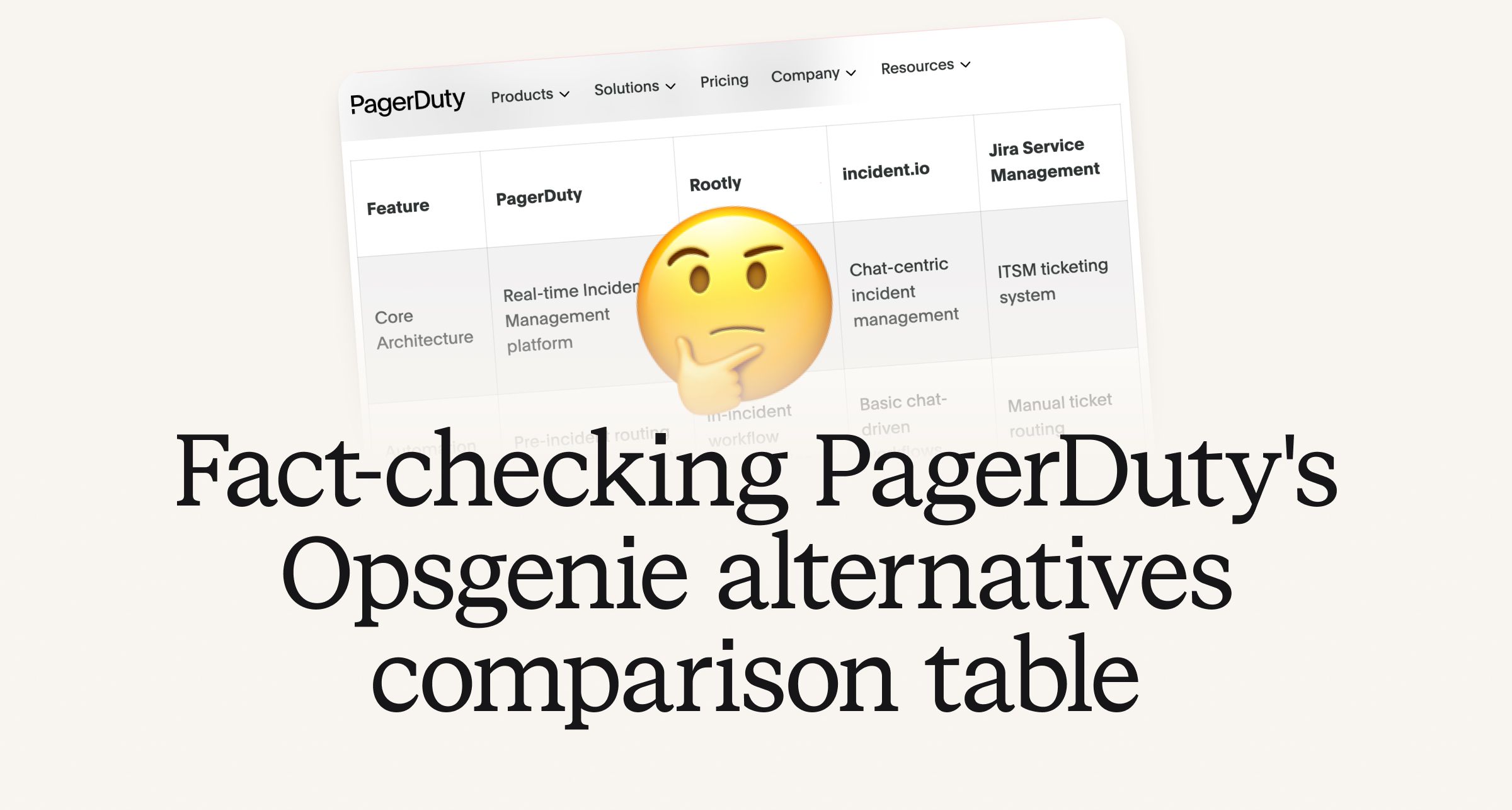
Fact-checking PagerDuty's Opsgenie alternatives comparison table
PagerDuty published a new comparison table about incident.io. Once again, it describes a product we don't recognize. So once again, we're correcting the record, row by row, with receipts.

July 28, 2026
So good, you’ll break things on purpose
Ready for modern incident management? Book a call with one of our experts today.
We’d love to talk to you about
- All-in-one incident management
- Our unmatched speed of deployment
- Why we’re loved by users and easily adopted
- How we work for the whole organization