ITSM compliance for DevOps: SOC 2, ISO 27001, and GDPR without killing velocity
March 27, 2026 — 17 min read
Updated Mar 27, 2026
TL;DR: You don't have to choose between DevOps velocity and ITSM compliance. Modern incident management platforms automate evidence collection and audit trails directly within your Slack workflows. Automated timeline capture satisfies SOC 2 and ISO 27001 evidence requirements without manual documentation. Integrating CI/CD and monitoring tools with your incident platform creates an immutable, audit-ready trail of every production change and response. AI can draft your post-mortems using captured timeline data, saving hours of administrative toil per incident.
Most SRE teams obsess over deployment frequency and MTTR but ignore the hours lost manually reconstructing incident timelines for SOC 2 audits, a process that can consume 60 to 90 minutes per incident with zero technical complexity involved.
The traditional approach to ITSM compliance forces a false choice: slow down deployments with Change Advisory Boards and heavyweight ticketing, or move fast and scramble before audits. You need to meet strict SOC 2, ISO 27001, and GDPR requirements, but manual documentation kills your MTTR and deployment velocity. The fix is automating evidence collection directly within your incident response workflow. This article shows you how the right incident management software lets you integrate your monitoring tools, automate timeline capture, and generate audit-ready post-mortems without leaving Slack.
How to automate incident response and evidence collection
The core compliance problem isn't process. It's evidence collection. Every framework (SOC 2, ISO 27001, GDPR) requires you to provide documented proof that you detected incidents, responded appropriately, and learned from them. SOC 2 Type II auditors require incident tickets, post-mortem analyses, and resolution timelines showing how quickly your organization responds to threats.
Most teams collect this evidence manually. Days after a P1 (Priority 1) incident, someone writes the post-mortem by scrolling through Slack channels, checking monitoring dashboards, and reconstructing the timeline from memory. That process wastes over an hour per incident and produces incomplete documentation that leaves auditors unconvinced.
The fix is capturing data where the work happens. When your incident response runs inside Slack, every message, role assignment, severity change, and decision automatically becomes part of a timestamped timeline. As one user described it:
"incident.io has drastically reduced the additional cognitive load on stakeholders involved in the Incident Response lifecycle in our company." - Igor Natanael A. on G2
That timeline is your audit trail, with no reconstruction needed.
Integrating CI/CD and monitoring with incident platforms
A compliant audit trail starts before someone types /inc declare. It starts when your monitoring tool detects the anomaly and your CI/CD pipeline logs the deployment that caused it. Here's how the integration chain works in practice:
- Monitoring alert fires and creates the incident: Datadog or Prometheus detects a latency spike and sends a webhook to your incident platform, which auto-creates
#inc-2847-api-latency-spikein Slack with the on-call engineer paged and the service catalog context pulled in. - CI/CD context surfaces automatically: Recent deployments from GitHub or GitLab appear in the channel showing commit hashes, deployment IDs, and the engineer who merged the change.
- Timeline captures everything: Role assignments, severity changes, shared links, and Slack threads all auto-populate the immutable incident record that NIST SP 800-61 recommends as a standardized response approach.
You can connect these tools through webhooks, native integrations, or APIs. Your incident platform should also integrate with your existing ITSM tools so follow-up actions and change records flow automatically. incident.io supports syncing incidents to Jira and Azure DevOps, creating the bidirectional link between incident response and change management that auditors look for.
Using AI to streamline post-mortems and reporting
When post-mortems take 90 minutes to write from memory, teams either skip them or produce superficial reports that don't satisfy auditors. incident.io's AI SRE assistant automates up to 80% of incident response, including generating post-mortem drafts with incident summaries, complete timelines, contributing factors, and suggested follow-up actions.
The compliance value is significant. SOC 2 requires that incidents undergo a lessons learned exercise. ISO 27001 Annex A 5.27 explicitly requires learning from information security incidents. When post-mortems take 10 minutes to refine instead of 90 minutes to reconstruct, teams are far more likely to complete them for every incident which means fewer compliance gaps and a much stronger audit trail.
"1-click post-mortem reports - this is a killer feature, time saving, that helps a lot to have relevant conversations around incidents (instead of spending time curating a timeline)" - Adrian M. on G2
Defining an incident across ITSM, SOC 2, ISO 27001, and GDPR
Before you automate compliance evidence collection, you need to align on what counts as an "incident" in each framework. These definitions overlap but aren't identical, and the differences matter for your response process.
- SOC 2: covers security events that compromise the confidentiality, integrity, or availability of information assets under the Trust Services Criteria, particularly the CC7 series governing system operations.
- ISO 27001: defines an incident as a situation where a loss of confidentiality, integrity, or availability has occurred, covering any event that compromises your data or systems.
- GDPR: uses a narrower definition focused on personal data: an incident causing unauthorized access or loss of personal data.
A database outage affecting your checkout system is an incident under all three frameworks, but the GDPR notification clock only starts ticking if personal data was compromised. Your incident forms and severity classifications should capture this distinction so your team knows which reporting obligations apply.
Comparing compliance requirements for incident management
Each framework demands different evidence, timelines, and documentation standards, so the table below maps exactly what auditors and regulators expect from your incident response process.
| Framework | Incident definition | Reporting timeline | Evidence required |
|---|---|---|---|
| SOC 2 Type II | Events compromising confidentiality, integrity, or availability | "Timely" response (not prescriptive) | Incident tickets, post-mortems, resolution timelines, change tickets with approvals |
| ISO 27001 | Loss of confidentiality, integrity, or availability | "As quickly as possible" (not prescriptive) | Incident reports, records of actions and outcomes, lessons learned evidence |
| GDPR | Unauthorized access, loss, or alteration of personal data | 72 hours after awareness | Breach details (categories and numbers affected), DPO contact, consequences, mitigation measures |
Two things stand out. First, GDPR is the only framework with a hard reporting deadline: 72 hours after awareness, with late notifications requiring written justification. Failure to notify carries fines of up to EUR 10 million or 2% of global annual turnover. Second, while SOC 2 and ISO 27001 don't specify exact deadlines, auditors evaluate the consistency and completeness of your evidence. You need a repeatable, documented process for every incident across months of operation, not just one well-written post-mortem.
This is why automation matters. Manual processes that work for one P1 outage fall apart when auditors review 50 incidents across a year and find half have incomplete documentation.
Tracking incident metrics for compliance and speed
Auditors want quantitative proof that your incident management process works and improves over time. Three metrics provide that proof:
- MTTR (Mean Time to Resolution): The average time to restore normal operations after an outage. This demonstrates effective remediation meeting SOC 2 CC7.3 and ISO 27001 A.5.26 requirements.
- MTTD (Mean Time to Detect): The average time to detection from incident occurrence, which directly impacts GDPR's 72-hour window because the clock starts at "awareness."
- MTTA (Mean Time to Acknowledge): The average time from alert trigger to when work begins, proving prompt response initiation to auditors.
These three metrics map the full incident lifecycle: Occurrence → Detection (MTTD) → Acknowledgment (MTTA) → Resolution (MTTR). Leading teams target MTTD and MTTA under 5 minutes and MTTR under 5 hours for critical systems. When your incident platform records timestamps for every state change, your Insights dashboard generates these metrics without additional work.
Overcoming challenges in ITSM and DevOps integration
Traditional ITSM platforms (ServiceNow, Jira Service Management) follow ticket-based workflows with approval gates and change advisory boards. DevOps teams who deploy continuously coordinate in Slack. When you force either side to adopt the other's workflow, you create resistance and slow everyone down. Here's how to bridge the gap:
- Replace approval gates with automated tracking. Instead of requiring Change Advisory Board pre-approvals, integrate your CI/CD pipeline with your incident platform so every deploy logs automatically with commit hash, author, and timestamp. If an incident correlates with a recent deploy, the connection surfaces automatically. You give auditors the change ticket evidence they need without blocking your deployment pipeline. Configure your incident platform to sync data to ServiceNow or Jira in the background while your engineers coordinate at conversation speed in Slack.
- Use policies to enforce compliance without manual gatekeeping. Define incident policies that automatically require post-mortems for P1 and P2 incidents, flag incidents involving personal data for GDPR review, and ensure severity classification happens at declaration. Automation enforces the rules so you don't need a human gatekeeper.
Checklist for a compliant DevOps incident response plan
Based on NIST SP 800-61 guidelines and SOC 2, ISO 27001, and GDPR requirements, your incident response plan needs these elements to pass audit:
Preparation:
- Incident response policy defining what constitutes an incident across all applicable frameworks
- Defined roles: Incident Commander, Technical Lead, Communications Lead
- Severity classification criteria with clear escalation paths
- Monitoring and alerting connected to your incident platform
- Runbook automation linked to services in your catalog
Detection and declaration:
- Automated incident creation from monitoring alerts
- Severity assigned at declaration with personal data flag for GDPR-relevant incidents
- On-call engineer paged and acknowledged within MTTA target
Response and containment:
- Dedicated incident channel with auto-populated context
- Timeline auto-capturing every action, message, and decision
- Status page updates triggered automatically based on severity
Post-incident and compliance:
- AI-drafted post-mortem reviewed and published within 24 to 48 hours
- GDPR notification filed within 72 hours if personal data was breached
- Lessons learned exercise completed and action items tracked
- Incident metrics (MTTR, MTTD, MTTA) automatically logged for audit reporting
"By automating the coordination, communication, and documentation tasks that are traditionally manual and time-consuming, incident.io frees up the incident response team to focus on solving the critical issues at hand." - Cameron R. on G2
How incident.io bridges the gap between speed and compliance
incident.io is the Slack-native incident management platform that turns compliance into a natural byproduct of resolving incidents. Here's how it addresses each requirement without slowing you down.
Automated timeline capture (SOC 2 and ISO 27001 evidence): When you run an incident using /inc commands, every action auto-populates the timeline: role assignments, severity changes, Slack threads, and shared links. This creates the incident tickets and resolution timelines SOC 2 auditors require, and the documented records ISO 27001 demands. No dedicated note-taker, and no manual reconstruction.
AI-drafted post-mortems (lessons learned compliance): incident.io's AI uses captured timeline data, call transcriptions from Scribe, and Slack messages to generate post-mortem drafts that are 80% complete. Your engineers spend 10 minutes refining instead of 90 minutes writing from scratch, directly satisfying ISO 27001 A.5.27's mandate for learning from security incidents.
Service Catalog with ownership (accountability evidence): incident.io's Service Catalog maps every service to its owner, dependencies, and runbooks. When an incident fires, the platform pulls this context into the channel automatically so auditors can see exactly who owned the affected service and who responded. For managing sensitive data during GDPR-relevant incidents, private incident channels ensure only authorized responders access personal data details.
incident.io is SOC 2 Type II certified with 99.99% uptime SLA, GDPR compliant, and supports SAML/SCIM for enterprise access controls. The platform's opinionated defaults get you operational and compliant in days, not weeks of configuration.
Pricing: incident.io's Pro plan runs $45/user/month ($25 base + $20 on-call add-on). No per-incident fees, no hidden add-ons for audit logs or SSO. For a 10-person on-call rotation, that's $450/month or roughly 3 engineer-hours at a $150 loaded hourly rate. If your team is resolving 10+ incidents per month and spending 15 minutes per incident on coordination overhead alone, the math works in your favor quickly.
Honest trade-offs: incident.io is the right fit for most engineering teams, but not every team. Three things worth knowing before you commit:
- Slack-first design. incident.io is built around Slack. If your team runs on Microsoft Teams or email-based coordination, you won't get the same workflow benefit. Teams support exists, but the deepest integrations are Slack-native.
- Coordination, not alerting. incident.io handles everything after the alert fires channel creation, role assignment, timeline capture, post-mortems. You still need Datadog, Prometheus, or PagerDuty to detect and route alerts. incident.io integrates with all three, it doesn't replace them.
- AI drafts need a human review pass. The AI SRE automates up to 80% of incident response including post-mortem structure, timeline reconstruction, and what happened and when, but engineers still need to review root cause analysis, add context, and sign off before publishing. Plan for 10-15 minutes of review time, not zero.
You don't have to choose between DevOps velocity and ITSM compliance. When timeline capture, AI-drafted post-mortems, and service catalog integration happen automatically in Slack, compliance becomes invisible and your team focuses on solving problems instead of documenting them.
Schedule a demo to see the AI SRE assistant and compliance reporting features in action.
Key terms glossary
SOC 2 Type II: An audit report evaluating an organization's controls over a period of time (typically 6 to 12 months) against the AICPA's Trust Services Criteria covering security, availability, processing integrity, confidentiality, and privacy. Unlike Type I (which evaluates design at a point in time), Type II tests whether controls actually operated effectively throughout the review period.
MTTR (Mean Time to Resolution): The average elapsed time from when an incident is detected to when normal operations are fully restored. This metric demonstrates effective remediation capabilities to auditors and leadership.
Data Subject Access Request (DSAR): A formal request from an individual under GDPR to know what personal data an organization holds about them. Under GDPR Article 15, organizations must respond within one calendar month of receiving the request.
Annex A 5.24 (ISO 27001): The specific control in ISO 27001:2022 requiring organizations to plan and prepare for managing information security incidents by defining processes and roles. It covers eight activities from initial detection through lessons learned.
FAQs

Tom Wentworth
Chief Marketing Officer
See related articles
Introducing Investigations, powered by Nexus.
Today we're launching Investigations: agentic root cause analysis that starts the moment you're paged, figures out what broke and why, and works with your team through to resolution. Here's what we built, what's powering it, and why it took some time to get right.

August 5, 2026
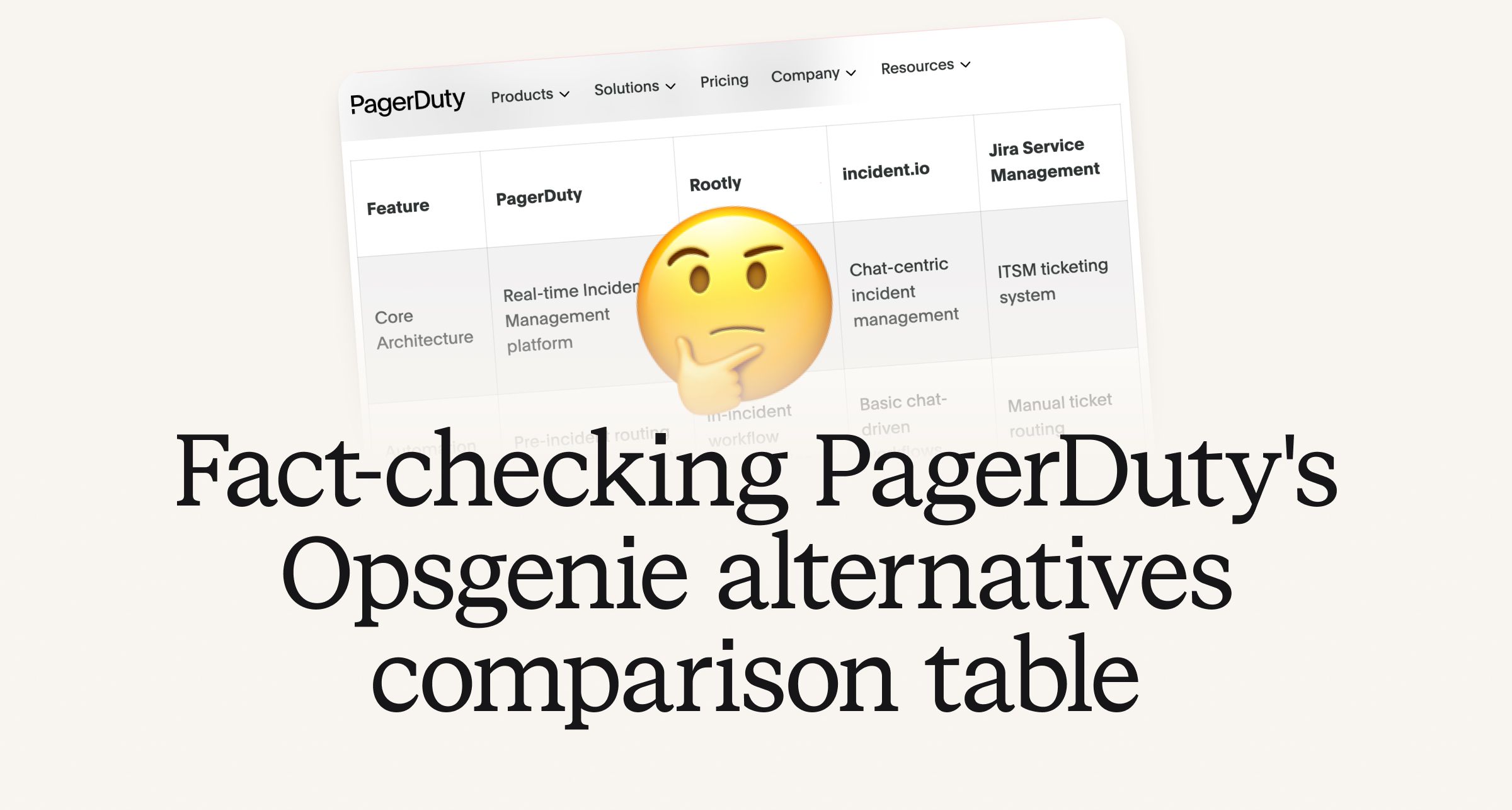
Fact-checking PagerDuty's Opsgenie alternatives comparison table
PagerDuty published a new comparison table about incident.io. Once again, it describes a product we don't recognize. So once again, we're correcting the record, row by row, with receipts.

July 28, 2026
Your genie is vanishing: introducing the Opsgenie rescue program
Today, we're launching the Opsgenie Rescue Program to make that landing soft: simplified migration and free overlap so you never pay two vendors at once.
July 9, 2026
So good, you’ll break things on purpose
Ready for modern incident management? Book a call with one of our experts today.
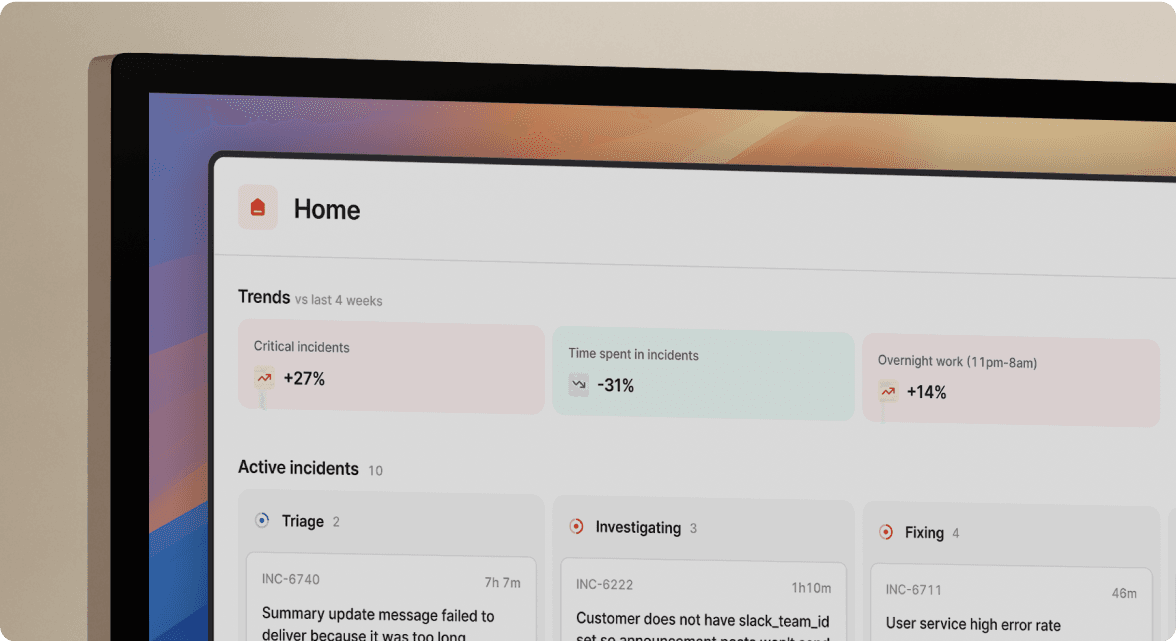
We’d love to talk to you about
- All-in-one incident management
- Our unmatched speed of deployment
- Why we’re loved by users and easily adopted
- How we work for the whole organization