ITSM & DevOps stack integration guide for incident management
February 27, 2026 — 21 min read
Updated February 27, 2026
TL;DR: ITSM and DevOps don't have to fight each other. The friction you feel, where Ops demands a ticket number while your SREs are debugging in a terminal, comes from disconnected tooling, not irreconcilable goals. Unified Service Management (USM) gives you the framework to run incident response in your "system of action" (Slack, Datadog) while automatically feeding your "system of record" (Jira, ServiceNow) for compliance. Automate the handoff between the two and you eliminate the coordination overhead per incident without sacrificing audit trails. ITSM compliance and DevOps velocity can coexist when workflows are properly integrated. Friction typically arises when engineers must manually bridge disconnected systems during incident response.
Modern engineering teams need the velocity of DevOps workflows, but the business requires the governance of ITSM. The solution isn't abandoning one for the other or forcing engineers into rigid ticketing systems mid-incident. Integrate your incident management software so incident response happens in chat while documentation flows downstream automatically. This guide gives you the architectural patterns, incident management best practices, tooling playbook, and real-world proof to make that happen.
The friction point: Why ITSM and DevOps teams drift apart
The root cause isn't cultural stubbornness. You're dealing with a genuine conflict between two legitimate sets of goals.
DevOps optimizes for change frequency and MTTR. ITSM optimizes for stability and risk control. Both are right for their respective jobs. The problem is that most organizations haven't built the plumbing to let them coexist without one team slowing the other down.
You see this conflict most sharply in three scenarios:
- The Change Approval Board vs. CI/CD pipeline. A deployment needs to go out to fix a production bug. ITSM protocol requires a change ticket and CAB review. Your CI/CD pipeline runs in minutes. These two clocks don't sync naturally.
- The war room vs. the ticketing queue. During a P1, one side is debugging in a terminal and Slack thread, while the other is waiting for a status update in ServiceNow.
- Double entry. An engineer resolves the incident in Slack, then spends 20 minutes manually copying updates into Jira for the audit trail.
The tooling gap amplifies this friction. As devops.com points out, each team relies on completely separate toolchains: "You might have a tool that developers use for tracking bugs or product backlog and then there's a completely separate IT service management tool." SREs live in Slack, terminals, and Datadog dashboards. IT managers live in ServiceNow and Jira. Neither tool talks to the other natively, so engineers become the messenger service.
You can quantify that messenger tax. Research from Dr. Gloria Mark shows it takes an average of 23 minutes and 15 seconds to fully regain focus after an interruption. Even brief interruptions can increase task completion time by up to 23%, and across a 10-person team constantly switching between five disconnected tools, those costs compound quickly into hundreds of thousands of dollars annually.
Unified Service Management (USM): The bridge between speed and control
What USM actually means
Unified Service Management (USM) is a universal, methodical approach for managing service organizations that provides a standardized service management system for setting up the organization, the processes and the technology of a service provider.
The critical distinction from ITIL: USM is principle-based, not practice-based. It doesn't replace ITIL or DevOps; it provides a framework that can accommodate both simultaneously. According to InvGate's analysis of USM, USM incorporates principles from ITIL, COBIT, and ISO 20000, giving practitioners options rather than locking them into one framework.
Here's a practical comparison across the three approaches:
| Dimension | Traditional ITIL | Pure DevOps | USM |
|---|---|---|---|
| Primary goal | Stability and risk control | Speed and agility | Reliability with integrated governance |
| Incident approach | Process-centric, formal tickets | Ad-hoc, velocity-focused | Automated workflows connecting both layers |
| Key tools | ServiceNow, Jira Service Management | Slack, Datadog, CI/CD | Integrated platforms syncing both layers |
| Governance model | Manual change approval | Minimal or none | Shift-left, embedded in workflow |
| MTTR focus | Secondary to stability | Primary | Shared metric across both teams |
USM focuses on outcomes (reliability, speed, compliance) rather than outputs (tickets closed, deployments shipped). That outcome orientation gives SREs and IT managers a shared language to work from the same playbook during incidents.
3 integration patterns for modern incident workflows
These architectural patterns eliminate specific categories of coordination tax. High-performing teams layer all three to make ITSM and DevOps work together without friction.
1. System of action + system of record
Engineers do real work in the system of action (Slack, terminal, Datadog). Compliance documentation lives in the system of record (Jira, ServiceNow). Automated sync connects the two.
A system of action automates workflows and provides real-time data to improve communication and task completion. A system of record stores important records to ensure consistency and regulatory compliance.
The flow in practice:
- Alert fires in Datadog at 2:47 AM
- incident.io auto-creates
#inc-2847-api-latencyin Slack (system of action) - On-call engineer joins, declares incident with
/inc - Jira ticket auto-creates in the background with incident metadata (system of record)
- Every Slack command, role assignment, and status update syncs to Jira
- Post-mortem auto-drafts from timeline data at resolution and exports to Confluence
No manual copy-pasting. No double entry. Engineers never leave Slack during the incident.
2. Automated change correlation
Linking CI/CD events directly to incident timelines is one of the fastest ways to reduce MTTR. When an alert fires, responders waste minutes asking "what changed recently?" before troubleshooting starts.
Modern incident response automation works by correlating deployment history from CI/CD tools (GitHub, GitLab, Jenkins) with monitoring telemetry from Datadog or Prometheus, then surfacing that correlation directly in the incident timeline. Instead of a responder manually checking the deployment log, the system automatically annotates the incident channel with "Deployment #4872 shipped 12 minutes before alert fired." That context dramatically shortens the discovery phase.
3. Shift-left on governance
Traditional ITSM audits governance after the fact. Shift-left governance embeds compliance checks directly into the incident response workflow, so you're compliant by construction rather than by post-hoc documentation.
Shift-left is "a proactive approach that involves integrating GRC practices earlier in the software development lifecycle, moving tasks like risk assessments, compliance checks, and security testing upstream." Applied to incident management:
- Automated role assignment at incident creation (incident commander, comms lead, scribe) creates the audit trail of who was responsible at each stage
- Mandatory custom fields capture change correlation, severity rationale, and customer impact data at declaration, not three days later
- Automatic timeline capture creates an immutable, timestamped record satisfying SOC 2 Type II audit requirements without a separate documentation step
Cloudflare implemented a shift-left approach where every production change goes through a validation pipeline enforcing approximately 50 security policies before deployment. The same principle applies to governance during incident response.
Tool convergence: Connecting your ITSM and DevOps stack
The pattern is consistent across the modern incident management stack: monitoring tools trigger response, the response platform coordinates in chat, and ITSM tools receive the compliance record automatically.
Jira and Azure DevOps sync
Bi-directional sync eliminates double entry. incident.io's Jira sync and Azure DevOps sync mean every /inc command in Slack updates the linked ticket without a human in the loop.
"The growing list of integrations with tools such as Jira, Pagerduty, our status page provider, etc, really helps keep everything together." - Andrew J. on G2
ServiceNow and ITSM platforms
Webhooks trigger major incident workflows from monitoring alerts automatically. Alert fires, ticket creates, no email chain required. Review the full list of supported platforms at incident.io's integrations page.
Cloud-native monitoring (Prometheus, Datadog)
Configure intelligent filtering: high-severity alerts create full incident workflows with ITSM tickets, low-severity alerts stay in Slack without compliance overhead. This keeps your system of record meaningful rather than becoming an alert graveyard. See the Datadog monitor migration guide for setup details.
The full pipeline:
Monitoring alert fires → incident.io creates Slack channel → on-call engineer declares incident → ITSM ticket auto-creates → timeline captures actions → post-mortem auto-drafts → documentation syncs to Confluence
This satisfies the SRE's need for speed and the IT manager's need for records in one automated pipeline. Explore why incident.io requires a communications platform to understand the architectural rationale.
Key metrics for measuring alignment and success
ITSM-DevOps integration finally gives you shared metrics that both teams care about. DORA metrics provide the common language. The DORA research team analyzes change lead time, deployment frequency, change failure rate, and MTTR. Elite performers achieve less than one hour MTTR. Google Cloud's 2021 Accelerate State of DevOps study found that elite teams restore service 6,570 times faster than low performers, driven primarily by automation and integration.
The four metrics for your shared scorecard:
- MTTR (Mean Time to Resolution): Track quarter-over-quarter in the incident.io Insights dashboard. Target 30%+ reduction within 90 days. Teams using incident.io have achieved up to 80% MTTR reduction by eliminating coordination overhead.
- Cost of coordination: Time from alert fire to first responder action in the incident channel. Target under two minutes. Above five minutes means assembly is the bottleneck, not troubleshooting.
- Percentage of incidents with auto-generated documentation: Your ITSM compliance efficiency score. Target 80%+ of incidents with automatically captured timelines and auto-drafted post-mortems. Below 50% means engineers are still creating channels and writing notes manually.
- Change failure rate: The percentage of deployments causing production failures requiring immediate response. This shared ITSM/DevOps metric reveals whether change management is working. As DORA metrics research shows, increased deployment frequency should correlate with improved stability, not more incidents.
Track on-call health separately. Measure off-hours page distribution and whether automation reduces cognitive burden. An integrated stack should produce fewer 3 AM pages, not just handle the same pages faster.
The cost of integration: Build vs. buy
Connecting ITSM and DevOps tooling through custom scripts costs more than initial estimates suggest. A multi-month build project using senior engineers adds up quickly in loaded engineering time before maintenance even begins. Every upstream API change from Jira, Datadog, or Slack requires ongoing work to maintain those custom pipelines.
Native platforms like incident.io get basic Jira and Datadog sync operational in under 30 minutes. Full stack integration (Datadog, PagerDuty, Jira, ServiceNow, Confluence) goes live in weeks with no custom code to maintain. See the Opsgenie migration tools guide for a practical example of how streamlined migration can be.
Realistic timeline:
- Weeks 1-2: Core integrations live. Datadog alerts auto-create incident channels. Jira tickets sync bi-directionally. On-call schedules imported.
- Weeks 3-4: Workflows configured for SEV1/SEV2/SEV3 routing. Custom fields capturing change correlation and customer impact data at declaration.
- Days 30-90: Full cultural adoption. MTTR trend data visible in the Insights dashboard. Post-mortems completing within 24 hours. Engineers stop asking "what do I do next?" mid-incident.
The tooling wires up fast. Getting teams to abandon old habits (manually creating channels, writing timeline notes in Google Docs) takes visible wins and consistent reinforcement.
Real-world example: Skyscanner unifies incident workflows
Skyscanner, the global travel platform, faced a textbook ITSM-DevOps disconnect. Issues went unreported, leading to gaps in documentation and learnings. Incident communication was fragmented, and non-technical incidents had no structured workflow, leaving problems unresolved longer than necessary.
The "before" state: no simplified way to track non-technical incidents, inconsistent communication across teams, and post-mortems that relied on whoever remembered what happened.
After integrating incident.io, Skyscanner made measurable improvements in incident response quality and efficiency. Separating channels for customer-affecting incidents from internal issues was a major workflow improvement, giving teams clear communication paths by incident type.
The key change wasn't the technology itself. It was building clear roles and responsibilities into the workflow so that incident response became a repeatable process rather than a fire-drill improvisation. Skyscanner gained visibility across both technical and non-technical incidents in a single system, which is the practical definition of Unified Service Management working in production. The ITSM and DevOps teams stopped operating in separate timelines because every incident, regardless of type, now flows through the same channel-creation, role-assignment, and documentation pipeline.
How incident.io bridges the ITSM-DevOps gap
incident.io operates as the orchestration layer in this integration stack. We don't replace your system of record (Jira, ServiceNow) or your system of observation (Datadog, Prometheus). We connect them so engineers never have to leave Slack during an incident.
Bi-directional Jira sync
When an engineer types /inc update "root cause identified as database config change" in Slack, that update appears in the linked Jira ticket immediately. Changes made in Jira sync back to the incident channel. The Jira syncing documentation covers the exact field mapping. No one manually copies updates between tools.
"incident.io allows us to focus on resolving the incident, not the admin around it. Being integrated with Slack makes it really easy, quick and comfortable to use for anyone in the company, with no prior training required." - Andrew J. on G2
Service catalog as the ITSM-DevOps bridge
The Service Catalog maps technical components (like auth-service) to their owners, on-call schedules, runbooks, and business functions. During an incident, incident.io surfaces this context automatically in the incident channel. The SRE knows who to page. The IT manager knows what business function is affected. No manual lookup required on either side. You can sync existing service catalogs from Backstage, Cortex, or OpsLevel directly into incident.io, so you're not rebuilding your service inventory from scratch.
Automated post-mortems that satisfy compliance requirements
Every Slack message in the incident channel, every /inc command, every role assignment, and every timeline event gets captured automatically. When the incident resolves, AI drafts the post-mortem using that captured data. Teams complete post-mortems within 24 hours instead of three to five days, and the documentation is accurate because it's drawn from the real-time record, not reconstructed from memory.
"1-click post-mortem reports - this is a killer feature, time saving, that helps a lot to have relevant conversations around incidents (instead of spending time curating a timeline)" - Adrian M. on G2
The compliance team gets a complete, timestamped audit trail. The engineering team spends 10 minutes editing rather than 90 minutes writing it. For a look at how ChatOps-native incident response ties the full workflow together.
The incident.io guide on automated runbooks and MTTR reduction is also worth reading alongside this integration guide to see how runbooks complement the full pipeline.
You don't need to pick a side
You don't need to pick between ITSM compliance and DevOps velocity. The teams running the most reliable production systems today know that ITSM and DevOps are complementary, not contradictory: ITSM provides governance and risk management, DevOps provides agile execution and automation.
Unified Service Management gives you the framework. The integration patterns give you the architecture. The right orchestration layer brings compliance documentation to engineers rather than forcing engineers into compliance tools. It eliminates double entry, coordination overhead, and war room friction that drags out every P1.
Teams still manually copying Slack updates into Jira tickets after incidents, or spending 90 minutes reconstructing post-mortem timelines from memory, are dealing with an integration problem. It's solvable in days, not quarters.
Book a demo with us to see how bi-directional Jira sync, automated timeline capture, and Slack-native workflows unify your ITSM and DevOps incident response in a single pipeline.
Key terms glossary
Unified Service Management (USM): A principle-based framework for managing service organizations that integrates ITIL, COBIT, DevOps, and other methodologies into a standardized system covering people, processes, technology, and services. Unlike ITIL, USM is not practice-specific and can accommodate multiple frameworks simultaneously.
System of record: An information system that stores authoritative data for compliance and consistency, such as Jira or ServiceNow in an incident management context. Serves as the source of truth for audit trails and regulatory reporting.
System of action: A platform that automates workflows and provides real-time data to support active work, such as Slack during incident response. Optimized for speed and collaboration rather than long-term record-keeping.
ITIL 4: The fourth iteration of the Information Technology Infrastructure Library, a framework defining 34 management practices designed to improve IT service management, focusing on service quality, consistency, and system resilience.
ChatOps: The practice of managing IT operations directly through chat platforms (Slack, Microsoft Teams) using commands and integrations, bringing tools and processes into the conversation rather than requiring context switches to external dashboards.
Change failure rate: A DORA metric measuring the percentage of deployments or changes that cause production failures requiring immediate remediation. A key shared metric for ITSM and DevOps teams tracking the quality of their change management process.
MTTR (Mean Time to Resolution): The average time from when an incident is detected to when normal service is restored. The primary benchmark for measuring incident response efficiency and the most direct metric for evaluating ITSM-DevOps integration success.
Shift-left governance: The practice of embedding compliance checks, risk assessments, and governance requirements directly into the incident response or deployment workflow rather than auditing for compliance after the fact.
FAQs

Tom Wentworth
Chief Marketing Officer
See related articles
Introducing Investigations, powered by Nexus.
Today we're launching Investigations: agentic root cause analysis that starts the moment you're paged, figures out what broke and why, and works with your team through to resolution. Here's what we built, what's powering it, and why it took some time to get right.

August 5, 2026
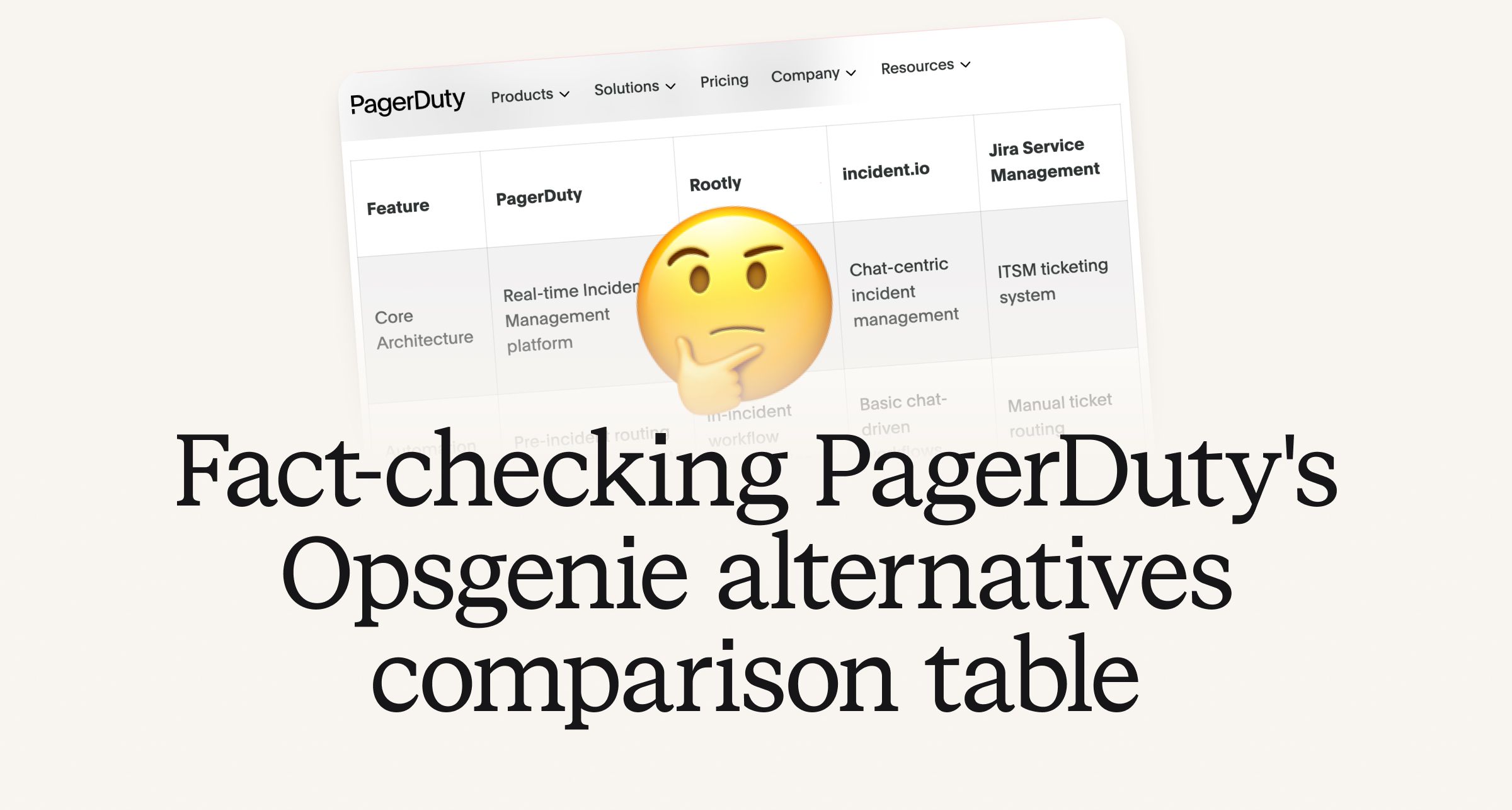
Fact-checking PagerDuty's Opsgenie alternatives comparison table
PagerDuty published a new comparison table about incident.io. Once again, it describes a product we don't recognize. So once again, we're correcting the record, row by row, with receipts.

July 28, 2026
Your genie is vanishing: introducing the Opsgenie rescue program
Today, we're launching the Opsgenie Rescue Program to make that landing soft: simplified migration and free overlap so you never pay two vendors at once.
July 9, 2026
So good, you’ll break things on purpose
Ready for modern incident management? Book a call with one of our experts today.
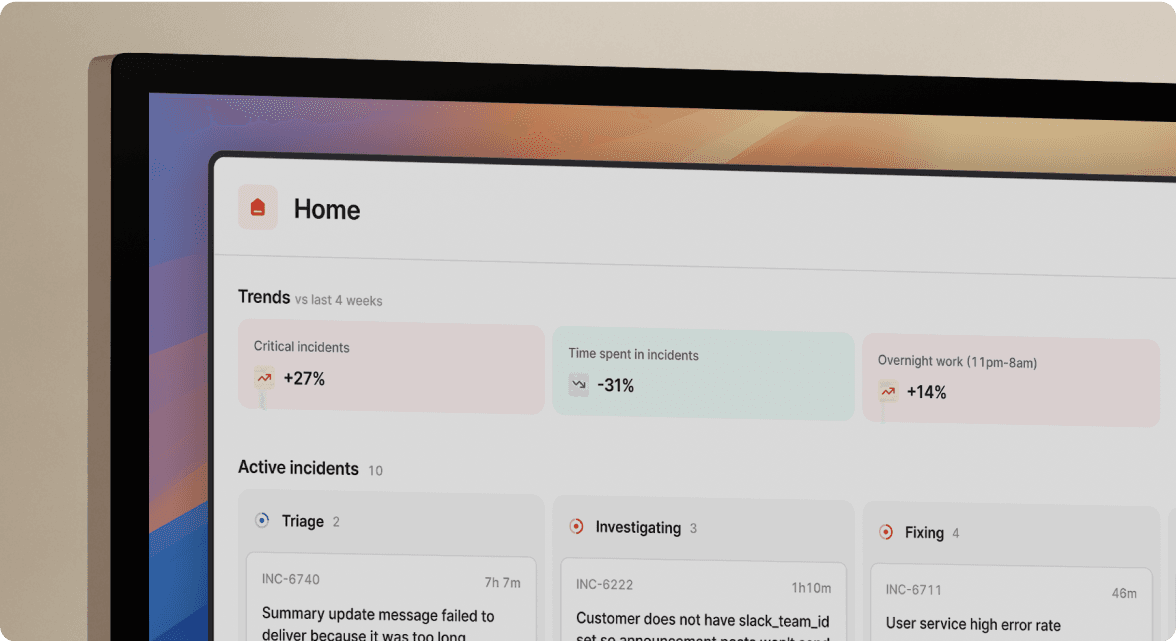
We’d love to talk to you about
- All-in-one incident management
- Our unmatched speed of deployment
- Why we’re loved by users and easily adopted
- How we work for the whole organization