Join live: What happens when your AI goes down?
PagerDuty alternatives 2026: The SRE's guide to modern incident management
February 27, 2026 — 18 min read
Updated February 27, 2026
TL;DR: PagerDuty mastered alerting, but we've found modern SRE teams need coordination and resolution automation, not just a pager. The top PagerDuty alternatives in 2026 are incident.io (Slack-native, end-to-end management), Opsgenie (Atlassian shops only, shutting down April 2027), Grafana OnCall (observability-first stacks), Better Stack (small teams, clean UI), and FireHydrant (complex service catalog needs). If you handle 10+ incidents per month and want to reduce MTTR by up to 80%, we built incident.io as your clearest upgrade path from PagerDuty. A migration takes days, not months.
Many engineering teams use PagerDuty for alerting while coordinating incidents in Slack. This often creates a split workflow: alerts are acknowledged in one system, while communication, channel creation, stakeholder updates, and documentation happen elsewhere. That fragmentation introduces coordination overhead before investigation even begins.
PagerDuty played a defining role in modern on-call alerting. In 2026, however, many teams view alert routing as table stakes. The greater challenge lies in coordinating response, capturing timelines, and automating post-incident documentation within a unified workflow. Addressing that coordination gap has become a primary lever for reducing MTTR.
We've compared the top PagerDuty alternatives in 2026, covering total cost of ownership (TCO), automation capabilities, Slack-native workflows, and honest trade-offs, so you can shortlist the right tool for your team size and technical requirements.
Why engineering teams are leaving PagerDuty in 2026
The single most cited reason for switching is cost. PagerDuty's Business plan runs $41/user/month, and that's before you add AIOps ($699/month), PagerDuty Advance for AI capabilities ($415/month), and Status Page ($89/month). For a 50-person engineering team, the base Business plan costs $2,050/month, and adding those three essential add-ons brings it to $3,253/month ($39,036/year). Teams evaluating alternatives consistently hit a $3,000/month breaking point and start shopping.
Pricing is only part of the story, because the other part is workflow friction. PagerDuty is a web-first product, but during a production outage your team is in Slack, and context-switching between a web UI and your chat platform adds cognitive load at exactly the moment you can least afford it. As detailed in incident management research across SRE teams, the pattern is consistent: "PagerDuty has become a stale product... a limiter in incident response processes." Teams report stagnant innovation, hidden pricing complexity that doubles TCO estimates, and tool sprawl that costs over 12 minutes of coordination overhead per incident before troubleshooting even begins.
The market has split into two categories: legacy alerting tools that wake you up, and modern incident management platforms that wake you up AND coordinate the response AND auto-generate the post-mortem. That split is the key decision framework when evaluating alternatives.
Evaluation criteria: what matters beyond the pager
Before you compare tools, define your scorecard. Here's what matters for SRE teams in 2026:
Unified workflow: Does the platform reduce tool sprawl? An alert that fires, creates a Slack channel, pages the right team, captures the timeline, and drafts the post-mortem is worth far more than a simple alert router with a web dashboard.
True AI capabilities: There's a clear difference between "AI washing" (adding GPT to generate generic summaries) and production-ready AI that automates real tasks. Our AI SRE automates up to 80% of incident response by identifying root causes from historical patterns, auto-drafting post-mortems from captured timelines, and executing response tasks, while PagerDuty's AIOps costs an extra $699/month and largely pattern-matches alert noise.
TCO and pricing transparency: Calculate the fully-loaded cost. Base plan, plus on-call scheduling, status page, AI features, and seats. Then compare that number to unified platforms that bundle these features without add-ons.
Scale without burnout: A tool that requires complex configuration or 2-3 weeks to onboard a new on-call engineer creates exactly the toil you're trying to eliminate. The right platform gets a new engineer through their first P2 incident with minimal guidance.
Support responsiveness: Production doesn't go down during business hours. Look for shared Slack support channels and documented response SLAs, not email ticketing that takes days.
The 5 best PagerDuty alternatives compared
Here's an honest breakdown of the top alternatives, with specific trade-offs for each.
1. incident.io: best for Slack-native end-to-end management
We built incident.io as the strongest direct upgrade for teams frustrated by PagerDuty's coordination overhead. Our platform is Slack-native, meaning your entire incident lifecycle happens in slash commands and channel interactions, not a web UI that pings Slack.
The workflow difference is concrete. A Datadog alert fires and incident.io automatically creates #inc-2847-api-latency, pages the on-call SRE, pulls in service owners from the Service Catalog, and starts capturing the timeline. You type /inc assign @sarah to make her incident commander, then /inc escalate @database-team when the root cause points to a connection pool issue. When you type /inc resolve, the status page updates automatically and an AI-drafted post-mortem appears with the timeline already 80% complete.
The results from teams who've made the switch are specific. Favor reduced MTTR by 37% after adopting incident.io, and incident detection increased by 214% because engineers started catching small issues before they became major outages. Etsy now presents workload reports to VPs, directors, and the CTO monthly, showing time spent on incidents including post-incident discussion time, data they simply didn't have before.
"incident.io as a fantastic solution for incident management! ... it's incredibly easy to get started with since all ICM tasks can be performed directly through Slack, so there's no need for responders to spend time learning a new tool." - Daniel L. on G2
For more on how the Slack-native workflow compares in practice, the PagerDuty vs incident.io vs FireHydrant comparison guide walks through real-world workflow differences.
Pricing: Pro plan at $45/user/month with on-call scheduling included. No separate add-ons for status pages or AI capabilities. For 50 users, you'll pay $2,250/month ($27,000/year) all-in, compared to PagerDuty's $3,253/month for equivalent functionality.
Best for: SaaS teams at 50-500 people running Slack, handling 10+ incidents per month, and frustrated by the post-mortem reconstruction tax.
Trade-offs: incident.io uses opinionated defaults. If you need extensive alerting configuration flexibility, PagerDuty offers more customization options, but that flexibility comes at a significant coordination cost.
2. Opsgenie: best for existing Atlassian-heavy users (with a major caveat)
Opsgenie's only real selling point in 2026 is the Jira Service Management bundle, but Atlassian stopped new purchases on June 4th, 2025 and will end access entirely on April 5th, 2027. You're evaluating a product on a documented end-of-life timeline.
Feature limitations are also real right now. Atlassian deprecated the Incident Command Center and doesn't support it in Jira Service Management. Chat integrations must be manually reconfigured since they require new authentication. For teams who've been using Opsgenie for years, the migration complexity to JSM or a third-party platform is a real planning consideration. We provide a dedicated Opsgenie migration guide for teams making this transition.
Pricing: Bundled with Jira Service Management Premium or Enterprise. Standalone pricing is no longer available for new customers.
Best for: Teams already on JSM Premium who handle fewer than 10 incidents per month and don't need advanced post-mortem automation. Everyone else should plan migration to a platform with a future roadmap before the April 2027 deadline.
Trade-offs: Product is in maintenance mode. UI is dated. Workflow automation significantly lags dedicated incident management platforms.
3. Grafana OnCall: best for open-source observability stacks
If your team lives inside Grafana dashboards and wants on-call management baked into your observability stack, Grafana OnCall is the natural fit because context-rich notifications deliver alert metrics, logs, and trace data in the page itself, so responders arrive with full context.
One important note on the OSS version: it entered read-only maintenance mode in March 2025 and will be archived on March 24, 2026. Grafana is merging OnCall and Incident into a unified Grafana Cloud IRM app, so evaluate the Cloud version if you're starting fresh.
The workflow automation gap is real. Grafana IRM handles alert routing and on-call scheduling well, but it lacks the depth of post-mortem automation and coordinated response tooling that dedicated platforms provide. Grafana is strong for observability-first contexts but limited for teams who need structured incident coordination and a blameless post-mortem culture.
Pricing: Available on Grafana Cloud plans, including a free tier for small teams. Self-hosted OSS version enters archive in March 2026.
Best for: Teams already invested in the Grafana ecosystem who want on-call scheduling without adding another vendor, and who handle simpler incident types with lighter post-mortem requirements.
Trade-offs: Post-mortem automation is basic. Status pages aren't native. Workflow customization is limited compared to dedicated platforms.
4. Better Stack: best for simple infrastructure monitoring
Better Stack takes a design-first approach with a clean UI combining uptime monitoring, log management, and on-call alerting in one product. The free plan includes 10 monitors with 3-minute checks and a status page, making it genuinely useful for small teams or early-stage products. The Opsgenie shutdown has driven many smaller teams toward Better Stack as a quick replacement.
Better Stack's strength is simplicity. Setup is fast and the interface is polished, making it ideal for teams running straightforward infrastructure without complex service ownership or multi-team escalation paths. For a 10-person startup handling 3-5 incidents per month, it covers the essentials without friction.
The enterprise limitations appear quickly at scale. RBAC complexity, advanced workflow automation, AI-powered post-mortems, and service catalog governance aren't core strengths. For a 100-person SaaS company with 80 microservices and complex on-call rotations, you'll hit friction quickly.
Pricing: Free tier available. Paid plans scale with monitoring and team size.
Best for: Startups, small infrastructure teams, and developers who want integrated uptime monitoring plus basic on-call without the configuration overhead of enterprise platforms.
Trade-offs: Not built for complex multi-team escalation, structured post-mortem culture, or enterprise compliance requirements.
5. FireHydrant: best for complex service catalog needs
FireHydrant's differentiation is its service catalog focus and compliance-friendly runbook workflows. If your incident management process requires detailed runbook execution tracking, built-in retrospective templates, and strong service ownership mapping, FireHydrant covers that use case well.
The primary trade-off is the web-first UI. FireHydrant's primary incident management surface is a dashboard, with Slack integration handling notifications rather than the full workflow. During a 3 AM P1, that means context-switching between your browser and Slack rather than staying in the channel where your team is coordinating. As incident management tool comparisons show, that context-switching overhead is the sharpest pain point when cognitive load is already high.
Pricing: Contact FireHydrant directly. Enterprise tiers are not publicly listed.
Best for: Teams with mature service catalogs who need rigorous runbook tracking and are comfortable with a web-first incident management interface.
Trade-offs: Web-first UI requires context-switching from Slack during incidents. Less Slack-native than incident.io.
Comparison table: features, pricing, and AI capabilities
| Platform | Pricing (with on-call) | Slack-native? | AI capabilities | Best for |
|---|---|---|---|---|
| incident.io Pro | $45/user/month (all-in) | Full (slash commands, auto-channels) | AI SRE: up to 80% automation, auto-drafts post-mortems | Slack-first SRE teams, 50-500 people |
| PagerDuty Business | $41/user/month + $1,203/month add-ons | Notifications only | AIOps $699/mo extra, Advance AI $415/mo extra | Enterprise, compliance-heavy |
| Opsgenie (via JSM) | Bundled with JSM Premium | Notifications only | Limited, EOL April 2027 | Atlassian shops (with migration plan) |
| Grafana OnCall | Cloud plans, free tier available | Partial | Basic alert grouping | Grafana-native observability stacks |
| Better Stack | Free tier available | Notifications only | Limited | Small teams, simple infrastructure |
| FireHydrant | Contact for pricing | Partial | Runbook automation | Complex service catalog needs |
Migration guide: moving off PagerDuty without downtime
The fear of migration is usually bigger than the migration itself. One engineering team with roughly 15 people completed their move from PagerDuty to incident.io in under 20 days. Here's the practical path, based on incident.io's migration tooling:
Step 1: Connect and import. Connect your PagerDuty instance to incident.io as an alert source and use the import tool to replicate your escalation policies, schedules, and users automatically. Nothing goes live until you validate it, so you test our coordination layer with zero risk to existing alerting.
Step 2: Redirect alert sources. For Datadog monitors pointing to PagerDuty via webhooks, update the Terraform config to redirect those monitors to incident.io instead. For teams with hundreds of monitors, this is script-level work, not click-by-click manual updates.
Step 3: Run parallel, then cut over. Keep PagerDuty live for 2 weeks while routing a subset of incidents through incident.io. Use the on-call readiness report to track team preparedness and MTTR comparisons in real time, then redirect all alert sources and downgrade PagerDuty once you're confident.
"Its post-mortem and follow-up tooling is simple, yet detailed, and gives us the structure to quickly share learnings from our incidents - cementing a healthy incident culture." - Matt B. on G2
Choosing the right tool for your stage
The right answer depends on your team's constraints, not on which platform has the longest feature list.
Choose Opsgenie only if you're already on Jira Service Management Premium and handling fewer than 10 incidents per month, and build your April 2027 migration plan now.
Choose PagerDuty if you're at a Fortune 500 with legacy compliance requirements and alert reliability is your only priority, and expect $39,000+/year for 50 users with full feature access. For small teams under 20 engineers, Better Stack or Grafana OnCall cover basic needs without enterprise overhead, and FireHydrant suits teams with mature service catalogs who prefer a web-first interface.
Choose incident.io if you want to reduce MTTR by up to 80%, eliminate the post-mortem reconstruction tax, and keep your workflow inside Slack. Etsy's 35% MTTR reduction in 90 days and Intercom's 40% time saved on incident management represent what's achievable after adopting the platform.
"After a lengthy vetting process with multiple incident management tools, we decided to purchase incident.io for managing incidents. One key factor in this decision was the ease of use -- it was so extremely simple to set up, adjust on the fly, add or subtract features, it made a real difference compared to other software." - Verified user on G2
If you want to see the Slack-native workflow in action before committing, book a demo and we'll walk through the TCO math for your specific configuration using your team's actual data.
Key terminology
MTTR (Mean Time To Resolution): The average time from incident detection to full resolution and the primary metric for measuring incident management effectiveness.
On-call rotation: A schedule defining which engineer is responsible for responding to production alerts during a given time window.
Escalation policy: The defined path for paging additional responders when an incident is not acknowledged or resolved within a specified time window.
Slack-native: A workflow design where incident management tasks (declaring, assigning roles, escalating, resolving, updating status pages) happen through Slack commands and channel interactions rather than a separate web interface, contrasted with "Slack-integrated" tools that send notifications to Slack but require a browser for actual incident work.
Post-mortem: A structured document written after a resolved incident that captures the timeline, root cause, impact, and follow-up actions. In incident.io, the AI SRE auto-drafts this from the captured channel timeline.
AI SRE: incident.io's AI assistant that automates up to 80% of incident response tasks, including root cause identification from past incident patterns, automated timeline capture, and post-mortem drafting.
FAQs

Tom Wentworth
Chief Marketing Officer
See related articles
Introducing Investigations, powered by Nexus.
Today we're launching Investigations: agentic root cause analysis that starts the moment you're paged, figures out what broke and why, and works with your team through to resolution. Here's what we built, what's powering it, and why it took some time to get right.

August 5, 2026
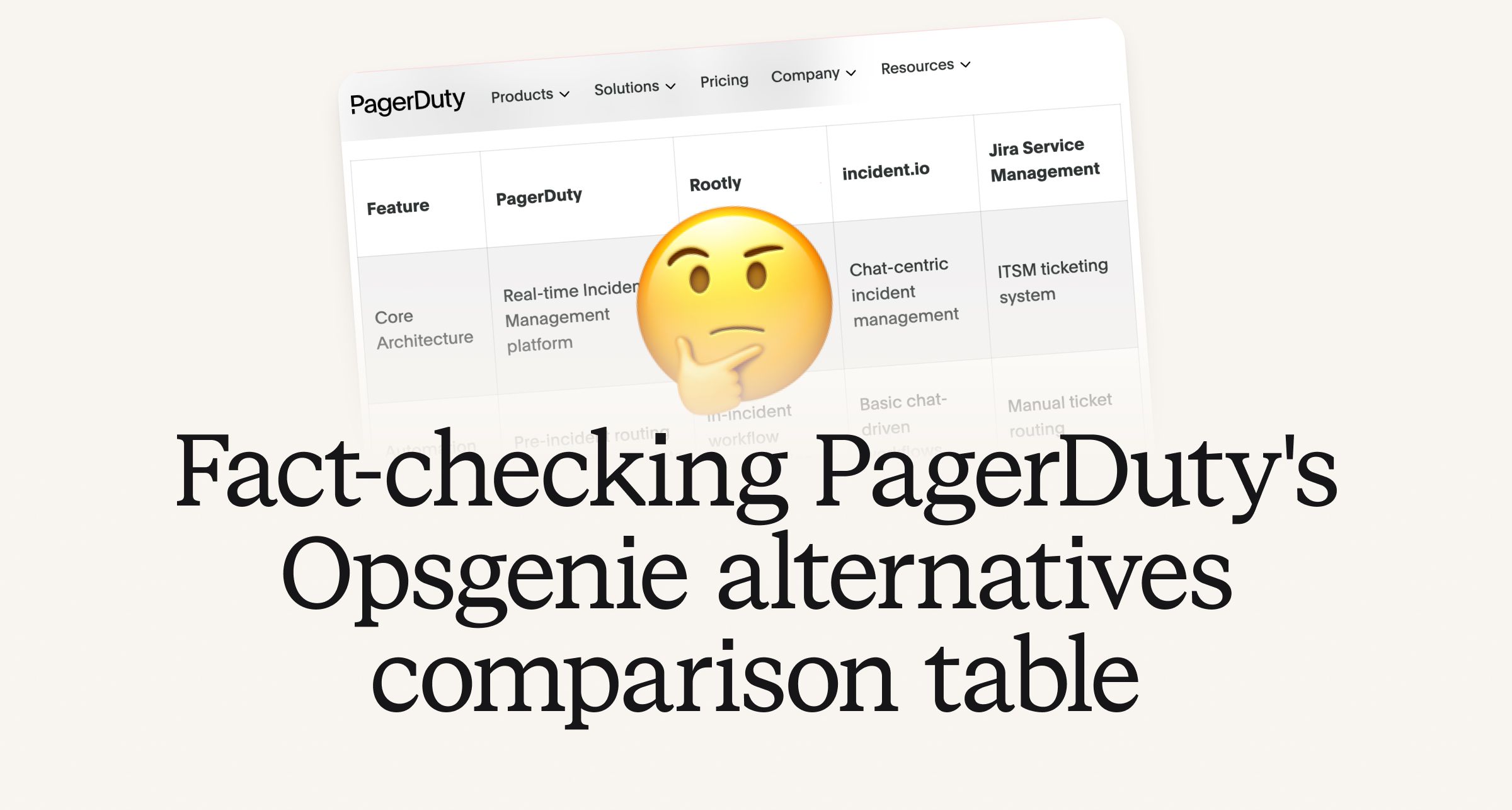
Fact-checking PagerDuty's Opsgenie alternatives comparison table
PagerDuty published a new comparison table about incident.io. Once again, it describes a product we don't recognize. So once again, we're correcting the record, row by row, with receipts.

July 28, 2026
Your genie is vanishing: introducing the Opsgenie rescue program
Today, we're launching the Opsgenie Rescue Program to make that landing soft: simplified migration and free overlap so you never pay two vendors at once.
July 9, 2026
So good, you’ll break things on purpose
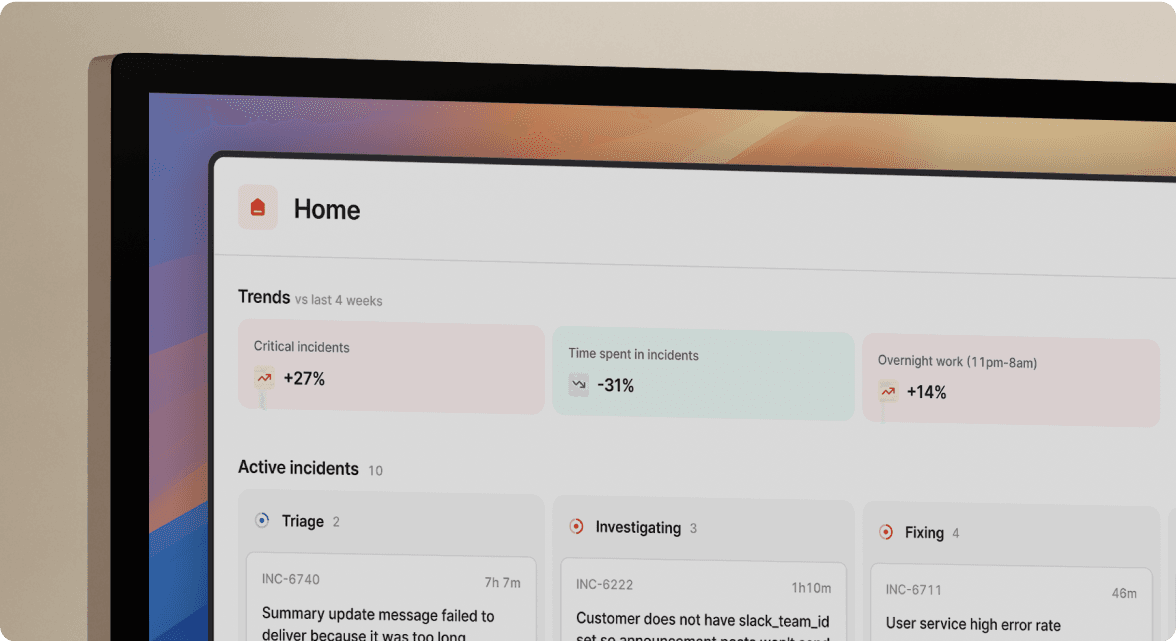
Ready for modern incident management? Book a call with one of our experts today.
We’d love to talk to you about
- All-in-one incident management
- Our unmatched speed of deployment
- Why we’re loved by users and easily adopted
- How we work for the whole organization