Runbook automation tools 2026: the complete guide to automating incident response
February 27, 2026 — 24 min read
Updated February 27, 2026
TL; DR: Runbook automation in 2026 has moved beyond bash scripts to Intelligent Runbook Execution: context-aware, human-in-the-loop workflows that coordinate people, tools, and communications automatically. For SRE and DevOps teams, that means measurable MTTR reductions and audit-ready timelines generated without manual effort. incident.io Workflows is one of the platforms advancing this category, combining Slack-native coordination, service catalog intelligence, and automated timeline capture.
When alerts fire outside business hours, initial response time can be influenced by manual coordination steps before troubleshooting begins. Channel creation, role assignment, and context gathering often occur sequentially rather than automatically, delaying structured investigation.
In an automated model, incident channels, role assignments, and workflow steps are created immediately based on alert context. Timeline capture begins at declaration, and response actions are recorded as they occur. According to incident.io's post-mortem ROI research, manual post-mortem reconstruction alone wastes 60-90 minutes per incident as teams review Slack threads, monitoring data, and call recordings to rebuild the timeline.
This guide covers the complete landscape of runbook automation tools for 2026, explains what separates legacy scripts from Intelligent Runbook Execution, and gives you a concrete framework for choosing incident management software, whether you're the SRE manager trying to eliminate toil or the security director who needs immutable audit trails for your next SOC 2 audit.
What is runbook automation? From static docs to intelligent execution
Runbook automation converts documented operational procedures into executable workflows. You trigger them via alerts, schedules, or manual action, and they perform pre-checks, run actions, handle errors, and confirm system health, all with evidence captured automatically.
The category has gone through three distinct generations:
- Static runbooks: A Confluence or Notion page with numbered steps. Engineers read them during incidents, skip steps under pressure, and nobody updates them after the post-mortem. Useful as documentation, useless as automation.
- Scripted automation: Bash or Python scripts, self-hosted tools like Rundeck, or Ansible playbooks that execute predefined tasks. These solved the "doing it manually" problem but introduced a maintenance burden: every API change breaks the script, and there's no context about which service owns what.
- Intelligent Runbook Execution: Context-aware, dynamically executed automation workflows that integrate service catalog data, support conditional logic and human approval gates, automatically generate audit trails, and operate natively within communication platforms to orchestrate incident response from detection through resolution.
Intelligent Runbook Execution powers Automated Incident Response (AIR), which uses workflows and AI to handle containment and remediation steps automatically, not just alerting. The incident.io Catalog is a practical example: it maps alerts to services, services to teams, and teams to on-call engineers, so automation decisions are driven by live organizational context rather than hardcoded values.
Why runbook automation is critical for SRE teams in 2026
Eliminating toil
The Google SRE book defines toil as work that tends to be manual, repetitive, automatable, tactical, devoid of enduring value, and that scales linearly as a service grows. Google's SRE teams aim to keep toil below 50% of an engineer's time because beyond that threshold, reliability improvements stall.
A significant portion of incident response work consists of repetitive coordination tasks, such as creating channels, updating tickets, publishing status page updates, and notifying stakeholders. These activities are important but do not require complex engineering judgment, making them strong candidates for automation.
Early-stage coordination and post-incident documentation often consume meaningful time during an incident lifecycle. Runbook automation reduces that overhead by structuring workflows, capturing actions automatically, and minimizing manual reconstruction efforts, delivering measurable efficiency gains over time.
Building the compliance case
This is where your security director becomes a stakeholder, not just an approver. SOC 2 Type II's CC7.3 control says you must demonstrate incident response procedures are in place and that you evaluate their effectiveness periodically. Both SOC 2 and ISO 27001 require incident response plans that document who did what and when.
When your runbook automation platform automatically captures a timestamped, immutable timeline for every incident, you generate SOC 2 evidence as a byproduct of normal operations. Audit logs provide an immutable record of user actions, enabling accountability, forensic analysis, and detection of unauthorized access. According to SOC 2 audit requirements, Type 2 reports require demonstrating the operational effectiveness of security controls for 6-12 months, and incident timeline logs are a primary evidence source.
How this satisfies your security director:
- CC7.3 (Incident Response): Immutable timeline captures who did what, when, with full evidence export.
- CC7.4 (Audit Logging): Every workflow action writes to the timeline automatically, with no manual reconstruction needed.
- CC6.1 (Access Control): Private incidents with RBAC-enforced channels ensure only authorized responders see sensitive data.
- CC6.6 (SCIM/SAML): Okta integration keeps permissions synchronized with your identity provider.
The result: your security team stops spending hours manually reconstructing timelines before each audit cycle and instead walks in with exportable, timestamped logs that auditors can review directly.
Standardization at scale
Manual runbooks rely on tribal knowledge. The engineer who knows the deployment rollback procedure is on vacation. The new SRE doesn't know which Slack channel to use. Runbook automation enforces consistent process regardless of who is on-call, how senior they are, or what time it is.
"Now engineers are comfortable that when the proverbial alarm bells ring at 3am, they won't miss out important process while dealing with chaos or have to be reading through long incident-management runbooks that aren't related to the problem at hand. Ability to focus entirely on resolving the issue while incident.io makes sure every box is checked has been keenly felt within the engineering teams." - Jack S. on G2
The 3 types of runbook automation tools
Before comparing specific platforms, understand the three categories. Each type excels at different use cases, and choosing the wrong category will frustrate your team:
| Type | Primary focus | Example platforms | Best suited for |
|---|---|---|---|
| Script executors | Running code and CLI commands on infrastructure | Rundeck, Ansible | Ops teams needing granular script control |
| Security orchestrators (SOAR) | Security alert triage and threat response | Tines, Torq | Security operations centers (SOC) |
| Incident workflow platforms | End-to-end incident lifecycle coordination | incident.io, FireHydrant | SRE/DevOps teams running cloud-native services |
The distinction matters because a script executor won't auto-create your Slack channel or draft your post-mortem. A SOAR tool excels at phishing triage but isn't built for service restoration or customer communication. Incident management platforms handle the full response lifecycle, from detection through post-mortem publication.
Top runbook automation tools and platforms for 2026
incident.io: Best for Slack-native incident workflows
We built incident.io Workflows for the way SRE teams actually work inside Slack, reacting to real-time alerts, coordinating across services they own. Workflows trigger automatically based on alert payload data, incident severity, or custom field values, and they execute within your existing Slack workspace so engineers don't context-switch to a separate web console.
What makes a difference is Service Catalog integration. The incident.io Catalog maps alerts to services, services to teams, and teams to on-call engineers, so when a payment service alert fires, the workflow already knows which engineer to page, which stakeholders to notify, and which runbook steps apply. Watch the hands-on Catalog introduction to see how this works in practice.
For compliance, every workflow action writes automatically to the incident timeline, creating the immutable audit trail your security team needs for SOC 2 evidence. Private incidents with granular RBAC ensure sensitive security events stay access controlled. SCIM provisioning via Okta keeps user permissions synchronized with your identity provider.
Watch How Incident Is Automating Incident Response and the Scribe transcription tool captures live call summaries automatically. You can see this in the how to automate incident resolution session from SEV0 London 2025. incident.io serves 600+ customers including Netflix and Etsy. Favor reduced MTTR by 37% after adopting the platform.
Best for: SRE and DevOps teams running Slack as their communication hub who need end-to-end incident coordination, service catalog-backed automation, and compliance-ready audit trails.
Strengths:
- Slack-native coordination: workflows run where your team already works
- Catalog-backed routing eliminates hardcoded escalation paths
- Automatic timeline capture generates SOC 2 evidence by default
- Private incident workflows for sensitive security events
- AI SRE automates up to 80% of incident response
Limitations: The intro plan limits integrations and automations available. Full workflow power requires a paid tier.
PagerDuty Process Automation: Best for legacy IT operations
PagerDuty Process Automation (formerly Rundeck Enterprise) is a separate product from PagerDuty's core alerting platform, priced at $125 per user monthly plus a platform fee, completely independent of your existing PagerDuty subscription. The PagerDuty model is "trigger a Rundeck job from a PagerDuty incident," which means two products, two pricing models, and two interfaces to maintain.
For teams managing enterprise-scale on-prem infrastructure with an existing PagerDuty investment, that integration makes sense. For teams who want automation to live inside their incident channel rather than a separate web console, the context-switching adds friction during the moments that matter most.
Best for: Enterprise IT operations teams managing on-prem or hybrid infrastructure with existing PagerDuty investment.
Limitations: Separate pricing from core PagerDuty product, server-based Runner architecture, and operates outside your Slack workflow rather than inside it.
Rundeck: Best for self-hosted script execution
Open-source Rundeck is a web console and API service that standardizes and executes operational workflows, letting teams convert manual procedures into automated jobs and build self-service portals for infrastructure tasks. Teams use automated Rundeck jobs to quickly diagnose and resolve incidents by gathering logs and service status from affected systems.
Rundeck excels at script execution but doesn't provide the communication coordination that incident workflow platforms offer. It restarts servers but doesn't assemble your team, update your status page, or draft your post-mortem. The open-source version also lacks pre-built integrations with Datadog, ServiceNow, and PagerDuty, requiring you to build and maintain those connections yourself.
Best for: Ops engineers comfortable with self-hosting who need granular script control for infrastructure tasks.
Limitations: No Slack-native execution, no service catalog awareness, no built-in compliance logging for incident timelines.
Tines: Best for security-specific orchestration
Tines is a SOAR (Security Orchestration, Automation, and Response) platform. Security practitioners use it to speed up responses to security events, reduce alert noise, and route qualified threats to the right security team. Common use cases include analyzing suspicious IPs, confirming whether an indicator of compromise is present in the network, and routing product security alerts to AppSec while IOC alerts go to the SOC.
Tines has been particularly effective replacing traditional SOAR platforms like XSOAR, Phantom, and Demisto. The gap for SRE teams: Tines is built for security triage, not service restoration. It doesn't have the service catalog awareness, on-call routing, or post-mortem generation that DevOps incident workflows require.
Best for: Security operations centers handling phishing triage, threat intelligence enrichment, and security-specific escalation flows.
Limitations: Security-focused scope means limited native support for SRE workflows like deployment rollback, MTTR tracking, and post-mortem generation.
FireHydrant: Best for service catalog-centric setups
FireHydrant positions as a reliability platform built around service catalog and runbook automation. Teams can store service catalog data as code in GitHub, automatically updating catalog records whenever their repository changes. Runbooks trigger manually or automatically based on incident details, with conditional execution rules that the platform constantly evaluates.
FireHydrant's approach mirrors ours: service metadata powers intelligent routing and automation decisions. The difference is UX. FireHydrant uses a traditional step-configuration runbook builder while incident.io uses a Slack-native workflow model. FireHydrant integrates with catalog formats including Backstage and OpsLevel, which appeals to teams with mature internal developer portals.
Best for: Teams with existing Backstage or OpsLevel service catalog investments who want runbook automation tightly coupled to catalog metadata.
Limitations: Less Slack-native than incident.io, and runbook conditions are locked to paid plans.
Comparison table
| Platform | Type | Slack-native | Auto audit trail | Pricing model |
|---|---|---|---|---|
| incident.io | Incident workflow | Yes (native) | Yes (automatic) | Contact sales |
| PagerDuty Process Automation | Script executor | Partial (via integration) | Job logs only | $125/user/mo + platform fee |
| Rundeck (OSS) | Script executor | No | No | Free (self-hosted) |
| Tines | SOAR | No | Yes (security-focused) | Tiered subscription |
| FireHydrant | Incident workflow | Partial | Partial | Tiered plans |
How to choose a runbook automation platform
Run through these four criteria before signing any contract:
- Integration depth with your existing stack. Your platform needs to talk to Datadog or Prometheus for alert ingestion, Slack or Teams for communication, Jira or Linear for ticket creation, and Statuspage for customer updates. The incident.io handles automatic incident creation from alert payloads and status page automation via API. Verify that integrations are bidirectional and don't require you to maintain a custom webhook layer.
- Usability for the team actually running incidents. A workflow builder that requires extensive training to configure basic escalation rules is unlikely to see consistent adoption. Evaluate whether engineers unfamiliar with the platform can declare an incident and trigger a workflow quickly, without relying on lengthy documentation or specialist support.
- Security and compliance readiness. This is where your CISO needs to sign off. Ask specifically:
- Does every workflow action write to an immutable, exportable audit log?
- Does the platform support private incidents with RBAC-enforced channel access?
- Is SAML/SCIM provisioning available for Okta or Azure AD?
- Pricing transparency. A $125/user/month automation add-on stacked on top of a $75/user/month alerting platform is a common budget surprise. Map out total cost including platform fees, integration costs, and any per-incident or per-automation charges before you present numbers to finance.
Step-by-step: Implementing runbook automation without breaking production
The safest path to automation is phased. Here's the approach that SRE best practices recommend:
- Audit and document your existing manual runbooks. List every step engineers take during your five most common incident types. Starting with a manual runbook lets you document each step accurately, map out dependencies between tasks, and validate accuracy before implementing automation. You need an accurate baseline before you can automate it.
- Automate safe, non-destructive tasks first. Channel creation, role assignment, Zoom link posting, Jira ticket creation, and status page updates are ideal starting points. These carry zero production risk and generate immediate time savings. As Microsoft Azure operational excellence guidance notes, the better approach is incremental: start with small, high-leverage tasks and expand from there.
- Add human-in-the-loop controls for sensitive actions. HITL automation pauses for a human to accept or reject an activity before continuing execution. Use this pattern for database rollbacks, credential rotations, feature flag changes, and any action with production impact. This pattern is widely used in CloudOps and DevOps workflows for access control approvals and deployment validation. In incident.io, this appears as a button in the Slack channel: the engineer clicks "approve" before the automation proceeds.
- Full automation for well-understood, low-risk scenarios. Once you've observed Phase 3 automations running correctly across 20+ incidents, remove the approval gate for the lowest-risk variants. Reserve human-in-the-loop for anything that touches production data or infrastructure state.
As a safety check across all phases: always dry-run workflows before activating them in production, and use conditional logic to validate pre-conditions before allowing sensitive actions to proceed.
Future trends: AI and predictive remediation
Two changes are shaping the next 18 months of runbook automation:
AI-generated workflow steps. Rather than manually configuring every runbook step, AI now suggests steps based on your installed integrations and past incident data. incident.io's AI SRE can automate up to 80% of incident response based on patterns from previous incidents. Tines has also enhanced its capabilities with AI at both build time and run time, using AI to generate code from prompts and power workflows as they execute. The consistent guidance from practitioners: keep AI-assisted actions behind human approval gates for any step that touches production systems or mints secrets.
Predictive remediation before the outage. The logical endpoint of runbook automation is triggering workflows from anomaly detection signals before you declare an incident. According to Gartner research on AIOps, I&O leaders should separate hype from achievable value in reduced toil and improved availability. The teams winning here have already instrumented service catalog data and built workflow logic that adapts to context, because predictive remediation requires that foundation.
Runbook automation has matured past the "restart the server automatically" era. In 2026, the platforms that deliver real MTTR reduction coordinate people, communication, and compliance in a single flow rather than executing scripts in isolation. Favor reduced MTTR by 37% with incident.io.
Verified users on G2 describe the outcome consistently.
"I appreciate how incident.io consolidates workflows that were spread across multiple tools into one centralized hub within Slack, which is really helpful because everyone's already there... The automation is great for handling repetitive tasks, which many engineers are eager to cut down on." - Alex N. on G2
"The catalog and workflows feature has allowed us to experiment with our process without needing to retrain everyone and helps us gather key data about incidents without having to manually review them all." - Verified User in Retail on G2
Shift from standalone scripts to orchestrated incident workflows. If you'd like to see the Service Catalog integration and AI SRE in action book a demo with the team.
Key terminology
Intelligent Runbook Execution: Context-aware, dynamically executed automation workflows that integrate service catalog data, support conditional logic and human approval gates, automatically generate audit trails, and operate natively within communication platforms to orchestrate incident response from detection through resolution.
Toil: Manual, repetitive, automatable work that is devoid of enduring value and scales linearly as a service grows. Incident coordination overhead including channel creation, role paging, and status updates is the most common source of toil in incident response.
Human-in-the-loop (HITL): A hybrid automation pattern where a workflow pauses at a defined step for a human to approve or reject the next action before execution continues. Used for production-impacting steps like database rollbacks, credential rotation, or infrastructure changes where automated errors would be costly.
Mean Time To Resolution (MTTR): The average time from incident detection to full resolution, and the primary metric runbook automation reduces. Most SRE teams see median P1 MTTR between 45-60 minutes without automation, with roughly 12 of those minutes spent on coordination overhead alone.
Service Catalog: A connected map of every service, team, and ownership relationship in your organization. Powers intelligent routing in runbook automation by enabling workflows to automatically page the correct on-call engineer, notify the right stakeholders, and apply service-specific runbook steps based on which service triggered the alert.
Private incidents: An access-controlled incident type where only explicitly authorized responders can view the channel, timeline, and communications. Critical for security incidents involving potential data breaches, zero-days, or executive account compromises where accidental exposure in a public channel would create compliance risk.
FAQs

Tom Wentworth
Chief Marketing Officer
See related articles

Introducing Investigations, powered by Nexus.
Today we're launching Investigations: agentic root cause analysis that starts the moment you're paged, figures out what broke and why, and works with your team through to resolution. Here's what we built, what's powering it, and why it took some time to get right.

August 5, 2026
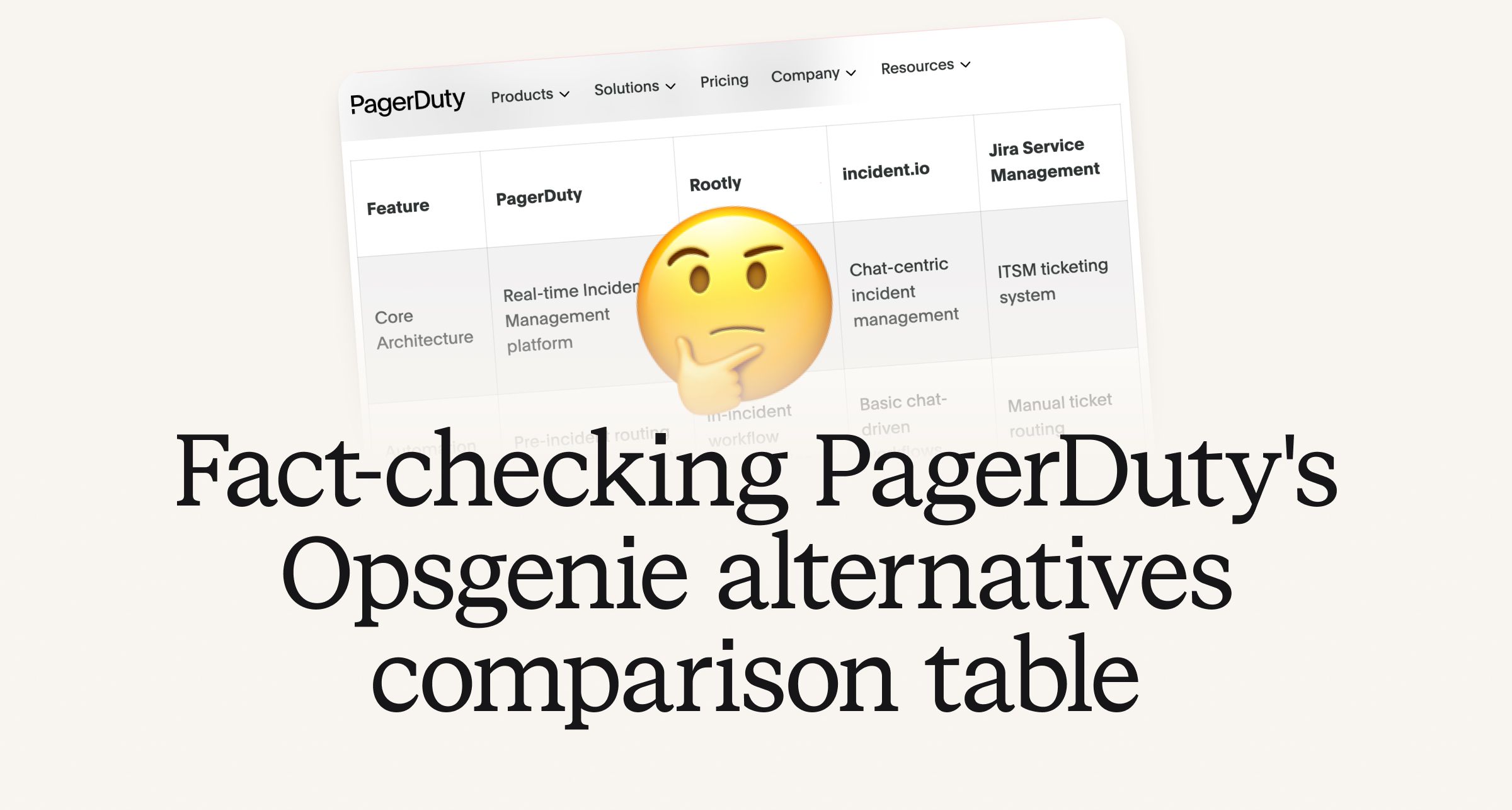
Fact-checking PagerDuty's Opsgenie alternatives comparison table
PagerDuty published a new comparison table about incident.io. Once again, it describes a product we don't recognize. So once again, we're correcting the record, row by row, with receipts.

July 28, 2026
Your genie is vanishing: introducing the Opsgenie rescue program
Today, we're launching the Opsgenie Rescue Program to make that landing soft: simplified migration and free overlap so you never pay two vendors at once.
July 9, 2026
So good, you’ll break things on purpose
Ready for modern incident management? Book a call with one of our experts today.
We’d love to talk to you about
- All-in-one incident management
- Our unmatched speed of deployment
- Why we’re loved by users and easily adopted
- How we work for the whole organization