Join live: What happens when your AI goes down?
Jira Service Management vs. Opsgenie: Complete comparison guide 2026
March 13, 2026 — 20 min read
Updated March 13, 2026
TL;DR: Opsgenie standalone ended new sales on June 4, 2025, with full end of support on April 5, 2027. Atlassian's default path leads to JSM, a full ITSM suite covering asset management to customer service ticketing. If your team runs IT helpdesk operations, JSM makes sense. If your team is SRE or DevOps-focused with high incident volume and a Slack-native culture, JSM introduces platform bloat, higher costs, and slower response workflows. For engineering-first teams, a specialized platform like incident.io is a faster migration and a better operational fit.
With Opsgenie's End of Sale already passed and the clock ticking toward the April 5, 2027 End of Support date, engineering teams across the industry face a forced migration. Atlassian's pitch: consolidate into JSM and simplify your stack. The reality for SRE teams: trading a focused alerting tool for a heavyweight ITSM suite that adds friction to every incident response. This guide breaks down whether that trade-off makes sense for your team, or whether a specialized alternative delivers faster migration and better outcomes.
Executive summary: The state of Opsgenie in 2026
Opsgenie stopped accepting new customers on June 4, 2025, as Atlassian officially announced. Existing customers can still renew until April 5, 2027, after which all un-migrated Opsgenie data gets deleted. This is not a soft deprecation or a gradual feature freeze: it is a hard shutdown with a clear deadline.
If you're evaluating your migration options now, our Opsgenie migration guide covers the parallel-run approach in detail.
Atlassian's recommended path is JSM, which now bundles alerting and on-call scheduling as part of its operations capabilities. The pitch is consolidation: one platform for IT service management and incident response. The reality is more complicated, especially for engineering-first teams who picked Opsgenie because it was focused, fast, and opinionated.
Here is the core conflict:
- ITSM platforms like JSM are built around structured ticket workflows, SLA management, and service catalog governance. They excel at IT helpdesk operations.
- Incident response tools like Opsgenie (standalone) are built around fast alerting, on-call scheduling, and reducing time from alert to acknowledgment. They excel at keeping engineers focused during production incidents.
These are different jobs, and mixing them under one roof can slow down the use case you care most about.
The big picture: Opsgenie's sunset and JSM's consolidation strategy
Atlassian's consolidation move is straightforward from a business perspective: fewer SKUs, higher seat costs. What Adaptavist describes as availability changes on June 4, 2025 is, in practice, a migration mandate.
The migration path Atlassian lays out sends customers to JSM plus Compass, their internal developer platform for software component cataloging. Atlassian's documentation notes that operations will function across both products if they are part of your Atlassian site, meaning alerts, on-call schedules, and escalation policies remain synchronized with a single source of truth across JSM and Compass. That sounds clean. In practice, you are navigating two products instead of one.
The tool sprawl paradox is real: JSM claims to reduce sprawl by consolidating tools but introduces feature sprawl inside a single heavy UI. An SRE at 3 AM does not need a service desk portal. They need a fast path from alert to resolution with all context in one place.
Feature deep dive: JSM vs. Opsgenie standalone
Alerting and on-call management
Opsgenie's strength was always its alert routing engine. Teams could run complex deduplication logic, severity filtering, and routing rules across 200+ native integrations without custom code.
Engineers in the Atlassian community report a specific gap in JSM Operations: the ALERT creation rules that were being done in Opsgenie are not available in JSM Operations. There is nothing in Team automation, policies, or project automation to have an alert created.
For on-call scheduling, JSM's feature availability depends heavily on which plan you buy. Basic on-call exists in the Free and Standard tiers, but advanced on-call management features like unlimited SMS and phone alerts require higher-tier plans. If you migrated from Opsgenie's standard tier expecting parity, you may need to upgrade just to match what you had before.
Incident response workflows
The workflow difference between JSM and a dedicated incident management tool comes down to one distinction: JSM is ticket-centric, specialized incident tools are chat-centric.
In JSM, an alert creates a ticket. You navigate to the JSM web UI to update the status, add notes, and track the incident. Slack notifications fire, but the source of truth lives in the browser. During a P1 incident, your engineers are context-switching between the investigation in Slack and the record-keeping in JSM. We've documented this coordination tax in our ITSM and DevOps integration guide: tool sprawl adds friction at every step. Alert fires in PagerDuty, coordination happens in Slack, tickets get created in Jira, and post-mortems get written in Confluence. Every context switch adds cognitive load.
incident.io solves this with a Slack-native architecture. The entire incident workflow, from declaration to resolution to post-mortem draft, runs inside Slack using /inc commands. As our response page explains, engineers declare, manage, and resolve incidents without leaving Slack. When a Datadog alert fires, incident.io auto-creates a dedicated channel like #inc-2847-api-latency, pages the on-call engineer, pulls in service owners from the Catalog, and starts capturing a live timeline. No browser tab required.
Integrations and ecosystem
Opsgenie built its reputation on deep integrations with monitoring tools. ServiceRocket's Opsgenie sunset analysis highlights that teams valued Opsgenie's deep integrations with 200+ monitoring, ticketing, and ITSM tools, which allowed routing alerts from any source through a single engine.
JSM's integration story runs through the Atlassian Marketplace, which is broad but inconsistent in depth. The alert ingestion and processing features that made Opsgenie valuable for complex routing logic are not fully replicated in JSM Operations. When dealing with a P1 incident at 2 AM, JSM lacks the real-time coordination capabilities that incident-first tools provide: no automated root cause analysis, no postmortem automation, no live fire drill support.
For teams using the Jira sync integration with incident.io, Jira tickets auto-create with full incident context when an engineer logs a follow-up action. You keep Jira as your task tracker without losing the speed of Slack-native incident coordination.
Feature comparison: JSM vs. incident.io at a glance
| Feature | Opsgenie Standalone (Legacy) | JSM Premium | incident.io Pro |
|---|---|---|---|
| Primary use case | Alert management, on-call | IT service management | Engineering incident response |
| On-call scheduling | Native, advanced | Premium plan required | Included with on-call add-on |
| Alert routing | 200+ integrations, advanced logic | Limited (automation gaps noted) | Team-based auto-routing |
| Slack integration | Alerts, acknowledgments, and on-call actions via ChatOps app | Alert notifications, on-call actions, incident creation, dedicated channels | Full native workflow with /inc commands |
| Incident coordination | Alert-centric | Ticket-centric (browser UI) | Chat-centric (Slack channels) |
| Post-mortems | Manual | PIR generation, Confluence export | AI auto-drafted (~80% complete) |
| Status pages | Separate product required | Separate Statuspage.io required | Included, published from Slack |
| Service catalog | Basic | CMDB/Assets (IT-focused) | Engineering Catalog (service ownership, runbooks) |
| Setup time | Days | Varies by complexity | Typically operational in days |
| Status in 2026 | End of Support April 5, 2027 | Active, Atlassian's required path | Active, modern alternative |
User satisfaction and market perception
What G2 and Capterra users say
G2's JSM vs. incident.io comparison surfaces a consistent pattern: incident.io shines in its ease of use, particularly for teams already using Slack, with users finding it easy to implement and reporting improved incident response times. By contrast, JSM users frequently report difficulty tailoring the software to specific workflows, leading to configuration hurdles. incident.io scores 9.8/10 for Quality of Support on G2. Capterra's JSM profile shows frequent feedback that JSM has a fairly slow learning curve and is not intuitive for users outside the Technology environment.
"incident.io makes incidents normal. Instead of a fire alarm you can build best practice into a process that everyone, technical or non-technical users alike, can understand intuitively and execute." - Verified user on G2
The "downgrade" debate
The community sentiment around JSM migration is not subtle. Engineers describe the move as "twice the cost for basically the same features." One recurring complaint is product stagnation: "Since it's been bought by Atlassian, I don't know how many years ago now, I don't think they've really done much to it to be quite honest. The product set of stuff in the market is a lot different now, way more features than what Opsgenie offers."
That sentiment points to a broader issue. JSM was not built specifically for engineering incident response. It was built for IT service management, and on-call scheduling was added as a feature, not architected as the core product.
Pricing and TCO: hidden costs of consolidation
JSM plan breakdown
Atlassian's pricing structure offers JSM at three tiers, but the features engineering teams need for incident management sit in the more expensive tiers:
| Plan | Price (per agent/month) | On-call features |
|---|---|---|
| Free | $0 | Basic alerts and on-call templates |
| Standard | $19-24 | On-call scheduling, audit logs, data residency |
| Premium | $47-57 | Advanced on-call, unlimited SMS and phone alerts |
For a 50-person engineering team, the math matters. The Premium plan average at approximately $51/agent/month for teams up to 100 agents, which translates to $30,600/year for 50 users at the tier that unlocks full on-call parity with Opsgenie.
If you were on Opsgenie's Standard plan before, the migration cost impact is significant. As one Atlassian Community member put it: "twice the cost for basically the same features." The Spike JSM pricing analysis notes the same pattern for Opsgenie customers evaluating their migration costs.
ROI for engineering teams
The hidden cost is not just the seat price. It is the MTTR tax that complex tooling introduces. Consider 15 minutes of coordination overhead per incident. At 18 incidents per month and a $150 loaded hourly cost per engineer, that is $675/month burned before anyone starts troubleshooting. If JSM's web-first workflow adds friction per incident compared to a Slack-native tool, additional coordination costs could accumulate that don't show up on any invoice.
For the incident.io Pro plan (with on-call included), current pricing is available at incident.io's pricing page. At equivalent team sizes, incident.io's all-in cost comes in lower than JSM Premium, with status pages included and no separate Statuspage.io subscription required.
The alternative path: specialized incident management
When to choose JSM
JSM makes genuine sense for specific use cases:
- Your team already runs ITSM operations (asset management, HR tickets, customer service queues) on Atlassian tooling and incident management is a secondary function.
- You have low incident volume (under 5 per month) and a broad IT operations role.
- Your engineering team prefers browser-first interfaces and is already deep in Jira for primary workflow.
When to look elsewhere: The incident.io case
For SRE and DevOps teams with Slack-native cultures and regular incident volume, JSM introduces the wrong trade-offs. Three features illustrate the difference clearly.
Auto-creating channels
When a Datadog alert fires, incident.io creates #inc-2847-api-latency-spike automatically, pages the on-call engineer, and pulls in service owners. Our team routing documentation shows how alert routing escalates to the right team without manual lookup. JSM creates a ticket and sends a Slack notification. You still need to manually create the coordination channel.
**Service Catalog vs. CMDB/**Assets
JSM's asset management is built for IT asset tracking: laptops, licenses, configuration items. incident.io's Catalog is built for engineering: service ownership, runbooks, deployment metadata, and on-call schedules, all queryable from a Slack command during an active incident.
Post-mortems vs. Confluence export
JSM's post-incident review feature generates draft content from incident data. incident.io's AI SRE assistant auto-drafts post-mortems from the captured timeline with approximately 80% completion, requiring about 15 minutes of editing rather than 90 minutes of reconstruction. Our guide on why post-mortems fail covers the reconstruction problem in detail.
"I love the fact that it creates a dedicated channel. This way every incident is treated singularly and there is no mash-up of info coming from different sources. It made me way more confident about running incidents." - Roberta L. on G2
For teams in the middle of the Opsgenie sunset decision, our "Beyond the pager" webinar walks through what modern incident management looks like beyond basic pager functionality.
Limitations to consider
incident.io is not the right fit for every team. Before committing, weigh these constraints:
- On-call is a paid add-on. On-call scheduling and alerting are not included in the base plan. Teams migrating from Opsgenie specifically for on-call functionality should model the full cost carefully before assuming incident.io is the lower-cost option.
- Slack-first by design. incident.io is built around Slack as the primary interface for incident response. Teams running on Microsoft Teams, or organizations without a strong chat-driven engineering culture, will get meaningfully less value from the product. Some core workflows simply work better or only in Slack.
- Smaller vendor footprint. incident.io has approximately 150 employees, compared to Atlassian's thousands. For enterprise procurement teams with vendor stability requirements, security review processes, or long-term contractual commitments, this size difference is worth factoring into the decision. It is not a disqualifier, but it is a real consideration.
Migration paths: What's next?
Migrating from Opsgenie to JSM
Atlassian provides an automated migration tool that ports teams, users, integrations, and alert history from Opsgenie into JSM. The tool syncs on-call schedules, team members, and alert history, but alert creation rules require manual rebuilding. Timeline: 2 to 4 months for complex configurations. The alert routing gap means you'll spend time in JSM's automation UI recreating logic that worked automatically in Opsgenie. Custom roles may also be downgraded to JSM's standard user role during migration, so review user permissions before you begin.
Migrating to a specialized platform
Moving to incident.io from Opsgenie is a parallel-run migration, not a hard cutover. Our Opsgenie migration tools documentation covers importing on-call schedules, connecting existing Opsgenie alerting in parallel, and running your first real incident through incident.io while Opsgenie stays active as a fallback.
The typical timeline:
- Days 1-3: Connect Slack, import on-call schedules, integrate Datadog. Run a test incident.
- Week 1-2: Run real P2 and P3 incidents through incident.io with Opsgenie as backup.
- Week 3-4: Migrate P1 escalation policies. Decommission Opsgenie routing rules as confidence builds.
- Month 2: Full cutover. Opsgenie remains as a read-only archive until your End of Support date.
For teams coming from PagerDuty rather than Opsgenie, our PagerDuty migration guide follows the same parallel-run approach. And if you want the broader landscape in 2026, our PagerDuty alternatives guide and best incident response tools guide cover the full set of options.
Decision framework for CTOs and SRE leads
Use this checklist to make the call:
Choose JSM if:
- You need IT service desk features and your team already runs ITSM operations on Atlassian tooling.
- Incident volume is low and incident management is secondary to broader IT operations work.
- Your engineering team prefers browser-first interfaces and is already deeply embedded in Jira.
Choose a specialized platform like incident.io if:
- MTTR is your primary reliability metric and every minute of coordination overhead matters.
- Your team is Slack-native and context switching to a browser UI during incidents costs real resolution time.
- You handle 10 or more incidents per month and need post-mortems to publish within 24 hours without a manual reconstruction burden.
- You want on-call, incident response, status pages, and post-mortems bundled in one price rather than assembled from multiple Atlassian products.
Limitations to consider with incident.io:
- On-call scheduling is a paid add-on, not included in the base plan. Factor this into your total cost comparison.
- The platform is built around Slack as the primary interface. Teams on Microsoft Teams, or organizations without a strong chat-driven culture, will get meaningfully less value from the workflow integrations.
- incident.io is a smaller company (approximately 150 employees) compared to Atlassian. For enterprise procurement teams with long-term vendor stability requirements, that size difference warrants consideration.
| Factor | JSM | incident.io |
|---|---|---|
| Primary use case | IT service management | Engineering incident response |
| Slack integration | Alert notifications, on-call actions, incident creation | Full native workflow |
| Setup time | 4-8 weeks (simple) / 2-4 months (complex) | Days to initial operation / ~2 months to full cutover |
| On-call scheduling | Premium plan required | Included with on-call add-on |
| Status pages | Separate Statuspage.io product | Included, published from Slack |
| Post-mortems | PIR generation, Confluence export | AI auto-drafted from timeline |
| Pricing (50 users) | ~$30,600/year (Premium) | See incident.io pricing for current rates |
The default migration path to JSM is built for IT organizations. If your team is juggling 18 incidents per month across microservices on Kubernetes, you deserve a tool built for that job, not a helpdesk suite with an on-call add-on bolted on the side.
Schedule a demo. We'll show you how Etsy reduced MTTR by 35% and reclaimed 210 engineer-hours per month.
Key terminology
ITSM (IT Service Management): A framework for managing IT services through structured workflows, SLA tracking, and service desk ticketing. JSM is built primarily for ITSM, and incident management is one component within that broader practice.
Incident management: The process of detecting, coordinating, resolving, and learning from production outages or service degradations. Specialized tools like incident.io focus specifically on this workflow rather than the broader ITSM stack.
On-call rotation: A schedule where engineers take turns being the first responder to production alerts outside business hours. On-call management includes scheduling, escalation policies, and override rules.
Escalation policy: A defined sequence of who gets paged if the first on-call responder does not acknowledge an alert within a set time window. Critical for P1 incident response.
MTTR (Mean Time To Resolution): The average time from when an incident is declared to when it is fully resolved. MTTR is the primary metric for measuring incident response efficiency.
ChatOps: Running operational workflows (incident declaration, status updates, escalations) inside a chat tool like Slack rather than in a separate browser-based UI. incident.io is a ChatOps-first platform.
Browser-based workflow: Managing incidents through a web UI with forms and navigation menus, as opposed to chat-based commands.
End of Sale vs. End of Support: End of Sale means no new customers or trials. End of Support means the product stops running and data gets deleted. Opsgenie's End of Sale was June 4, 2025. Its End of Support is April 5, 2027.
FAQs

Tom Wentworth
Chief Marketing Officer
See related articles
Introducing Investigations, powered by Nexus.
Today we're launching Investigations: agentic root cause analysis that starts the moment you're paged, figures out what broke and why, and works with your team through to resolution. Here's what we built, what's powering it, and why it took some time to get right.

August 5, 2026
Fact-checking PagerDuty's Opsgenie alternatives comparison table
PagerDuty published a new comparison table about incident.io. Once again, it describes a product we don't recognize. So once again, we're correcting the record, row by row, with receipts.

July 28, 2026
Your genie is vanishing: introducing the Opsgenie rescue program
Today, we're launching the Opsgenie Rescue Program to make that landing soft: simplified migration and free overlap so you never pay two vendors at once.
July 9, 2026
So good, you’ll break things on purpose
Ready for modern incident management? Book a call with one of our experts today.
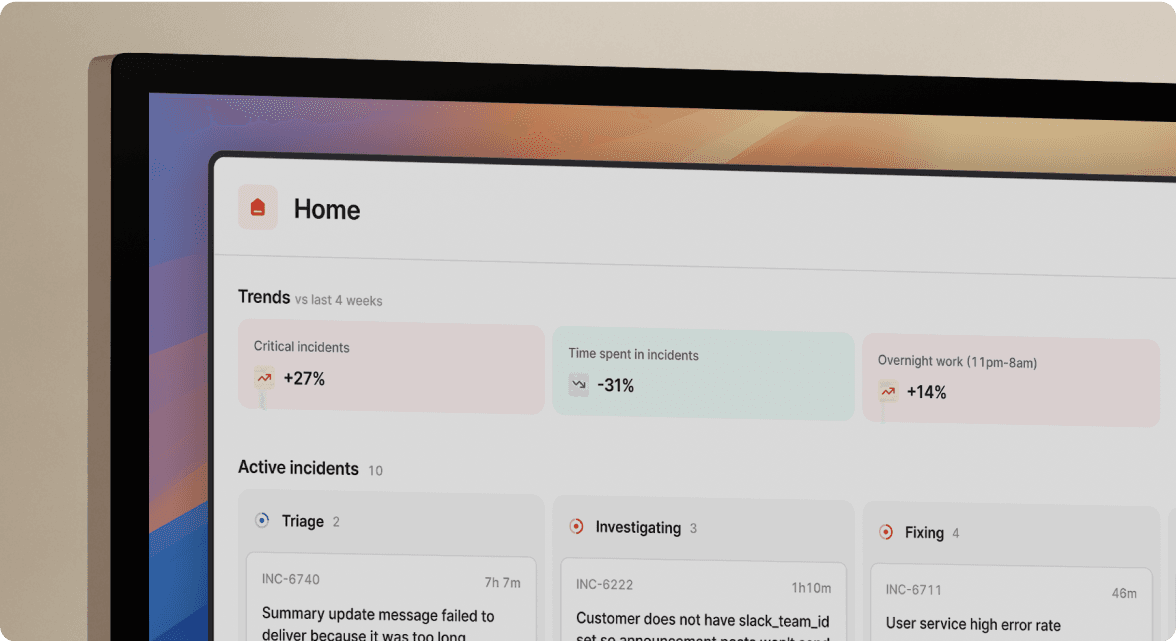
We’d love to talk to you about
- All-in-one incident management
- Our unmatched speed of deployment
- Why we’re loved by users and easily adopted
- How we work for the whole organization