Incident management for enterprise teams: PagerDuty alternatives that scale
September 1, 2026 — 18 min read
TL;DR: PagerDuty alerts. It doesn't coordinate the response, which is where enterprise teams lose the most time during a P0. incident.io runs the entire incident lifecycle, on-call scheduling, response coordination, and post-mortems, inside Slack and Microsoft Teams, cutting alert-to-resolution time by an order of magnitude. At 500+ engineers, the Enterprise plan adds what PagerDuty gates behind separate negotiations: SCIM provisioning and 12 months of audit log retention, alongside everything in Pro (including private incidents). For teams migrating off PagerDuty, the PagerDuty Rescue Program covers up to 12 months of overlap costs on a multi-year deal.
When a P0 fires across a large engineering organization, coordination overhead can consume critical early minutes: your team pages the right responders, creates a Slack channel, updates the status page, and pulls in service owners manually. Legacy alerting tools like PagerDuty send the alarm but do not run the response. At enterprise scale, that gap costs real money and drives up Mean Time To Resolution (MTTR). Modern engineering organizations need a platform that runs the entire incident lifecycle inside the tools where their engineers already work, with governance controls, AI-driven root-cause analysis, and dedicated support that scales with them.
Key requirements for scaling incident response
Scaling incident response at 500+ engineers requires more than routing alerts. You need to coordinate multiple engineering groups, maintain immutable audit trails for compliance, and guarantee that your incident management tooling itself never goes down during an outage. These three pillars determine whether a platform actually scales or just claims to.
Multi-team incident orchestration
Large organizations run platform, security, core application, and data teams simultaneously, each owning different services. When an incident spans multiple groups, manually identifying and paging the right service owners can add significant overhead before anyone touches the actual problem. Automated routing based on a service catalog eliminates that delay by mapping alerts directly to service owners and pulling them into a dedicated channel automatically. Netflix adopted incident.io's Catalog to democratize incident management at scale, reaching widespread adoption across engineering teams.
Compliance and audit-trail requirements
Enterprise applications operating under SOC 2 Type II, GDPR (General Data Protection Regulation), and DORA (Digital Operational Resilience Act) frameworks require an immutable, timestamped audit trail for every incident. Manual timeline logging introduces gaps that fail audits. Your platform needs to capture every decision, role assignment, and status update automatically at the moment it happens, so you never reconstruct timelines from Slack scroll-back three days later.
Platform reliability guarantees
Your incident management platform should never become an incident itself. Enterprise teams benefit from high uptime guarantees, redundant call routing, and infrastructure that stays live when your production environment does not. incident.io delivers 99.99% dashboard uptime, backed by SOC 2 Type II certification and EU data residency with primary hosting in Belgium and a hot standby in the Netherlands.
PagerDuty's fit for large engineering teams
PagerDuty has been a standard in incident management for years: deep alerting capabilities, over 700 integrations, and widespread enterprise adoption. For teams evaluating alternatives, the starting point is understanding where PagerDuty's strengths end and coordination gaps begin.
PagerDuty's on-call and escalation scaling
PagerDuty handles large volumes of on-call schedules and routing rules, making it capable at complex paging. incident.io provides comprehensive on-call schedule management on Pro and Enterprise plans, with the critical difference that engineers manage schedules, escalations, and incidents entirely within Slack rather than toggling into a separate web portal during an active P0.
SSO and user governance
PagerDuty supports SAML (Security Assertion Markup Language) and SCIM (System for Cross-domain Identity Management) for enterprise identity management. On the incident.io Enterprise plan, SCIM provisioning lets identity providers centrally control user access and on-call seat assignments automatically. SAML SSO is available on Pro and above.
Contract flexibility at enterprise scale
PagerDuty's enterprise contracts bundle capabilities that require careful negotiation to avoid add-on fees. incident.io uses transparent pricing with Enterprise plans offering custom pricing with a dedicated CSM and comprehensive support, all in one contract.
PagerDuty's coordination gap
PagerDuty's interface can require engineers to navigate configuration steps in a separate portal to manage an active incident, creating context-switching overhead. Think of it this way:
- PagerDuty: the smoke detector that sends the alarm
- incident.io: the fire response team that coordinates everything that follows
We auto-create channels, capture timelines, assign roles, and draft post-mortems inside Slack.
Incident response at 500+ engineers
Here is how incident.io addresses the core operational challenges that emerge when engineering organizations grow beyond 500 engineers.
Cross-team incident ops
When an alert fires, incident.io can automatically:
- Create a dedicated Slack channel
- Page on-call responders from the relevant schedule
- Pull in service owners based on Catalog mappings
All before a human types a single message. Organizations running approximately 20 incidents per month can save roughly 15 minutes of coordination overhead per incident: 20 incidents × 15 minutes = 5 hours per month, and at a typical $150/hour loaded engineer cost, that's $750 per month in reclaimed capacity redirected from tab-switching to debugging.
Watch how incident.io helped WorkOS transform incident response and how Isometric runs incidents end-to-end to see the full Slack-native lifecycle in action.
Enterprise security and compliance features
incident.io's Enterprise plan covers the governance requirements a CISO (Chief Information Security Officer) will ask about. SCIM automatic provisioning handles user lifecycle at scale. Private incidents, included from the Pro plan, operate on an invite-only model with access granted via direct invitation, incident team membership, the org-wide "Manage private incidents" permission, or a Slack workspace admin override. The private incidents update details how team-scoped privacy keeps sensitive security incidents isolated from the broader organization. The Enterprise plan also retains 12 months of audit log history for configuration changes and permission modifications.
High-touch support for global teams
incident.io provides high-touch support with a dedicated CSM (Customer Success Manager) on Enterprise. The support velocity gap is concrete in Etsy's case study: in the time it took a competitor to respond to one support ticket, incident.io shipped four features Etsy had requested during evaluation.
Teams switching from PagerDuty consistently report the same onboarding experience:
"Very clean and intuitive interface. Easy to develop on call schedules... Pricing is solid in comparison to pagerduty, good ROI. Onboarding support was very high, they helped us convert everything over and even created additional materials to help onboard folks." - Verified user on G2
Pricing transparency for large teams
We price transparently with no hidden add-ons:
| Plan | Base price | On-call add-on | Real total |
|---|---|---|---|
| Pro | $25/user/mo | $20/user/mo | $45/user/mo |
| Enterprise | Custom, on-call included | — | Contact for pricing |
FireHydrant's approach to incident coordination
FireHydrant competes in the same Slack-native space with strong runbook orchestration. See an independent platform comparison for a side-by-side view of PagerDuty, incident.io, and FireHydrant.
FireHydrant's coordination model
FireHydrant runs incident response through Slack too, with runbook-driven orchestration, but configuring those runbooks and reviewing analytics still means opening the web console. incident.io takes a chat-first approach all the way through: the entire incident lifecycle, including configuration, runs through /inc commands in Slack, with the web dashboard as an optional view rather than the primary interface. Engineers who are already in Slack at 3 AM do not need to open a browser to declare, escalate, or resolve an incident.
Role-based access at scale
incident.io's RBAC system covers three default roles (Regular User, Administrator, and Owner) plus custom role configuration that gates settings access, billing, private-incident visibility, and sensitive data actions, all detailed in our admin guide and separate from the incident-lifecycle flow itself.
Custom API control for large teams
FireHydrant exposes an API for custom integrations. incident.io provides an open API and webhooks from the Team plan up, including a Terraform provider for teams managing incident management infrastructure as code.
Automation and documentation for complex teams
Here is how incident.io handles the automation, documentation, and workflow requirements that define incident response at enterprise scale.
AI-driven incident response automation
AI SRE (Site Reliability Engineering) is the industry category. Investigations is incident.io's specific product within it. The moment an alert fires, Investigations reasons across telemetry, deploys, and past incidents to formulate root-cause hypotheses. It then surfaces actionable findings in Slack and drafts a fix pull request for review and merge. Teams get from alert to resolution an order of magnitude faster. Investigations gets teams from alert to resolution an order of magnitude faster.
Scribe operates alongside Investigations as a separate product, transcribing incident calls in real time and flagging key decisions as they happen. The Inside Investigations webinar walks through how the agentic analysis works in practice. All AI processing runs under contractual commitments with AI sub-processors that prohibit storing inputs or using customer data for model training.
Automated logs for audit readiness
Timeline capture records every role assignment, status update, and Slack thread automatically throughout the incident. On resolution, incident.io uses that captured data to auto-draft a post-mortem within seconds. You edit and refine rather than reconstructing the timeline from memory three days later.
Slack-first incident response flows
A complete enterprise incident in incident.io runs start to finish without leaving Slack: an alert triggers automatic channel creation and on-call paging, the incident lead sets severity and assigns roles with a single /inc command each, Investigations surfaces root-cause findings in the channel within minutes, Scribe transcribes the response call, and resolving the incident triggers status page updates, follow-up task creation, and post-mortem draft generation automatically. For a manager reporting upward, that's a fully documented, auditable incident closed with no separate note-taker and no post-incident reconstruction. See post-incident workflows in practice and recent on-call improvements.
Key criteria for your PagerDuty migration
Here are the technical and operational requirements to evaluate before committing to a PagerDuty migration at enterprise scale.
Security scaling with SSO and SCIM
SAML SSO and SCIM are non-negotiable at 500+ engineers. Manual user provisioning creates security gaps and administrative burden no team should carry. On incident.io's Enterprise plan, SCIM with Okta or other providers handles on-call seat assignment by group automatically, with provisioning and deprovisioning flowing directly from your identity provider.
Your incident management platform must hold SOC 2 Type II certification with annual renewal, full GDPR compliance with a Data Processing Agreement, and AES-256 encryption at rest. incident.io meets all three, with EU customer data hosted in Belgium and a hot standby in the Netherlands. No customer data leaves Europe for EU-region customers.
Guaranteed uptime and support SLAs
High uptime guarantees and dedicated support with strict SLAs are Enterprise-plan features at incident.io. That combination means that if your monitoring fires at 2 AM and your incident management platform itself has a problem, you have a contractual response time on the support side rather than an email queue.
Incident pipeline integrations
Your existing observability stack does not need to change. We integrate with common observability and ticketing tools including Jira and Linear, creating a follow-up task automatically once the incident closes, so nothing falls through the cracks after the retro.
Transparent per-user pricing models
Ask any vendor to show you the total cost including on-call before you compare. For incident.io, Enterprise uses custom pricing.
Incident response maturity benchmarks
Here is how to evaluate your current incident response process and validate a new platform before rolling it out across your organization.
Cross-team POC structure
Run your POC (proof of concept) with a single engineering group of 5-15 engineers before rolling out globally. Populate the service catalog for that group's services first, since catalog quality directly determines routing accuracy. Measure team assembly time before and after as your primary benchmark, and validate at least a handful of real incidents before evaluating metrics.
Security and compliance assessment checklist
Your CISO will ask these questions about any platform you evaluate:
- Data residency: EU customer data hosted in Europe
- AI data handling: Contractual zero-retention commitments with AI sub-processors
- Certifications: SOC 2 Type II, GDPR compliant
- Private incidents: Invite-only access, configurable via the "Manage private incidents" org-wide permission
- Audit logs: Available on the Enterprise plan, retaining 12 months of history for configuration changes and permission modifications
PagerDuty migration execution
The PagerDuty Rescue Program removes the two biggest blockers to switching: contract overlap cost and migration risk. A migration assistant scans your entire PagerDuty account, producing a full report with every service categorized, dependencies mapped, and a phased migration plan generated automatically. The contract buyout covers up to one year of incident.io at no cost when signing a multi-year deal.
Use a parallel-run strategy rather than a hard cutover: run both platforms simultaneously for one to two weeks, validate alert routing, and switch over once your team trusts the new routing. Our migration guide covers the full process, including how to populate the service catalog before any live traffic shifts.
If coordination overhead is the bottleneck your team keeps working around, book a demo of incident.io and see your first incident coordinated in Slack with a custom Enterprise walkthrough built around your org structure.
Key Terms Glossary
MTTR (Mean Time To Resolution): The average time from when an incident is declared to when it is fully resolved. MTTR is the primary metric engineering teams use to measure the speed and effectiveness of their incident response process.
SCIM (System for Cross-domain Identity Management): A protocol that lets your identity provider (Okta, Google Workspace, or Microsoft Entra ID) automatically provision and deprovision user accounts and on-call seat assignments in connected platforms, eliminating manual access management at scale.
SAML (Security Assertion Markup Language): An authentication standard that enables single sign-on (SSO), allowing engineers to log into incident management tooling using their existing corporate identity credentials without a separate username and password.
Service Catalog: A structured registry that maps each service in your infrastructure to its owners, dependencies, and on-call schedules. Catalog quality directly determines how accurately alert routing pulls the right responders into an incident channel automatically.
POC (Proof of Concept): A time-bounded evaluation in which a small engineering group (typically 5-15 engineers) runs a new platform against real incidents before a broader rollout. A POC validates alert routing, measures team assembly time, and builds trust in the platform before you commit to a full migration.
FAQs

Tom Wentworth
Chief Marketing Officer
See related articles
Introducing Investigations, powered by Nexus.
Today we're launching Investigations: agentic root cause analysis that starts the moment you're paged, figures out what broke and why, and works with your team through to resolution. Here's what we built, what's powering it, and why it took some time to get right.

August 5, 2026
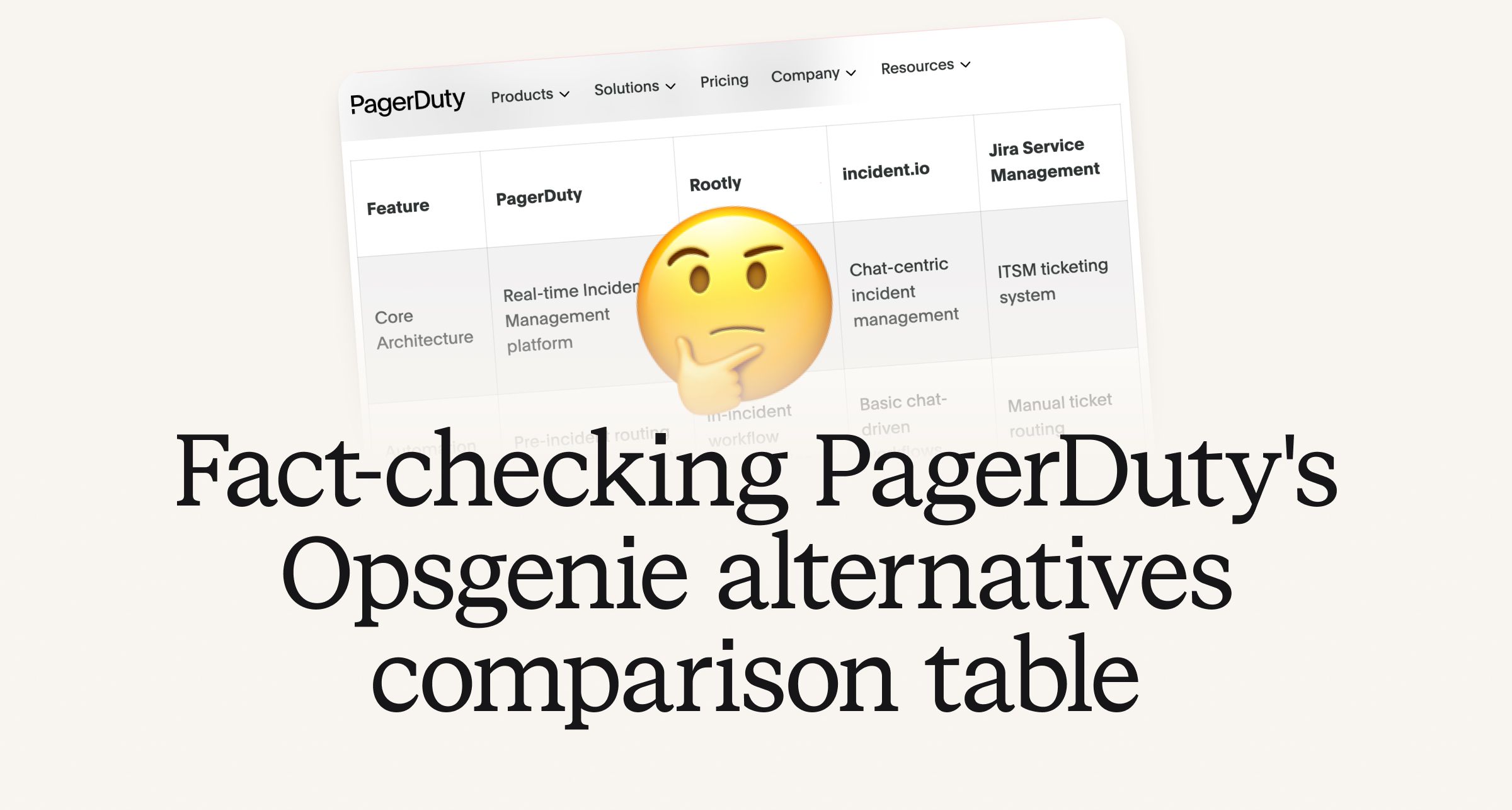
Fact-checking PagerDuty's Opsgenie alternatives comparison table
PagerDuty published a new comparison table about incident.io. Once again, it describes a product we don't recognize. So once again, we're correcting the record, row by row, with receipts.

July 28, 2026
Your genie is vanishing: introducing the Opsgenie rescue program
Today, we're launching the Opsgenie Rescue Program to make that landing soft: simplified migration and free overlap so you never pay two vendors at once.
July 9, 2026
So good, you’ll break things on purpose
Ready for modern incident management? Book a call with one of our experts today.
We’d love to talk to you about
- All-in-one incident management
- Our unmatched speed of deployment
- Why we’re loved by users and easily adopted
- How we work for the whole organization