Fact-checking PagerDuty's Opsgenie alternatives comparison table
July 28, 2026 — 8 min read
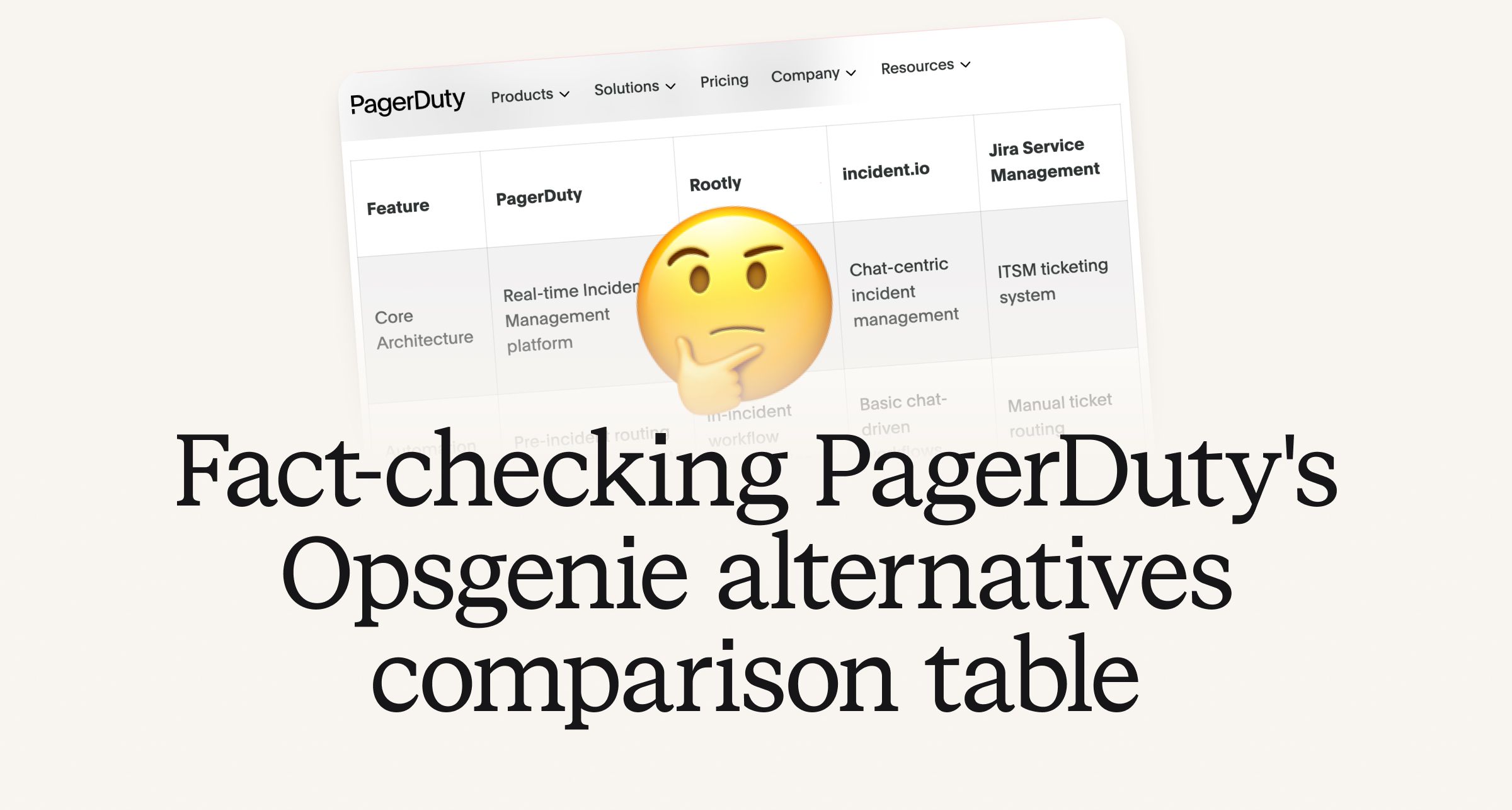
Last year, I wrote about PagerDuty's comparison page against incident.io, which claimed we couldn't do a long list of things our customers use every day. I ended that post hoping we'd all do better.
PagerDuty recently published a new article, Opsgenie Alternatives for Enterprise Teams in 2026, aimed at the many engineering teams who need a new home before Opsgenie shuts down in April 2027. It includes a feature comparison table with a column about incident.io.
The column about us describes a product I don't recognize. So once again, I'm going to correct the record, row by row, with receipts. And at the end, I'll share a corrected version of the table.
What PagerDuty's table says about us
Here's the incident.io column from their feature comparison table, verbatim:
| Feature | incident.io (according to PagerDuty) |
|---|---|
| Core Architecture | Chat-centric incident management |
| Automation Focus | Basic chat-driven workflows |
| AI Capabilities | Limited post-mortem AI |
| Chat Integration | Slack-native only |
| G2 Rating (as of 2026) | ~4.8/5 (~180 reviews) |
| Enterprise Proof Point | Mid-market focused |
Let's go through it.
Row 1: "Chat-centric incident management"
The framing here is that incident.io is a Slack app, and PagerDuty is a "real-time incident management platform."
incident.io is an end-to-end AI incident management platform: on-call scheduling and paging, alert routing and noise reduction, incident response, a full web dashboard, a mobile app, status pages serving over a million visitors a day, AI investigation, post-mortems, and insights. Catalog, which maps every service, team, and dependency in your organization, is the connective tissue underneath all of it.
Yes, we meet responders where they already are, in Slack or Microsoft Teams. That's a design decision, not an architectural limitation. When engineers at Fin (formerly Intercom) were jumping between tools during high-pressure incidents, centralizing everything in incident.io is what fixed it. "Chat-centric" is a funny way to describe the thing customers cite as the reason they switched.
Row 2: "Basic chat-driven workflows"
Our workflow engine automates the full incident lifecycle: assembling responders, creating channels, assigning roles, escalating, updating status pages, nudging post-incident tasks, and syncing follow-ups to your issue tracker. Alert routes group and deduplicate alerts before anyone gets paged. All of it is configurable in the dashboard and manageable via API and Terraform.
If "basic chat-driven workflows" were accurate, it would be hard to explain why teams like Etsy and Skyscanner run their incident response on it, or why over 70% of Skyscanner's organization participates in incidents through incident.io.
Row 3: "Limited post-mortem AI"
Of all the rows, this one is my favorite, because the one capability they claim is “limited” is the one where we go deepest.
Here's what actually happens after an incident closes. AI generates a complete first draft from your real incident data: your Slack or Teams channels, the timeline, pull requests, custom fields, and any AI investigations. Not a template with blanks to fill in, a write-up with the specifics of what happened. From there, you can select any section and have AI rework it: tighten the language, pull in context that isn't on the page yet, or shift the tone for a customer-facing RCA versus an internal review. When the draft's in good shape, AI reviews the whole document against the incident data and leaves comments where something's missing or doesn't match what actually happened. And when you sit down with your team for the debrief, Scribe joins the call, transcribes it, and pulls the key takeaways back into the document. You can run all of this across multiple documents per incident: an engineering post-mortem, a customer-facing RCA, and a leadership summary, each drawing on the same incident data. The full workflow is in our changelog.
"Limited" is doing a lot of work in that sentence. It's like describing PagerDuty as "a pager." Which, notably, is exactly the mischaracterization their article complains about. The section titled "A note on 'just an alerting tool'" argues it's unfair when vendors describe PagerDuty by its original scope rather than its current platform. Agreed! Same energy, please.
Row 4: "Slack-native only"
This one is just false. incident.io has full Microsoft Teams support: incident channels, announcements, chat with the incident platform, status page updates, the works. Every plan on our pricing page is available on Slack or Teams, including the free one, and our changelog shows Teams improvements shipping regularly.
The article also claims incident.io has "fewer enterprise-scale access controls than platforms built for large, multi-team organizations." Our Enterprise customers run SAML SSO, SCIM directory sync, role-based access controls, audit logs, and private incidents with scoped access, on a SOC 2 Type II compliant platform.
Row 5: "~4.8/5 (~180 reviews)"
Half credit here. The rating is right: incident.io is rated 4.8 out of 5 on G2. The review count is stale, though. We're at 219 and counting.
PagerDuty's rating, from their own article, is 4.5.
They frame the review count difference as a weakness: "a smaller review base (~180 reviews), reflecting strong satisfaction among a more mid-market user set." Another way to read it: a company founded in 2021 versus one founded in 2009, and the newer one is rated higher by the people who actually use it. We'll happily keep this row in the corrected table.
Row 6: "Mid-market focused"
Netflix. Airbnb. Zendesk. Etsy. Skyscanner. Fin. These are some of our customers, and you can read their stories too see if they sound like “mid-market” problems. Alongside them, our customer base includes a leading AI research organization, one of the largest US fintech companies, one of the world's biggest gaming companies, a major global observability vendor, and one of Europe's largest fintechs.
It's also worth being precise about what "enterprise" means. Companies like Netflix and Airbnb operate at a scale, in traffic, infrastructure, and blast radius when things break, that exceeds most traditional enterprises. Their incident tooling bar is about as high as it gets, and they chose incident.io.
For Enterprise teams whose reliability bar demands it, we also commit to a 99.99% uptime SLA in writing. That's a stronger written commitment than the 99.9% web availability SLA PagerDuty cites in this same article as an enterprise proof point.
Bonus round: the pricing table
Their pricing comparison lists incident.io as "Tiered, contact for pricing." Our pricing is published at incident.io/pricing. There's a free plan. Paid plans start at $15 per user per month billed annually. It's one of the more transparent pricing pages in the category, which makes "contact for pricing" an odd thing to get wrong when the correct answer is one Google search away.
The corrected table
Here's the same table with the incident.io column corrected. We've left PagerDuty's own column as they wrote it (lightly trimmed for space), because we'd expect the same courtesy.
| Feature | PagerDuty (their words) | incident.io (corrected) |
|---|---|---|
| Core Architecture | Real-time Incident Management platform | End-to-end AI incident management platform: on-call, response, status pages, built on Catalog |
| Automation Focus | Pre-incident routing & remediation scripts | Automation before, during, and after: alerts grouped before anyone's paged, responders assembled and comms drafted mid-incident, follow-ups and post-mortems handled automatically |
| AI Capabilities | AIOps noise reduction, plus SRE Agent triage & remediation | Investigations builds root cause hypotheses from logs, deploys, and past incidents; Scribe live transcription; AI post-mortems and comms |
| Chat Integration | Full incident lifecycle natively in Slack and Microsoft Teams | Full incident lifecycle natively in Slack and Microsoft Teams |
| G2 Rating (as of 2026) | 4.5/5 (900+ reviews) | 4.8/5 (219 reviews) |
| Enterprise Proof Point | ~70% of Fortune 100 | Netflix, Airbnb, Zendesk, Etsy, plus a leading AI research organization and some of the world's largest fintech and gaming companies; 99.99% uptime SLA for Enterprise |
If you're actually leaving Opsgenie
Thousands of teams have to be off Opsgenie by April 2027, when Atlassian shuts it down and deletes the historical data. If that's you, my advice is the same as last year. Ignore the comparison tables, including ours. Run a trial of your shortlist. See which product your engineers actually want to use at 3am. To make switching easy, we run the Opsgenie Rescue Program: most teams are live in days.
One last thing for PagerDuty's content team: this time you wrote incident.io with a lowercase i. Progress! See, we can all get better at this :)

Tom Wentworth
Chief Marketing Officer
See related articles
Introducing Investigations, powered by Nexus.
Today we're launching Investigations: agentic root cause analysis that starts the moment you're paged, figures out what broke and why, and works with your team through to resolution. Here's what we built, what's powering it, and why it took some time to get right.

August 5, 2026
Your genie is vanishing: introducing the Opsgenie rescue program
Today, we're launching the Opsgenie Rescue Program to make that landing soft: simplified migration and free overlap so you never pay two vendors at once.

July 9, 2026
De-risking a PagerDuty migration: the objections we hear most, and how to clear them
Often, switching on-call platforms isn't a technical challenge but a human one. In this post, we break down the seven objections engineering teams raise most often when considering a PagerDuty migration, and share exactly how to address each one.

June 9, 2026
So good, you’ll break things on purpose
Ready for modern incident management? Book a call with one of our experts today.
We’d love to talk to you about
- All-in-one incident management
- Our unmatched speed of deployment
- Why we’re loved by users and easily adopted
- How we work for the whole organization