Join live: What happens when your AI goes down?
incident.io vs. PagerDuty for DevOps teams: What real customers say
December 31, 2025 — 19 min read
Updated December 31, 2025
TL;DR: PagerDuty defined on-call alerting, but you need more than a pager. We built incident.io as a Slack-native platform that eliminates coordination overhead by auto-creating channels, capturing timelines, and drafting post-mortems. Users report up to 80% MTTR reduction, and our support team ships bug fixes in hours rather than weeks. Our transparent pricing includes status pages and AI capabilities without expensive add-ons. PagerDuty remains strong for enterprises requiring maximum alerting customization, but if you're tired of context-switching during 3 AM incidents, we consolidate on-call, response, status pages, and post-mortems into one chat-native workflow.
incident.io vs. PagerDuty for DevOps Teams represents a fundamental choice between Slack-native incident management and traditional web-based alerting.
What's the difference between incident.io and PagerDuty?
With PagerDuty, alerts require you to go through multiple manual steps, acknowledging the page, logging in, and coordinating with the service owner, before you can start troubleshooting. Valuable time is lost before resolving the issue.
With incident.io, that same alert auto-creates a dedicated Slack channel, pages you and the service owner, and starts capturing the timeline automatically. You're troubleshooting in under two minutes.
This difference isn't just about speed. It's about eliminating the coordination tax that drives up MTTR and burns out engineering teams.
Who should consider incident.io vs. PagerDuty?
This choice matters most for DevOps teams who work primarily in Slack or Teams and handle frequent incidents requiring coordination across multiple people. If your team context-switches between alerting tools, chat platforms, and status pages during response, you're experiencing the exact coordination overhead incident.io eliminates.
PagerDuty excels at alerting, but incident.io orchestrates the entire response lifecycle where your team already works.
The core philosophy: Alerting tool vs. incident management platform
We built incident.io to solve a fundamentally different problem than PagerDuty tackles.
PagerDuty's web-first architecture made sense in 2009 when the primary challenge was reliable alerting. You needed a tool that would wake you up when production broke, with sophisticated escalation policies and multi-channel notifications. PagerDuty delivers this exceptionally well. Their alerting infrastructure is battle-tested, their integrations library covers 200+ tools, and their escalation logic handles complex enterprise scenarios.
But here's what changed: Engineering teams stopped working in web UIs. You moved into Slack and Microsoft Teams. When an incident fires today, you don't want to open PagerDuty's web interface. You want to coordinate where you're already chatting.
PagerDuty offers Slack integration, but it's fundamentally a notification layer. You get alerts in Slack, but the actual incident management happens elsewhere. Creating channels, assigning roles, updating status pages, and capturing timelines. These actions require bouncing between PagerDuty's web UI, Slack, Jira, and Google Docs.
We built our Slack-native architecture from a different premise: your entire incident lifecycle should happen in one place. When a Datadog alert fires and we receive it through our integrations, we create #inc-2847-api-latency-spike, invite you and the service owner, surface relevant context from your service catalog, and begin recording everything automatically. Every action uses /inc slash commands. No browser tabs required.
This architectural difference shows up in user feedback:
"A great replacement for PagerDuty... The way it organises all the information being fed into an incident makes it easy to follow for everyone in and out of engineering." - Verified user review of incident.io
Slack-native workflows vs. web-first legacy: A feature showdown
The difference between "works with Slack" and "works in Slack" becomes stark when you compare specific incident workflows.
Incident declaration and team assembly
Your PagerDuty process: Alert fires. You acknowledge on your phone. Open laptop. Log into PagerDuty web UI. Manually create Slack channel. Copy incident details. Manually invite team members. Begin troubleshooting.
Estimated time to assembled team: 10-15 minutes.
Your incident.io process: Alert fires. You see notification in your designated Slack channel. Click "Declare incident" or type /inc new. Dedicated channel auto-creates with you, service owner, and incident lead pre-invited. Service catalog context surfaces automatically. You're troubleshooting immediately.
Estimated time to assembled team: Under 2 minutes.
You save coordination overhead that compounds across incidents. For your team handling 15 incidents monthly, that's 195 minutes (3.25 hours) you reclaim per month just from eliminating manual assembly.
Real-time collaboration and context capture
During active incidents, both platforms handle communication differently.
PagerDuty maintains the "source of truth" in its web interface. Updates logged there need manual copying to Slack. Decisions you make in Slack threads don't automatically appear in PagerDuty's timeline. When someone shares a critical graph or proposes a fix in Slack, that context lives separately from the official incident record.
We treat the Slack channel as the source of truth. Every message, role assignment, severity change, and status update automatically contributes to the timeline. Our AI Scribe feature transcribes your incident calls and extracts key decisions in real-time. When you resolve the incident, nothing needs reconstruction because we captured everything as it happened.
"incident.io strikes just the right balance between not getting in the way while still providing structure, process and data gathering to incident management." - Verified user review of incident.io
Status page updates and customer communication
PagerDuty treats status pages as a separate product (StatusPage by Atlassian) or expensive add-on, forcing you to context-switch away from your coordination channel to another interface.
We include status pages in all paid plans. You update them via slash commands in your incident channel: /inc status update Investigating API latency issues. Your customer-facing status page updates immediately. When you resolve the incident, we auto-update the status page. No manual closing forgotten until angry customer emails arrive three hours later.
AI capabilities: Noise reduction vs. resolution assistance
Both platforms market AI capabilities, but they target fundamentally different problems in the incident lifecycle.
PagerDuty's AIOps: Alert consolidation
PagerDuty focuses their AI on alert consolidation through their AIOps platform. Their Event Intelligence feature uses machine learning to group related alerts into single incidents, reducing alert fatigue. If your monitoring tools generate 50 alerts for a single database failure, PagerDuty's AI recognizes the pattern and creates one incident instead of 50.
This is valuable for teams drowning in alert volume. The problem? It's an expensive add-on starting at $699 per month plus usage fees, on top of your base subscription.
We built our AI to accelerate resolution
We built our AI to take a different approach, focused on accelerating resolution rather than filtering noise. Our AI SRE assistant:
- Investigates autonomously: When an incident fires, our AI examines recent deployments, correlates metrics from your observability stack, and identifies likely root causes. It surfaces "PR #4872 deployed 14 minutes before error spike" without human prompting. Our AI maintains 80% precision and 60% recall in root cause identification across production incidents, meaning when it suggests a cause, it's correct 8 times out of 10.
- Generates environment-specific fixes: Based on past incidents and current context, our AI can draft pull requests to resolve issues. Not generic suggestions, but actual code changes tailored to your infrastructure.
- Auto-drafts post-mortems: Using captured timeline data, call transcriptions, and identified root causes, our AI generates 80% complete post-mortems in 15 minutes. You spend 10 minutes refining, not 90 minutes writing from scratch.
We include AI SRE capabilities in our Pro plan, no additional fees.
"The AI insights have been incredibly helpful in identifying trends and areas for improvement." - Verified user review of incident.io
For a complete demonstration, watch our AI SRE resolving incidents autonomously on YouTube.
What real customers say: The support velocity gap
User reviews reveal a stark difference in support experiences between the two platforms.
PagerDuty: Frustration with responsiveness
PagerDuty support issues surface frequently in user feedback, with complaints about slow response times and support focused more on selling add-ons than solving problems. Many teams report frustration with the upselling approach during support interactions and lengthy wait times for product feedback to be addressed.
We built our support model around shared slack channels
Our support model is fundamentally different. You get shared Slack channels with our engineering team, enabling real-time collaboration when issues arise.
The most compelling evidence comes from Etsy. Jeremy Tinley, Principal Systems Architect at Etsy, told us: "In the time that it had taken us to get one vendor to respond to our product feedback, incident.io had shipped four features we requested."
G2 reviews consistently praise this velocity:
"Incident.io is a great product that allowed us to easily port our existing manual processes into the tool with very little training or configuration... their support is truly world class." - Verified user review of incident.io
We built our support model this way because you can't wait 48 hours when production is down at 3 AM.
Pricing transparency and total cost of ownership
Pricing structures reveal fundamental differences in how these platforms think about value delivery.
PagerDuty's tiered model with expensive Add-ons
PagerDuty structures pricing across three main tiers with numerous add-ons that quickly escalate costs:
| Feature | Professional Plan | Business Plan | Digital Operations Plan |
|---|---|---|---|
| Base Price (per user/month) | $21 | $41 | Custom |
| On-Call Management | ✓ | ✓ | ✓ |
| Status Pages | $89/page add-on | $89/page add-on | ✓ Included (Premium) |
| Post-mortems | Coming soon | ✓ | ✓ |
| AI capabilities | $699/month add-on | $699/month add-on | $699/month add-on |
| Advanced Automation | Limited | ✓ | ✓ |
The add-on model creates sticker shock. For a 50-person team requiring on-call, status pages, and AI capabilities, the annual cost breakdown looks like this:
- Base subscription (Business plan): 50 users × $41/month × 12 months = $24,600
- Status pages: Approximately $2,136 annually for basic coverage
- AIOps base fee: $699/month × 12 = $8,388
- Estimated total first-year cost: ~$35,124
And that's before usage-based fees for AIOps event processing, which can add thousands more depending on your alert volume.
"It didn't happen only once when we reported some type of issue in the process to Incident.io support and in matter of hours the fix was released. That shows their commitment to the product and customers." - Verified user review of incident.io
Our All-inclusive approach
We offer straightforward pricing with no surprise add-ons. Our Team plan starts at $19/user for basic incident response, but for fair comparison to PagerDuty's feature set, our Pro plan is the right benchmark:
- Pro Plan: $25/user/month (incident response)
- On-call add-on: $20/user/month for Pro plan
- Effective Pro + On-call cost: $45/user/month with everything included
Critical difference: Status pages, AI SRE capabilities, post-mortems, and unlimited workflows are included in the Pro plan. No surprise add-ons.
For that same 50-person team:
- Pro plan with on-call: 50 users × $45/month × 12 months = $27,000 annually
- All features included: Status pages, AI SRE, post-mortems, unlimited workflows
The TCO advantage becomes more significant at scale. For a 200-person team, our transparent pricing of $108,000 annually compares favorably to PagerDuty Enterprise plans that can exceed $165,000 in the first year.
Here's the complete comparison:
| Feature | PagerDuty Professional | PagerDuty Business | incident.io Pro + On-call |
|---|---|---|---|
| Base price per user/month | $21 | $41 | $45 ($25 + $20 on-call) |
| On-call management | ✓ | ✓ | ✓ |
| Status pages | $89/page add-on | $89/page add-on | ✓ Included |
| AI capabilities | $699/month add-on | $699/month add-on | ✓ Included |
| Post-mortems | Coming soon | ✓ | ✓ Included (AI-drafted) |
| Workflow automation | Limited | ✓ | ✓ Unlimited |
| 50-person team annual cost | ~$24,600 + add-ons | ~$35,124 with add-ons | $27,000 all-in |
Migration reality: Moving from PagerDuty to incident.io
Switching incident management platforms feels risky because production incidents don't stop for migrations. We designed our migration approach to minimize disruption through parallel operation.
The parallel-run strategy: During a typical 2-4 week transition, you run both platforms simultaneously. Import your service catalog and schedules (we can sync with existing PagerDuty schedules), route a subset of alerts to us initially, then gradually shift more alert routing as your team builds confidence. The Intercom engineering team successfullymoved from PagerDuty in a matter of weeks, not quarters.
What's easier than expected: The Slack-native interface requires virtually no training, you already know how to use Slack.
"The onboarding experience was outstanding—we have a small engineering team (~15 people) and the integration with our existing tools was seamless and fast less than 20 days to rollout." - Verified user review of incident.io
Most integrations connect via straightforward configurations to tools you already use.
What's harder than expected: Breaking old habits takes 2-3 incidents as you adjust to managing everything in Slack. If you've heavily customized PagerDuty workflows, translating these requires planning and our support team helps map these during migration.
Watch our full platform walkthrough on YouTube to understand the interface before switching.
When to choose incident.io over PagerDuty
No platform fits every scenario. Here's the honest assessment of when each tool makes sense.
Choose incident.io if you:
- Live in Slack or Microsoft Teams. If your team's default question is "did you see that in Slack?", we built incident.io for you. Our entire value proposition depends on chat being your central nervous system.
- Handle frequent incidents (5+ per month). The coordination overhead savings compound with volume. For your team with 10-20 incidents monthly, 13 minutes saved per incident equals 130-260 minutes you reclaim monthly.
- Want one platform, not five integrations. Consolidating on-call scheduling, incident response, status pages, post-mortems, and follow-up tracking into one tool eliminates integration maintenance and synchronization headaches.
- Value support velocity. If you've experienced the frustration of filing a critical bug and waiting days for response, our shared Slack channels with our engineering team eliminate that anxiety.
- Need transparent pricing. If you're tired of "contact sales" and hidden add-on costs, our all-inclusive plans are refreshingly straightforward.
Choose PagerDuty if you:
- Require maximum alerting customization. PagerDuty offers a more sophisticated event rules engine for complex alert routing scenarios. If you need intricate conditional logic for alert processing, they provide more granular control than we do.
- Need deep process automation. PagerDuty acquired Rundeck to provide powerful runbook automation capabilities that we don't attempt to match. If automated remediation scripts are central to your incident response, this matters.
- Operate in a non-Slack/Teams environment. If your team primarily uses email, phone, or other communication platforms, our core advantage disappears. PagerDuty's multi-channel notification approach is more flexible.
- Already deeply invested in PagerDuty's ecosystem. If you've built extensive custom integrations, event rules, and workflows around PagerDuty, and they're working well, migration friction may outweigh potential benefits.
- Are a massive enterprise with complex compliance requirements. PagerDuty's longer market presence means they've navigated more regulatory environments. We're SOC 2 Type II certified and GDPR compliant, which covers most mid-market needs, but PagerDuty's breadth of compliance documentation is broader.
The modern incident management choice
PagerDuty built the on-call category and remains solid for large enterprises requiring maximum alerting flexibility. But if you're a mid-sized engineering team (100-500 people) working primarily in Slack or Teams, handling frequent incidents, and wanting to eliminate coordination overhead, we built incident.io's architecture for how you actually work.
The evidence from your peers is clear: Users consistently praise our Slack-native workflow, support velocity that fixes bugs in hours, and transparent pricing. Customers report the intuitive design and stellar customer experience makes incident management feel effortless.
Ready to see the difference? Schedule a demo and run your next incident entirely in Slack.
Key terminology
MTTR (Mean Time To Resolution): Average time from incident detection to full resolution. Measured in minutes or hours depending on severity.
Slack-native architecture: Platform design where your entire workflow happens within Slack using slash commands and channels, rather than Slack acting as notification layer for external tool.
Coordination overhead: Time you spend assembling teams, finding context, and updating tools during incidents, separate from actual problem-solving work. This can significantly extend resolution time.
AI SRE: Artificial intelligence assistant that autonomously investigates incidents, identifies root causes, and suggests remediation steps, acting as your always-on teammate.
Service catalog: Centralized database of services, owners, dependencies, and runbooks that surfaces relevant context automatically during your incidents.
FAQs

Tom Wentworth
Chief Marketing Officer
See related articles
Introducing Investigations, powered by Nexus.
Today we're launching Investigations: agentic root cause analysis that starts the moment you're paged, figures out what broke and why, and works with your team through to resolution. Here's what we built, what's powering it, and why it took some time to get right.

August 5, 2026
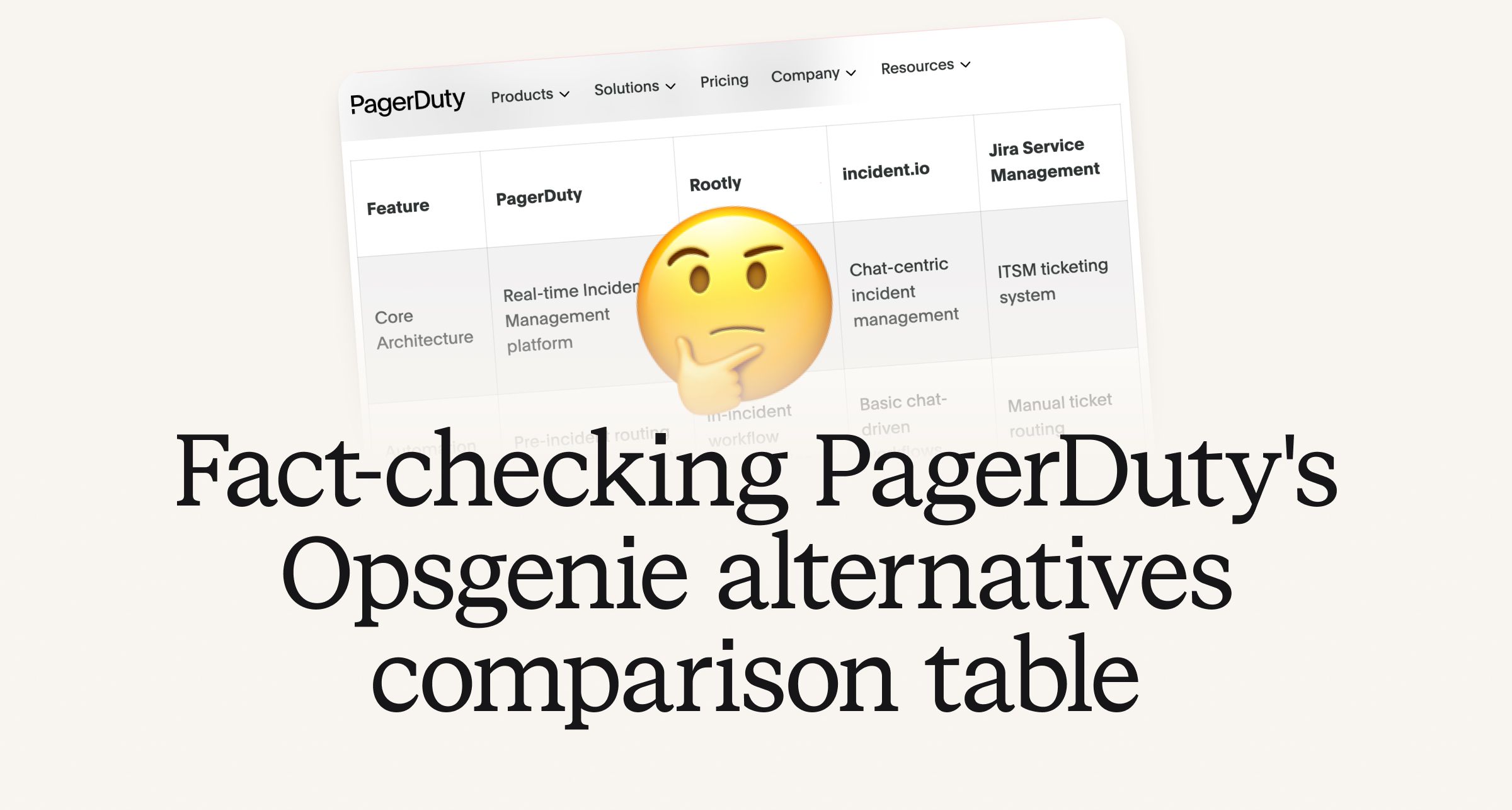
Fact-checking PagerDuty's Opsgenie alternatives comparison table
PagerDuty published a new comparison table about incident.io. Once again, it describes a product we don't recognize. So once again, we're correcting the record, row by row, with receipts.

July 28, 2026
Your genie is vanishing: introducing the Opsgenie rescue program
Today, we're launching the Opsgenie Rescue Program to make that landing soft: simplified migration and free overlap so you never pay two vendors at once.
July 9, 2026
So good, you’ll break things on purpose
Ready for modern incident management? Book a call with one of our experts today.
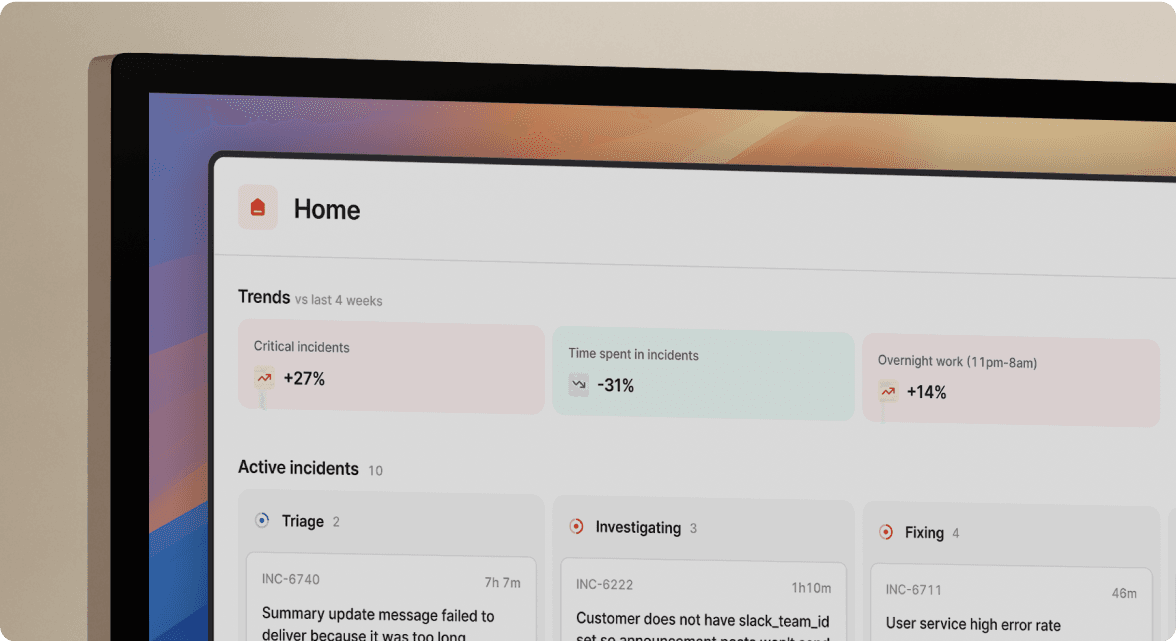
We’d love to talk to you about
- All-in-one incident management
- Our unmatched speed of deployment
- Why we’re loved by users and easily adopted
- How we work for the whole organization