Best Open-source PagerDuty alternatives: Grafana OnCall, Opsgenie, and self-hosted options
March 6, 2026 — 19 min read
Updated March 06, 2026
TL;DR: The most feature-complete open-source PagerDuty alternative, Grafana OnCall OSS, entered maintenance mode on March 11, 2025 and Grafana will archive it on March 24, 2026, eliminating the strongest self-hosted option. Tools like GoAlert and OneUptime remain available at zero licensing cost, but self-hosting a production paging system adds real infrastructure overhead: PostgreSQL clusters, Redis, RabbitMQ, and Twilio for SMS/voice. When you factor in infrastructure plus engineer maintenance time, the "free" option can cost $18,720-$39,960 annually. incident.io delivers developer-friendly flexibility without the "who watches the pager?" risk: a managed Slack-native platform with no infrastructure to own, AI-powered post-mortems, and up to 80% MTTR reduction.
For teams tired of PagerDuty's pricing and stagnant feature set, open-source alternatives like Grafana OnCall promise freedom and cost savings. But self-hosting your incident response stack creates a new risk: who pages you when the pager breaks? A 50-person engineering team running PagerDuty Business pays approximately $24,600 annually before adding noise reduction, AI, and status pages as paid add-ons. That math naturally pushes engineers toward open-source options.
This guide evaluates the top open-source and self-hosted alternatives against modern SaaS platforms so you can decide where to invest your engineering hours, and avoid replacing one expensive problem with a more expensive one.
Why engineering teams are seeking PagerDuty alternatives
PagerDuty has accumulated features through acquisition rather than integration, creating a web of add-ons that inflate the real cost well beyond the advertised base price. Users on G2 consistently cite UI complexity and dated design as top frustrations, describing setup as confusing and the interface as unchanged from years past.
Five reasons consistently drive teams away from PagerDuty:
- Pricing complexity: The Business tier runs $41 per user per month, but AIOps, advanced runbooks, and status pages cost extra. A 50-person team pays $24,600 annually before touching enterprise features.
- UI debt: The web interface reflects 15 years of bolt-on development, built for an era before Slack.
- Rigid workflows: Everything lives in PagerDuty's own UI, forcing constant context-switching to get back into Slack where engineers work.
- Support tiers: Live chat is restricted to Premium Support customers, leaving standard tiers relying on email channels for most issues.
- Tool sprawl tax: A typical incident involves PagerDuty for alerts, Slack for coordination, Jira for follow-up, and Confluence for post-mortems. That coordination overhead costs roughly 15 minutes per incident before any troubleshooting starts.
Read this comparison of PagerDuty, incident.io, and FireHydrant for a practical breakdown of how these tools differ in day-to-day use.
What "self-hosted" really means for incident management
"Self-hosted" is not downloading a binary and running it on a single VM. A production-grade paging system needs high availability across multiple availability zones.
The infrastructure reality:
- Database cluster with HA replication, message queue (RabbitMQ), and caching layer (Redis) across multiple availability zones
- HTTPS termination: Public endpoint with proper TLS, required for webhook ingestion and Slack callbacks
- SMS/voice gateway: Neither GoAlert nor Grafana OnCall OSS includes SMS delivery. You configure and pay for your own Twilio account
The Twilio dependency is real and ongoing. Standard US SMS costs $0.0075 to $0.04 per message sent, plus $0.013 to $0.030 per minute for outbound voice calls. A team managing moderate alert volume should budget $300-$500 per month for Twilio alone.
The risk nobody talks about:
If your Kubernetes cluster runs out of disk space at 3 AM, your incident paging system goes down exactly when you need it most. There's no SLA on a system you own. The team that built it has likely rotated, and the one engineer who understands the Twilio integration is on vacation. This is the "who watches the watchers?" problem, and it's not theoretical.
Here's the annual infrastructure baseline before adding a single engineer-hour of maintenance:
| Component | Monthly estimate | Annual estimate |
|---|---|---|
| Compute (multi-AZ, 3 nodes) | $300-$600 | $3,600-$7,200 |
| PostgreSQL HA | $200-$500 | $2,400-$6,000 |
| Redis + RabbitMQ | $100-$300 | $1,200-$3,600 |
| Twilio SMS/voice | $300-$500 | $3,600-$6,000 |
| Total infrastructure | $900-$1,900 | $10,800-$22,800 |
Top open-source PagerDuty alternatives
Grafana OnCall
Grafana OnCall was the most feature-complete open-source on-call management tool available. Launched on Grafana Cloud in late 2021 and open sourced in 2022, it provides on-call schedules, escalation chains, alert grouping to reduce noise, and deep integration with the Grafana/Prometheus observability stack.
What it does well:
- Native integration with Grafana, Prometheus, Alertmanager, and Zabbix
- Flexible escalation policies with calendar-based schedule management
- Alert templates, routing rules, and outgoing webhooks
- Free cloud tier supporting up to three active users per month
The critical limitation you need to know:
As of March 11, 2025, Grafana OnCall OSS entered maintenance mode and Grafana will archive it on March 24, 2026. No further updates or new features will arrive. More critically, the OSS version relied on Grafana Cloud as a push notification relay for SMS, phone, and push notifications, and Grafana will also deprecate that connection on March 24, 2026.
If you build a production paging system on Grafana OnCall OSS today, you're building on a foundation that stops functioning in months. You'll need to migrate to either Grafana Cloud IRM (paid, starting at $20/active user/month on the pro tier) or a different tool entirely.
The Slack distinction:
Grafana OnCall sends notifications to Slack but manages incidents through its own web UI. Your engineers receive an alert in Slack, then switch to a Grafana dashboard to manage the response. It's Slack-as-notification-endpoint, not Slack-native workflow.
GoAlert
GoAlert is a minimalist Go-based tool built by Target's engineering team for on-call scheduling and automated escalations. Target ships it as a single binary with a PostgreSQL backend, making it one of the simplest self-hosted options to deploy.
What GoAlert does well:
- Lightweight architecture: single binary, standard PostgreSQL database
- Clear escalation policy model: services, escalation policies, schedules, and rotations
- Two-way SMS for US-based numbers
- Basic API for alert ingestion via integration keys
Where GoAlert stops short:
GoAlert focuses on alerting and escalation, handling the "page the right person when an alert fires" problem. It doesn't include incident coordination features that most SRE teams need:
- No Slack channel creation or
/inccommands - No timeline capture during active incidents
- No AI-powered root cause analysis
- No post-mortems
- No service catalog or integrated runbooks
- No status pages
GoAlert also requires you to configure a Twilio account for SMS and voice delivery. For teams outside the US, government regulations in some countries restrict two-way SMS, limiting notification options.
OneUptime
OneUptime combines monitoring, status pages, incident management, on-call scheduling, logs, metrics, and traces in a single Apache 2.0-licensed package. This breadth creates both OneUptime's appeal and its limitation: you're accepting "good enough at everything" rather than "excellent at one thing." For teams with genuine budget constraints and the engineering bandwidth to maintain a complex self-hosted stack, it's worth evaluating. The GitHub repository shows active development, but 6,000+ stars is modest compared to more established specialized tools, and concentrating this many critical operational functions in a younger project carries risk.
LinkedIn Iris and Oncall
LinkedIn's Iris and its companion Oncall scheduling tool are battle-tested at true scale, processing over 700,000 messages daily with bursts exceeding 3,000 messages per second. The setup complexity matches that scale. Iris requires Python dependencies, LDAP integration for user management, and multiple configuration layers connecting Iris to the Oncall component. LinkedIn has continued developing the Iris message processor as a separate component, adding another dependency to manage. For a 50-200 person SaaS company, the operational overhead of running these projects likely exceeds the cost of a commercial tool.
Commercial alternatives often compared to open source
Opsgenie
Opsgenie is not open source. It's a SaaS product that frequently appears in open-source comparison searches because it historically offered lower pricing than PagerDuty. That distinction matters less now for one critical reason: Opsgenie is shutting down.
Atlassian announced the following timeline:
- June 4, 2025: End of sales for new Opsgenie instances
- April 5, 2027: Complete shutdown of Opsgenie, after which the service will no longer be accessible
Atlassian is moving Opsgenie's capabilities into Jira Service Management and Compass, consolidating its IT operations offering. If you're currently on Opsgenie, your migration timeline is set by Atlassian, not you. The migration routes your alerting and on-call configuration into Jira Service Management, an ITSM platform with a significantly different workflow focus than a developer-centric on-call tool.
The hidden costs of open-source incident management
"Free software" means zero licensing cost. It does not mean zero cost. The cost shifts from your vendor invoice to your engineering hours, and those hours are expensive.
Maintenance overhead: A conservative estimate puts self-hosted maintenance at 10% of one engineer's fully loaded time annually. Based on industry benchmarks for fully-loaded SRE compensation ranging from $79,200 to $171,600 per year (reflecting variation in seniority and geography, per sources like Glassdoor and levels.fyi), that's roughly $7,920–$17,160 per year in ongoing maintenance alone, before the initial 40-80 hour setup ($4,400-$8,800 one-time).
| Cost category | Annual estimate |
|---|---|
| Infrastructure (compute, DB, cache) | $7,200-$16,800 |
| SMS/voice (Twilio) | $3,600-$6,000 |
| Engineer maintenance (10% FTE) | $7,920-$17,160 |
| Total self-hosted TCO | $18,720-$39,960 |
Feature gaps that compound over time: Open-source alerting tools handle the "page the right person" problem. They don't handle the incident coordination that follows: no automated Slack channel creation, no AI-powered root cause analysis, no timeline capture during active incidents, no AI-drafted post-mortems, no no-code workflow builder, and no integrated status pages. For a team handling 15 incidents monthly, manual post-mortem reconstruction alone costs $29,700 per year in engineering time at a 90-minute average per incident and $110 per engineer-hour.
Security and compliance you own completely: When you self-host, your CISO's SOC 2 questionnaire gets harder. You own data encryption, access controls, audit logs, penetration testing, and data residency compliance. You're not inheriting a vendor's SOC 2 Type II certification. You're building your own, and every PostgreSQL security patch is your responsibility at 3 AM.
incident.io: The Slack-native alternative to PagerDuty
We didn't build incident.io as another SaaS alerting tool with a Slack bot. We built it as the software reliability platform built to investigate, respond and prevent incidents, powered by AI that deeply understands your organization, where the entire incident lifecycle, from declaration through post-mortem, runs inside Slack without forcing engineers into a separate web UI, and incident management is one part of what it solves..
The distinction from tools like Grafana OnCall's ChatOps approach is direct: Grafana sends notifications to Slack. We run in Slack. When a Datadog alert fires, incident.io auto-creates #inc-2847-api-latency, pages the on-call engineer, pulls in service owners from the Catalog, starts a live timeline, and begins capturing context. Your team assembles in under 3 minutes instead of 12.
What we built that open-source tools can't replicate:
AI SRE with autonomous investigation: Our AI SRE connects telemetry, code changes, and past incidents to surface root causes. Intercom Engineering documented a case where the AI generated the exact fix their team would have implemented, but in 30 seconds instead of 30 minutes. No GoAlert fork does that.
AI-powered post-mortems: Our Scribe feature joins your Zoom or Google Meet calls as a participant, transcribes in real-time, and captures decisions in a structured timeline. When the incident closes, the post-mortem is already 80% complete. You spend 10-15 minutes reviewing instead of 90 minutes reconstructing from Slack scrollback.
No-code workflow builder: Customize escalation logic, stakeholder updates, and evidence collection through a visual workflow editor without writing scripts. When Slack changes their API, we absorb the maintenance. You don't.
Zero infrastructure: Install incident.io in 30 seconds and run your first incident through Slack before the end of the day. No PostgreSQL cluster to provision. No Twilio account to configure. No 10% FTE maintenance budget.
Our Pro plan at $45/user/month with on-call delivers the full platform without the build vs. buy debate.
G2 reviewers who've made the switch describe the experience directly:
"We like how we can manage our incidents in one place... The recent addition of on-call allowed us to migrate our incident response from PagerDuty and it was very straight forward to setup." - Harvey J. on G2
"1-click post-mortem reports - this is a killer feature, time saving, that helps a lot to have relevant conversations around incidents (instead of spending time curating a timeline)" - Adrian M. on G2
"Frictionless configuration and onboarding (so easy that our first incident was created/led by a colleague even before the 'official rollout' all by themselves!)" - Luis S. on G2
For teams migrating from PagerDuty, the PagerDuty migration guide covers schedule and escalation policy import to minimize transition friction.
Comparison summary: open source vs. PagerDuty vs. incident.io
| Feature | PagerDuty | Grafana OnCall OSS | GoAlert | incident.io |
|---|---|---|---|---|
| Hosting model | SaaS | Self-hosted (archived Mar 2026) | Self-hosted | SaaS |
| License cost (50 users) | ~$24,600/yr+ | $0 (+ infrastructure) | $0 (+ infrastructure) | Pro: $45/user/month with on-call |
| Estimated TCO (50 users) | $24,600+ before add-ons | $18,720-$39,960 | $17,520-$36,360 (PostgreSQL + Twilio only; no Redis/RabbitMQ required) | ~$27,000/yr (Pro with on-call); lower net cost when MTTR savings factored in |
| Maintenance required | None | 10% FTE + project archived | 10% FTE | None |
| Slack integration | Notifications only | Notifications only | Minimal | Fully Slack-native |
| On-call scheduling | Yes | Yes | Yes | Yes |
| Incident coordination | Limited | No | No | Full |
| AI features | Add-on cost | Basic anomaly detection | None | AI SRE + auto post-mortems |
| Post-mortems | Manual/templated | Manual | None | AI-drafted (10-15 min edit) |
| Status pages | Add-on cost | No | No | Integrated |
| Service Catalog | No | No | No | Yes |
| Infrastructure required | None | PostgreSQL, RabbitMQ, Redis, Twilio | PostgreSQL, Twilio | None |
| Support | Premium tier for live chat | Community/paid cloud | Community | Shared Slack channel |
Choosing the right tool for your stage
When open source makes sense:
You're early stage with zero budget, and you have an engineer with infrastructure bandwidth who genuinely enjoys maintaining distributed systems. GoAlert is a legitimate starting point for "we just need to page the right person." Grafana OnCall Cloud's free tier (3 users) works if you're already deep in the Grafana stack, but plan your migration off the OSS version before March 2026.
The honest check: if the engineer who'd maintain your self-hosted paging system is also the engineer you'd page for a P1, you have a conflict of interest built into your incident response architecture.
When incident.io makes sense:
In our experience, incident.io makes sense when your team is past early stage, you're handling 10+ incidents per month, and the 15 minutes of coordination overhead per incident starts showing up in MTTR metrics your VP Engineering asks about. You want post-mortems published within 24 hours instead of 3 days. You want new on-call engineers productive in 3 days instead of 3 weeks. And you do not want to own the infrastructure your paging system depends on.
The tradeoff is real and worth naming: incident.io is opinionated. Strong defaults accelerate setup and get you operational in days, but if you need infinite alerting flexibility and deeply custom workflows editable in YAML, PagerDuty offers more configuration surface. Most teams at 50-500 engineers don't need infinite flexibility. They need incidents to suck less, faster.
If you're migrating from PagerDuty or Opsgenie and want to see what the process looks like end-to-end, schedule a demo and we'll walk through your specific stack.
Key terms glossary
MTTR (Mean Time To Resolution): The average time from incident detection to resolution. Reducing MTTR is the primary metric for incident management effectiveness.
Escalation policy: A defined sequence of notification steps triggered when an alert isn't acknowledged. Typically routes from primary on-call to secondary, then to a manager.
High availability (HA): A system design ensuring no single point of failure. For a self-hosted paging system, HA requires database replication, multiple compute nodes across availability zones, and redundant message queuing.
On-call rotation: A schedule assigning which engineer receives pages during a given time window. Tools like GoAlert, Grafana OnCall, and incident.io all manage rotation scheduling.
Post-mortem: A structured document analyzing what happened, why, and what changes prevent recurrence. Manual reconstruction typically takes 90 minutes. AI-assisted drafting in incident.io reduces that to 10-15 minutes of editing.
Coordination tax: The time lost to logistics before actual troubleshooting begins: creating Slack channels, paging the right people, finding context across tools. This typically runs 10-15 minutes per incident for teams using fragmented tooling.
Slack-native: An architecture where the entire incident workflow runs inside Slack through slash commands and automated channel management, rather than using Slack as a notification endpoint for a separate web UI.
ChatOps: An approach where operational actions and notifications are delivered through a chat platform. Distinct from Slack-native: ChatOps tools manage incidents in their own UI and push updates to Slack, while Slack-native tools treat Slack as the primary interface.
FAQs

Tom Wentworth
Chief Marketing Officer
See related articles
Introducing Investigations, powered by Nexus.
Today we're launching Investigations: agentic root cause analysis that starts the moment you're paged, figures out what broke and why, and works with your team through to resolution. Here's what we built, what's powering it, and why it took some time to get right.

August 5, 2026
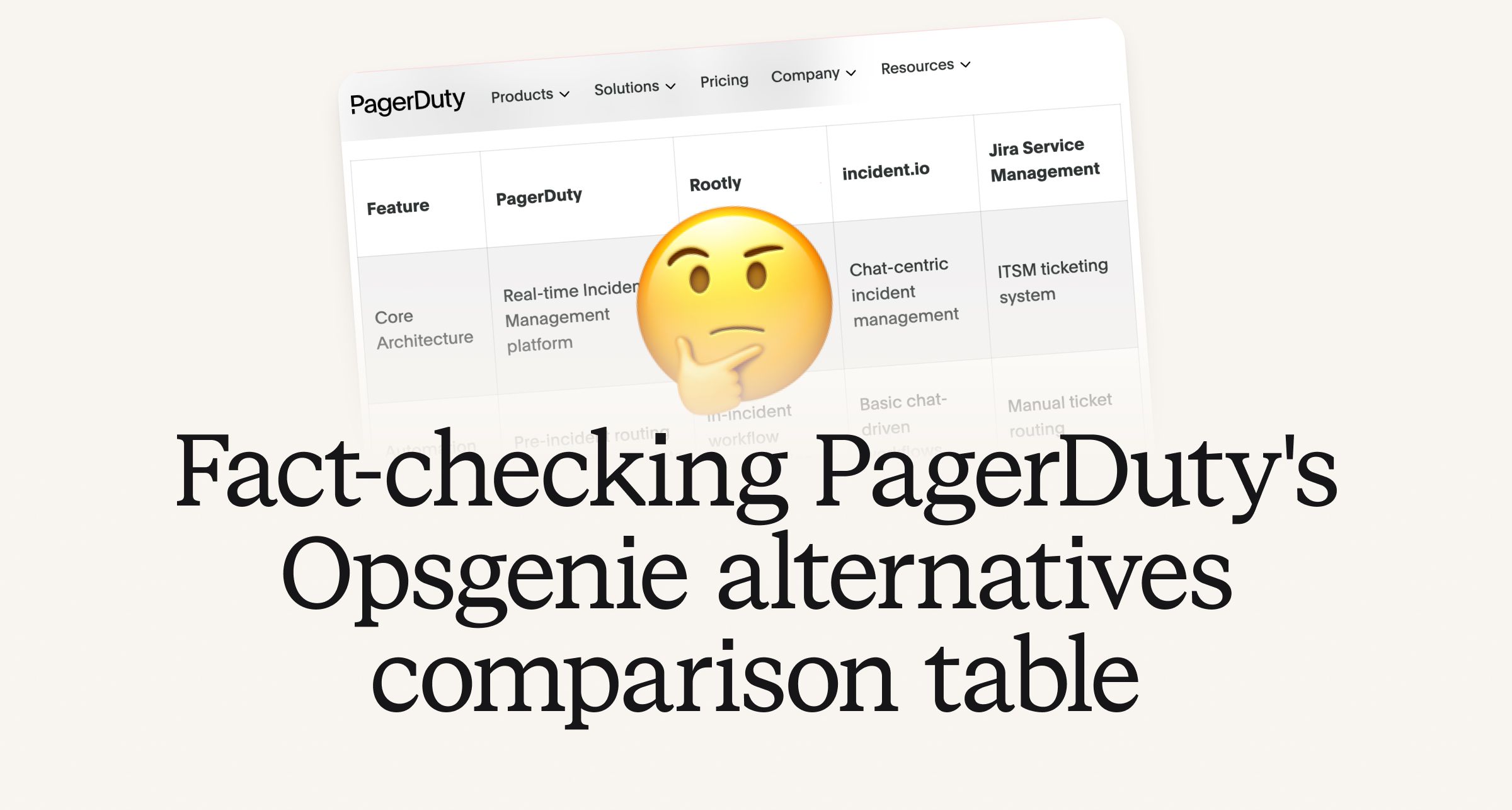
Fact-checking PagerDuty's Opsgenie alternatives comparison table
PagerDuty published a new comparison table about incident.io. Once again, it describes a product we don't recognize. So once again, we're correcting the record, row by row, with receipts.

July 28, 2026
Your genie is vanishing: introducing the Opsgenie rescue program
Today, we're launching the Opsgenie Rescue Program to make that landing soft: simplified migration and free overlap so you never pay two vendors at once.
July 9, 2026
So good, you’ll break things on purpose
Ready for modern incident management? Book a call with one of our experts today.
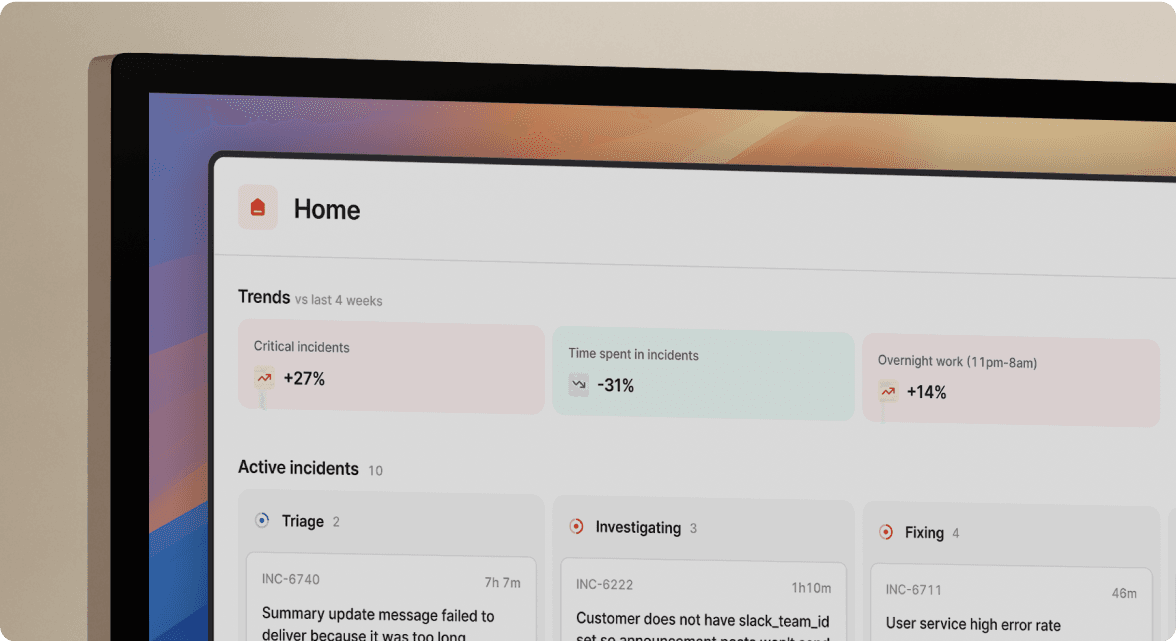
We’d love to talk to you about
- All-in-one incident management
- Our unmatched speed of deployment
- Why we’re loved by users and easily adopted
- How we work for the whole organization