Best AI incident detection tools for startups and small engineering teams
September 15, 2026 — 19 min read
TL;DR: For most 20-100 person engineering teams, incident.io is a strong starting point among AI incident detection tools for startups: it's Slack-native, has a genuinely usable free tier, and scales from free to Team ($25/user/month with on-call, annual) to Pro ($45/user/month with on-call) as you grow. FireHydrant and Rootly are alternatives worth considering. PagerDuty offers robust alerting but more than most teams need at this stage, and Squadcast works if you only need on-call scheduling. Enterprise tools like BigPanda and Splunk On-Call don't fit Series A teams.
Most AI incident detection tools target companies with dedicated SRE teams. If you're a CTO or founding engineer at a 20-100 person company standing up incident response for the first time, you don't need enterprise event correlation, dedicated CSMs, or complex alert routing rules. You need something your whole team can run from Slack, that you can test for free without a sales call, and that won't force you into workflows you'll pay for and never use.
This article ranks the best AI incident detection platforms for teams at your stage, using the criteria that matter right now: a real free tier, Slack-native workflow, time to first working setup, and transparent per-user pricing. It also calls out which enterprise-scale tools are overkill and when that changes.
How we vetted each incident platform
We evaluated every tool on this list against four criteria that map to how a small team actually buys and adopts incident tooling. No vendor demos, no "contact sales" gates, only what you can verify yourself.
Handling incidents on the free plan
You should be able to run a real incident through the free tier without talking to sales, or it doesn't count. We checked what each free plan actually includes: on-call schedules, status pages, integrations, and workflow limits.
incident.io's Basic tier includes 1 on-call schedule, 1 public status page, 2 integrations, and 1 workflow, enough to declare, coordinate, and close real incidents in Slack, as shown in the incident.io pricing breakdown. By contrast, Rootly doesn't offer a free plan, only a trial. FireHydrant does not offer a free plan: only a 14-day trial of its Pro tier. AI-assisted investigation (the equivalent of incident.io's Investigations) is gated behind FireHydrant's Enterprise tier, not available on trial or mid-tier plans. PagerDuty's free tier caps at 5 users.
Configuring alerts in under an hour
Time to first working setup matters more than feature depth when nobody on your team owns this full-time. Opinionated defaults beat infinite customization at this stage: you want to connect Datadog or Prometheus, create an on-call schedule, and declare a test incident before lunch. incident.io ships pre-built alert source configuration, and the easier alert source setup changelog shows how quickly new sources come online. PagerDuty's free tier, by comparison, inherits enterprise complexity: escalation policies and integration settings built for teams several times your size, even on the free plan.
Managing incidents directly in Slack
Slack-native means the entire incident workflow runs in chat through slash commands and automated channels, not a web UI that posts notifications to Slack. With incident.io, you /inc declare, assign roles with /inc assign, set severity with /inc severity, and resolve with /inc resolve, as described in our incident management tools trends breakdown.
FireHydrant offers Slack integration alongside its own web dashboard, so evaluate directly whether your team can run a full incident lifecycle from Slack alone. For a team already living in Slack, the difference shows up in adoption: new hires can run their first incident with /inc commands instead of a 47-step runbook.
"I like the simplicity of incident.io as it makes the platform easy to understand and use, which helps with adoption across teams. I appreciate how it is powered by Slack because we are primarily a Slack workspace, making it easy to declare incidents, coordinate responders, and communicate updates." - Verified user on G2
Showing clear, per-user pricing
Hidden add-ons are a dealbreaker when you're watching a limited budget. incident.io publishes real per-user pricing including on-call: Team at $25/user/month with on-call ($15 base + $10 on-call add-on, annual billing) and Pro at $45/user/month with on-call ($25 base + $20 on-call add-on). PagerDuty's add-on model separates features like AIOps into extra line items, which can push total cost above the advertised base price. Enterprise platforms like BigPanda require sales conversations rather than publishing per-user pricing upfront.
Best AI-powered tools for early-stage incident response
Here's the ranked shortlist of the best AI-powered incident detection tools for teams of 20-100 engineers. Each entry stands alone, so you can jump to the ones that fit your stack.
1. incident.io: Simple incident workflows
incident.io is the top pick for AI incident detection for small teams because it combines a genuinely usable free tier, Slack-native coordination, and AI that does real work. Investigations, our AI investigation product, gets you from alert to resolution an order of magnitude faster, automating alert triage through root cause analysis to a draft fix PR (pull request) that a human reviews and merges, per the incident.io AI SRE page. Favor, for example, reduced MTTR by 37% after adopting the platform, largely by eliminating manual coordination overhead.
The free tier has honest limits: Basic gives you 1 workflow, 2 integrations, no API, and no webhooks. You'll hit those limits as you grow, and that's when you upgrade to Team, not through a sales ambush. Team plan at $25/user/month with on-call (annual) unlocks unlimited integrations, API access, and 3 workflows.
"The UI is polished and is clear. The @incident Slack bot helps a lot in incidents by taking vague direction and understanding what I need. Scribe for incident calls helps keep teams in sync. The AI generated incident summaries and updates saves a lot of time." - Verified user on G2
2. FireHydrant: Slack-native incident response
FireHydrant offers structured incident response in Slack but does not have a free plan, only a 14-day trial of its Pro tier. incident.io covers the same workflows with deeper AI and transparent per-user pricing. Investigations does root cause analysis and drafts fix PRs on paid tiers, while FireHydrant's AI features are gated behind Enterprise. FireHydrant's Pro plan runs $25/responder/month, billed annually, while a 20-person team pays $10,800/year on incident.io Pro with on-call ($6,000/year on Team).
3. Rootly: Automated incident lifecycle management
Rootly brings solid automation-focused incident workflows into Slack, but it offers a roughly two-week trial rather than a free plan. Paid plans for small teams run $15,000-$30,000 annually for 20-50 users, while incident.io covers the same Slack-native automation at $10,800/year for 20 users or $27,000/year for 50 users on Pro with on-call (or $6,000/$15,000 on Team), backed by a customer base of 1,200+ companies.
4. PagerDuty: On-call setup for first-time buyers
PagerDuty's alerting is robust, and its iOS app holds a 4.8-star rating across 5,200 ratings. If deep alerting customization is genuinely required, PagerDuty delivers it. incident.io integrates with PagerDuty rather than replacing it, so you keep PagerDuty's alerting strength and add the Slack-native coordination, timeline capture, and auto-drafted post-mortems it doesn't offer.
The trade-off: PagerDuty's Business tier runs $41/user/month annually before add-ons, charged per named user regardless of paging volume, so engineers who rarely get paged cost the same as your busiest on-call engineer, and its UI carries a steeper learning curve than a first-time buyer needs. incident.io, by contrast, gets your team operational in days with /inc commands instead of a 47-step runbook.
5. Squadcast: On-call for growing teams
Squadcast is a unified on-call and incident response platform, offering a free tier for up to 5 users, a Pro plan at $9-$12/user/month, and a Premium plan at $16-$19/user/month. If you only need an on-call rotation today, it's a reasonable starting point, and incident.io covers the same on-call scheduling plus incident response, status pages, and post-mortems in one platform, so you don't stitch together a second tool when your process matures.
| Tool | Free tier | Slack-native | Cost with on-call (per user/mo unless noted) |
|---|---|---|---|
| incident.io | 1 schedule, 1 status page, 2 integrations | Yes, full lifecycle | $45 (Pro, annual), Team from $25 |
| FireHydrant | None (14-day trial only) | Partial, web-first | $25/responder (Pro, annual) |
| Rootly | No free plan (trial only) | Yes | $15k-$30k/yr (20-50 users) |
| PagerDuty | 5 users, 100 notifications/mo | No, web-first | $41/user (Business) |
| Squadcast | 5 users, basic on-call | Limited | $9-$12 (Pro) , $16-$19 (Premium) |
Why complex tools don't fit early teams
Vendors keep pitching some tools in every "best of" list, but they built those tools for a different buyer. Here's when each one is overkill, and when it stops being.
When enterprise tools make sense
PagerDuty's enterprise tiers offer deep alerting customization and trigger-based workflows, while Splunk On-Call integrates with Microsoft Teams, making it useful beyond Splunk-only environments. Both serve enterprises with dedicated SRE (Site Reliability Engineering) teams, and for a 30-person startup they mean paying for configuration complexity you'll never use. If you already have PagerDuty embedded, our PagerDuty migration tooling moves schedules and escalation policies over, or you can run incident.io alongside it as the coordination layer. Otherwise, a modern Slack-native tool ships features faster and costs less to operate.
When BigPanda makes sense
BigPanda is enterprise-scale AIOps designed for event correlation across large, complex infrastructures with dedicated operations teams. It requires sales conversations rather than publishing per-user pricing upfront, and its AIOps correlation engine is built for a scale of alert volume a Series A team doesn't generate. If you're running a 40-person team on Kubernetes with Datadog, BigPanda likely solves a problem you don't have yet.
Signs your team has outgrown free incident tools
Free tiers are a starting point, not a long-term strategy, and these three triggers tell you when it's time to pay.
Meeting SOC 2 and audit requirements
When customers or investors start asking pointed questions about uptime and incident process, "we handle it" stops working. A documented, repeatable workflow with post-mortems gives you a credible answer. We're SOC 2 (System and Organization Controls 2) Type II certified, and we auto-draft post-mortems from captured timeline data, so every incident produces an audit-ready record without extra work. Our AI governance documentation covers how AI features handle your data, which matters when compliance questions arrive.
Managing complex multi-region infrastructure
When a single incident spans three regions, two services, and four alerts from different monitoring tools, manual correlation breaks down. AI-assisted investigation starts paying off here: Investigations analyzes telemetry, code changes, and past incidents to surface likely root causes, as detailed on the Investigations product page. This is also where alert noise becomes a real problem, and features like shard alert source rate limits keep noisy sources from drowning your on-call rotation.
Integrating your existing tool stack
Once you need Datadog plus GitHub plus Jira plus a status page, or you want API access and webhooks to automate your own workflows, you've outgrown Basic. incident.io's Team plan unlocks unlimited integrations, API, and webhooks, and the platform prompts you as you approach plan limits so nothing breaks mid-incident, per the pricing breakdown.
How AI accelerates incident resolution
AI in incident tooling ranges from genuinely useful to pure marketing. Here's what it does well today, and where it stops.
Taming alert fatigue with AI
Rule-based detection fires on fixed thresholds you configure by hand, while AI-driven detection correlates multiple signals, identifies patterns, and surfaces likely root causes. AIOps-style event correlation groups alerts. An AI SRE actively investigates them, per our incident management tools trends analysis. For a small team, the practical win is fewer 3 AM pages that turn out to be noise.
Automating incident workflows in Slack
The biggest time sink in small-team incidents isn't diagnosis, it's coordination: assembling people, creating channels, capturing what happened. incident.io auto-creates the channel, pages on-call, and starts timeline capture the moment an alert fires, dramatically reducing team assembly time. Features that help draft status updates and follow-up tasks streamline the work that otherwise falls on the incident lead.
Mapping recurring incident patterns with AI
Think of Investigations as a senior engineer who never sleeps and always remembers the last five similar incidents. It analyzes telemetry, code changes, and past incidents to surface likely root causes and draft fix PRs, detailed in our AI root cause analysis testing guide. Scribe handles the parallel problem on calls: real-time transcription and decision capture, so nobody takes notes during a P1 (Priority 1 incident).
Recognizing where AI falls short
AI can't replace human judgment, and any vendor claiming otherwise is selling hype. Investigations drafts fix PRs, but a human reviews and merges every one. It never acts on production systems on its own. It automates the most common patterns rather than every edge case, which is why teams see meaningful improvements rather than full automation. If you want to see how the product works under the hood, the Inside Investigations webinar walks through the architecture.
Evaluating your top incident tool finalists
You've got a shortlist. Here's how to pick between your finalists in a week, not a quarter.
Walk through a sample incident
Sign up for the free tier and run a mock incident end to end. The channel should create itself, on-call should get paged, the timeline should capture automatically, and you should be able to resolve without leaving Slack. If any step requires a sales call or professional services, that tool isn't actually self-serve.
Evaluate Slack-native incident workflows
Run the full lifecycle in Slack: declare, assign, update, resolve. With incident.io, /inc commands cover every step, and you can manage incidents without leaving the channel. If your evaluators keep getting pushed into a web dashboard, the tool is Slack-integrated, not Slack-native, and adoption will show it.
Calculate actual cost at 20-50-100 users
Do the math with on-call included, because base prices hide it:
| Team size | Pro plan ($45/user/mo) | Team plan ($25/user/mo) |
|---|---|---|
| 20 users | $10,800/year | $6,000/year |
| 50 users | $27,000/year | $15,000/year |
| 100 users | $54,000/year | $30,000/year |
For a 20-person team on Pro with on-call, that's $10,800/year ($45/user/month × 20 users): compare that against 15 minutes of coordination overhead per incident × 15 incidents/month × your loaded engineer cost, and the math justifies the line item. Smaller teams can start on Team ($6,000/year for 20 users) and upgrade as process matures.
Check the migration path as you scale
The right tool grows with you: Basic to Team when you hit workflow or integration limits, Team to Pro when you need custom incident types, private incidents, or Microsoft Teams support. No re-platforming, no data migration. Teams coming from Opsgenie should move soon anyway, since Atlassian is sunsetting it in April 2027, per our Opsgenie migration plan, and our Opsgenie migration tooling handles the transition.
Across all five tools, the pattern holds: incident.io fits teams that want Slack-native coordination, a free tier that works without a sales call, and AI that does real investigative work, without paying for enterprise complexity they don't need yet. FireHydrant and Rootly are reasonable Slack-native alternatives once you've weighed FireHydrant's Enterprise-gated AI and Rootly's trial-only access against incident.io's Pro plan. PagerDuty and Splunk On-Call make sense once alerting sophistication matters more than coordination speed, and Squadcast covers you if on-call scheduling is all you need today.
Book a demo of incident.io and see your first incident coordinated in Slack, from alert to auto-drafted post-mortem, in under 30 minutes.
Key terms glossary
AI incident detection: Software that uses machine learning to identify, correlate, and triage incidents from monitoring alerts, reducing the manual work of figuring out what's actually broken.
MTTR: Mean Time To Resolution: the average time from incident detection to resolution, and the core metric for measuring whether your incident response improves over time.
Alert correlation: Grouping related alerts from multiple sources into a single incident, so responders focus on root cause instead of chasing symptoms across five dashboards.
On-call rotation: A schedule assigning incident response responsibility to specific engineers during defined periods, so someone is always accountable and the founders stop being the permanent safety net.
Post-mortem: A written analysis of an incident after resolution: what happened, why, and what prevents recurrence. incident.io auto-drafts these from captured timeline data so you edit instead of reconstructing from memory.
FAQs

Tom Wentworth
Chief Marketing Officer
See related articles
Introducing Investigations, powered by Nexus.
Today we're launching Investigations: agentic root cause analysis that starts the moment you're paged, figures out what broke and why, and works with your team through to resolution. Here's what we built, what's powering it, and why it took some time to get right.

August 5, 2026
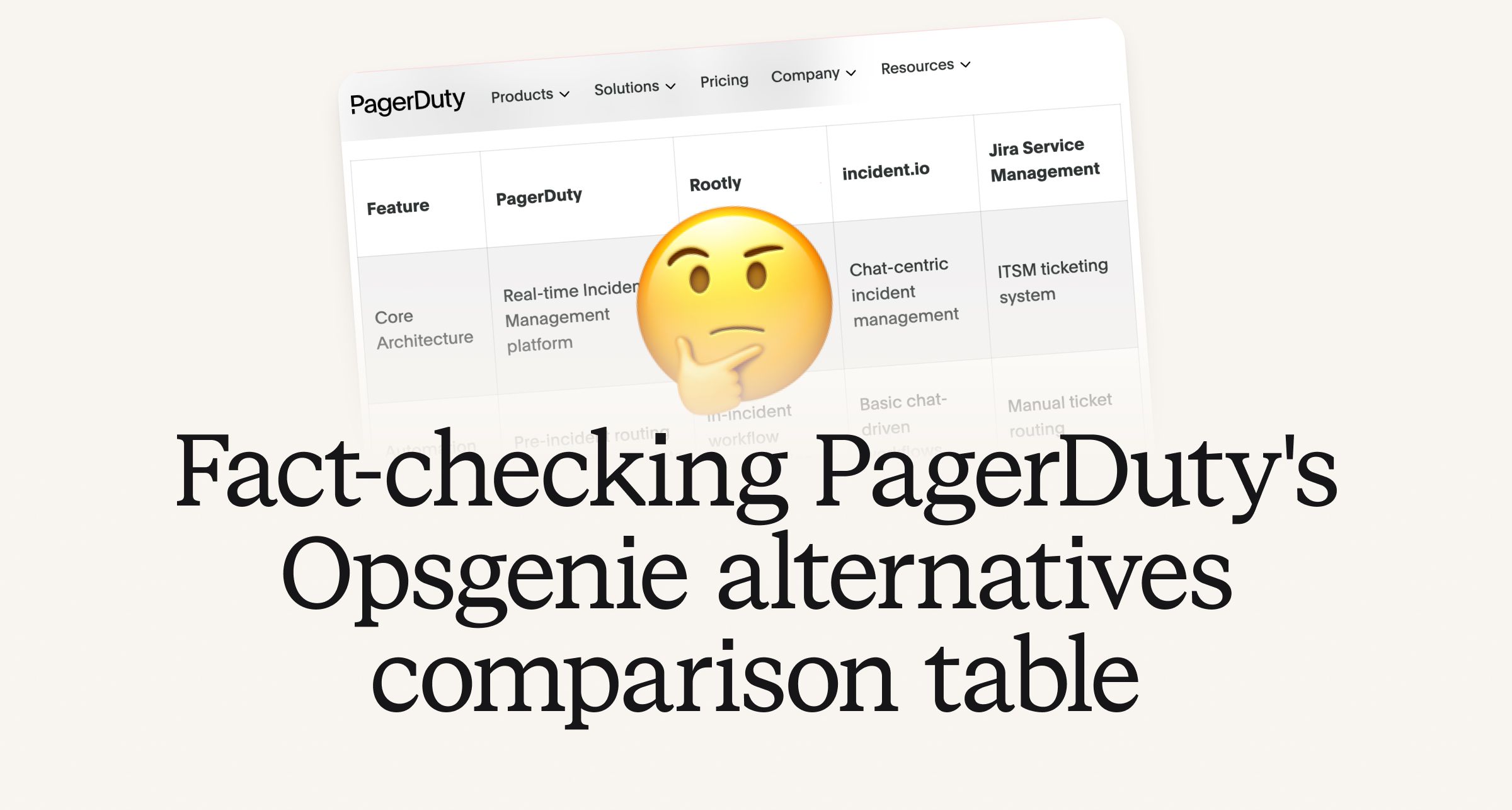
Fact-checking PagerDuty's Opsgenie alternatives comparison table
PagerDuty published a new comparison table about incident.io. Once again, it describes a product we don't recognize. So once again, we're correcting the record, row by row, with receipts.

July 28, 2026
Your genie is vanishing: introducing the Opsgenie rescue program
Today, we're launching the Opsgenie Rescue Program to make that landing soft: simplified migration and free overlap so you never pay two vendors at once.
July 9, 2026
So good, you’ll break things on purpose
Ready for modern incident management? Book a call with one of our experts today.
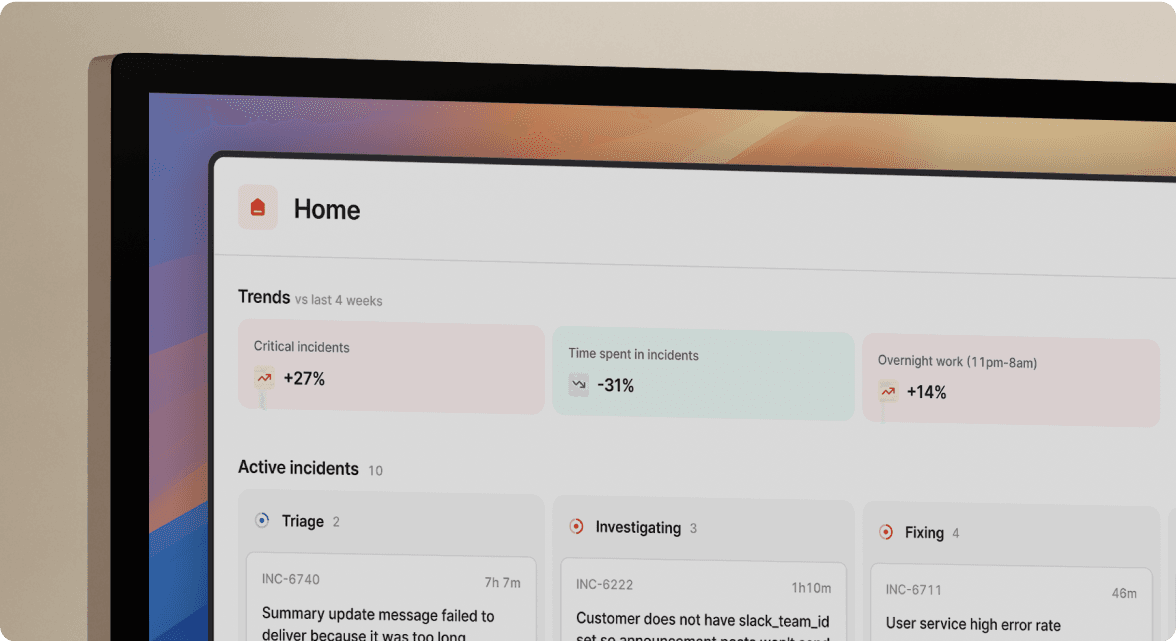
We’d love to talk to you about
- All-in-one incident management
- Our unmatched speed of deployment
- Why we’re loved by users and easily adopted
- How we work for the whole organization