incident.io pricing transparent breakdown: What you're actually paying for
July 6, 2026 — 18 min read
TLDR: incident.io charges per user with a transparent base price plus an optional on-call add-on. The Team plan runs $15/user/month (annual) for incident response, plus $10/user/month for on-call, totaling $25/user/month. The Pro plan is $25/user/month base, plus $20/user/month for on-call, totaling $45/user/month. Viewers who join Slack incident channels are free. Enterprise is custom-priced. The real value calculation isn't just per-seat cost: it's the 10-15 minutes of coordination overhead eliminated per incident, which adds up to tens of thousands of dollars in recovered engineering time annually.
When a critical incident hits, spending 15 minutes hunting down who's on-call and manually creating a Slack channel is expensive operational overhead that no pricing spreadsheet captures. This guide breaks down every plan, seat type, and add-on cost for incident.io so you can calculate your exact monthly spend and compare it directly to your current setup.
Breakdown of incident.io cost per user
incident.io prices on a per-user, per-month basis with two clearly separated components: the incident response seat and the optional on-call scheduling add-on. You see the complete cost before you talk to anyone in sales, which contrasts with how incumbent tools price. Your total effective cost (base plus on-call) is visible upfront, not discovered at renewal.
Team plan cost and inclusions
The Team plan targets growing engineering teams (typically 20-100 people) establishing formal incident response patterns.
- Annual billing: $15/user/month for incident response + $10/user/month for on-call. Total with on-call: $25/user/month
- Monthly billing: $19/user/month for incident response + $10/user/month for on-call. Total with on-call: $29/user/month
The plan includes:
- 2 on-call schedules
- 3 workflows
- 3 custom fields
- Unlimited integrations
- API access and webhooks
- Live chat support
Pro plan pricing and user limits
The Pro plan targets mature engineering organizations (100-500 users) that need advanced automation, custom incident types, and Microsoft Teams support.
- Annual billing: $25/user/month for incident response + $20/user/month for on-call. Total with on-call: $45/user/month
- Monthly billing: Higher (annual contracts are the standard for Pro)
Pro unlocks unlimited workflows, unlimited custom fields, unlimited on-call schedules, private incidents for security issues, AI-powered post-mortem generation, informed by Scribe's call transcription, Microsoft Teams support, 3 custom Insights dashboards, 1 incident policy, and 1 live call routing number.
The jump from Team to Pro is significant in cost. The payoff is eliminating the Team plan's workflow and schedule limits, which become real constraints for teams running 4+ on-call rotations or needing more than 3 automated workflows.
Enterprise plan custom quote options
The Enterprise plan serves organizations above 300-500 users or those with strict compliance requirements. It's custom-priced and adds:
- SAML SSO and SCIM provisioning for automated user management
- Slack Enterprise Grid support
- Sandbox environment for testing workflows before production
- Dedicated Customer Success Manager
- Live phone support with SLAs
- Unlimited custom dashboards, incident policies, and status pages
- Advanced access controls and audit logs
All paid plans include SOC 2 Type II certification and GDPR compliance. Enterprise does not gate them.
Comparing user-seat costs and responder fees
The most common billing objection from SRE Leads evaluating incident.io is: "Will I get billed for every developer who joins a Slack incident channel?" The answer is no, and understanding why requires a clear definition of how incident.io categorizes users.
Defining billable seats
Any user who actively manages incidents within incident.io needs a paid seat. That means incident commanders, on-call engineers, and dedicated responders who declare, escalate, and resolve incidents. Stakeholders and executives who join incident channels to observe or monitor progress are free viewers with no seat cost attached.
This distinction matters for your headcount math. For example, a 200-person engineering org where 30 engineers carry pagers and 170 others occasionally read incident summaries in Slack would pay for 30 seats, not 200.
Defining billable incident responders
According to incident.io's seat type documentation, billing triggers automatically based on incident engagement. A user becomes a billable Responder when they change an incident status, accept or decline an incident, or assign someone an incident role.
To illustrate: a Staff SRE who owns the on-call rotation and runs the incident response process would need both a Responder seat and an On-Call add-on ($45/user/month on Pro, annual). A junior developer who occasionally joins incidents as a supporting responder but isn't on rotation would need only a Responder seat ($25/user/month on Pro, annual). Your exact mix will vary.
Predicting your monthly incident bill
Per the managing seats documentation, you can manage seat assignments from Settings > Users. You can view each user's current seat type and adjust their access as your team grows or reorganizes.
Per incident.io's billing documentation, changes take effect immediately with pro-rated billing adjustments.
Inside the Team plan for incident response
The Team plan covers the core incident management lifecycle for teams outgrowing ad-hoc Slack coordination but not yet at the complexity level requiring unlimited workflows.
Core capabilities on the Team plan
When an alert fires from Datadog or Prometheus, incident.io automatically creates a dedicated #inc-[service-name] channel in Slack, pages the on-call engineer, and pulls in service context from the catalog (owners, dependencies, runbooks).
The entire incident lifecycle runs through /inc commands: /inc severity high sets the severity, /inc assign @sarah makes Sarah the incident commander, /inc resolve closes the incident and triggers the post-mortem draft.
The Team plan includes unlimited integrations covering Datadog, Prometheus, New Relic, Jira, Linear, GitHub, Confluence, Google Docs, and PagerDuty, plus API access and webhooks.
incident.io captures every role assignment, status update, and Slack message in a structured timeline throughout the incident. When you run /inc resolve, the platform uses that captured timeline to generate a post-mortem draft that's already 80% complete, turning 60-90 minutes of manual Slack scroll-back into roughly 10 minutes of refinement.
"Everything integrates seamlessly around Slack; new incidents are quickly declared via the commands or automatically created via your own alerting and integrations." - Rob L. on G2
Team plan capacity and limits
The Team plan limits are worth understanding upfront:
- 3 workflows maximum (covers P0, P1, P2 but not custom paths for security vs. infrastructure incidents)
- 3 custom fields maximum
- 2 on-call schedules maximum
These limits signal growth triggers. When you need a dedicated security incident workflow with different stakeholder notifications and a separate on-call rotation for your infrastructure team, that's your signal to evaluate Pro.
Pro plan value: advanced automation tools
The Pro plan is where incident.io's capabilities expand from solid incident response to unified reliability operations. For a 100+ person engineering organization, the unlimited workflow and schedule headroom is the primary justification for the cost step up.
Key differences between Pro and Team plans
| Feature | Team | Pro |
|---|---|---|
| Workflows | 3 | Unlimited |
| Custom fields | 3 | Unlimited |
| On-call schedules | 2 | Unlimited |
| Microsoft Teams support | No | Yes (same pricing) |
| Private incidents | No | Yes |
| AI post-mortem generation | No | Yes (platform-level, with Scribe for call transcription) |
| Custom incident types | No | Yes |
| Insights dashboards | 0 custom | 3 custom |
Automated incident timeline generation
Pro includes Scribe, the AI call transcription and note-capture tool that joins your Google Meet or Zoom call during an incident, transcribes the conversation, and flags key decisions in the timeline automatically. Scribe is available to Pro and Enterprise customers only. The result: post-mortems that are 80% complete before anyone opens a blank document.
Configuring incident types and workflows
Incident types are exclusive to Pro and Enterprise plans. They let you define separate configurations for distinct incident categories: a security vulnerability is handled differently than a payment processing outage. Each incident type can have its own severity levels, required fields, workflows, and roles.
"It's easy to integrate with any process or tools you may have already inside of your company. It just works and you can build any kind of workflow you may want through a nice and clean UI." - Emanuele M. on G2
Granular access controls for incidents
Private incidents are a Pro-only feature that lets you declare and manage an incident in a channel visible only to explicitly invited responders. This is critical for security incidents where a public Slack channel would create compliance exposure before a CVE is patched. Private incidents maintain the same timeline capture and post-mortem generation as standard incidents.
Pricing breakdown for on-call management tools
The on-call add-on is the pricing component that surprises buyers who see the base price and assume it's all-in. It's on the pricing page and documented clearly, but it's worth understanding the exact mechanics before building your budget.
Predicting your per-user on-call cost
We charge the on-call add-on per user for only those who need schedule access. You don't pay for the entire organization, just the engineers who carry a pager.
| Plan | On-call add-on (annual) | On-call add-on (monthly) |
|---|---|---|
| Team | $10/user/month | $10/user/month |
| Pro | $20/user/month | Not standard |
Scope of the on-call scheduling tier
The on-call add-on includes intuitive rotation scheduling with override management, escalation paths with configurable timeouts, and a compensation calculator for on-call pay. You're not context-switching to a separate web dashboard to check your rotation.
Justifying the on-call add-on cost
As an illustrative example: a team handling 15 incidents per month with 6 responders per incident at a $150/hour loaded engineer rate would spend (15 incidents x 6 responders x 12 minutes / 60) x $150 = $2,700/month assembling teams before anyone starts troubleshooting, roughly $32,400 annually in coordination overhead alone, before a single line of code is fixed. Your figures will vary based on incident frequency, responder count, and loaded engineer cost.
At $45/user/month (Pro with on-call) for 25 engineers, your annual license cost is $13,500. You recover more than twice that figure in coordination overhead alone, before accounting for faster Mean Time To Resolution (MTTR). incident.io can reduce MTTR by up to 80%, and every minute shaved off resolution time directly reduces the business cost of downtime.
Enterprise plan: when to request a custom quote
The Enterprise tier is the right conversation to start when your organization hits any of these triggers: 300+ engineers on the platform, requirements for SAML SSO with SCIM provisioning, multi-environment status pages, Slack Enterprise Grid, or dedicated support SLAs.
Configuring SSO and SCIM integration
SAML SSO configuration on Enterprise lets you manage incident.io access through your existing identity provider (Okta, Microsoft Entra ID, and similar providers are supported). SCIM provisioning automates user lifecycle management: when you add an engineer to your IDP group, they're provisioned in incident.io automatically. See the user permissions documentation for how role-based access controls layer on top of SSO.
Custom support tiers and SLAs
Enterprise customers get a dedicated Customer Success Manager, live phone support, and contractual uptime SLAs. For teams where incident.io availability is mission-critical infrastructure, this contractual guarantee matters during procurement reviews.
Data residency for regulated environments
SOC 2 Type II certification and GDPR compliance ship with all plans. Enterprise customers can address DORA compliance requirements and negotiate custom data residency arrangements. At the Enterprise tier, you can export audit logs with a timestamped record of every action taken within the platform, satisfying SOC 2 audits without manual documentation. The Fin migration case study shows how a team moved from PagerDuty and Atlassian Status Page, reducing MTTR and cognitive load in the process.
Volume discounts for growing SRE teams
We offer volume discounts for organizations scaling past 500 users. If you're evaluating at 300-500 users, include volume pricing as an explicit ask during your demo with the sales team.
Calculating your actual incident.io spend
The following is an illustrative example for a 25-person on-call team on the Pro plan, billed annually with on-call included:
| Component | Per user/month | Monthly total | Annual total |
|---|---|---|---|
| Pro base (incident response) | $25 | $625 | $7,500 |
| On-call add-on | $20 | $500 | $6,000 |
| Total | $45 | $1,125 | $13,500 |
Scaling to 100 users on Pro plan
The following is an illustrative example for a 100-person engineering org on Pro, with all 100 users as responders and 30 carrying the on-call add-on:
| Component | Users | Per user/month | Annual total |
|---|---|---|---|
| Pro base (incident response) | 100 | $25 | $30,000 |
| On-call add-on | 30 | $20 | $7,200 |
| Total | $37,200 |
If all 100 need on-call access, the total is $54,000/year.
incident.io vs PagerDuty and Opsgenie costs
| Dimension | incident.io (Pro) | PagerDuty (Business) |
|---|---|---|
| Base price/user/month | $25 | $41 |
| On-call scheduling | +$20/user | Included |
| AI features | Included (Scribe, AI post-mortem generation) | $1,114/month in add- ons ($699/month AIOps + $415/month Advance) |
| Status pages | Included | Premium Status Pages: Enterprise only (not included on Business) |
| Slack-native architecture | Yes (built-in) | No (integration only) |
| Support model | Shared Slack channel | Email-only |
Opsgenie's situation is urgent: new sales ended June 4, 2025, and the service shuts down April 5, 2027. If you're currently on Opsgenie, you have under a year to complete your migration.
As documented in the 2026 pricing comparison, a 150-person team on PagerDuty Business with their AI add-on runs $87,168/year, compared to incident.io's Pro plan with all 150 users on on-call at $81,000/year, and incident.io includes status pages and AI without separate invoices.
Understanding your incident.io subscription costs
Breakdown of all incident.io costs
| Plan | Base (annual) | Base (monthly) | On-call add-on (annual) | On-call add-on (monthly) | Total with on-call (annual) |
|---|---|---|---|---|---|
| Basic | Free | Free | N/A | N/A | Free |
| Team | $15/user/mo | $19/user/mo | $10/user/mo | $10/user/mo | $25/user/mo |
| Pro | $25/user/mo | Contact sales | $20/user/mo | Contact sales | $45/user/mo |
| Enterprise | Custom | Custom | Custom | Custom | Custom |
Can I switch between per-seat and per-responder?
Yes. You can adjust seat allocations at any time through the admin dashboard. When an on-call engineer rotates off the schedule for a quarter, downgrade their seat from On-Call to Responder to avoid paying for unused on-call access. Changes are pro-rated within the billing cycle.
Managing overages on your current tier
incident.io handles tier limits without cutting off access mid-incident. If you approach your plan's workflow or schedule limits, the platform prompts you to upgrade. Your production emergency won't be compounded by a billing gate at 3 AM.
Getting started on the free plan
The Basic plan functions as a permanent free tier with 1 on-call schedule, 1 workflow, 1 public status page, and 2 integrations. Eligible early-stage startups can apply for additional savings through the incident.io startup program.
Comparing annual and monthly billing
Annual billing saves meaningfully across both plans:
| Plan component | Monthly billing | Annual billing | Savings |
|---|---|---|---|
| Team (incident response) | $19/user/mo | $15/user/mo | 21% |
| Team (on-call add-on) | $10/user/mo | $10/user/mo | 0% |
| Team total with on-call | $29/user/mo | $25/user/mo | 14% |
The math favors annual commitment unless your headcount is genuinely uncertain.
incident.io costs less than legacy tools when you account for what you're not buying separately (status pages, AI features, post-mortem tooling, and on-call scheduling at PagerDuty's equivalent tiers). The coordination tax your team pays today in tool-switching and manual documentation doesn't show up in your SaaS budget, but it does show up in your Mean Time To Resolution (MTTR).
Book a demo to see incident.io running through a sample incident with your team's seat mix modeled out, and walk away knowing exactly what you'd pay.
Key terms glossary
Coordination tax: The operational time wasted by engineers during an incident on administrative tasks like creating Slack channels, paging responders, and updating status pages. Typically 10-15 minutes per incident. As an illustrative example, a team handling 15 incidents per month with 6 responders at a $150/hour loaded engineer rate could spend roughly $32,400 annually on coordination overhead alone. Actual figures depend on your incident frequency, responder count, and loaded engineer cost.
Responder seat: A paid incident.io license that allows an engineer to actively declare, manage, and resolve incidents within Slack. Triggered automatically when a user changes an incident status or assigns an incident role.
On-call seat: An add-on license ($10/user/month on Team, $20/user/month on Pro, annual billing) that grants an engineer access to on-call schedules, rotations, and automated escalation paths.
Total effective cost: The complete per-user cost combining the base incident response seat and the on-call add-on. Team total: $25/user/month (annual). Pro total: $45/user/month (annual).
Viewer: A free, non-billable user who can join Slack incident channels and read dashboards without managing incidents. Viewers become Responders automatically if they take an active management action.
FAQs

Tom Wentworth
Chief Marketing Officer
See related articles

Introducing Investigations, powered by Nexus.
Today we're launching Investigations: agentic root cause analysis that starts the moment you're paged, figures out what broke and why, and works with your team through to resolution. Here's what we built, what's powering it, and why it took some time to get right.

August 5, 2026
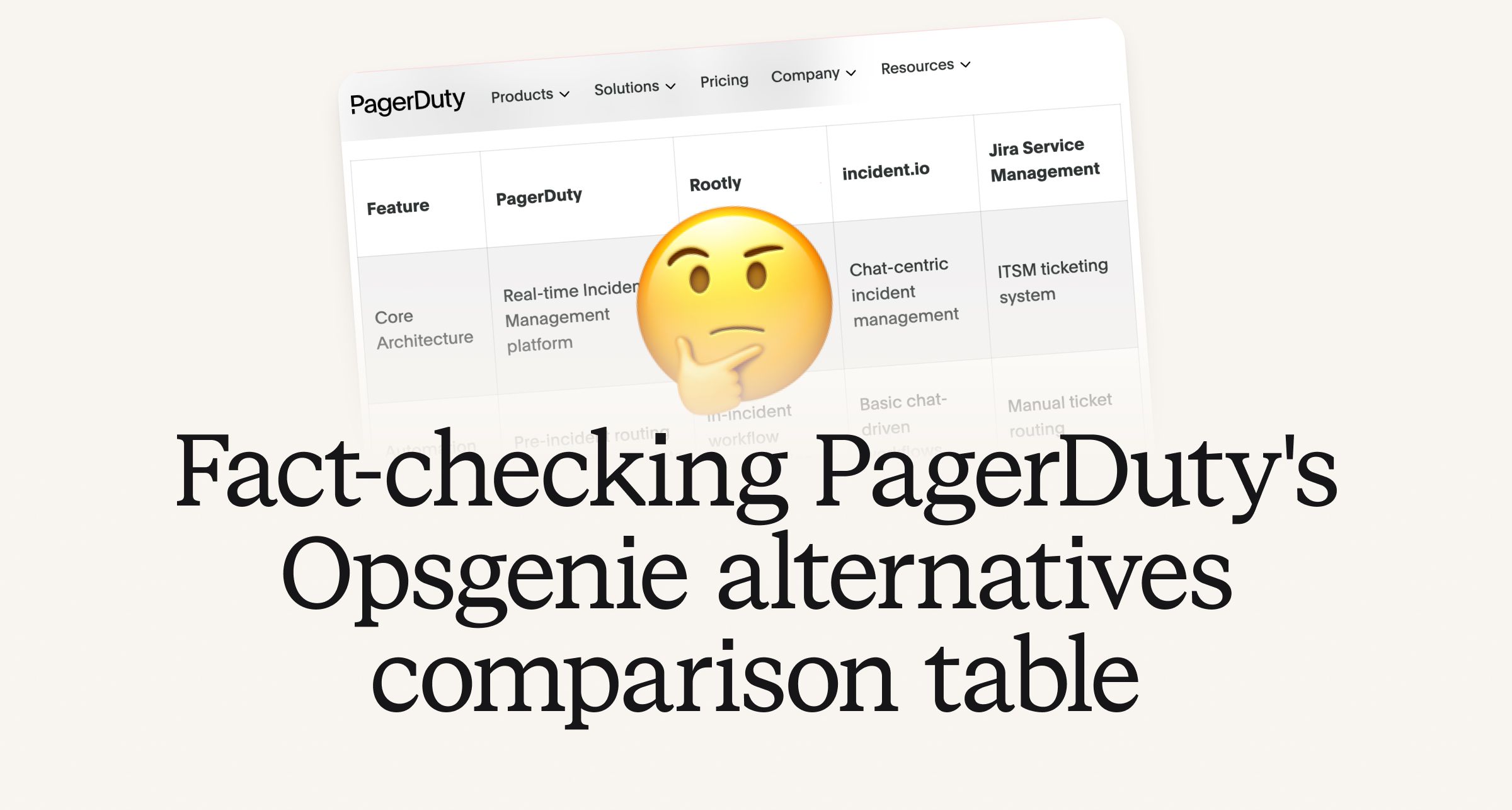
Fact-checking PagerDuty's Opsgenie alternatives comparison table
PagerDuty published a new comparison table about incident.io. Once again, it describes a product we don't recognize. So once again, we're correcting the record, row by row, with receipts.

July 28, 2026
Your genie is vanishing: introducing the Opsgenie rescue program
Today, we're launching the Opsgenie Rescue Program to make that landing soft: simplified migration and free overlap so you never pay two vendors at once.
July 9, 2026
So good, you’ll break things on purpose
Ready for modern incident management? Book a call with one of our experts today.
We’d love to talk to you about
- All-in-one incident management
- Our unmatched speed of deployment
- Why we’re loved by users and easily adopted
- How we work for the whole organization