Join live: What happens when your AI goes down?
SRE alerting best practices: Reducing alert fatigue & improving signal-to-noise
March 26, 2026 — 25 min read
Updated March 26, 2026
TL;DR: Alert fatigue is a systemic failure, not an engineer failure. Your monitoring stack fires thousands of pages, but around 3% require immediate action, burning out your on-call rotation and training your team to ignore the pager. The fix has two steps: design alerts around the four golden signals (Latency, Traffic, Errors, Saturation) to eliminate non-actionable noise, and consolidate incident response into a Slack-native platform to cut the coordination tax that inflates MTTR after a legitimate alert fires. Teams using incident.io reduce MTTR by up to 80% by combining smarter alerting with automated channel creation, timeline capture, and AI-driven root cause analysis.
Your on-call rotation is not broken because your engineers are bad. It is broken because your alerting system treats every anomaly like a P0 and then forces the responder to coordinate across PagerDuty, Datadog, Slack, Jira, and a Google Doc before any actual problem-solving begins. That coordination tax (not the technical complexity of the incident itself) is what keeps your MTTR high and your engineers burned out.
This guide gives you a framework to fix both problems: the signal design that determines which alerts fire, and the response workflow that determines how fast you resolve them.
The problem: Why alert fatigue is burning out your engineering team
Alert fatigue happens when monitoring systems generate so much noise that engineers stop trusting their pagers. Research shows teams receive over 2,000 alerts weekly with only around 3% needing immediate action. When the overwhelming majority of alerts are false alarms, the natural human response is to start ignoring pages, and that is exactly when real incidents slip through.
Impact on your team and your business:
The financial damage is direct and measurable. According to industry estimates, unplanned downtime can cost organizations $5,600 per minute on average. The hidden cost runs deeper than dollars. According to an ISACA 2023 report, 43% of cybersecurity professionals cite burnout as a reason for leaving, and replacing a mid-level engineer can cost 50–200% of their annual salary. Alert fatigue is not a temporary inconvenience. It is a talent retention crisis.
IBM's analysis of alert fatigue estimates the problem costs mid-size teams hundreds of thousands of dollars annually once you account for wasted triage time, missed real incidents, and engineering attrition. That figure does not include the cost of incidents that slip through because your best engineers have learned to snooze the pager.
Root causes and technical factors behind noisy alerts
Noisy alerting is almost always the result of system design choices, not engineer negligence. The most common root causes fall into three categories.
1. Alerting on symptoms rather than user impact: Monitoring CPU spikes, memory usage, or queue depth in isolation generates constant noise. The alerts that matter are those directly correlated to degraded user experience, not internal infrastructure metrics that may never surface to customers.
2. Static thresholds that ignore context: A CPU alert that fires every night during a scheduled batch job is not an alert. It is scheduled noise. Static thresholds do not adapt to traffic patterns, deploy cycles, or seasonal load changes, so they generate false positives during predictable operating conditions.
3. Tool sprawl creating coordination overhead: Even when an alert is legitimate, a fragmented incident management stack of PagerDuty, Datadog, Slack, Jira, and Confluence adds 15 or more minutes of coordination overhead before any engineer starts troubleshooting. According to analysis of Jira and Slack workflows, manual incident coordination costs engineering teams $20,000 to $54,000 annually in hidden overhead alone.
Human factors compound the technical ones. Engineers who receive too many pages adapt by mentally discounting alerts. That discounting becomes permanent, and when a real P0 fires, valuable initial response time is wasted re-establishing whether the alert is genuine.
Technical factors include insufficient alert deduplication, missing alert correlation across services, and the absence of SLO-based alerting that anchors thresholds to actual user impact rather than arbitrary infrastructure metrics.
Core principles of SRE alert design
Base alerts on the four golden signals
Google's SRE Book defines four golden signals as the canonical metrics for monitoring any user-facing system. If you can only measure four things, measure these.
| Signal | What it measures | Example alert trigger |
|---|---|---|
| Latency | Time to serve a request, split by success and failure | P99 response time exceeds your SLO threshold for a defined duration |
| Traffic | Demand on your system (requests per second) | Request rate drops significantly below your baseline |
| Errors | Rate of failed requests | HTTP 5xx error rate exceeds your SLO threshold over a monitoring window |
| Saturation | Resource utilization (CPU, memory, I/O, queue depth) | Database connection pool approaches capacity for a sustained period |
The Splunk SRE monitoring guide notes that saturation is particularly important because it predicts imminent user impact before a failure occurs. A database connection pool nearing capacity is not broken yet, but it will be soon, and that is your window to act proactively.
A critical nuance on latency: a fast error is not a good response. When you configure latency alerts, separate successful request latency from failed requests. This prevents a flood of fast 5xx errors from masking P99 degradation in your healthy request path. Google's SRE Book covers this distinction in depth.
Start with these four signals before adding custom metrics. If an alert does not map to one of them or to a specific SLO, question whether it belongs in your on-call rotation at all.
Align alerts with service level objectives (SLOs)
Static threshold alerting reacts to symptoms. SLO-based alerting predicts budget exhaustion. Rather than alerting when CPU hits 80%, you alert when your error budget burns at a rate that will exhaust it before the end of your compliance window.
Google's SRE Workbook defines burn rate as how fast, relative to the SLO, a service consumes its error budget. A burn rate of 1 means you exhaust the budget exactly at the end of the compliance window. A burn rate of 2 means you exhaust it in half the time. Google's SRE Workbook discusses alerting strategies based on budget consumption rates over different time windows.
Datadog's burn rate documentation confirms that burn rate alerting catches short but significant anomalies that static thresholds miss. The practical result is fewer pages for normal operating variance and faster pages when something genuinely threatens your reliability budget.
Distinguish critical issues from benign anomalies
The clearest test for any alert: if the on-call engineer cannot take a specific action to resolve it, the alert should not exist. Audit your current alert roster with this table.
| Alert type | Example | Requires immediate action | Verdict |
|---|---|---|---|
| User-facing error rate spike | Error rate spike during normal traffic patterns | Yes, investigate deployment or infra | Keep |
| Latency degradation at P99 | API response time exceeds your SLO threshold | Yes, investigate and escalate | Keep |
| Scheduled job resource spike | CPU spikes every night at the same time | No, expected behavior | Remove |
| Memory creep within range | Memory increases gradually with no user impact | No, within operating range | Demote to ticket |
| Connection pool warning | Pool utilization near capacity for sustained period | Yes, proactive action needed | Keep with runbook |
Effective alerting requires distinguishing actionable signals from noise. If the majority of your alerts are being dismissed without action, you have a signal-to-noise problem that needs addressing.
5 strategies to reduce alert fatigue and improve signal-to-noise
1. Adjust alert thresholds and sensitivity
Start with regular alert audits. For every alert your system fires, answer three questions:
- Does this alert represent real or imminent user impact?
- Does the on-call engineer have a runbook or clear action to take?
- Has this alert fired and been ignored more than twice in the last 30 days?
Any alert that fails the third question may be a candidate for immediate removal or conversion to a non-paging ticket. For alerts you keep, move from static thresholds to dynamic ones. Set thresholds relative to a rolling baseline rather than a fixed number.An error rate of 2% at 2 AM during low traffic can represent a different signal than 2% during peak load on Monday morning.
The incident.io guide on on-call best practices includes a practical checklist to run against your existing alert configuration.
2. Group and correlate alerts using AI
Microservices architectures mean a single root cause triggers dozens of downstream alerts. A database going down fires alerts for every dependent service within seconds. Without deduplication, your on-call engineer wakes up to 40 pages from one incident, each requiring the same triage.
Our alert deduplication feature groups related alerts into a single incident so your engineers respond to one consolidated incident rather than an alert storm. Investigations takes this further, pulling data from alerts, telemetry, code changes, and past incidents to pinpoint the root cause automatically. It identifies the likely pull request behind the incident so your engineer can review the change without leaving Slack, and if the root cause is a code issue, it generates a fix and opens a pull request directly in the incident channel.
"I like that with incident.io, issues are right there in Slack, giving really good visibility into what sort of issues are being submitted and ensuring that people are responding. It structures the response, making sure there's a clear process, ownership, and coordination going into resolving issues." - Alex N. on G2
3. Map alert severity to clear escalation policies
Every alert needs a severity level that maps to a specific escalation path. Without that mapping, on-call engineers make judgment calls at 3 AM when cognitive performance is impaired. We show how to connect alert priorities to incident priorities in our severity mapping documentation so the response workflow triggers automatically.
Here is how to structure your severity tiers with clear escalation paths.
P0 (Critical): Production down, revenue impacted, or customer data at risk. Typically requires immediate page and escalation to incident commander.
P1 (High): Significant degradation, SLO burn rate critical. Often warrants paging on-call and auto-creating an incident channel.
P2 (Medium): Partial degradation, SLO burn rate elevated. May involve creating a ticket and notifying on-call at next check-in.
P3 (Low): Minor anomaly, no confirmed user impact. Generally logged for review without paging.
Clear severity definitions can help reduce cognitive burden on the on-call engineer and support more appropriate escalation decisions. See our priorities documentation for how to configure this mapping in practice.
4. Automate repetitive tasks and runbooks
Every manual step in your incident response process is a source of delay and variability. When an on-call engineer starts responding to an incident, they should not need to remember to create a Slack channel, notify stakeholders, start a timeline, or update the status page. We automate all of these tasks, triggering them inside Slack the moment an incident is declared. Your engineers walk into a prepared incident environment rather than a blank channel and a blank Google Doc.
For runbooks, consider attaching them directly to alert rules. Our team routing documentation can help route alerts to the right team based on service ownership so the correct runbook can surface automatically in the incident channel. Your engineer does not need to hunt for it across Confluence.
"incident.io allows us to focus on resolving the incident, not the admin around it. Being integrated with Slack makes it really easy, quick and comfortable to use for anyone in the company, with no prior training required." - Andrew J. on G2
End-to-end workflow
Fixing your alert signal-to-noise ratio solves the first problem. But when a real incident does fire, the next bottleneck is coordination. Slack-native incident management software eliminates that bottleneck by keeping everything in one place. Here is what the end-to-end workflow looks like:
- Datadog alert fires on elevated API latency
- incident.io auto-creates
#inc-2847-api-latencyin Slack - On-call engineer is paged directly into the channel
- Service owner is pulled in automatically based on the service catalog
- The relevant runbook surfaces in the channel
- Timeline capture starts immediately, logging every action and update
- Once resolved, an AI-drafted post-mortem is ready within minutes
No browser tabs. No manual setup. No 15-minute assembly overhead.
Integrating with existing alerting tools
Intercom's team saw this play out directly. After consolidating incident management into incident.io, their engineers resolved incidents faster and reduced MTTR. The key drivers: automated summaries, real-time highlights, and auto-created channels that eliminated tool-switching mid-incident.
"incident.io has made our incident process so much smoother. It integrates perfectly with Slack and makes it easy to keep everyone informed without having to manually update multiple tools." - Matt B. on G2
incident.io integrates with PagerDuty rather than replacing it. PagerDuty handles alerting. incident.io handles coordination. If you are already running PagerDuty for on-call scheduling and escalation policies, those stay in place. incident.io layers on top to manage the response workflow inside Slack.
If you are on Opsgenie and considering migration, incident.io supports a parallel-run approach. Both systems operate simultaneously during a transition window so no incidents fall through the gaps while your team builds confidence in the new setup.
Pricing on the Pro plan is $45/user/month with on-call ($25 base + $20 on-call add-on). No per-incident fees. No surprise add-ons.
5. Eliminate non-actionable alerts
This is the hardest strategy because it requires removing alerts that feel safe to keep. Non-actionable alerts neither require immediate attention nor any subsequent action. Over time, they become invisible background noise and train your team to discount legitimate pages.
Run a 30-day review. Export your alert history, identify every alert that fired without producing a resolved incident, and delete or demote it. This feels uncomfortable because it seems like removing a safety net, but a net full of holes that trains your team to ignore it provides no protection at all.
The practical benchmark from alert fatigue research: if your alert-to-actionable-incident conversion rate sits below 20%, you have a noise problem that needs immediate attention. Your target operating range is 30-50% actionable.
Context-specific alerting for modern architectures
Alerting for cloud-native and microservices environments
Microservices create a challenge that monolithic systems do not face: cascading failures. One upstream service degrading can trigger alerts across 10 downstream services within seconds. Your alerting strategy should consider prioritizing alerts on entry points and user-facing services rather than internal service dependencies.
Apply golden signal alerting at your API gateway and customer-facing service boundaries first. Internal service-to-service alerts should be P2 or P3 until you confirm they are causing user impact. Use our Alert Insights feature to track which alerts consistently correlate with each other so you can group them into a single incident rather than paging separately for each one.
For Kubernetes environments, using rolling averages rather than point-in-time checks for saturation alerts on node CPU and memory is commonly recommended. This approach can help reduce false positives from temporary pod scheduling spikes during deployments, which may appear concerning in isolation but often resolve quickly.
Alerting for security incidents and vulnerabilities
Security alerts require a different severity model. A vulnerability notification in a non-production system is not a P0. A successful authentication from an unexpected geography during off-hours could be, depending on your risk model. Map your security alert thresholds to actual breach risk, not just detection confidence.
For security incidents, private incident functionality (check pricing for plan availability) lets you run sensitive investigations in a closed channel so you control visibility before you understand the full scope. Combine this with AI-powered tools to help surface related signals from audit logs without manually grep-ing through terabytes of data.
Measuring alerting effectiveness and ROI
Key metrics: MTTR, incident frequency, and engineer satisfaction
You cannot improve what you do not measure. Track these four metrics.
MTTR: The median time from alert fire to incident resolution. This is your primary outcome metric and the number your board will ask about.
Alert-to-incident conversion rate: The percentage of alerts that become investigated incidents.
False positive rate: Alerts that fired and required no action.
On-call engineer satisfaction score: A monthly 1-10 survey question. Declining scores may signal emerging team health issues.
Our Alert Insights feature tracks alert volume, conversion rates, and correlation patterns automatically so you do not need to manually export data to build these dashboards.
Calculating the cost of alert fatigue
Run this calculation before your next budget review to quantify what fragmented alerting actually costs your team. Use your own incident frequency, but here is the framework with illustrative numbers.
Coordination overhead savings (example: 15 incidents/month):
- 13 minutes saved per incident (from 15 minutes to 2 minutes for team assembly)
- 15 incidents per month as an example baseline
- $150 loaded hourly cost per engineer
Monthly coordination savings: (13 min / 60) x 15 incidents x $150 = $487.50
Now add the post-mortem impact. Manual reconstruction from Slack scroll-back takes 60 to 90 minutes. Automated post-mortem generation takes 10 to 15 minutes.At 15 incidents per month, that is an additional 975 minutes (16.25 hours) saved monthly.
| Cost driver | Before | After | Monthly time saved |
|---|---|---|---|
| Coordination overhead | 15 min/incident | 2min/incident | 195 min |
| Post-mortem generation | 75 min/incident | 10 min/incident | 975 min |
| Total | 1,170 min (19.5 hours) |
At $150/hour loaded cost, 19.5 hours per month equals $2,925 in monthly savings, or $35,100 per year for a team running 15 incidents monthly. Against incident.io's Pro plan at $45/user/month ($25 base + $20 on-call), a team of 50 engineers pays $27,000 per year and generates a net ROI of approximately $8,100 in year one, before accounting for any reduction in engineer attrition or incident frequency.
Etsy cut MTTR from 42 to 28 minutes, a 35% reductio, within 90 days of adopting incident.io. Across 15 monthly incidents, that's 210 minutes saved every month from faster resolution alone, before counting any time reclaimed from coordination overhead or post-mortem drafting.
Integrating alerting with incident management workflows
The value of Slack-native incident response
End-to-end workflow
Fixing your alert signal-to-noise ratio solves the first problem. The second problem is what happens in the minutes after a legitimate alert fires. The coordination tax (assembling the team, finding context, starting a timeline, updating the status page) is where most of your MTTR actually lives.
With incident.io, the entire workflow collapses into a single Slack channel. Here is how it runs end to end.
- Alert fires from Datadog, Prometheus, New Relic, or any connected monitoring tool.
- We auto-create
#inc-2847-api-latency-spikeand page the on-call engineer via push, SMS, or call. - Our Service Catalog surfaces relevant context automatically: owners, recent deployments, runbooks, and service dependencies.
- Investigations gets to work immediately, identifying the likely root cause and suggesting next steps based on past incidents.
- The on-call engineer uses
/inccommands to assign roles, set severity, and escalate without opening a single browser tab. - Timeline captures automatically throughout the incident, building the post-mortem as the response unfolds.
/inc resolvetriggers automatic status page updates, Jira follow-up creation, and a post-mortem that is largely complete before the engineer writes a single word.
Intercom's numbers back this up directly. The claim: eliminating coordination overhead reduces incident time and compresses on-call ramp-up. The evidence: after adopting incident.io, Intercom reduced total incident time by 40% and got new engineers effective on-call in 3 days instead of 2 weeks. The takeaway: the coordination tax isn't just paid during the incident itself — it's paid every time a new engineer joins the rotation and has to learn a fragmented process from scratch. When the process lives in Slack and runs on /inc commands, onboarding stops being a knowledge-transfer problem and becomes a muscle-memory one.
"Without incident.io our incident response culture would be caustic, and our process would be chaos. It empowers anybody to raise an incident - and helps us quickly coordinate any response across technical, operational and support teams." - Matt B. on G2
PagerDuty's alerting is battle-tested, and we integrate with it rather than replacing it. The difference in philosophy is direct. PagerDuty focuses on getting the right person paged.We focus on what happens after the page fires, handling coordination and resolution in the platform your team already uses. For teams already invested in PagerDuty's routing capabilities, we integrate directly with PagerDuty's on-call management. You keep the alerting layer and replace the coordination layer.
If you are currently on Opsgenie, Atlassian ended new Opsgenie sales in June 2025 and has scheduled a complete shutdown in April 2027. A migration before that deadline is not optional, and incident.io is purpose-built for the coordination workflow that Opsgenie never fully addressed.
Our Pro plan costs $45/user/month with on-call included. For a team of 50 engineers, the annual cost is $27,000 compared to calculated annual savings of $35,100 from coordination and post-mortem efficiency gains alone.
Ready to cut your MTTR and eliminate coordination overhead? Book a demo to see Investigations identify a root cause and generate a fix PR in a live walkthrough.
Key terms glossary
Alert fatigue: The desensitization of on-call engineers to monitoring alerts caused by excessive volume and high false positive rates, resulting in missed real incidents and on-call burnout.
Four golden signals: The four metrics defined by Google's SRE Book as the foundation for monitoring any user-facing system: Latency, Traffic, Errors, and Saturation.
MTTR (Mean Time To Resolution): The median elapsed time from when an incident alert fires to when the incident is marked resolved. The primary outcome metric for measuring incident management effectiveness.
SLO burn rate: A metric measuring how fast a service consumes its error budget relative to the SLO compliance window.A burn rate above 1 means the error budget will be exhausted before the window closes.
Coordination tax: The non-technical time lost during incident response to assembling responders, sharing context, and synchronizing information across multiple platforms. This overhead happens before any troubleshooting begins.
Error budget: The allowable amount of downtime or errors within a compliance period, calculated as (1 minus SLO goal) multiplied by total eligible events. When the error budget is exhausted, reliability work takes priority over feature development.
FAQs

Tom Wentworth
Chief Marketing Officer
See related articles
Introducing Investigations, powered by Nexus.
Today we're launching Investigations: agentic root cause analysis that starts the moment you're paged, figures out what broke and why, and works with your team through to resolution. Here's what we built, what's powering it, and why it took some time to get right.

August 5, 2026
Fact-checking PagerDuty's Opsgenie alternatives comparison table
PagerDuty published a new comparison table about incident.io. Once again, it describes a product we don't recognize. So once again, we're correcting the record, row by row, with receipts.

July 28, 2026
Your genie is vanishing: introducing the Opsgenie rescue program
Today, we're launching the Opsgenie Rescue Program to make that landing soft: simplified migration and free overlap so you never pay two vendors at once.
July 9, 2026
So good, you’ll break things on purpose
Ready for modern incident management? Book a call with one of our experts today.
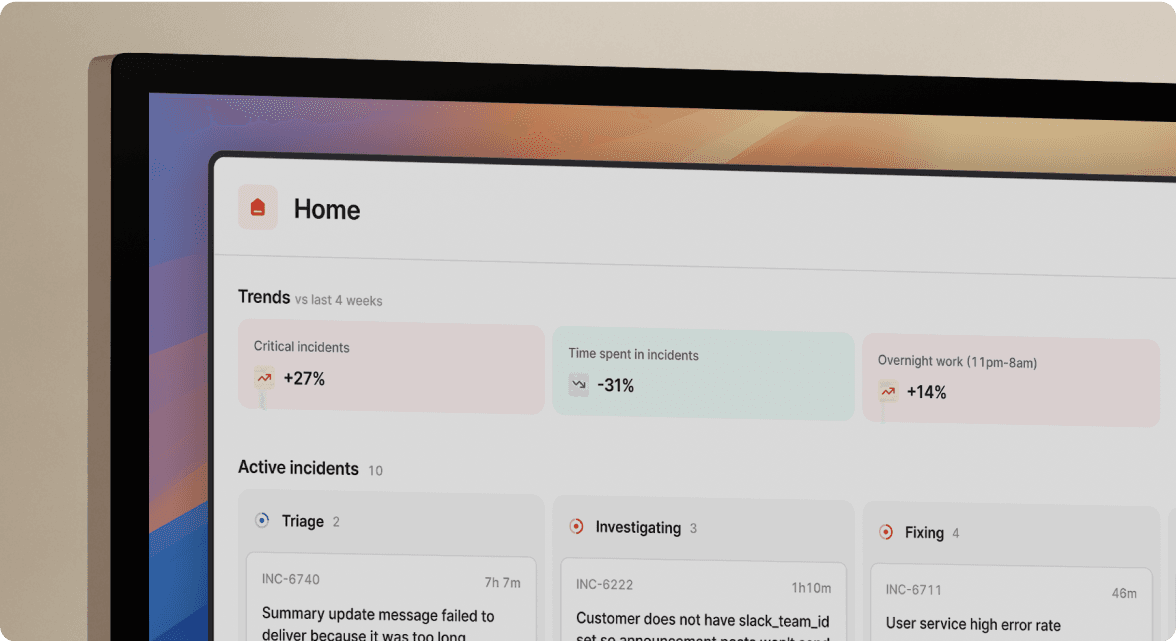
We’d love to talk to you about
- All-in-one incident management
- Our unmatched speed of deployment
- Why we’re loved by users and easily adopted
- How we work for the whole organization