JSM vs. Opsgenie for small teams: which scales better as you grow?
March 20, 2026 — 14 min read
Updated March 20, 2026
TL;DR: Atlassian's April 5, 2027 Opsgenie shutdown forces every small engineering team to pick a replacement. Migrating to Jira Service Management (JSM) looks like the obvious path if you already use Jira, but JSM's ITIL (Information Technology Infrastructure Library) ticketing roots add admin overhead that fast-moving SRE teams can't afford. For teams of 100-500 engineers, a purpose-built, Slack-native platform like incident.io reduces coordination overhead, requires no process overhauls, and costs less than JSM Premium at $45/user/month (Pro + on-call) versus JSM's ~$51/agent/month Premium rate. Pick the tool built for real-time incident coordination, not IT helpdesk tickets.
Coordination overhead eats a significant share of incident response time, often rivaling the technical fix itself. The Opsgenie sunset on April 5, 2027 means you can't ignore this any longer. You have roughly 12 months to migrate, validate, and deprecate your current setup. The question isn't whether to move, it's where to move. This guide compares JSM and modern alternatives to help you choose incident management software that scales with your team without requiring a dedicated admin or months of reconfiguration.
The Opsgenie sunset and what it means for small teams
Atlassian's timeline is tighter than many teams realize. New Opsgenie purchases and upgrades stopped on June 4, 2025. Full end-of-support lands on April 5, 2027, at which point Atlassian permanently deletes all Opsgenie data. That means your on-call schedules, escalation policies, and historical incident data disappear.
For a 100-500 person engineering team, the risks are concrete:
- Migration-induced outages: A misconfigured escalation path during cutover can cause a missed page during a P1 (Priority 1) incident.
- Lost historical context: If you don't export your on-call schedules and alert integrations before April 2027, that data is gone permanently.
- Forced consolidation pressure: Atlassian's sales motion naturally pushes you toward JSM, but that doesn't mean JSM is the right tool for your SRE workflow.
JSM vs. Opsgenie: core differences for startups
Alerting and on-call management
Opsgenie's architecture centers on "Teams," "Alerts," and "Escalation Policies." Every workflow starts with an alert and routes directly to a human responder. JSM takes the opposite approach: it starts with a service project and an ITIL-aligned issue/ticket. Per Atlassian's own documentation, JSM creates major incidents as Jira tickets, with alert routing handled through integrated on-call features on the sidebar, meaning the ticket is the primary object, not the alert.
For a small SRE team, that distinction matters. When your Datadog alert fires at 2 AM, you want a pager, not a form.
Incident coordination and ChatOps
Both Opsgenie and JSM are largely web-first by design. ChatOps (the practice of running operational workflows directly inside a chat platform like Slack) is largely an afterthought in both tools. JSM requires you to navigate to your service project, select Incidents, and create a ticket with the relevant impacted service, all before your on-call engineer has opened a Slack channel.
incident.io's Slack-native approach removes that web UI dependency entirely. You declare an incident directly in Slack using /incidentinc declare in any channel, and incident.io auto-creates the dedicated channel, pages on-call, and starts timeline capture automatically.
Post-incident review and AI capabilities
JSM offers basic post-incident reporting tied to Jira issue history. incident.io's AI SRE assistant connects telemetry, code changes, and past incidents to draft post-mortems from captured timeline data, delivering up to 80% reduction in MTTR. The post-mortem problem is real: what previously took 90 minutes of manual reconstruction becomes approximately 10 minutes of review and publish.
JSM setup challenges for small teams
Configuration overhead
Configuring JSM's incident management module for a small team involves a meaningful number of steps: subscribing to the right plan, creating an ITSM service project, enabling on-call features in the sidebar, setting up user notification preferences, creating response teams, assigning owner teams to services, configuring routing rules, and customizing ITIL workflows. Each step requires Jira administrator permissions.
Third-party analysis at SmartSuite (an Atlassian competitor in the project management space) confirms that JSM's setup is complex for teams without prior Jira expertise, with the interface difficult for non-technical users to understand and customization requiring significant configuration and ongoing maintenance.
For a 10-15 person Site Reliability Engineering (SRE) team without a dedicated ITSM admin, that configuration debt lands directly on your engineers.
Cost structures and hidden fees
JSM on-call scheduling is available across plans, but advanced routing features like multiple routing rules per team and advanced escalation steps require JSM Premium, which runs approximately $51/agent/month for teams up to 100 agents. incident.io's Pro plan with on-call costs $45/user/month ($25 base + $20 on-call add-on). Here's how the annual math works for a 20-person on-call team:
| Tool | Monthly cost per user | Annual cost (20 users) | Advanced on-call routing |
|---|---|---|---|
| JSM Premium | ~$51 (Atlassian list price) | ~$12,240 | Requires Premium |
| incident.io Pro + On-call | $45 | $10,800 | Included |
The $1,440 annual difference favors incident.io, and that's before accounting for the admin hours JSM's ITIL configuration requires.
Pros and cons for small teams: JSM vs. incident.io
JSM
Pros:
- Deep Jira integration: follow-up tasks, ticket history, and SLA tracking under one vendor.
- Single procurement contract if you already use the full Atlassian suite.
- ITIL-compliant workflows for teams that need formal change and problem management.
Cons:
- Web-first UI requires browser navigation during live incidents when your team is already in Slack.
- Configuration complexity scales admin burden as your team and service catalog grow.
- IT helpdesk focus means incident workflows carry ticket-based assumptions that don't map well to real-time SRE coordination.
- Advanced on-call routing requires project admin permissions to configure escalation steps and routing rules.
incident.io
Pros:
- Slack-native from day one: declare, manage, and close incidents without leaving Slack via
/inccommands. - Transparent all-in pricing at $45/user/month (Pro + on-call). No hidden agent tiers or Premium upgrade surprises.
- AI SRE delivers up to 80% reduction in MTTR, including identifying the likely change behind incidents, opening pull requests directly in Slack, and auto-drafting post-mortems.
- Jira follow-up tasks sync bi-directionally to your existing Jira projects, so you're not replacing Jira, you're feeding it better incident data.
- Ranked #1 in G2's Relationship Index (Spring 2024), with reviewers consistently citing ease of use and support quality.
Cons:
- Adds a new vendor outside the Atlassian stack, requiring a separate procurement approval.
- Smaller plans have integration count limits that can constrain teams with many monitoring tools on entry-tier pricing.
- No standalone mobile app, on-call engineers rely on the Slack mobile app, which ties reliability to Slack's uptime and notification delivery.
- Opinionated workflow design can limit customization as teams scale and develop bespoke incident processes that don't fit the default structure.
Feature comparison
| Feature | JSM | incident.io | Key differentiator for small teams |
|---|---|---|---|
| Incident declaration | Web UI form | /inc declare in Slack | No browser tab needed at 3 AM |
| On-call scheduling | All plans (advanced routing needs Premium) | Pro + add-on ($45/user/mo) | Transparent pricing, no tier surprises |
| Post-mortem automation | Basic issue history | AI-drafted from timeline | 90-min manual work drops to ~10 min (company-reported) |
| Jira follow-up sync | Native | Bi-directional sync | Both tools work together, not against |
| ITIL framework | Built-in, required | Optional via workflows | SRE teams aren't running IT helpdesks |
| Opsgenie migration tools | Atlassian-native path | Dedicated migration tooling | Schedules, escalations, data import |
Top incident and on-call tools for startups
If you're evaluating beyond JSM and incident.io, two other incident management tools come up consistently for engineering teams.
incident.io
Best for Slack-native coordination and AI-assisted post-mortems delivering up to 80% reduction in MTTR. The Beyond the Pager webinar covers the Opsgenie migration path in detail, including parallel-run strategies and data import tooling. A dedicated Opsgenie migration guide with schedule import and escalation mapping is built in.
Rootly
Good for teams wanting deep Slack integration alongside a Terraform-heavy infrastructure-as-code workflow. Rootly's Essentials tier runs $240/user/year ($20/user/month), making it cheaper than incident.io for pure incident response without on-call. However, the Scale tier jumps to $42,000/year for 100 users, so the pricing trajectory changes significantly as you grow.
Grafana OnCall
Best for teams already running Grafana for observability. Grafana OnCall is open-source and integrates deeply with Grafana alerts, reducing the need for separate paging infrastructure. While it may not offer the same AI post-mortem automation and Slack workflow depth as incident.io, it is worth evaluating if your monitoring stack is Grafana-first.
Decision framework: how to choose your next incident management tool
Three questions cut through the noise when you're choosing incident management software under a deadline:
- Does this tool require a dedicated admin to configure and maintain it? JSM's ITIL workflows need Jira administrator permissions to edit, and advanced customization adds significant overhead. If your team doesn't have an ITSM admin, that burden lands on your SREs.
What is the true all-in cost including on-call routing? The base price is rarely the real price.JSM requires Premium for advanced on-call at approximately $51/agent/month. JSM requires Premium for advanced on-call at approximately $51/agent/month. incident.io adds $20/user/month for on-call on top of the $25 base Pro rate, landing at $45/user/month. Get the full number before comparing vendors.
- Will engineers actually use it at 3 AM without a manual? This is the adoption question that determines whether your migration actually improves MTTR (Mean Time To Resolution) or just shifts tool sprawl. As one verified G2 reviewer puts it:
"Incident Workflows - The tool significantly reduces the time it takes to kick off an incident. The Slack Commands feel natural and approachable for team members in our workspace." - Carmen G. on G2
Once you've answered these three questions, review the Opsgenie migration guide for detailed schedule import, parallel-run strategies, and a step-by-step migration checklist.
How incident.io helps small teams scale incident response
Auto-created Slack channels via/inc declare
A Datadog alert fires, incident.io creates #inc-2847-api-latency-spike, pages the on-call engineer, pulls in the service owner, and starts live timeline capture. Compare that to the typical manual flow: someone checks the alert tool, manually posts to #incidents, creates a new channel, pastes the alert link, and @mentions teammates, all before a single line of diagnostic output gets reviewed. Alert routing documentation covers how to configure team-level routing rules that mirror your existing Opsgenie escalation paths.
AI SRE for auto-drafted post-mortems
When an incident closes, incident.io's AI SRE assistant has already captured the full timeline, connected code changes and past incidents, and drafted 80% of the post-mortem. That turns what was previously a 90-minute reconstruction effort into approximately a 10-minute review and publish cycle (company-reported). One G2 reviewer captures the shift well:
"incident.io makes incidents normal. Instead of a fire alarm you can build best practice into a process that everyone - technical or non-technical users alike - can understand intuitively and execute." - Verified user on G2
Insights dashboard for MTTR tracking
For many teams, median P1 MTTR runs 45 to 60 minutes, with a significant chunk going to team assembly before any diagnostic work starts. incident.io's Insights dashboard tracks MTTR trends, incident volume by service, and repeat patterns, giving you the data you need to justify reliability investments in quarterly business reviews without manually wrangling Jira and Google Sheets exports.
Schedule a demo to see the Opsgenie migration path and Slack workflow live before your team commits.
Key terms glossary
MTTR: Mean Time To Resolution. The average time from when an incident is detected to when normal service is fully restored. Tracked per severity tier (P1, P2) and used to measure reliability improvement over time.
On-call rotation: A schedule that defines which engineer is responsible for responding to alerts outside of business hours. Rotations typically cycle weekly or bi-weekly across a team.
Post-mortem: A structured document written after an incident that captures the timeline, root cause, impact, and follow-up actions. The goal is learning and prevention, not blame.
ITIL: Information Technology Infrastructure Library. A set of ITSM best practices originally designed for enterprise IT departments managing hardware, software, and service requests. JSM's incident management workflows are built on ITIL principles, which can add process overhead for SRE teams focused on real-time production incident coordination.
FAQs

Tom Wentworth
Chief Marketing Officer
See related articles
Introducing Investigations, powered by Nexus.
Today we're launching Investigations: agentic root cause analysis that starts the moment you're paged, figures out what broke and why, and works with your team through to resolution. Here's what we built, what's powering it, and why it took some time to get right.

August 5, 2026
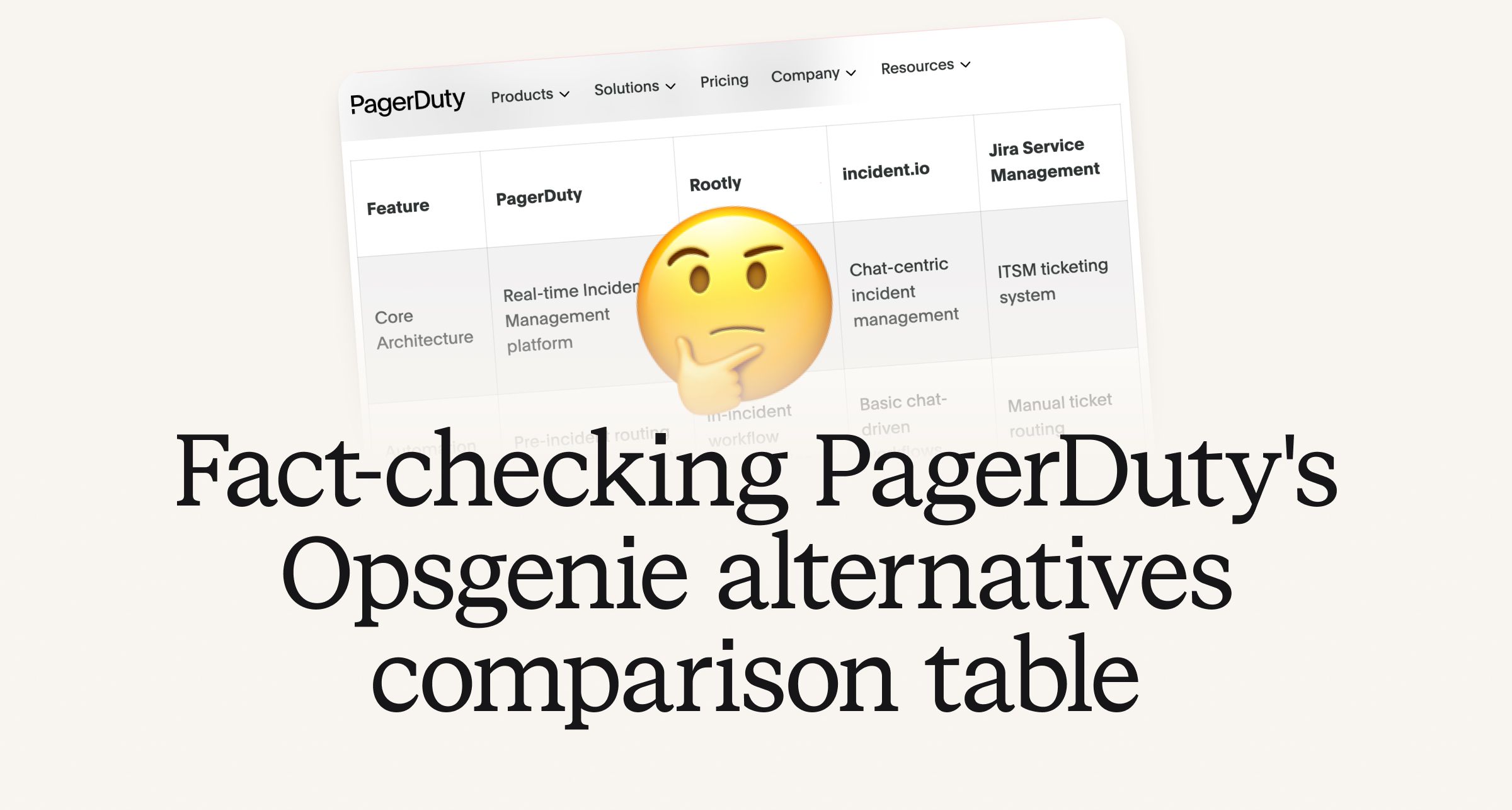
Fact-checking PagerDuty's Opsgenie alternatives comparison table
PagerDuty published a new comparison table about incident.io. Once again, it describes a product we don't recognize. So once again, we're correcting the record, row by row, with receipts.

July 28, 2026
Your genie is vanishing: introducing the Opsgenie rescue program
Today, we're launching the Opsgenie Rescue Program to make that landing soft: simplified migration and free overlap so you never pay two vendors at once.
July 9, 2026
So good, you’ll break things on purpose
Ready for modern incident management? Book a call with one of our experts today.
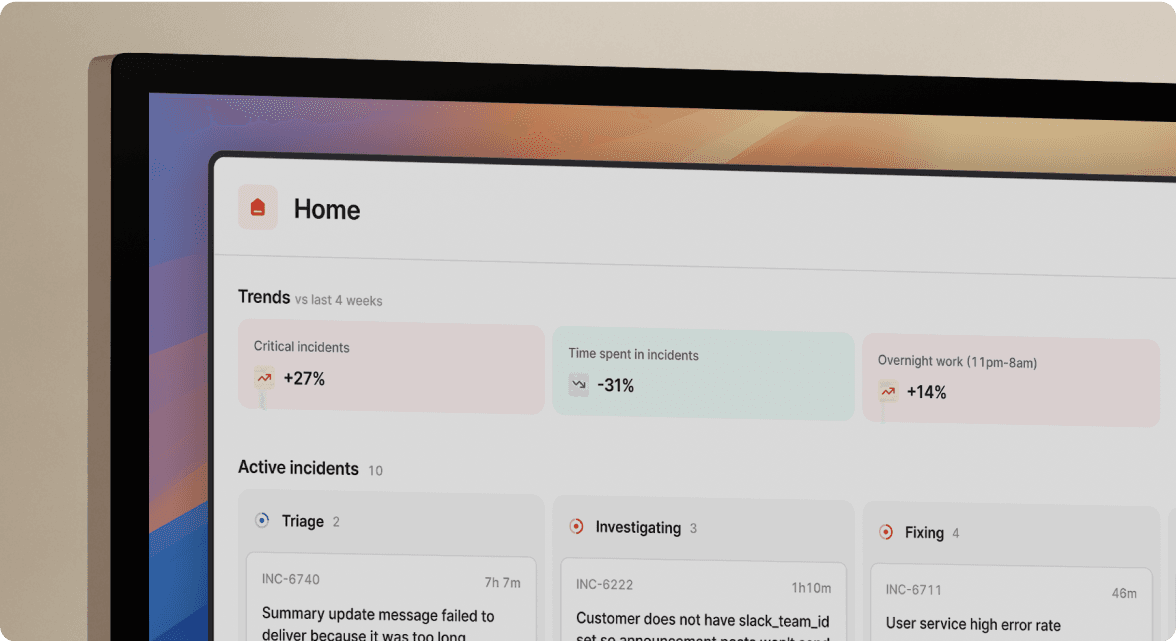
We’d love to talk to you about
- All-in-one incident management
- Our unmatched speed of deployment
- Why we’re loved by users and easily adopted
- How we work for the whole organization