Join live: What happens when your AI goes down?
PagerDuty vs. Opsgenie: Feature comparison, pricing, and migration guide
February 17, 2026 — 24 min read
Updated February 17, 2026
TL;DR: Atlassian is consolidating Opsgenie into Jira Service Management with end-of-support on April 5, 2027, forcing existing customers to migrate. PagerDuty remains the legacy alerting standard but costs $21-41+ per user monthly with expensive add-ons for AI and status pages. Both tools focus on alerting but leave coordination work scattered across multiple tools. Modern engineering teams are choosing incident.io to unify on-call alerting and incident response in a single Slack-native platform, reducing Mean Time To Resolution (MTTR) by up to 80% through automated coordination and auto-drafted post-mortems.
If you're evaluating PagerDuty versus Opsgenie today, you're likely reacting to one of two catalysts. Either Atlassian's forced consolidation of Opsgenie into Jira Service Management with an April 2027 deadline has pushed you to reconsider your entire incident stack, or PagerDuty's escalating renewal costs and declining support quality have made you question whether you're getting value for $40+ per user monthly.
But swapping one legacy alerting tool for another doesn't solve the core problem your team faces at 3 AM when production is down. The problem isn't just "who gets paged." It's the 15 minutes wasted assembling the team across five tools, the 90 minutes spent reconstructing post-mortems from Slack scroll-back, and the cognitive load of context-switching between PagerDuty, Slack, Jira, Datadog, and a Google Doc while you're trying to fix the actual issue.
This guide compares PagerDuty and Opsgenie on features, pricing, and workflow reality against incident management best practices, then evaluates whether standalone alerting tools still make sense when the real MTTR killer is coordination overhead, not who gets paged.
The core difference: Standalone alerting vs. Atlassian ecosystem vs. unified incident management
PagerDuty is the established independent powerhouse. The platform handles alerting at scale with 700+ integrations and serves many Fortune 100 companies. PagerDuty excels at routing alerts, managing on-call schedules, and ensuring someone gets paged reliably. But once the page fires, you leave PagerDuty to coordinate the response. You're back in Slack creating channels manually, opening Datadog dashboards, starting Google Docs for notes, and updating your status page separately.
Opsgenie was built as the on-call scheduling tool for teams already committed to the Atlassian ecosystem. It offered 200+ integrations with deep Jira and Confluence hooks. The value proposition was simple: if you already pay for Jira Service Management, you get alerting capabilities included. The tradeoff was a complex UI and forced coupling to JSM's service desk workflows that many engineering teams didn't need. Now, with Atlassian requiring migration to JSM or Compass by April 2027, that "bundled" value is forcing teams to re-evaluate whether they want incident management dictated by their ticketing system.
The third option is unified incident management software. Tools like incident.io consolidate on-call alerting, Slack-native incident coordination, automated timeline capture, auto-drafted post-mortems, and status page updates into a single workflow.
Feature-by-feature comparison
| Feature | PagerDuty | Opsgenie/JSM | incident.io |
|---|---|---|---|
| On-call scheduling | Advanced templates, mobile editing, complex rotations | Clear single-screen view, calendar switcher, simple overrides | Import from PD/Opsgenie, flexible rotations, Slack-native management |
| Alerting & routing | 700+ integrations, sophisticated rules engine, AIOps (AI for IT Operations) noise reduction (add-on) | 200+ integrations, deep Jira/JSM coupling, timeline view | Native monitoring integrations (Datadog, Prometheus), alert priorities, auto-escalation |
| Incident coordination | Web UI or Slack notifications with basic actions | Web UI-first with Slack commands for acknowledging/closing alerts | Fully Slack-native with /inc commands, auto-created channels, role assignment |
| Timeline capture | Alert history only; coordination happens elsewhere | Basic timeline of alert events; manual documentation | Automatic capture of Slack messages, commands, Scribe AI call transcription |
| Post-mortem generation | Manual or third-party tools | Manual with Confluence integration | AI-drafted from captured timeline, 10-15 min editing vs. 90 min manual |
| Status pages | Separate subscription (1,000 subscribers = $1,068/year) | Requires Statuspage.io subscription | Included in plans |
| Mobile app quality | Industry-leading, full schedule management, Intune support | Solid for incident response, less comprehensive | iOS/Android apps with notification customization |
| Pricing model | Per-user/month + add-ons (AIOps, AI, Status) | Per-agent JSM license (includes on-call) | Transparent per-user: $25/user Pro + $20/user on-call add-on |
Alerting and on-call management
PagerDuty's on-call capabilities are the gold standard for complex enterprises. The platform supports sophisticated escalation policies that notify targets sequentially until acknowledgment, schedule templates for multi-team coordination, and mobile apps with full editing capabilities.
Opsgenie's scheduling interface is widely praised for its clarity. The single-dashboard view of rotations, overrides, and final schedules with a useful calendar/timeline switcher makes it easier to understand who's actually on-call at any given moment. The platform allows teams to acknowledge, close, or assign alerts directly from Slack using commands like /genie ack, though the deeper coordination work still happens in the web UI.
We handle on-call scheduling with flexible rotation building and inherit the best ideas from both platforms. The key differentiator is what happens after the page fires. Instead of switching to a web UI, engineers stay in Slack where we auto-create incident channels with the right people already invited, relevant service context from the Service Catalog, and commands to escalate or assign roles without leaving the conversation.
"incident.io allows us to focus on resolving the incident, not the admin around it. Being integrated with Slack makes it really easy, quick and comfortable to use for anyone in the company, with no prior training required." - Andrew J. on G2
Incident response and coordination
This is where the architectural differences become critical. When an alert fires in PagerDuty or Opsgenie, you get a Slack notification with basic details and buttons to acknowledge or view in the web UI. The actual work of coordinating the response (creating a war room channel, pinging the database team, capturing what changes were made, updating stakeholders) happens manually across multiple tools.
We invert this model. incident.io is Slack-native by design, meaning the entire incident lifecycle runs in chat. When a Datadog alert fires, we auto-create #inc-2847-api-latency, page the on-call SRE, pull in the service owner based on Catalog data, and start capturing a timeline automatically. Role assignment (/inc assign @sarah), severity changes (/inc severity high), and escalation (/inc escalate @database-team) happen as natural Slack commands.
The coordination automation delivers measurable time savings. Teams using incident.io report up to 80% MTTR reduction by eliminating coordination overhead. You spend 2-3 minutes assembling instead of 12-15 minutes manually creating channels and hunting for the right people across spreadsheets and org charts.
"Without incident.io our incident response culture would be caustic, and our process would be chaos. It empowers anybody to raise an incident - and helps us quickly coordinate any response across technical, operational and support teams." - Matt B. on G2
Integrations and ecosystem depth
PagerDuty leads on raw integration count with 700+ platform integrations spanning monitoring tools (Datadog, Prometheus, New Relic), communication platforms (Slack, Microsoft Teams), and ITSM (IT Service Management) systems (ServiceNow, Jira). This breadth makes PagerDuty viable for large enterprises with legacy systems that still need alerting coverage.
Opsgenie's strength is depth within the Atlassian ecosystem with two-way sync to Jira tickets, Confluence post-mortem templates, and JSM service catalog mapping. If your organization runs entirely on Atlassian tools, this tight coupling can be valuable. For teams using best-of-breed tools across vendors, it becomes restrictive.
We prioritize deep workflow integrations over breadth. incident.io connects with Slack, Microsoft Teams, PagerDuty, Opsgenie, Datadog, Jira, GitHub, and major observability platforms with rich bidirectional data flow: auto-creating Jira follow-ups with timeline context, pulling service metadata from Backstage, syncing with ServiceNow. We integrate with the tools you actually use during incidents, not legacy systems you're trying to sunset.
Pricing and total cost of ownership
PagerDuty's published pricing starts with a Professional plan at $21 per user per month (annual billing). The Business plan costs $41 per user monthly, adding custom incident types, trigger-based workflows, and advanced admin features. For a 100-user team, that's $49,200 annually before add-ons.
The add-on structure escalates costs quickly. Critical features are sold separately: AIOps for noise reduction costs $699 monthly, PagerDuty Advance for AI capabilities costs $415 monthly, and Status Pages are sold in 1,000-subscriber packs at $1,068 per pack annually. Adding these three features brings the annual cost for a 100-user team to $63,636 before analytics, incident response capabilities, or professional services.
According to data from Vendr's marketplace, the average PagerDuty contract is approximately $64,621 annually, suggesting most teams purchase at least some add-ons to make the platform functional for modern incident management needs.
Opsgenie's standalone pricing historically ranged from $9.45 to $31.90 per user monthly depending on plan tier. However, with the consolidation into Jira Service Management, current pricing is tied to JSM agent licenses. JSM Standard costs approximately $20 per agent monthly, Premium runs $47-53 per agent, and Enterprise requires custom pricing often reaching six figures annually.
The challenge with JSM pricing is that on-call features are bundled with full ITSM capabilities your engineering team may not need. Standard plans include 5,000 automation rule runs monthly, but lack advanced features like asset management and AI virtual agents. Premium and Enterprise plans include 1,000 AI-assisted conversations monthly, after which you pay $0.30 per conversation. Status pages require a separate Statuspage.io subscription for both Opsgenie and JSM.
For teams that don't need a full service desk platform, you're effectively paying for ticketing, change management, and CMDB (Configuration Management Database) functionality just to get incident alerting, creating higher costs and increased complexity compared to purpose-built incident management tools.
We use transparent per-user pricing. Our Pro plan costs $25 per user monthly for incident response features (timeline capture, workflows, status pages, AI post-mortems). On-call management is a $20 per user monthly add-on, bringing the total to $45 per user for teams that need both incident coordination and on-call scheduling.
Why teams are leaving Opsgenie (and where they go)
The Opsgenie sunset announcement created a forcing function for thousands of engineering teams. Atlassian requires existing customers to migrate data and configurations before April 5, 2027, with the platform unavailable for new purchases or trials after June 4, 2025.
User sentiment around the migration is overwhelmingly negative. Teams that relied on Opsgenie's unified approach for years report frustration at being forced into a fragmented solution managing incident response across multiple Atlassian interfaces. The choice between migrating to JSM (gaining ITSM features they don't need) versus Compass (managing incidents separately from service operations) feels like a step backward.
The complexity of JSM implementations adds migration burden. According to teams who actually migrated, simple setups took 6-8 weeks minimum and complex setups with 20+ integrations took 8-16 weeks. For teams that could set up Opsgenie in days, committing to a multi-month JSM implementation to retain incident management capabilities is difficult to justify.
Pricing predictability has eroded. Since the deprecation transition into JSM, many teams report costs becoming less predictable and harder to justify compared to standalone Opsgenie's straightforward per-user model. The per-agent JSM pricing combined with usage-based charges for AI conversations and asset objects creates budget uncertainty.
Most significantly, the strategic question many teams are asking is whether they want their incident management tool dictated by their ticketing vendor. Opsgenie's strength was its unified approach as a purpose-built alerting tool. Migrating to JSM means accepting that incident response becomes a subset of ITSM workflows rather than a specialized discipline with its own requirements.
Teams evaluating alternatives after the Opsgenie announcement generally fall into three camps: those already deeply invested in Atlassian who migrate to JSM despite the friction, those seeking a "like-for-like" alerting replacement and evaluating PagerDuty, and those using the migration as an opportunity to rethink their entire incident management stack toward unified platforms.
The third option: Why modern teams choose incident.io
The challenge with both PagerDuty and Opsgenie is that they solve the "who gets paged" problem but not the "how do we fix this efficiently" problem. Alert routing is table stakes. The real MTTR killer is coordination overhead: manually creating channels, assembling teams, capturing what happened, writing post-mortems, and updating status pages across five different tools while you're trying to actually resolve the incident.
We consolidate this fragmented workflow into a single Slack-native platform. When a Datadog alert fires, our system auto-creates a dedicated incident channel, pages the on-call SRE, pulls in service owners based on Catalog metadata, and begins capturing a timeline automatically. Every Slack message, command, and role assignment flows into a structured timeline that becomes the foundation for automated post-mortems.
The coordination happens through intuitive /inc commands that feel like natural Slack conversations. Type /inc assign @sarah to make her incident commander. Type /inc escalate @database-team when you realize it's a connection pool issue. Type /inc severity high when customer impact increases. No web UI, no context switching, no manual documentation.
The AI capabilities speed up both response and follow-up. During incidents, the AI SRE identifies likely root causes and suggests next steps based on past incidents. After resolution, Scribe AI joins Google Meet or Zoom calls automatically, transcribes conversations in real-time, identifies key decisions, and feeds that context into post-mortem drafts. Using the captured timeline of commands, messages, and decisions, the AI generates post-mortems that include incident summary, timeline of events, contributing factors, and suggested follow-up items. Engineers spend 10-15 minutes reviewing and refining instead of 90 minutes writing from scratch.
Status pages included in our plans can be updated manually or via workflows during incident response. Follow-up Jira tickets auto-create with timeline context, ensuring action items don't disappear into post-mortem documents that nobody reads.
"I'm new to incident.io since starting on a new job, after many years using Atlassian's Statuspage and PagerDuty. Three things that I believe are done very well in incident.io: integration with other apps and platforms, holistic approach to incident alerting and notifications, and customer/technical support. It's on a very different level (much better) from other vendors." - Rodrigo Q. on G2
For teams migrating from PagerDuty or Opsgenie, we offer direct import tools for schedules and escalation policies. Our platform can run in parallel with your existing paging tool during a validation period, allowing you to test the Slack-native workflow with real incidents before committing to full migration. Intercom's engineering team used this parallel-run approach when migrating from PagerDuty and Atlassian Status Page, consolidating their fragmented stack into a single platform.
The measurable impact shows up in MTTR trends and engineer satisfaction. Teams report assembly time dropping from 15 minutes to 2-3 minutes, and new engineers handling on-call confidently in days instead of weeks because the process lives in intuitive commands rather than tribal knowledge.
"Makes managing major incidents smooth and intuitive... Everything can be done from Slack. For Slack-centric departments / businesses, this makes it easy to pick up and use with minimal training (if any)" - Verified user on G2
Migration strategy: Moving from Opsgenie without downtime
Whether you're migrating to PagerDuty, incident.io, or another platform, the core challenge is maintaining 24/7 incident response capability while transitioning infrastructure. Here's a framework for safe migration:
1. Audit your current configuration (Week 1)
Export your existing Opsgenie schedules, escalation policies, integration configurations, and alert rules. Document which teams own which services, who's in each on-call rotation, and what notification preferences matter. For teams migrating to incident.io, our automated import tools use this configuration as your baseline.
2. Set up parallel alerting (Week 2-3)
Configure your new platform to receive alerts alongside Opsgenie. Use webhook routing or alert forwarding so both systems receive monitoring alerts simultaneously. This parallel-run period lets you validate that alerting works correctly in the new tool before cutting over on-call responsibilities.
3. Migrate on-call schedules (Week 3)
We support bulk import of schedules directly from Opsgenie, which saves significant time if you have multiple schedules. For manual migration to any platform, start with one or two teams rather than migrating everyone simultaneously. Validate that on-call notifications work correctly and that schedule overrides function as expected.
4. Run real incidents on both platforms (Week 3-6)
For several weeks, respond to incidents using both Opsgenie and your new platform. This reveals workflow gaps, missing integrations, or configuration issues before you're dependent on the new tool. Document what works differently and adjust processes. Based on actual migration experiences, teams underestimate this validation period by 2-3x, so plan for 4-6 weeks minimum.
5. Cut over incrementally by team (Week 6-10)
Migrate one team at a time rather than a big-bang cutover. Start with a team that has simpler on-call requirements and good process discipline. Use their feedback to refine configuration before migrating teams with more complex needs.
6. Decommission Opsgenie (Week 10+)
Once all teams have successfully handled incidents on the new platform for at least two weeks, disconnect Opsgenie integrations and cancel the subscription. Archive your Opsgenie post-mortem data and configuration exports for reference.
Our platform enables faster migration than typical JSM implementations because the Slack-native interface requires minimal training compared to web-based tools that need formal onboarding. Teams can validate the workflow with real incidents during parallel runs without extensive configuration or change management processes.
Final verdict: Which tool is right for you?
Choose PagerDuty if:
- You're a large enterprise (500+ engineers) with complex alerting requirements and legacy systems requiring 700+ integration breadth
- Budget is not a primary constraint and you value the battle-tested reliability of nearly 70% of Fortune 100 companies trusting the platform
- You need sophisticated alerting rules engines and complex escalation paths for tens of thousands of monthly alerts
- You're comfortable paying separately for coordination tools (Slack), post-mortem platforms (Confluence), and status pages (Statuspage.io)
- Your team prefers web-first UIs over chat-native workflows
Choose Opsgenie/JSM if:
- You are 100% committed to the Atlassian ecosystem and already run Jira Service Management as your ITSM platform
- You need tight integration between incident management and service desk ticketing workflows
- Budget is the only constraint and you can accept the forced ITSM features bundled with JSM licenses
- You're prepared for 8-16 week complex implementations and the learning curve of managing incidents within JSM's broader service management interface
- You've evaluated the April 2027 Opsgenie sunset timeline and confirmed migration to JSM or Compass aligns with your incident management philosophy
Choose incident.io if:
- You want to reduce MTTR by up to 80% by eliminating coordination overhead rather than just improving alerting
- Your team lives in Slack or Microsoft Teams and you want incident management to happen where work already flows
- You're tired of tool sprawl and want on-call scheduling, incident coordination, timeline capture, auto-drafted post-mortems, and status pages in one platform
- You value transparent pricing ($25/user/month Pro + $20/user/month on-call) over complex per-feature add-on models
- You need to migrate from Opsgenie using our automated import tools rather than spending months on JSM implementation
- You want measurable MTTR improvements from coordination automation, not just more sophisticated alerting
The reality is that PagerDuty and Opsgenie were both built in an era when "incident management" meant "who gets paged." Modern incident management is about the full lifecycle: assembling the right team in seconds, capturing what happened automatically, learning from incidents through auto-drafted post-mortems, and measuring improvement over time.
Schedule a demo to run your first incident in Slack and see how coordination feels when you never leave chat.
Key terms glossary
MTTR (Mean Time To Resolution): The average time from when an incident is detected until it is fully resolved and services are restored. Lower MTTR indicates more efficient incident response.
On-call rotation: A schedule defining which engineer is responsible for responding to alerts during specific time periods, typically rotating weekly or daily across team members.
Escalation policy: A set of rules defining who gets notified and when if an initial on-call responder doesn't acknowledge an alert within a defined time window.
Slack-native: Software architecturally designed to function primarily within Slack using native commands and interfaces, rather than a web application with Slack integration added later.
Timeline capture: Automated recording of all actions, decisions, and communications during an incident to create a chronological record for post-mortem analysis without manual note-taking.
FAQs

Tom Wentworth
Chief Marketing Officer
See related articles
Introducing Investigations, powered by Nexus.
Today we're launching Investigations: agentic root cause analysis that starts the moment you're paged, figures out what broke and why, and works with your team through to resolution. Here's what we built, what's powering it, and why it took some time to get right.

August 5, 2026
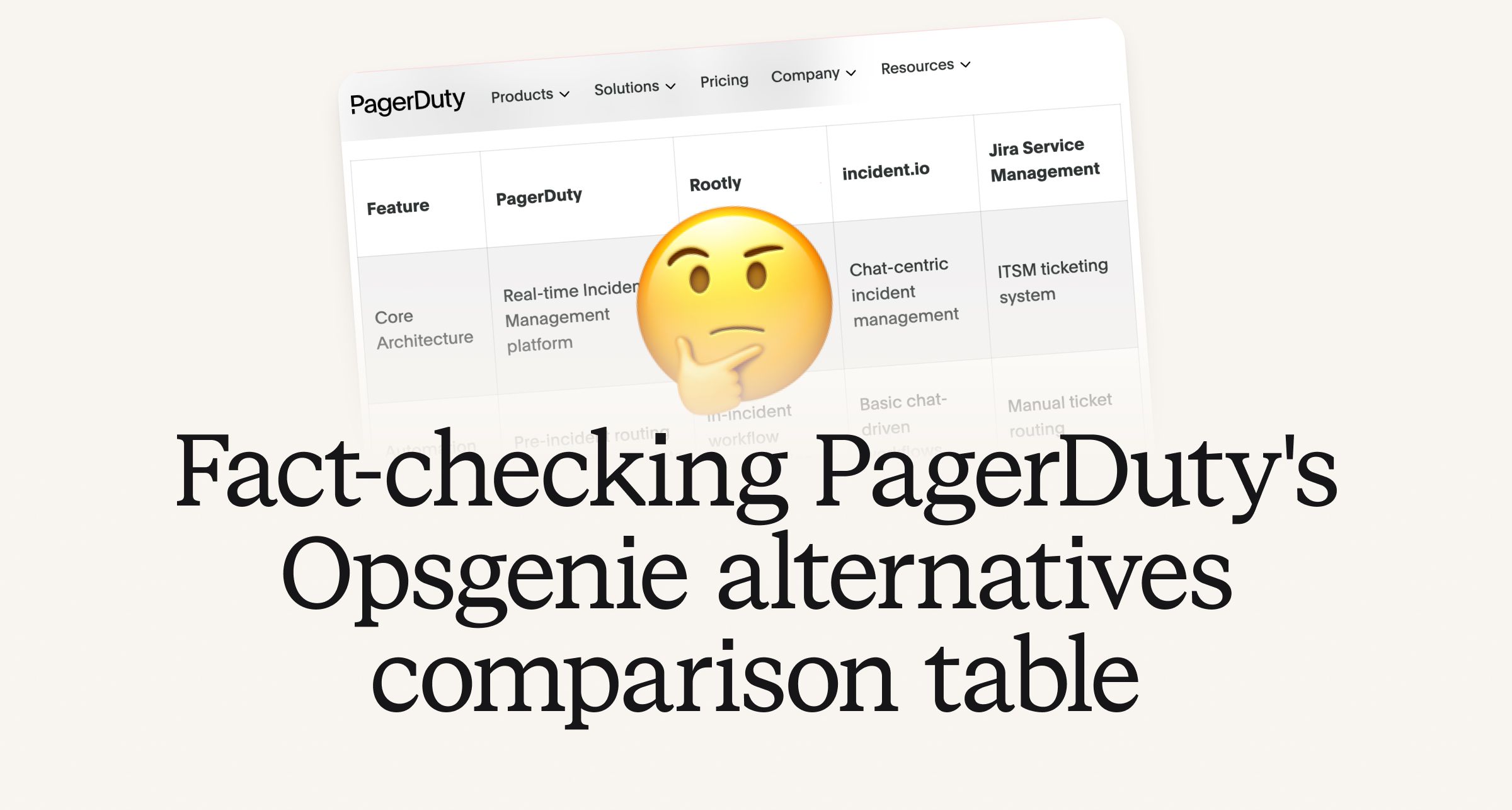
Fact-checking PagerDuty's Opsgenie alternatives comparison table
PagerDuty published a new comparison table about incident.io. Once again, it describes a product we don't recognize. So once again, we're correcting the record, row by row, with receipts.

July 28, 2026
Your genie is vanishing: introducing the Opsgenie rescue program
Today, we're launching the Opsgenie Rescue Program to make that landing soft: simplified migration and free overlap so you never pay two vendors at once.
July 9, 2026
So good, you’ll break things on purpose
Ready for modern incident management? Book a call with one of our experts today.
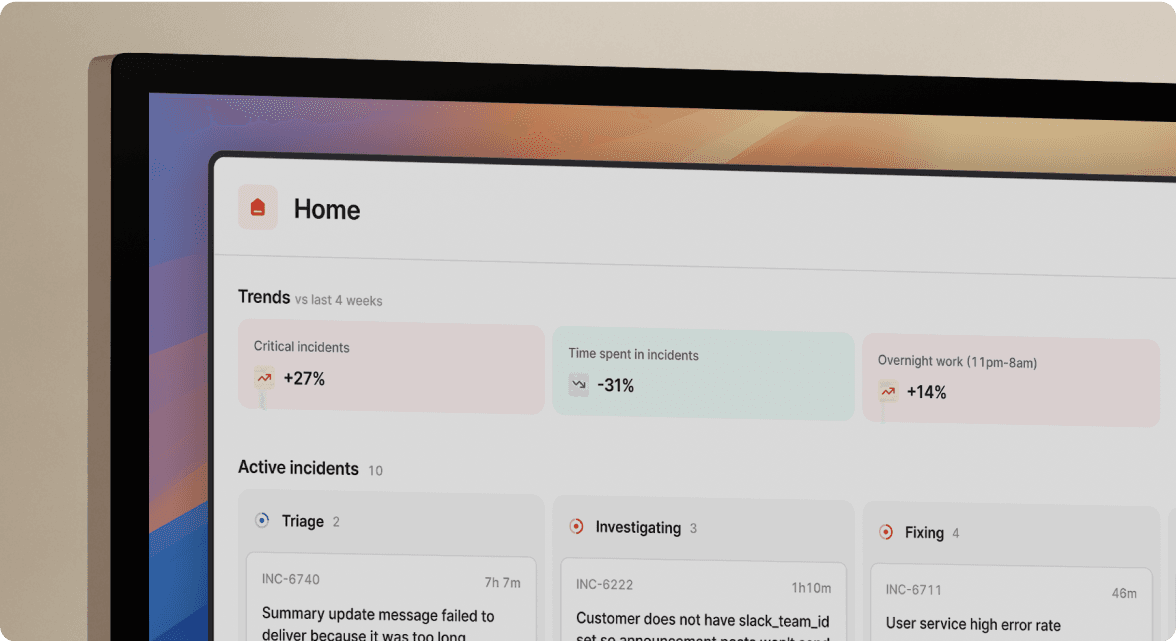
We’d love to talk to you about
- All-in-one incident management
- Our unmatched speed of deployment
- Why we’re loved by users and easily adopted
- How we work for the whole organization