Incident.io vs PagerDuty After Opsgenie: Which Platform Delivers Faster MTTR?
December 23, 2025 — 20 min read
Updated December 23, 2025
TL;DR: PagerDuty excels at alerting but forces teams to juggle five tools during incidents. We unify the entire lifecycle (alerting, coordination, status pages, post-mortems, AI investigation) directly in Slack. For a 100-person engineering team, PagerDuty’s Business plan costs approximately $58,656 annually after adding Status Pages and AIOps capabilities based on published pricing and add-on costs. Our Pro plan with on-call costs approximately $54,000 annually for a 100-person engineering team, with incident response at $25 per user per month and on-call scheduling at an additional $20 per user per month. Teams report cutting MTTR by removing the "coordination tax" of context-switching. Favor reduced MTTR by 37%, while Intercom migrated from PagerDuty in weeks without disrupting on-call rotations. PagerDuty wins on alerting rule granularity and proven enterprise scale. We win on workflow speed, support velocity, and total cost for teams under 500 engineers.
The coordination tax is killing your MTTR
A Datadog alert fires. The on-call engineer acknowledges it in PagerDuty, then manually creates a Slack channel, hunts for service owners, starts a Google Doc for notes, opens a Zoom call, and updates the status page. Eighteen minutes pass before troubleshooting begins. The technical fix takes 12 minutes. Three days later, reconstructing the post-mortem from memory and Slack scroll-back takes 90 minutes.
This is the coordination tax. PagerDuty solves alerting brilliantly, but teams still toggle between five tools during the critical path. The result is predictable: MTTR stays stubbornly high not because problems are harder, but because tools fragment the workflow.
We eliminate this tax by unifying on-call, response coordination, AI investigation, status pages, and post-mortems inside Slack. One platform, one interface, one timeline auto-captured from declaration through resolution. This article compares both incident management platforms across pricing, features, AI capabilities, and migration paths to help you decide which architecture fits teams of 50 to 500 engineers.
Web-first vs. Slack-native: Why architecture matters
The fundamental difference between PagerDuty and our platform is not feature count. It is where the work happens.
PagerDuty was built in 2009 as a web application with mobile apps added years later. The Slack integration sends notifications and enables basic actions, but core workflow steps like creating incident channels, updating status pages, and managing post-mortems happen in the PagerDuty web UI. You get an alert in Slack, then leave to do the work elsewhere.
We built incident.io in 2021 as a Slack-native platform. The entire incident lifecycle runs in chat via slash commands. When an alert fires, we auto-create a dedicated Slack channel, invite on-call responders, start capturing a timeline, and surface relevant runbooks. Role assignment (/inc assign), severity changes (/inc severity high), and resolution (/inc resolve) happen without leaving the conversation. Our web dashboard exists for reporting and configuration, not real-time response.
A workflow comparison
PagerDuty incident response:
- Alert notification arrives in Slack
- Engineer acknowledges in PagerDuty mobile app or web UI
- Manually create incident Slack channel and invite responders
- Open PagerDuty web UI to update incident details
- Switch to status page tool to post customer update
- Return to Slack for team coordination
- Create Jira ticket manually after resolution
- Reconstruct timeline from memory for post-mortem
Our incident response workflow:
- Alert auto-creates incident channel with context pre-loaded
- On-call engineer is auto-paged and joins channel
- Type
/inc assign @leadto designate incident commander - Our AI SRE begins investigation, surfacing potential root causes
- Status page updates automatically when incident state changes
- Timeline captures every message, role change, and decision
- Follow-up tasks auto-create in Jira from Slack
- Post-mortem auto-drafts from captured timeline data
The architectural difference translates to measurable time savings.
"We like how we can manage our incidents in one place. The way it organises all the information being fed into an incident makes it easy to follow for everyone in and out of engineering." - Verified user review of incident.io
Feature comparison: What's included vs. what costs extra
The total cost of ownership diverges sharply when you compare base features against required add-ons.
| Feature | Our Pro Plan | PagerDuty (Business Plan) |
|---|---|---|
| Base Price | $25/user/month | $41/user/month |
| On-Call Scheduling | Add-on: +$20/user/month | Included |
| Status Pages | Included (unlimited) | Basic page included (Professional: 250 subscribers, Business: 500 subscribers). Premium features require quote |
| Post-Mortems | Included (AI-generated) | Included in Business+ |
| AI Capabilities | Included (AI SRE, root cause analysis, fix PRs) | AIOps add-on: $699/month + consumption fees |
| ChatOps Commands | Native slash commands in Slack | Notifications + basic actions via integration |
| Incident Timeline | Auto-captured by AI Scribe | Manual or web UI entry |
| Support Model | Shared Slack channels, hours to fix bugs | Email ticketing, week-long response times reported |
This table reveals the core positioning difference. PagerDuty prices per user with features gated behind plan tiers and add-ons. We include the full incident lifecycle in the Pro plan, with on-call as the only add-on for teams needing alerting capabilities.
The hidden costs of add-ons
Marketplace research confirms that PagerDuty’s Status Pages and AIOps add-ons can significantly increase total annual costs, often exceeding $50,000 per year for mid-sized teams once required features are added.
We position AI, status pages, and automated post-mortems as core platform capabilities, not upsell opportunities. This philosophical difference drives TCO divergence at scale.
Total cost of ownership: running the numbers
Let's compare 12-month TCO for engineering teams of 50, 100, and 200 people. Assumptions: 30% of engineers are on-call at any time, PagerDuty Business plan with Status Pages and AIOps add-ons, our Pro plan with on-call.
Note: Calculations assume 30% of engineering team is on-call. PagerDuty licenses required for all on-call users. Our licenses required for all users who participate in incident response.
50-person engineering team
| Cost Component | PagerDuty | incident.io |
|---|---|---|
| Base licenses | 15 users × $41/mo × 12 = $7,380 | 15 users × $45/mo × 12 = $8,100 |
| Status Pages | $1,068/year | Included |
| AIOps | $8,388/year | Included |
| Annual Total | $16,836 | $8,100 |
| Savings | — | $8,736 (52%) |
100-person engineering team
| Cost Component | PagerDuty | incident.io |
|---|---|---|
| Base licenses | 30 users × $41/mo × 12 = $14,760 | 30 users × $45/mo × 12 = $16,200 |
| Status Pages | $1,068/year | Included |
| AIOps | $8,388/year | Included |
| Annual Total | $24,216 | $16,200 |
| Savings | — | $8,016 (33%) |
200-person engineering team
| Cost Component | PagerDuty | incident.io |
|---|---|---|
| Base licenses | 60 users × $41/mo × 12 = $29,520 | 60 users × $45/mo × 12 = $32,400 |
| Status Pages | $1,068/year | Included |
| AIOps | $8,388/year | Included |
| Annual Total | $38,976 | $32,400 |
| Savings | — | $6,576 (17%) |
These calculations use verified pricing from market research and official sources. The savings stem from our unified platform eliminating add-on fees that compound in PagerDuty's model.
Engineering time savings amplify ROI. If coordination overhead is reduced by approximately 15 minutes per incident across recurring incidents, teams can reclaim meaningful engineering hours annually, translating into measurable productivity gains depending on fully loaded hourly rates.
Reducing MTTR by eliminating coordination overhead
The promise of "faster incident resolution" requires evidence. Here's how the Slack-native architecture translates to measurable MTTR improvement.
Coordination tax breakdown
Research into incident response workflows reveals that teams using web-first tools lose 12-18 minutes per incident to coordination tasks:
- 3-5 minutes: Manually creating incident Slack channel and inviting responders
- 4-7 minutes: Switching between tools to gather context (monitoring, logs, recent deploys)
- 2-3 minutes: Manually updating status page
- 3-5 minutes: Creating follow-up tickets and documentation
We automate all four steps. When an alert fires, our platform instantly creates a channel, invites the on-call engineer and service owners, surfaces recent changes from the service catalog, and begins timeline capture. Status pages update when incident state changes. Follow-up tasks auto-create in Jira or Linear.
Customer evidence
Favor's engineering team reported a 37% reduction in Mean Time to Resolution (MTTR) after adopting our platform. A mid-sized company saved approximately 50% on on-call costs by migrating from PagerDuty while gaining better features and functionality.
"Too many to list - it's a one stop shop for incident management (not just on call rotations like many competitors. Built in and custom automations, great slack integration, automated post mortem generation, jira ticket creation, followup and actions creation..." - Verified user review of incident.io
This directly addresses the post-incident toil that often takes 60-90 minutes when reconstructing timelines from Slack scroll-back and memory.
Where PagerDuty excels
Honesty requires acknowledging PagerDuty's strengths. Its alerting rules engine is more sophisticated than ours, offering granular routing logic and complex escalation paths. For organizations with hundreds of services and intricate on-call hierarchies, PagerDuty's depth is valuable.
PagerDuty's mobile app is mature and feature-rich, with proven reliability for waking engineers at 3 AM. We rely on Slack and Teams mobile apps for notifications, which is excellent for teams already living in those platforms but may feel less specialized.
The trade-off is intentional. We optimize for "good enough" alerting with exceptional coordination. PagerDuty optimizes for maximum alerting flexibility with bolted-on coordination. Choose based on whether your pain is "alerts not reaching people" (PagerDuty) or "people wasting time coordinating after alerts arrive" (our platform).
AI that automates response vs. AI that costs extra
Both platforms market "AI capabilities," but their implementations and business models differ substantially.
PagerDuty's AIOps: alert intelligence add-on
PagerDuty AIOps is an add-on starting at $699/month that provides:
- Intelligent alert grouping to reduce noise
- Anomaly detection across incoming events
- Probable root cause suggestions based on alert correlation
- Event consumption-based pricing that scales with volume
This functionality operates at the pre-incident phase. AIOps helps you manage the flood of alerts before declaring an incident. It does not assist during active response, post-mortem generation, or follow-up task creation. Teams wanting automation throughout the lifecycle must piece together multiple tools.
Our AI SRE: Included workflow automation
Our AI SRE capabilities are built into the platform at no additional cost. The suite includes:
- Automated investigation: Analyzes telemetry, code changes, and past incidents to surface potential root causes
- Fix generation: Can create pull requests directly in Slack to remediate identified issues
- Scribe: Real-time transcription of incident calls, capturing key decisions and action items without a dedicated note-taker
- Post-mortem drafting: Uses captured timeline data to generate 80% complete post-mortems within minutes of resolution
Our AI SRE automates up to 80% of incident response tasks. This claim refers to the procedural and documentation work (timeline capture, role assignments, status updates, follow-up creation) rather than the technical troubleshooting itself.
The philosophical difference
"The AI insights are fantastic and genuinely useful." - Verified user review of incident.io
PagerDuty's AI is a premium feature sold separately. Our AI is a core platform capability included in base pricing. For teams evaluating total cost, this distinction is material.
The Opsgenie sunset: A forcing function for reevaluation
Atlassian's April 2025 Opsgenie sunset announcement created urgency for thousands of engineering teams. This forced migration offers a natural opportunity to reevaluate the entire incident management stack rather than defaulting to the nearest alternative.
Migration paths: JSM vs. PagerDuty vs. incident.io
Atlassian recommends migrating to Jira Service Management (JSM), but JSM is a service desk platform, not purpose-built for real-time incident response. Teams choosing JSM gain deeper Atlassian ecosystem integration at the cost of incident-specific workflow optimization.
PagerDuty is the incumbent option for teams prioritizing maximum alerting flexibility and enterprise scale. Expect higher costs and the coordination tax described earlier.
We offer direct import tools for Opsgenie schedules and escalation policies, enabling migration in days rather than weeks. Our platform supports parallel runs, allowing teams to test incident.io alongside Opsgenie before full cutover.
"The AI features really reduce the friction of incident management." - Verified user review of incident.io
Migration tooling and timeline
Our migration process for teams moving from PagerDuty or Opsgenie includes:
- Connect PagerDuty or Opsgenie: Configure integration in settings
- Bulk import: Escalation policies, schedules, and users transfer automatically
- Configure alert sources: Route monitoring tool alerts to incident.io
- Test and validate: Run test incidents to verify workflows
- Go live: Deactivate old platform after confidence period
Intercom's migration case study documents their engineering team migration from PagerDuty and Atlassian Status Page in a matter of weeks. The ability to mirror schedules during transition minimizes risk.
What users say: G2 reviews and support experiences
Third-party review platforms offer unbiased feedback on both tools. Here's what users say about our platform on G2.
User praise for our slack integration and ease of use
"To me incident.io strikes just the right balance between not getting in the way while still providing structure, process and data gathering to incident management." - Verified user review of incident.io
"The onboarding experience was outstanding — we have a small engineering team (~15 people) and the integration with our existing tools (Linear, Google, New Relic, Notion) was seamless and fast less than 20 days to rollout." - Verified user review of incident.io
"incident.io makes incidents normal. Instead of a fire alarm you can build best practice into a process that everyone - technical or no n-technical users alike - can understand intuitively and execute." - Verified user review of incident.io
Support auality as differentiator
"Overall, it is a very well-thought-out product that perfectly fits in a much-needed area for companies that want to achieve operational excellence." - Verified user review of incident.io
Multiple reviews emphasize our support velocity.
"We've already had some nice interactions with their customer success team and engineers with some minor feature requests that got added quickly." - Verified user review of incident.io
Our case study with Etsy includes a powerful data point: we shipped four requested features in the time a competitor took to respond to a single support ticket. This support velocity matters during production incidents when bugs or missing features can block resolution.
PagerDuty user concerns
Third-party analyses highlight pricing complexity and UI challenges with PagerDuty. Some reviews note that even after years of use, teams still need to look up how to perform basic functions, and many features require complex workflow setup. That said, reviews consistently acknowledge PagerDuty's reliability and extensive integration ecosystem.
Who should choose which platform
Choosing incident management software depends on team size, Slack adoption, and where your current pain lives.
Choose us if:
- You live in Slack or Teams. If "did you see that in Slack?" is your team's default question, our native architecture eliminates context switching. Teams report becoming operational in less than 20 days with seamless integrations to Linear, Google, New Relic, and Notion.
- You prioritize speed over infinite customization. Opinionated defaults get you operational in days. If you need six months to configure every edge case, PagerDuty offers more flexibility (and complexity).
- You value support responsiveness. Shared Slack channels with our team mean bugs get fixed in hours, not days. Our engineering team is directly accessible during your incidents.
- You want AI that's included, not upsold. AI SRE capabilities come standard in the Pro plan, no additional $699/month fee required.
- You're tired of tool sprawl. We consolidate on-call scheduling, incident response, status pages, post-mortems, and AI investigation into one platform. No need to maintain integrations between PagerDuty, Statuspage, Confluence, and Jira.
Choose PagerDuty if:
- You need maximum alerting customization. PagerDuty's rules engine handles complex routing scenarios that our system cannot match.
- You're already deeply invested in the ecosystem. Migration friction may outweigh benefits if you have hundreds of custom integrations and workflows.
- You require proven enterprise scale. As a public company with thousands of enterprise customers, PagerDuty offers stringent SLAs and infrastructure redundancy that matter for the largest organizations.
- You don't use Slack or Teams as your central hub. Our core advantage evaporates without chat-centric workflows.
Making the switch: Next steps
PagerDuty built a reliable alerting platform for the web-first era. We built a unified software reliability platform for the Slack-native era. The coordination tax of toggling between five tools during incidents is measurable: 12-18 minutes lost per incident, 60-90 minutes reconstructing post-mortems, thousands of dollars in annual add-on fees.
Schedule a demo to run your next incident entirely in Slack. See how automated timeline capture, AI-assisted investigation, and one-command resolution feel compared to your current workflow. Or explore our platform walkthrough to review how our Slack-native architecture works for teams of your size.
The Opsgenie sunset and rising PagerDuty costs create a forcing function. Choose the architecture that eliminates coordination overhead rather than perpetuating it.
Key terminology
Understanding these terms helps evaluate both platforms:
MTTR (Mean Time to Resolution): Average duration from incident detection to resolution. Lower is better. Measures end-to-end response efficiency.
Coordination tax: Time lost switching between tools during incidents rather than troubleshooting. Includes manual channel creation, status page updates, and documentation overhead.
Slack-native: Architecture where core workflows happen in chat via commands, not in a web UI with Slack notifications. Reduces context switching by eliminating the need to leave the conversation.
On-call rotation: Schedule determining which engineers respond to alerts during specific time periods. Typically week-long shifts distributed across team.
AIOps: AI Operations. Machine learning applied to alert management for noise reduction and correlation. In PagerDuty, a separate paid add-on starting at $699/month.
Service catalog: Registry of services, dependencies, owners, and runbooks. Surfaces relevant context during incidents without manual searching.
FAQs

Tom Wentworth
Chief Marketing Officer
See related articles
Introducing Investigations, powered by Nexus.
Today we're launching Investigations: agentic root cause analysis that starts the moment you're paged, figures out what broke and why, and works with your team through to resolution. Here's what we built, what's powering it, and why it took some time to get right.

August 5, 2026
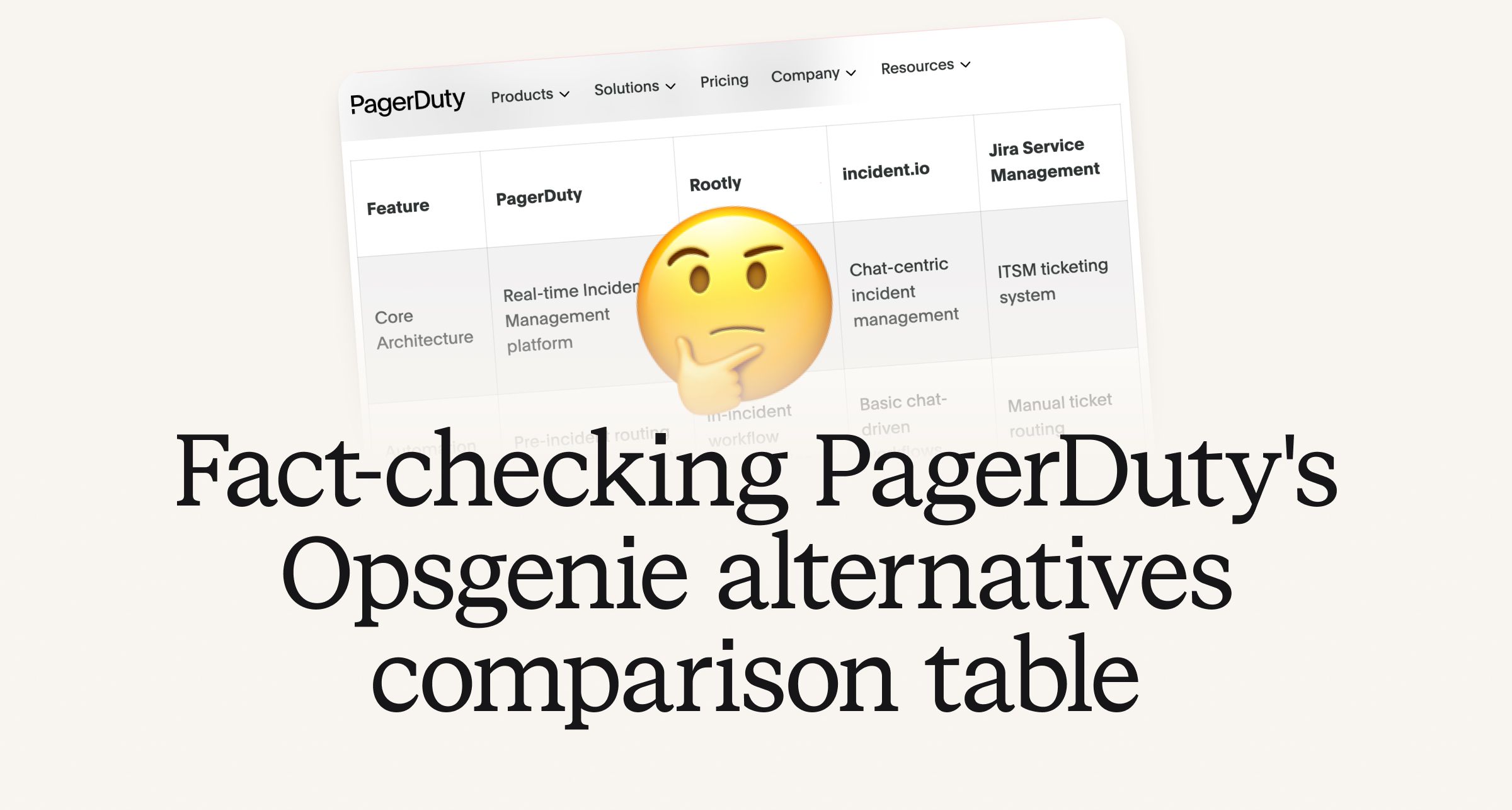
Fact-checking PagerDuty's Opsgenie alternatives comparison table
PagerDuty published a new comparison table about incident.io. Once again, it describes a product we don't recognize. So once again, we're correcting the record, row by row, with receipts.

July 28, 2026
Your genie is vanishing: introducing the Opsgenie rescue program
Today, we're launching the Opsgenie Rescue Program to make that landing soft: simplified migration and free overlap so you never pay two vendors at once.
July 9, 2026
So good, you’ll break things on purpose
Ready for modern incident management? Book a call with one of our experts today.
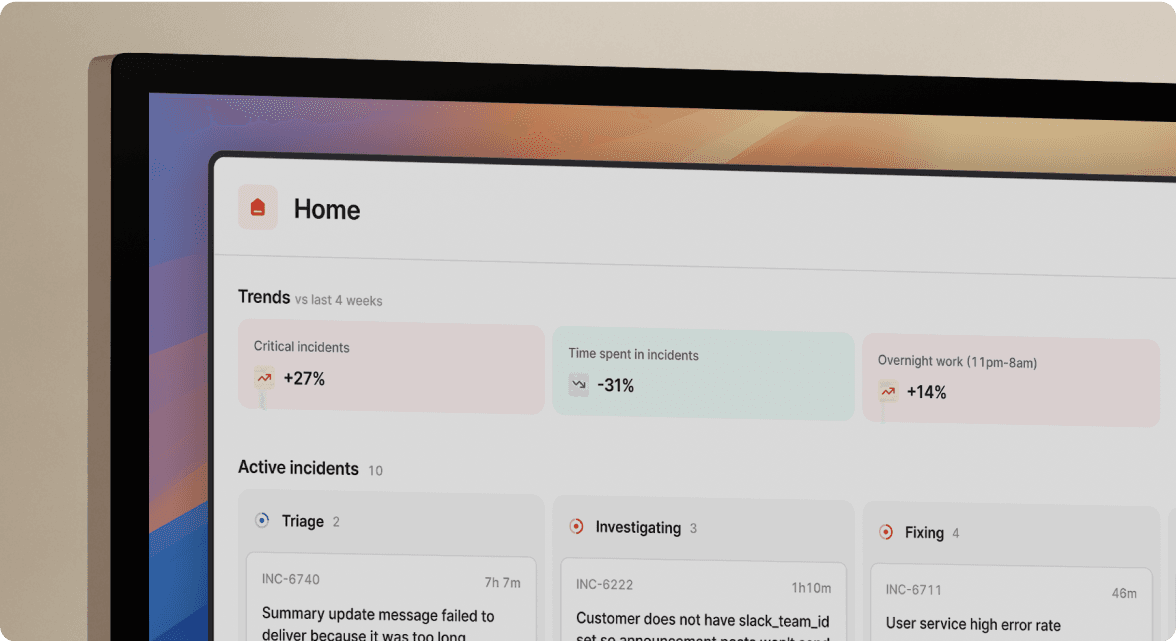
We’d love to talk to you about
- All-in-one incident management
- Our unmatched speed of deployment
- Why we’re loved by users and easily adopted
- How we work for the whole organization