Stop choosing between fast incident response and secure access
December 1, 2025 — 7 min read
Every production system will eventually break. It's not pessimism, it's just reality. That's why engineers go on-call, and why companies invest heavily in incident response tooling and incident management software.
But here's the problem: the moment an engineer goes on call, they typically need elevated access to production systems, databases, and sensitive customer data. And that elevated access? It's often permanent, overly broad, and a security nightmare waiting to happen.
We've seen this pattern play out dozens of times: teams grant production access liberally because they need fast incident resolution, then cross their fingers hoping nothing goes wrong. It's a choice between security best practices and operational reality, and operational reality usually wins.
That tension is exactly what we're addressing with our new integration with Opal Security.
The on-call access problem
Let's be honest about what typically happens in most organizations:
Scenario 1: Permanent elevated accessEngineers get production access on day one and keep it forever. Sure, it makes incident response fast, but it also means you've got 20+ people with admin privileges who rarely need them. It's the security equivalent of giving everyone a spare key to your house.
Scenario 2: Just-in-time access requestsSomeone gets paged at 3am, then has to wait for approvals before they can even start investigating. By the time they get access, your customers have been down for 45 minutes. Not ideal.
Scenario 3: Break-glass processesYou've got emergency access mechanisms, but they're poorly documented, inconsistently enforced, and impossible to audit properly. People use them liberally because they're easier than the "proper" process.
None of these are good. What you actually want is access that's automatically granted when someone goes on call, automatically revoked when they're off, and fully auditable throughout.
That's exactly what the Opal Security & incident.io integration delivers.
How Opal and incident.io work together
The integration is straightforward: incident.io knows who's on call and when. Opal controls access to your production systems. Put them together, and you get automatic, time-bound access management tied directly to your on-call schedule.
Here's what that looks like in practice:
- Automatic access grants: When an engineer's on-call shift starts, Opal automatically provisions the access they need—production databases, AWS accounts, Kubernetes clusters, whatever you've configured. No manual requests, no approval delays, just seamless access right when they need it.
- Automatic revocation: The moment their shift ends, access is automatically removed. No lingering permissions, no cleanup work, no "I forgot to revoke their access three months ago" moments.
- Context-aware permissions: You can configure different access levels for different on-call rotations. Your database on-call gets database access. Your infrastructure on-call gets AWS access. Everyone gets exactly what they need, nothing more.
- Break-glass with guardrails: Sometimes you need emergency access outside your scheduled rotation. The integration supports that too, but with proper logging and optional secondary approval requirements. It's flexible when you need it to be, without becoming a security free-for-all.
Why this matters for incident response
We've spent years building incident.io to make incident response faster and more effective. But speed isn't worth much if you're creating security vulnerabilities in the process.
This integration means you can move quickly without compromising on security posture:
- Faster initial response: On-call engineers don't waste time requesting access or hunting down credentials. They're paged, they respond, they have what they need. Time to mitigation goes down significantly.
- Reduced attack surface: Your production environment isn't perpetually accessible to dozens of people. Access is time-limited and tightly scoped to active on-call periods, which dramatically reduces your exposure window.
- Better compliance posture: Every access grant and revocation is automatically logged. You've got a complete audit trail showing exactly who had access to what, when, and why—tied directly to incident.io's incident records and on-call schedules.
Less operational overheadNo more manual access reviews, no more quarterly audits trying to figure out who still needs production access, no more tickets to provision and deprovision access. It just happens automatically based on your schedule.
The bigger picture
This integration is part of something we think about a lot at incident.io: how do you build systems that allow your team to move quickly when it’s critical, but also maintain a secure environment.
Too often, those goals are treated as opposing forces. You can have security or you can have speed, pick one. But with this new integration, you don’t need to make this tradeoff.
The best systems allow teams to move fast because they're well-designed, not in spite of security controls. When you remove manual steps, reduce cognitive load, and automate the boring stuff, engineers can focus on actually solving problems instead of fighting with tooling.
That's what we're building here. Not just another integration, but a fundamentally better way to handle the intersection of incident response and access control.
Get started
The integration is available now for incident.io and Opal customers.
Check out the incident.io documentation and Opal's documentation to get started, or schedule a demo if you want to see it in action first.
About incident.io
incident.io is the all-in-one AI platform for on-call, incident response, and status pages. It's the incident command center built for fast-moving teams.
About Opal Security
Opal is the unified identity security platform that enables organizations to implement least privilege access at scale while maintaining operational efficiency.

Brian Hanson
Head of Channel and Alliances
Brian Hanson is Head of Channel & Alliances at incident.io, where he leads partnerships and strategic go-to-market efforts to deliver enterprise-grade incident response capabilities. With over a decade of experience building alliances and scaling SaaS growth, Brian is passionate about helping engineering teams eliminate friction, strengthen security and respond to incidents with confidence. He lives at the intersection of product, partner ecosystems and high-impact operations.
See related articles
Introducing Investigations, powered by Nexus.
Today we're launching Investigations: agentic root cause analysis that starts the moment you're paged, figures out what broke and why, and works with your team through to resolution. Here's what we built, what's powering it, and why it took some time to get right.

August 5, 2026
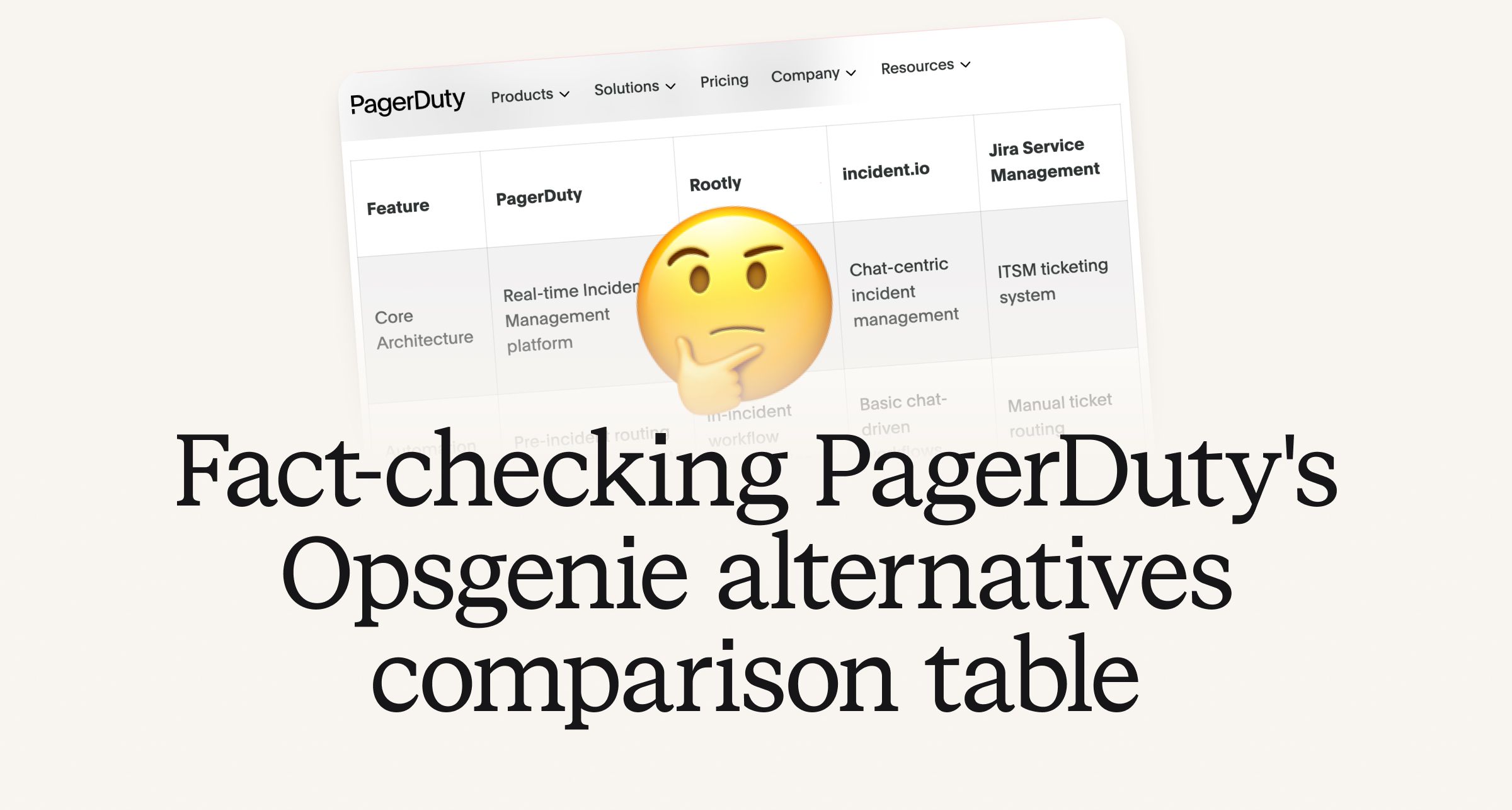
Fact-checking PagerDuty's Opsgenie alternatives comparison table
PagerDuty published a new comparison table about incident.io. Once again, it describes a product we don't recognize. So once again, we're correcting the record, row by row, with receipts.

July 28, 2026

Your genie is vanishing: introducing the Opsgenie rescue program
Today, we're launching the Opsgenie Rescue Program to make that landing soft: simplified migration and free overlap so you never pay two vendors at once.
July 9, 2026
So good, you’ll break things on purpose
Ready for modern incident management? Book a call with one of our experts today.
We’d love to talk to you about
- All-in-one incident management
- Our unmatched speed of deployment
- Why we’re loved by users and easily adopted
- How we work for the whole organization