Join live: What happens when your AI goes down?
PagerDuty MTTR benchmarks vs alternatives: Can you cut resolution time by up to 80%?
April 24, 2026 — 21 min read
Updated Apr 24, 2026
TL;DR: Yes, you can cut MTTR by up to 80%, and the lever is coordination overhead, not debugging speed. Teams running PagerDuty alongside fragmented toolchains (Slack, Jira, Google Docs, Statuspage) lose roughly 50% of total incident time to coordination, with 15 of those minutes spent just assembling the team before a single diagnostic command gets typed. Switching to a Slack-native platform like incident.io eliminates that overhead. Across 15 monthly incidents, teams reclaim hundreds of minutes per month.
Your median MTTR is likely higher than it needs to be. The reason has nothing to do with how fast your engineers can debug. Most engineering teams pay premium prices for alerting tools, then lose critical minutes to context switching, manual Slack coordination, and six different browser tabs open at 3 AM. The bottleneck isn't technical skill. It's the coordination tax baked into your toolchain.
The cost of slow incident resolution
Mean Time To Resolution (MTTR) measures the average time from when a system fails to when it becomes fully operational again. It typically covers detection (how quickly an alert fires), response (how fast the team assembles), repair (how long diagnosis and fix take), and verification (confirming system stability). Critically, MTTR ends when the system is restored to normal parameters, not when the post-mortem is written.
For a company processing $100K per day in transactions, that's $69 per minute when the system is down. A 45-minute P0 (your most critical, all-hands incident) burns over $3,100 in direct revenue before SLA credits and support escalations stack on top. And the internal cost typically runs higher than the revenue loss itself.
Our MTTR analysis breaks down a typical P1 incident (a high-severity, customer-impacting outage, one tier below an all-hands P0): roughly 15 minutes assembling the team and gathering context, with the remainder split between troubleshooting, mitigation, and cleanup (updating status pages, creating Jira tickets, starting the post-mortem). Coordination and admin overhead can consume up to 50% of total incident time, not technical problem-solving.
Run the math for a 120-person engineering org handling 15 P1s per month. At a fully loaded engineer cost of approximately $150 per hour, 15 incidents at 48 minutes each equals 720 minutes, or 12 hours of direct incident labor per month. Cut 18 minutes per incident and you reclaim 270 minutes (4.5 hours) monthly, saving $675 per month or $8,100 per year in engineering productivity alone.
Industry MTTR benchmarks by company size
Benchmarks vary by org maturity and tooling. Our SRE benchmark data shows most SRE teams see median P1 MTTR between 45-60 minutes when running fragmented toolchains. Teams using Slack-native coordination can achieve results under 30 minutes for P1s.
Current MTTR for PagerDuty users
PagerDuty is battle-tested alerting infrastructure. Its alert routing, escalation policies, and on-call scheduling are genuinely sophisticated, and its uptime track record is solid. The problem isn't what PagerDuty does. It's what happens after the alert fires.
Why PagerDuty MTTR stalls: tool sprawl and coordination overhead
PagerDuty's core job is to get the right engineer's phone buzzing. That job it does well. But the moment the engineer acknowledges the alert, they're on their own to:
- Find the right Slack channel (or create one manually)
- Figure out who else needs to be pulled in
- Open Datadog or New Relic for metrics context
- Create a Jira ticket for tracking
- Set up a Google Doc for incident notes
- Remember to update Statuspage before customers start tweeting
Our coordination research shows this logistics phase typically consumes 15 minutes per incident, with multiple minutes of tab switching before a single diagnostic command gets typed. That's 15 minutes gone before troubleshooting starts, and it's a structural limitation of alerting-only tools, not a configuration problem you can tune away.
The 12-tab problem: context switching during critical incidents
Here's what a P0 looks like with a fragmented toolchain: PagerDuty fires, you acknowledge the alert, then manually find or create a Slack channel and @mention the database engineer, the API team lead, and the incident commander. You open Datadog for metrics. You open Google Docs to start a timeline because nobody else is taking notes. You open Jira to create a ticket. You open Statuspage to post an "investigating" notice before customers flood Support.
Six tools, dozens of tab switches, and many minutes before anyone types a single diagnostic command. Meanwhile, customers are watching a dead spinner.
How incident.io reduces MTTR by up to 80%
The numbers from teams switching to our Slack-native approach show reductions of up to 80%. Our benchmark data shows teams can reduce MTTR by up to 80% after full adoption.
Before: manual coordination across 6 tools
For illustration: a 150-person engineering org running Kubernetes microservices on AWS, handling 10-15 P1 incidents per month with PagerDuty for on-call alerting, ad-hoc Slack channels for coordination, Jira for follow-ups, Confluence for post-mortems (when they write them), and Statuspage for customer communication. Teams with this setup typically spend 15+ minutes assembling the team before troubleshooting starts.
After: Slack-native incident response in 90 days
After switching to incident.io, the same team runs a different incident lifecycle. A Datadog alert fires and we automatically create a dedicated incident channel like #inc-2847-api-latency-spike. The on-call engineer gets paged via push, SMS, or call. The channel already contains the triggering alert with context, service ownership from our Catalog, the auto-assigned incident lead, and a live timeline recording. Everything starts without a single manual step.
From there, the incident commander runs the entire response in Slack using /inc commands. /inc assign @sarah-sre sets the commander. /inc severity high flags customer-facing impact. /inc escalate @database-team pulls in the right specialists. Our PagerDuty migration tooling transfers existing on-call schedules and escalation policies directly, so the migration process is streamlined. The result: MTTR drops by up to 80% for P1 incidents.
Blueprint for 28-min MTTR
The mechanics behind the reduction are specific and repeatable:
- Automated channel creation: Alert fires in Datadog → we create a dedicated incident channel automatically, pulling in on-call engineers based on service ownership.
- Service context on arrival: The channel can surface the relevant service owner, recent deployments, runbooks, and dependencies from our Service Catalog.
- Automatic timeline capture: Every
/inccommand, role assignment, and key action joins the incident timeline automatically, with no designated note-taker required. - Scribe AI transcription: For incidents running on Google Meet or Zoom, Scribe transcribes the call and extracts key decisions.
- One-command resolution:
/inc resolvetriggers status page updates, creates follow-up tasks in Jira or Linear, and generates a post-mortem draft from the captured timeline, cutting post-mortem time from 90+ minutes to approximately 10 minutes of refinement.
Comparative MTTR benchmarks: PagerDuty vs modern alternatives
| Platform | Median P1 MTTR | Architecture | Pricing transparency |
|---|---|---|---|
| PagerDuty | Varies; coordination overhead can add time post-alert | Web-first, Slack integration | $41/user/month (Business tier); some features cost extra |
| incident.io | Under 30 min achievable | Slack-native | $45/user/month all-in ($25 base + $20 on-call add-on); AI features included |
| FireHydrant | Varies by incident complexity | Web-first, Slack integration | Public pricing; tiered flat pricing starting at $9,600/year for Platform Pro (up to 20 responders) |
| Opsgenie | Sunsetting April 2027 | Integration-dependent | No new sales; migration required |
incident.io: under 30 minute P1 resolution
For P1 incidents, our internal benchmark data shows teams can reduce MTTR by up to 80% after 90 days of adoption. Our AI SRE assistant automates up to 80% of incident response by identifying the likely change behind the incident, pulling metrics and logs into the Slack channel, and suggesting next steps, so your engineers start troubleshooting with a hypothesis rather than from zero.
FireHydrant's MTTR benchmark
FireHydrant is a peer competitor with strong Slack integration and a web-first architecture. Their platform serves teams managing incidents across varying complexity levels. FireHydrant has published good thinking on incident metrics, and their web-first architecture means coordination workflows behave differently than a Slack-native approach when your team is already mid-incident.
Opsgenie: a mandatory migration decision
Any team still running Opsgenie isn't evaluating whether to migrate, only where. Atlassian stopped new Opsgenie purchases on June 4, 2025, meaning no new signups and no edition upgrades, though existing customers can still add seats until full end of support arrives in April 2027, confirmed by ServiceRocket's Opsgenie EOL analysis. We provide dedicated Opsgenie migration tooling to export schedules and map configurations so the transition is measured in days, not sprints.
What drives MTTR differences across platforms
The delta between a 45-minute MTTR and a sub-30-minute MTTR has almost nothing to do with how quickly alerts fire. The difference lives entirely in what happens after the alert fires:
- Context-gathering speed: Does the engineer arrive at a fully-loaded incident channel or an empty Slack thread?
- Team assembly speed: Does on-call paging happen automatically based on service ownership, or does someone manually hunt for who's responsible?
- Coordination overhead: Does the team coordinate inside one Slack channel or across six browser tabs?
- AI assistance: Does the platform suggest the likely root cause (deploy correlation, resource exhaustion) or does the engineer start from zero?
Platforms that address all four can reduce P1 MTTR by up to 80% compared to alerting-only tools.
Actionable steps to cut MTTR by up to 80%
1. PagerDuty migration: unify incident flow
A parallel-run strategy offers the safest migration path. Run incident.io alongside PagerDuty for a trial period: PagerDuty still fires alerts, but those alerts now auto-trigger incident.io channels in Slack. Your on-call rotation stays intact while your team builds muscle memory with /inc commands. Our PagerDuty migration documentation covers schedule export, escalation policy mapping, and Datadog monitor migration.
2. Speed MTTR with automated incident timelines
Manual note-taking during a P0 creates a cognitive tax you can eliminate. We capture every command, role assignment, message, and participant automatically, building a precise timeline without a dedicated scribe. This serves two MTTR reduction functions: it removes coordination overhead per incident, and it means post-mortems draft themselves much faster than manual reconstruction. When post-mortems actually get written, root causes get documented giving your team something concrete to action rather than a vague memory of what went wrong.
3. Reduce time-to-assemble with instant Slack channels
The 15-minute team assembly time is the single highest-leverage target for MTTR reduction. Eliminate it with three configuration steps: map your Service Catalog so we know who owns each service, connect your monitoring tools (Datadog, Prometheus, New Relic) so alerts auto-trigger channel creation, and configure escalation policies so the right on-call engineer gets paged automatically. Teams completing all three reduce assembly time from 15 minutes to under 2 minutes.
"Incident Workflows - The tool significantly reduces the time it takes to kick off an incident. The workflows enable our teams to focus on resolving issues while getting gentle nudges from the tool to provide updates and assign actions, roles, and responsibilities." - Carmen G. on G2
4. Cut MTTR with AI root cause analysis
There's a meaningful difference between AI that surfaces related log entries and AI that identifies the likely deployment causing the incident and suggests next steps based on recent similar incidents. Our AI SRE assistant automates up to 80% of incident response by identifying the likely change, pulling metrics and logs into the Slack channel, and suggesting fixes, so your engineers start troubleshooting with a hypothesis rather than from zero.
5. Quickstart for new on-call engineers
On-call onboarding that takes weeks is a rotation bottleneck disguised as a training problem. The actual problem is that your current process lives in a lengthy runbook nobody reads during a P0. Our slash commands solve this by making incident management intuitive. New engineers can type /inc escalate, /inc assign, or /inc severity high in their first incident without reading a runbook. Our incident management software guide covers what to evaluate when selecting platforms for fast onboarding.
Quantifying the ROI: engineer productivity and cost savings
MTTR reduction of up to 80% per incident
Using our benchmark data as the baseline, teams moving to incident.io can reduce MTTR by up to 80%. Across 15 monthly incidents, that's up to 270 minutes of engineering time reclaimed per month.
The productivity math
The calculation is straightforward for a single-engineer view:
- Reducing MTTR by up to 80% across 15 incidents/month creates substantial engineering time savings
- At $150 loaded hourly rate, that compounds to $675/month in reclaimed engineering time
- Annual savings can reach thousands of dollars in reclaimed engineering time
For incidents involving 3-4 engineers, the savings compound. Multi-engineer P1s resolved faster reduce total incident cost per resolution.
PagerDuty vs incident.io: true cost
The pricing comparison for a 120-user engineering org on annual billing:
| Cost item | PagerDuty | incident.io Pro |
|---|---|---|
| Base platform | $41/user/month (Business tier) | $25/user/month |
| On-call | Included in base | $20/user/month |
| AI features | Additional add-on | Included |
| All-in per user/month | $41 + add-ons | $45 |
PagerDuty's Business plan starts at $41/user/month when billed annually, with on-call scheduling included in the base tier. However, AI features and other advanced capabilities require additional add-ons at extra cost. incident.io's Pro plan is $25/user/month, with on-call available as a $20/user/month add-on (all-in $45/user/month). The Pro plan includes AI post-mortem generation and unlimited integrations.
When you add the engineering labor savings to the consolidated tooling cost, the ROI case becomes compelling. Teams replacing multiple tools with incident.io often see positive returns as coordination overhead drops and MTTR improves.
Automating workflows for deeper MTTR cuts
Post-mortem completion rate impact on repeat incidents
Post-mortem completion influences incident management effectiveness: teams documenting root causes can reference them for future incidents, while teams skipping documentation may face similar failures. When post-mortems require extensive manual timeline reconstruction, completion rates stay low. When they auto-generate from captured timeline data, your team spends approximately 10 minutes refining instead of 90+ minutes reconstructing.
Any team handling recurring incidents benefits from this cycle: documentation quality directly influences whether the same failure happens twice.
Automated status page updates reduce customer inquiries
Tie your status page to incident state changes to eliminate the manual update that consistently happens late. When /inc resolve fires in Slack, we automatically update the public status page from "investigating" to "resolved." That automation stops the flood of "is this still broken?" support tickets and reduces the on-call engineer's cognitive load during recovery, since they're not fielding simultaneous support escalations while validating the fix.
AI identifies root causes, suggests fixes
During the post-incident learning phase, Scribe AI transcribes the incident call and extracts key decisions for the post-mortem. The auto-drafted post-mortem contains the timeline, key decisions, and the actions that resolved the incident. When that data feeds into our Insights dashboard, you can see which services cause the most incidents and track reliability trends over time. That's the reliability trend data that answers a board question with a chart instead of an anecdote.
Schedule a demo with our team to see how our AI SRE and Slack-native workflow can help you reduce MTTR and reclaim engineering hours.
Key terms glossary
MTTR (Mean Time To Resolution): The average time from when a system fails to when it becomes fully operational again. MTTR covers detection (when the alert fires), response (team assembly), repair (diagnosis and fix), and verification (confirming system stability). MTTR ends when the system is restored to normal parameters, not when the post-mortem is written.
P0 (Priority Zero): Your most critical, all-hands incident. A P0 represents severe system failure with widespread customer impact requiring immediate response from multiple teams.
P1 (Priority One): A high-severity, customer-impacting outage, one tier below an all-hands P0. P1 incidents require urgent resolution but may affect a subset of services or users rather than the entire system.
Incident Commander: The person responsible for coordinating the incident response, making decisions, delegating tasks, and ensuring the team stays focused on resolution. Also called incident lead.
Post-mortem: A documented analysis written after an incident is resolved that captures the timeline, root cause, impact, and action items to prevent recurrence. Not to be confused with retrospective or post-incident review.
On-call rotation: The scheduled assignment of engineers who are responsible for responding to alerts and incidents during specific time periods, typically 24/7 coverage across a team.
Timeline capture: The automatic recording of every action, command, role assignment, and key decision during an incident, creating an auditable record without requiring a dedicated note-taker.
Coordination overhead: Time spent assembling the team, gathering context, switching between tools, and updating stakeholders during an incident, as opposed to time spent on actual technical troubleshooting and repair.
Runbook: A documented set of procedures for diagnosing and resolving specific types of incidents or operational tasks. Runbooks provide step-by-step instructions for on-call engineers.
Service Catalog: A centralized directory that maps services to their owners, dependencies, runbooks, and relevant context, enabling faster incident response by surfacing who owns what.
Escalation policy: Rules that define how alerts route to engineers, including primary on-call, backup on-call, and escalation paths if the alert isn't acknowledged within a defined timeframe.
AI SRE assistant: An AI system that automates portions of incident response by identifying likely root causes, correlating recent deployments or changes, pulling relevant metrics and logs into the incident channel, and suggesting next steps based on similar past incidents.
FAQs

Tom Wentworth
Chief Marketing Officer
See related articles
Introducing Investigations, powered by Nexus.
Today we're launching Investigations: agentic root cause analysis that starts the moment you're paged, figures out what broke and why, and works with your team through to resolution. Here's what we built, what's powering it, and why it took some time to get right.

August 5, 2026
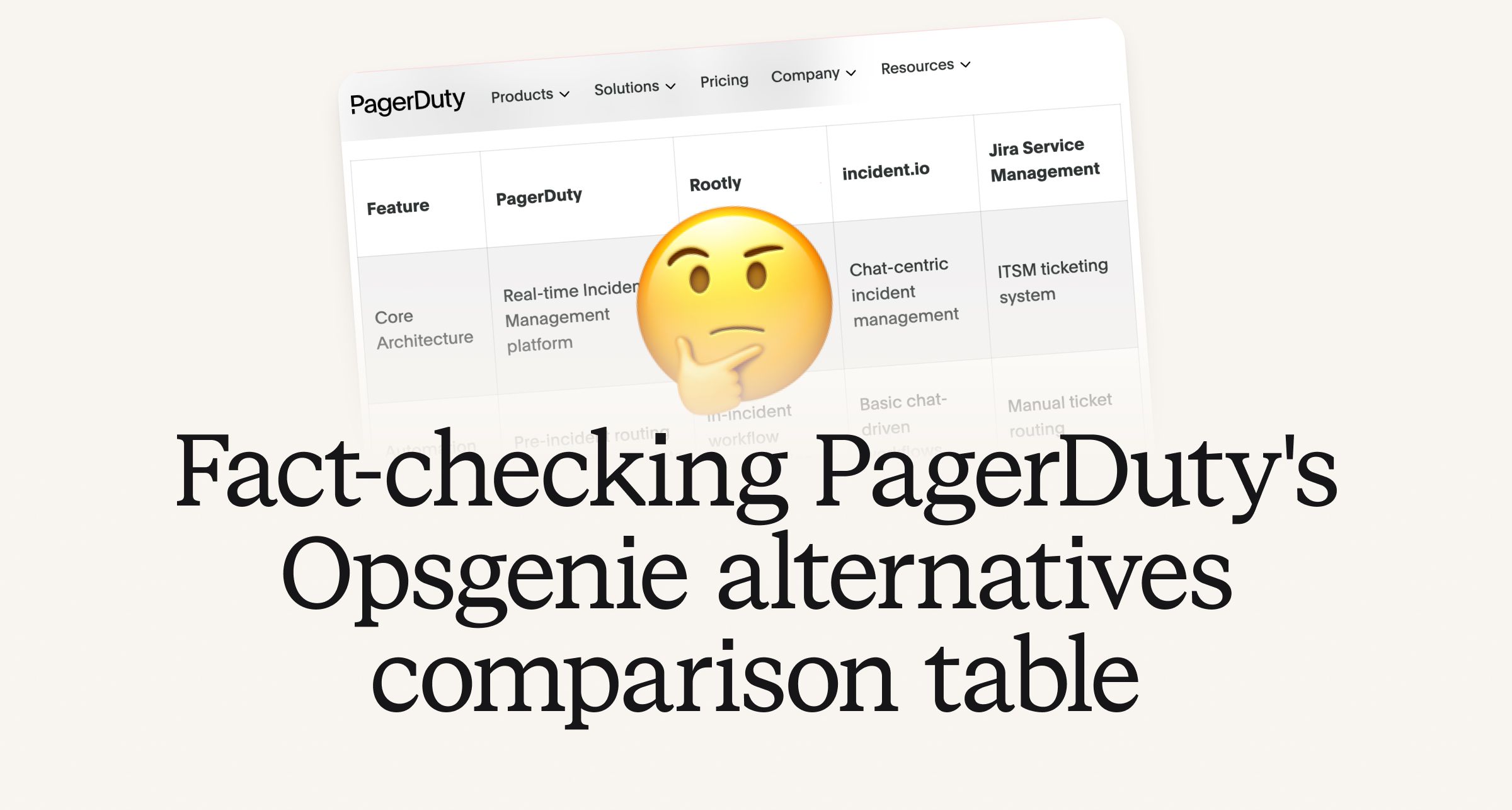
Fact-checking PagerDuty's Opsgenie alternatives comparison table
PagerDuty published a new comparison table about incident.io. Once again, it describes a product we don't recognize. So once again, we're correcting the record, row by row, with receipts.

July 28, 2026
Your genie is vanishing: introducing the Opsgenie rescue program
Today, we're launching the Opsgenie Rescue Program to make that landing soft: simplified migration and free overlap so you never pay two vendors at once.
July 9, 2026
So good, you’ll break things on purpose
Ready for modern incident management? Book a call with one of our experts today.
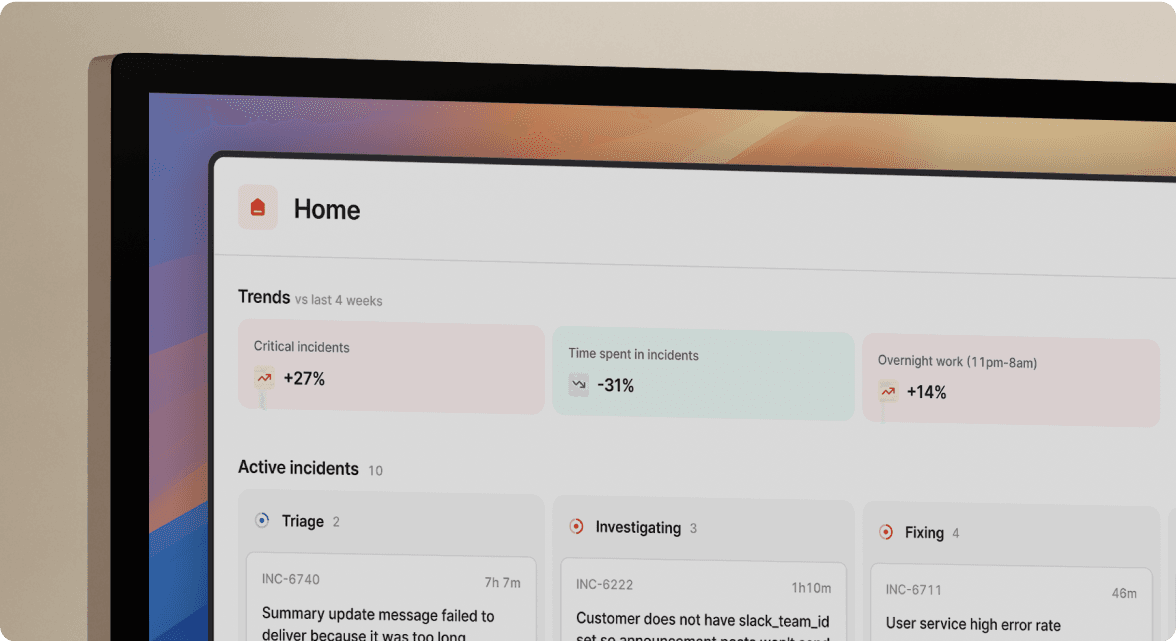
We’d love to talk to you about
- All-in-one incident management
- Our unmatched speed of deployment
- Why we’re loved by users and easily adopted
- How we work for the whole organization