Opsgenie vs. JSM: Alert routing & on-call management deep dive
March 20, 2026 — 15 min read
Updated March 20, 2026
TL;DR If you manage on-call for a scaling engineering team, the Opsgenie sunset forces a real choice. Jira Service Management (JSM) absorbs Opsgenie's alerting features but wraps them in an IT service management (ITSM) ticketing model, adding friction to real-time incident response. Opsgenie's granular alert routing and multi-tier escalation policies don't migrate automatically, and Atlassian splits the functionality across JSM and Compass. For teams that live in Slack, a purpose-built, Slack-native platform eliminates the coordination tax that a ticketing system can't fix.
Teams often spend 10-15 minutes per incident just assembling people, creating channels, and finding context before any actual troubleshooting starts. The April 2027 Opsgenie deadline means you have to migrate your on-call schedules and alert routing. Atlassian's default path is Jira Service Management, but moving from a dedicated alerting tool to a ticketing system built for password resets won't reduce those 10-15 minutes of overhead before troubleshooting starts. Before you commit to JSM, you need to understand exactly what breaks, what requires manual rebuild, and what a better migration to a modern incident management platform looks like.
This guide is for DevOps leads and SRE managers evaluating their migration options against incident management best practices before the April 2027 deadline.
The Opsgenie sunset and the JSM migration reality
Atlassian has set a hard end-of-support date of April 5, 2027 for Opsgenie, after which all Opsgenie data gets deleted. New sales and trials stopped on June 4, 2025. If you're running the JSM-bundled version of Opsgenie, that access ended even earlier, in October 2025.
Here's the fundamental problem: Atlassian built Opsgenie as a dedicated alerting and on-call platform. Atlassian designed JSM as an IT service management platform around structured service requests, change management, asset tracking, and support tickets. ITSM covers the full lifecycle of designing and delivering IT services across an organization, and within that broad ITSM scope, real-time automated alert routing is one component among many.
The migration isn't a feature-for-feature swap. JSM won't automatically import your Opsgenie alert actions and incident rules, so you'll need to recreate them manually. Chat integrations like Slack require reauthentication, and any custom integrations, alert routing rules, and Opsgenie-specific action policies need manual configuration from scratch.
Alert routing: How Opsgenie and JSM distribute critical signals
Opsgenie alert routing methods
Opsgenie routes alerts based on inbound payload content, including message fields, source, priority tags, and custom properties. When a Datadog alert fires, Opsgenie evaluates the payload against your routing rules and delivers the alert to the correct on-call schedule or escalation chain. Opsgenie's alert policy configuration walkthrough demonstrates how these policy layers stack in practice.
Engineers value this setup for its granularity: you can build routing logic around specific services, alert severity levels, time windows, and originating monitoring tools without touching a ticketing workflow.
JSM alert routing
JSM evaluates incoming requests against team routing rules and matches them to the appropriate schedule, escalation, or notification, as described in Atlassian's routing rules documentation. Teams can set routing rules based on source, content, and time, with a cap of up to 100 routing rules per team.
Your JSM plan tier determines routing rule depth. On Free or Standard plans, you can create only one custom routing rule. Multiple routing rules, the kind you need to route Datadog P1 alerts differently from Prometheus capacity warnings, require JSM Premium.
JSM also adds a gating step that Opsgenie doesn't have: JSM first matches the request source against its integration configuration, and if the content doesn't match any existing integration, JSM may not process the request, as described in Atlassian's how are alerts created documentation. That's a meaningful risk when you're migrating 200+ alert integrations from Opsgenie.
On-call scheduling and escalation policies compared
Opsgenie on-call management features
Atlassian purpose-built Opsgenie for on-call scheduling. You can configure daily and weekly rotations, handle after-hours coverage with separate schedules, define user-specific notification preferences, and chain multiple schedules into layered coverage patterns. Teams managing 8-15 microservices with different owners can map each service to its own on-call schedule and escalation path without contention.
JSM on-call scheduling
JSM brings core on-call scheduling into its Operations feature set, covering schedules, escalation policies, and routing rules as the three pillars of its on-call model. You can define who is on-call and when, and tie those schedules to routing rules that direct alerts to the right person. For basic rotation setups, this works as advertised, as confirmed in neteye-blog's JSM on-call management review.
Escalation policies
Here the technical gap between Opsgenie and JSM shows most clearly. JSM adds escalation options that Opsgenie didn't have, including the ability to notify the next member on rotation, the previous member, or a random team member, plus repeat escalation with time delays, maximum repetitions, and automatic alert closure when repeats finish.
The gap is architectural, not just feature-level. JSM escalation logic sits inside a ticketing model, which means it's optimized for structured, asynchronous workflows rather than the real-time, Slack-centered response your engineers are running at 3 AM. The result is a more complex configuration experience than Opsgenie's dedicated model when you need to fine-tune multi-step escalation chains for different services and teams.
Feature comparison table: Opsgenie vs. JSM vs. incident.io
| Feature | Opsgenie | JSM | incident.io |
|---|---|---|---|
| Alert routing granularity | High (payload, source, tags, priority) | Configurable routing rules (varies by plan) | High (team routing, alert attributes, priority levels via alert routing) |
| On-call custom rotations | Daily, weekly, after-hours, layered | Basic rotations with Premium | Custom rotations with priority-based on-call |
| Escalation policy tiers | Multi-tier, time-based delays | Multi-tier with repeat escalation. ITSM-centric config. | Multi-tier with auto-escalation |
| Slack integration depth | Bi-directional: acknowledge, close alerts, and execute actions via /genie commands | Notification delivery. Requires reauthentication on migration. | Slack-native: incidents declare, manage, and resolve entirely in Slack |
| Pricing transparency | N/A (sunset April 2027) | Premium required for full on-call | $45/user/month with on-call ($25 base + $20 on-call add-on, Pro plan) |
Why JSM falls short for real-time incident response
Ticketing vs. incident response
A Priority 1 (P1) incident at 2 AM is the opposite of a structured service request. The coordination tax kicks in immediately: creating channels, finding the right on-call engineer, assembling the team, updating the status page. Teams often spend 10-15 minutes on this overhead before troubleshooting can begin. Intercom reported saving 40% of total incident time after eliminating it. Atlassian designed ITSM platforms like JSM to manage structured, asynchronous service workflows, and a ticketing system doesn't reduce that overhead. It often adds to it by requiring engineers to toggle between JSM's web UI and the Slack channels where actual coordination happens.
"Back in the days, we had a process: it was not good or bad, it was just not followed during the adrenaline rush of an incident. Reading process doc is 100% not your goal. Who can blame the first responder that saved the day? That's where incident.io really shines: it allows to seamlessly nudge or suggest actions." - Alexandre R. on G2
The fragmentation problem
Atlassian routes incident management to JSM and service catalog management to Compass. Both platforms share one source of truth for Operations features, with changes in one reflecting in the other. In practice, your team needs to understand which workflows live in which product. As oxalis.io's analysis of the Opsgenie migration (oxalis.io is an Atlassian consulting partner) puts it, this combination "only adds complexity with tool fragmentation across your teams." Compass can alert responders and escalate across teams, but automated incident timeline creation requires manually escalating alerts to incidents first, adding another layer to an already fragmented workflow.
Pricing and Total Cost of Ownership (TCO)
JSM Premium, required for advanced on-call capabilities like multiple routing rules per team and advanced escalation steps, runs approximately $47.82 per agent per month. For a 100-person team with on-call needs, you're paying for a large surface area of ITSM features (asset management, change management, ITIL workflows) your Site Reliability Engineering (SRE) team will never use, alongside the Compass licenses needed to fill the service catalog gap Opsgenie leaves behind.
A better alternative: Migrating to a Slack-native platform
We built incident.io to eliminate the 10-15 minutes teams often spend assembling before any troubleshooting starts. It's Slack-native, meaning the entire incident workflow, declaring, managing, escalating, and resolving, happens inside Slack channels via /inc commands. No browser tabs. No web form submissions during a P1.
When integrated with your monitoring tools, incident.io automatically creates #inc-2847-api-latency-spike, pages the right on-call engineer, pulls in the service owner, and starts timeline capture, so the team is troubleshooting in minutes rather than after a manual coordination sprint. That improvement comes directly from removing the overhead before troubleshooting begins.
The 14-day parallel run strategy
The proven approach to a zero-downtime migration is a four-phase parallel run: audit your current setup, map your schedules and routing rules, run both systems simultaneously, then cut over. During the parallel run, alerts dual-feed to both Opsgenie and incident.io via webhook fan-out (sending the same alert simultaneously to multiple endpoints). Your team validates that every alert routes correctly in incident.io before turning off the Opsgenie webhook.
incident.io provides dedicated migration tools for Opsgenie users, including automated schedule and escalation policy imports that eliminate the manual rebuild work JSM requires. Your schedules imported directly rather than recreated from scratch.
The ITSM comparison in a single flow:
| Stage | JSM (ITSM ticket model) | incident.io (Slack-native) |
|---|---|---|
| Alert fires | Webhook matches integration config | Webhook triggers channel creation |
| Team assembled | Manual Slack coordination | Auto-paged on-call, service owner pulled in |
| Incident managed | Toggle between JSM web UI and Slack | /inc commands entirely in Slack |
| Timeline captured | Manual notes | Auto-captured in real time |
| Post-mortem | Manual reconstruction | Auto-drafted from captured timeline |
For a 100-user team, incident.io Pro plan with on-call runs $45/user/month ($25 base + $20 on-call add-on), totaling $54,000/year. Compare that against JSM Premium at approximately $47.82/agent/month for 100 agents ($57,384/year), and you're paying more for a tool that requires two products (JSM and Compass), manual alert rule recreation, and a web-first workflow that adds context-switching during incidents.
Where incident.io isn't the right fit
incident.io's opinionated design is a strength for teams that want a fast, structured workflow out of the box, but it becomes a constraint if your organization needs deep customization beyond its built-in templates. It also has a hard dependency on Slack or Microsoft Teams. If either is unavailable or your organization restricts their use, the core incident channel workflow doesn't function. There is no standalone mobile app either, so engineers who rely on mobile-first on-call management will find the experience more limited than dedicated tools built around that use case.
Making your Opsgenie exit plan
The April 2027 deadline is fixed. JSM keeps your team in the Atlassian ecosystem, but it requires configuration to auto-create incident channels, won't capture timelines automatically, and won't spare you from manually rebuilding the routing rules and action policies that Opsgenie runs today. If your team lives in Slack and handles 5-20+ incidents per month, the results from teams like Etsy (33% MTTR reduction) and Intercom (40% reduction in total incident time) show what a Slack-native platform can deliver, and the Opsgenie migration tools in incident.io mean you keep your Jira and Confluence workflows intact while upgrading to a modern incident management stack, as covered in the ITSM and DevOps integration guide.
Schedule a demo of incident.io to see a live Opsgenie migration walkthrough, a full incident managed in Slack from alert to post-mortem, and a 14-day parallel run strategy that gets you migrated with zero missed pages.
Key terms glossary
Alert routing: The process of evaluating an incoming alert's payload (source, priority, content, tags) against predefined rules to deliver it to the correct on-call schedule, escalation policy, or team.
Escalation policy: A defined sequence of notification steps triggered when an alert goes unacknowledged. Each step specifies who gets paged, via which channel, and after how long a delay.
Inbound payload: The structured data sent by a monitoring tool (Datadog, Prometheus, etc.) when an alert fires. Routing rules evaluate fields within this payload to determine where the alert goes.
ITSM platform: IT service management (ITSM) is a framework for designing, delivering, and optimizing IT services across an organization, covering service requests, change management, asset tracking, and incident management. ITSM tools optimize for structured, asynchronous workflows rather than real-time coordination.
Parallel run strategy: A migration approach where both the old platform (Opsgenie) and the new platform (incident.io) receive the same alerts simultaneously via webhook fan-out. Teams validate routing and paging accuracy in the new tool before turning off the legacy system, ensuring zero missed pages during cutover.
FAQs

Tom Wentworth
Chief Marketing Officer
See related articles
Introducing Investigations, powered by Nexus.
Today we're launching Investigations: agentic root cause analysis that starts the moment you're paged, figures out what broke and why, and works with your team through to resolution. Here's what we built, what's powering it, and why it took some time to get right.

August 5, 2026
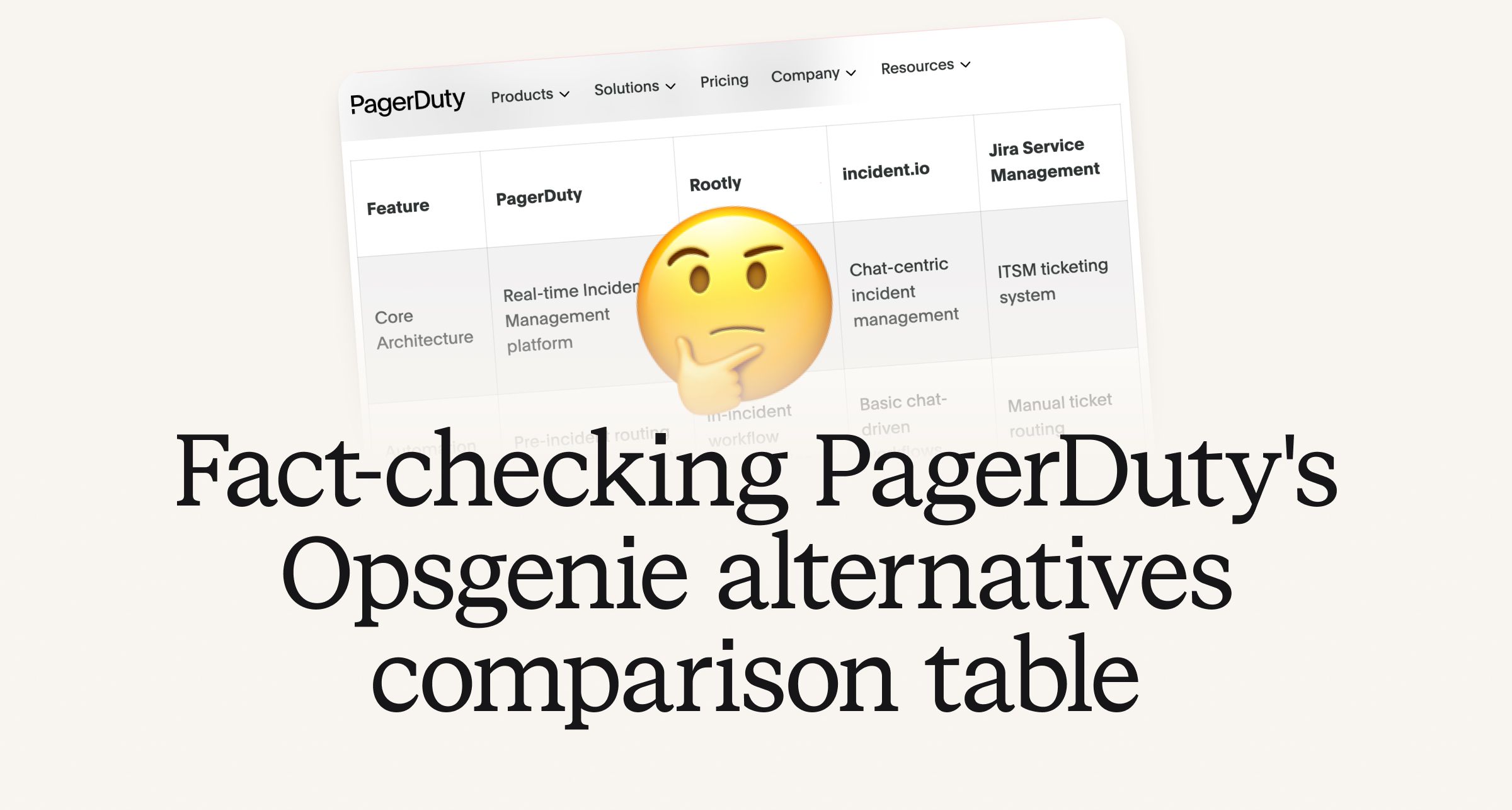
Fact-checking PagerDuty's Opsgenie alternatives comparison table
PagerDuty published a new comparison table about incident.io. Once again, it describes a product we don't recognize. So once again, we're correcting the record, row by row, with receipts.

July 28, 2026
Your genie is vanishing: introducing the Opsgenie rescue program
Today, we're launching the Opsgenie Rescue Program to make that landing soft: simplified migration and free overlap so you never pay two vendors at once.
July 9, 2026
So good, you’ll break things on purpose
Ready for modern incident management? Book a call with one of our experts today.
We’d love to talk to you about
- All-in-one incident management
- Our unmatched speed of deployment
- Why we’re loved by users and easily adopted
- How we work for the whole organization