On-call tool selection: Feature evaluation framework and 2026 vendor comparison
May 4, 2026 — 22 min read
Updated May 4, 2026
TL;DR Coordination tax, which comes from constantly switching between alerts, chat, and tracking tools, directly increases total resolution time before any real troubleshooting even begins. A true total cost of ownership should account not only for subscription pricing but also for on-call add-on fees, implementation effort, and the fully loaded cost of engineer hours spent reconstructing post-mortems from memory. AI in incident response should go beyond simple log correlation by automating timeline capture and drafting post-mortems, reducing manual overhead and improving accuracy. With Atlassian planning to sunset Opsgenie in 2027, this is an ideal moment to begin running a migration pilot and evaluating more integrated, future-ready solutions.
Your team loses valuable time per incident just assembling responders and finding context. This coordination tax (time spent toggling between PagerDuty, Slack, Jira, and Google Docs) happens before a single line of troubleshooting begins.
The biggest bottleneck in reducing MTTR is not the technical fix. It is the time lost figuring out who is on call, where the runbook lives, and why the status page still shows green while customers are already filing support tickets.
This guide provides a structured evaluation framework for 2026 on-call management platforms. We compare leading vendors, break down the true cost of ownership, and show you how to choose incident management software that integrates with your stack without adding complexity.
Key requirements for SRE on-call tools
Modern on-call management, guided by incident management best practices, is not just about paging the right person. It is about eliminating the process overhead that turns a 20-minute technical fix into a 50-minute incident. The incident management software you evaluate in 2026 needs to do three things well: reduce the coordination tax, integrate deeply with your existing stack, and get new engineers productive fast.
Prioritizing critical on-call needs
Coordination tax is the time wasted switching between tools to assemble a team and find context. For teams running high incident volumes, this overhead accumulates across every incident and represents substantial monthly waste before a single line of troubleshooting happens. We eliminate this by collapsing all five tools into one interface, typically Slack or Microsoft Teams, where your team already works.
Integration depth with existing stack
You are not looking for a tool that replaces Datadog or Prometheus. You are looking for a coordination layer that connects them into a modern incident management stack. The platforms we recommend in 2026 offer two-way integrations with Datadog, Jira, GitHub, Confluence, and your monitoring stack so context flows into the incident channel automatically.
Concretely, when properly configured, a Datadog alert can trigger an incident in incident.io that automatically creates a dedicated Slack incident channel, pages the on-call engineer via configured escalation paths, surfaces the service owner from the catalog, and starts capturing a live timeline. When the incident resolves, follow-up Jira tickets can be created with timeline context. Our alert priority documentation shows how this routing logic works across severity levels.
Quick team onboarding and adoption
Junior engineers fumble their first on-call rotation not because they are incompetent, but because the process lives entirely in senior engineers' heads across four different tools. We fix this by making incident management the same as using Slack. There is no separate UI to learn, no 47-step runbook to memorize. Chat-native platforms get you operational in days, not weeks.
Assess on-call tools for MTTR impact
Reducing MTTR requires more than faster paging. It requires eliminating the coordination overhead before, during, and after the incident.
API for unified on-call workflows
A robust API lets you connect your internal service catalog, automate custom routing logic, and build event-driven workflows that trigger on specific alert conditions. For teams running 80+ microservices on Kubernetes, generic on-call routing is not enough. You need routing that understands your service ownership model. Our escalation API supports programmatic escalation paths, letting you define exactly who gets paged and in what order based on service context.
Automating Slack for incident response
The difference between a Slack integration and a Slack-native platform is architectural. Web-first tools send notifications to Slack. We run the entire incident lifecycle inside Slack.
With incident.io, you manage incidents with /inc declare/inc assign and /inc escalate commands, escalate, and resolve /inc resolvedirectly in Slack. Every action happens in Slack, not through a context switch to a web UI. Engineers in verified reviews specifically call out this workflow as a key benefit.
"For our engineers working on incident, the primary interface for incident.io is slack. It's where we collaborate and where we were gathering to handle incident before introducing incident.io." - Alexandre R. on G2
On-call logic and escalation configuration
Flexible scheduling means more than setting up a rotation. It means configuring time zone coverage, backup escalation paths, and override windows so an 11 PM P2 does not cascade into a P1 because the DB team was not paged for 25 minutes. Our decision flows documentation covers how automated escalation logic prevents these cascades by routing based on service ownership and severity thresholds.
AI-powered post-mortems and timeline capture
Manual post-mortems waste significant time per incident reconstructing a timeline from Slack scroll-back, PagerDuty alert history, and Datadog events days after the incident when memory has faded.
Our AI Scribe feature transcribes incident calls via Google Meet or Zoom in real time, captures key decisions as they happen, and generates comprehensive post-mortem drafts automatically. When the incident resolves, the post-mortem draft is 80% complete without any manual writing, reducing reconstruction time from 90 minutes to around 10 minutes of refinement. Our AI SRE can automate up to 80% of incident response, handling timeline capture and post-mortem generation so your engineers stay focused on the technical fix.
True cost of on-call platforms
Base pricing is almost never the full cost. Here is the TCO breakdown for a 100-person engineering team at current pricing:
| Platform | Plan | Per user/month | Annual (100 users) |
|---|---|---|---|
| incident.io Pro | Base + on-call included | $45 | $54,000 |
| PagerDuty Professional | On-call included | $21 | $25,200 |
| PagerDuty Business | On-call included | $41 | $49,200 |
| PagerDuty Business + AIOps | $41/user/month + $699/month flat add-on | ~$48 | ~$57,600+ |
| FireHydrant | Custom | Requires direct quote | Requires direct quote |
All per-user rates shown on annual billing for consistent comparison. PagerDuty monthly billing rates: Professional $25/user/month, Business $49/user/month.
incident.io's Pro plan at $45/user/month includes on-call scheduling, AI post-mortem generation, and status pages in a single line item. PagerDuty's Business plan includes on-call, but AIOps noise reduction is a separate add-on that pushes TCO higher for teams that need it.
Add the loaded cost of engineer time. Manual post-mortem reconstruction consumes significant engineering hours monthly. With post-mortems generating 80% complete from captured timeline data, documentation overhead drops from 90 minutes to around 10 minutes of refinement per incident.
Vendor support you can trust
When production is down at 2 AM, a 24-hour first-response SLA is not a support model. It is a liability.
We operate shared Slack channels with customers for real-time bug reports and feature requests, with bug fixes typically within hours. 92% of users rate our support 9.1/10 on G2, where we hold the #1 Relationship Index ranking.
"As mentioned by many others, the customer experience has been beyond anything seen in enterprise software. Issues are incredibly easy to raise and are responded to and sometimes even fixed within hours." - Luis S. on G2
Choosing the right SRE incident platform
Evaluating incident management tools without a structured framework leads to vendor selection driven by demos rather than requirements.
On-call tool evaluation matrix
| Criterion | incident.io | PagerDuty | Opsgenie | FireHydrant |
|---|---|---|---|---|
| Ease of use | Slack-native /inccommands, quick setup | Complex web UI, longer onboarding | Atlassian product, sunsetting 2027 | Slack-native with web console |
| Unified workflow | On-call + response + status + post-mortem in one | Many features behind paywalls | Core alerting features | Runbook automation focus |
| AI capabilities | AI SRE automates up to 80% of incident response, including timeline capture and post-mortem drafting | AI add-on, not core platform | Limited automation | AI-assisted summaries and retrospectives |
| Pricing transparency | Published pricing, $45/user/month with on-call | Public pricing; AIOps and advanced features are add-ons | Sunsetting | Requires direct quote |
Tailoring criteria to team stage
Different team sizes have different requirements. Smaller teams prioritize time-to-value and adoption: you want to be operational quickly, not managing lengthy implementations while incidents keep happening. Larger organizations require compliance features, with SAML/SCIM for identity management and Enterprise SLA with defined response times.
We cover both stages. The Pro plan ($45/user/month) serves mid-sized teams with unlimited workflows, AI post-mortems, and Microsoft Teams support. The Enterprise plan adds SAML/SCIM, dedicated Customer Success, and sandbox environments.
Weighing feature trade-offs for SREs
Opinionated defaults versus infinite customization is the core trade-off in this market. PagerDuty offers the most sophisticated alert routing with conditional logic that covers edge cases most teams never hit. If your team requires deep alerting customization beyond standard routing rules, PagerDuty remains the most flexible option.
But flexibility has a cost: teams configure PagerDuty over longer timeframes before running their first incident. Teams using our opinionated defaults can run their first real incident more quickly. For most SRE teams, the speed of value outweighs the marginal benefit of unlimited alerting customization.
2026 vendor comparison: incident.io vs. competitors
incident.io: Slack-first incident command
We built incident.io Slack-native from the ground up. The entire incident lifecycle lives in chat: declaration, escalation, role assignment, timeline capture, status page updates, and post-mortem generation all happen via /inc commands. The AI capabilities provide context and assistance during incidents. The Pro plan at $45/user/month includes unlimited workflows, AI post-mortem generation, and Microsoft Teams support.
PagerDuty: Enterprise alerting's evolution
PagerDuty remains a reliable option for sophisticated alert routing. Its conditional escalation logic, extensive integrations, and established reliability make it the incumbent choice for enterprises prioritizing alerting depth over coordination features. The Business plan includes on-call, but AIOps and advanced analytics are separate add-ons that increase TCO for teams needing those capabilities. Our PagerDuty migration tooling supports schedule imports to reduce migration friction.
Opsgenie: Jira and Confluence on-call
Atlassian announced the Opsgenie sunset: it stopped accepting new customers on June 4, 2025 and will shut down entirely in 2027. The migration question is not if but when and where. Atlassian's recommended path is Jira Service Management (JSM), but JSM is not purpose-built for real-time SRE incident response. Our Opsgenie migration tools cover the step-by-step import process.
FireHydrant: Reduce MTTR with guided response
FireHydrant centers on automated runbooks and guided response workflows with both Slack-native functionality and a web console. If your team values structured runbook-driven response and wants both chat and web interfaces during incidents, FireHydrant is a credible peer option. Pricing requires a direct quote, as public sources show significant variation.
Not sure which vendor fits your stack? Schedule a demo and we'll map your requirements against the options in this guide.
Feature matrix for on-call tool selection
Unified workflow vs. point solutions
Unified platforms reduce tool sprawl from five context switches to two: incident.io as the coordination layer, integrated with your existing monitoring stack. You keep Datadog and Prometheus as the source of truth for alerts. We handle everything downstream: channel creation, escalation, timeline capture, status page updates, and post-mortem drafting.
On-call add-on costs and surprises
Hidden pricing is the most common procurement frustration in this category. A platform advertised at one price becomes higher once you add on-call scheduling, which most SRE teams need from day one. Our pricing is public and tiered:
- Pro plan: $25/user/month (incident response) + $20/user/month (on-call add-on) = $45/user/month total on annual billing.(A Team plan is also available at $25/user/month total, for teams that need core incident response without the full Pro feature set.)
- Enterprise: Custom pricing with SAML/SCIM, dedicated CSM, and multiple status pages.
All ROI calculations in this guide use the Pro plan at $45/user/month as the baseline, since that is the tier that includes AI post-mortems, unlimited workflows, and Microsoft Teams support.
Vendor support and SLA metrics
Standard vendor SLAs promise a 24-hour first response. We deliver bug fixes within hours via shared Slack channels with engineering.
Platform selection by use case
Slack-native incident workflows
If Slack is your team's central nervous system, we eliminate the biggest source of coordination tax by running incident management natively inside Slack. You do not need to convince engineers to adopt a new tool. You give them a better way to use the tool they already have open 8 hours a day.
CISO-approved incident platforms
For CISOs and Security Leads
Security review requirements for incident management tools typically include SOC 2 Type II certification, GDPR compliance with a signed Data Processing Addendum, SAML/SCIM for identity management, and AES-256 encryption at rest. We meet all of these requirements: SOC 2 Type II certified, GDPR compliant, SAML/SCIM on the Enterprise plan, and AES-256 encryption.
Streamlining Atlassian workflows
Atlassian teams that depend on Jira for follow-up tracking can connect incident.io with Jira integration. When an incident resolves via /inc resolve, we can create Jira tickets with captured timeline context. Follow-up status updates sync from Jira to incident.io. Engineers never need to open Jira during the incident itself.
Optimizing on-call with SLOs
Teams where SLO management is the primary workflow and incident response is secondary should evaluate FireHydrant's Enterprise plan, which now incorporates SLO and error budget capabilities following its acquisition of Blameless in August 2024. For teams where incident response is primary and SLO visibility is a reporting need, our Insights dashboard provides MTTR trends and incident frequency without requiring a separate platform.
Pilot to reduce MTTR: Your trial plan
30-day trial checklist and success metrics
Run a structured pilot rather than an open-ended evaluation:
- Days 1-5: Connect your monitoring tool to incident.io, configure an on-call schedule, and test the Slack workflow with a few SRE team members.
- Days 6-20: Run real incidents through the platform in parallel with your current tooling. Measure time-to-assemble for each incident.
- Days 21-30: Generate AI-drafted post-mortems, measure editing time versus your baseline, and gather team adoption feedback.
Accurate MTTR pilot measurement
Track two distinct metrics during the pilot, not just overall MTTR.
Time-to-assemble: From alert firing to incident commander assigned and full response team in the channel. This directly measures the coordination tax. Time-to-resolve: From incident declared to resolution. This captures actual troubleshooting time, where your engineering expertise matters.
If time-to-assemble drops significantly but time-to-resolve stays flat, you have eliminated the coordination tax. That is the primary win. Further MTTR reduction comes from AI root cause suggestions reducing troubleshooting time.
Quantify pilot ROI for leadership
For Engineering Managers and CTOs
Use your actual pilot numbers to build the business case. Teams saving coordination time per incident across monthly incidents recover substantial engineering hours. Post-mortem time reduction adds further documentation savings. Combined, these numbers typically offset a meaningful portion of the platform cost, and that is before factoring in eliminated Statuspage subscriptions or reduced PagerDuty seats.
Security and compliance review requirements
The procurement artifacts your CISO and Legal teams will require:
- SOC 2 Type II report (available from incident.io on request)
- Data Processing Addendum (DPA) for GDPR compliance
- Data flow and encryption documentation showing how incident data is stored and protected
- SAML/SCIM configuration documentation for Enterprise plan deployments
Critical questions for on-call tool selection
PagerDuty: integrate or replace on-call?
You do not need to rip out PagerDuty on day one. Teams can keep PagerDuty for legacy alerting while routing incident coordination through incident.io, or replace PagerDuty entirely to consolidate costs and eliminate dual-tool maintenance. Our PagerDuty migration tooling supports both approaches, including schedule imports that reduce migration friction.
Calculating true on-call investment
True TCO includes per-user software cost, engineer hours on post-mortems at loaded hourly rate, minus status page subscriptions saved. Run this calculation with your actual incident volume and team size before comparing vendor pricing at face value.
What's the implementation timeline?
Opinionated platforms like ours take days to get operational. Highly customizable platforms with complex configuration can take weeks. The right question is not "how long does setup take?" but "how quickly can we run our first real incident through this platform and measure the result?"
Do I need to migrate off existing tools immediately?
The proven migration strategy is a parallel run: configure the new platform, test alerts to both systems for a period, validate that on-call schedules and escalation paths work as expected, and then cut over. For Opsgenie customers, the 2027 sunset gives you time to complete migration. Running a pilot now with a full cutover by mid-2026 gives you comfortable buffer. Our Opsgenie migration guide covers the step-by-step import process.
On-call for Microsoft Teams users?
Yes. We support Microsoft Teams with the same Slack-native functionality on the Pro and Enterprise plans.
See how incident.io eliminates coordination tax in your stack. Schedule a demo and we'll walk you through the AI SRE, Scribe transcription, and Slack-native workflows with your team's setup in mind.
Key terms glossary
Coordination tax: The time wasted switching between different tools to assemble a team and find context during an incident. This adds measurable overhead to resolution times across every incident.
MTTR (Mean Time To Resolution): The average time it takes to fully resolve a system failure and return to normal operations. Different organizations define the start and end points differently based on their needs.
Slack-native: A software architecture built directly into Slack as the primary interface, where users execute commands and manage workflows entirely within chat channels rather than a separate web dashboard. Distinct from a Slack integration, which sends notifications from a web-first tool.
AI SRE: Our AI assistant that automates up to 80% of incident response tasks, including root cause identification, fix PR generation, real-time call transcription via Scribe, and post-mortem drafting from captured timeline data, so your engineers spend less time on coordination overhead and more time on the technical fix. This task automation contributes to broader MTTR reduction across the incident lifecycle.
On-call add-on: A per-user monthly fee charged separately from the base incident response platform fee. For incident.io, the Pro plan on-call add-on is $20/user/month on annual billing (the Team plan add-on is $10/user/month). For accurate TCO comparisons, always check whether on-call scheduling is included in base pricing or requires a separate line item.
FAQs

Tom Wentworth
Chief Marketing Officer
See related articles
Introducing Investigations, powered by Nexus.
Today we're launching Investigations: agentic root cause analysis that starts the moment you're paged, figures out what broke and why, and works with your team through to resolution. Here's what we built, what's powering it, and why it took some time to get right.

August 5, 2026
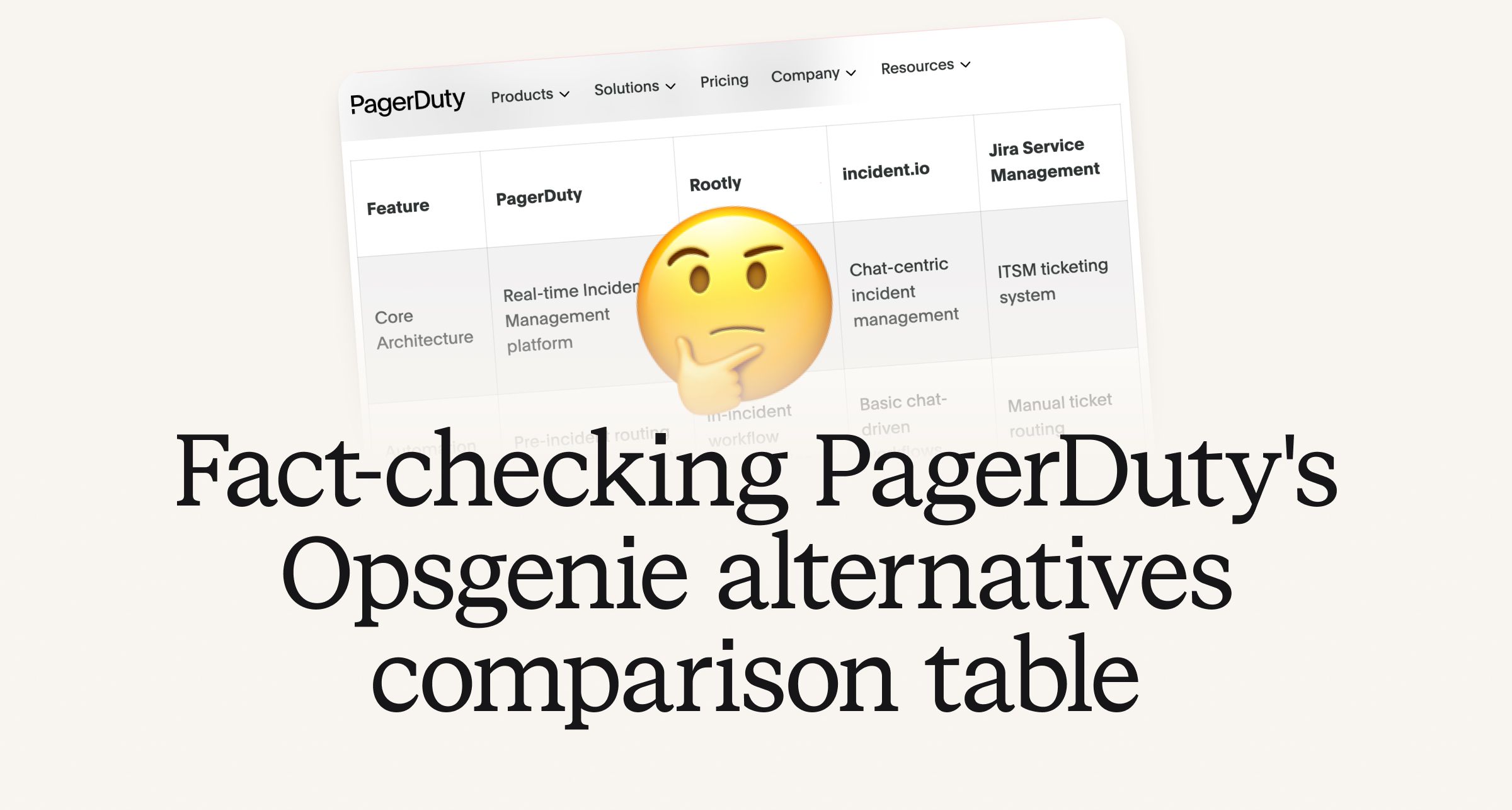
Fact-checking PagerDuty's Opsgenie alternatives comparison table
PagerDuty published a new comparison table about incident.io. Once again, it describes a product we don't recognize. So once again, we're correcting the record, row by row, with receipts.

July 28, 2026
Your genie is vanishing: introducing the Opsgenie rescue program
Today, we're launching the Opsgenie Rescue Program to make that landing soft: simplified migration and free overlap so you never pay two vendors at once.
July 9, 2026
So good, you’ll break things on purpose
Ready for modern incident management? Book a call with one of our experts today.
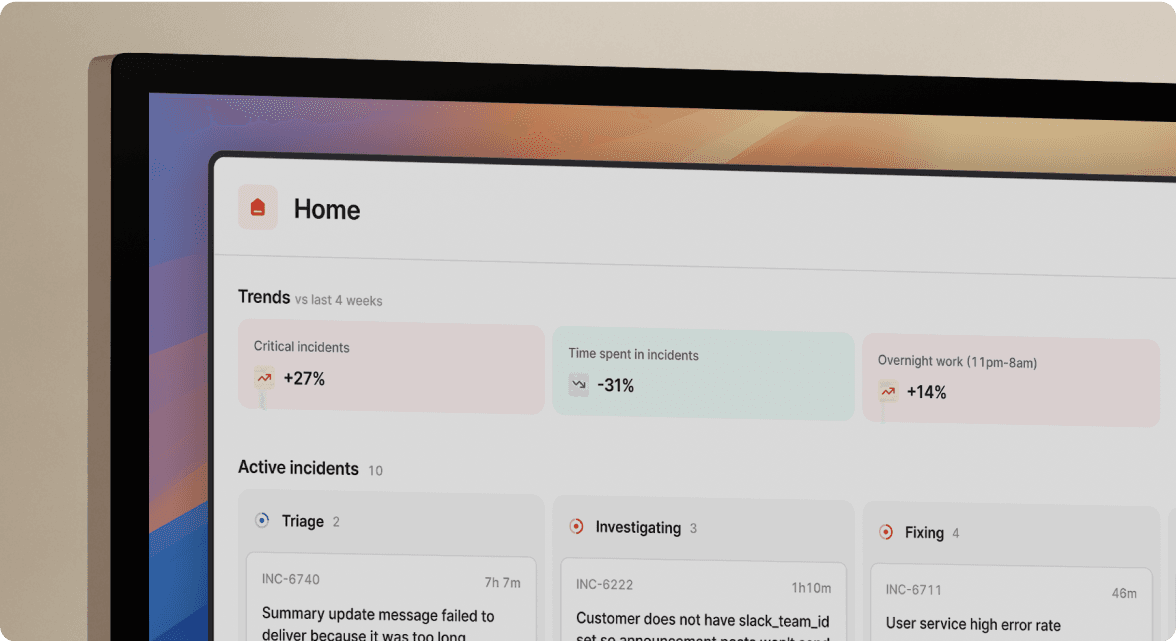
We’d love to talk to you about
- All-in-one incident management
- Our unmatched speed of deployment
- Why we’re loved by users and easily adopted
- How we work for the whole organization