Join live: What happens when your AI goes down?
Escalation policy best practices: designing policies that actually work
June 11, 2026 — 29 min read
TL;DR: Effective escalation policies route alerts directly to service owners, automate role assignments, and keep response workflows inside Slack rather than scattered across five browser tabs. Teams that consolidate alerting and coordination into a Slack-native platform like incident.io can reduce team assembly time from 15 minutes to 2 minutes. Set escalation delays for high-urgency incidents based on your SLO acknowledgment targets. If your P1 SLO requires acknowledgment within 5 minutes, your escalation timeout should fire at minute 6, not later. Limit tiers to three maximum, and staff rotations with at least eight engineers for single-site 24/7 coverage.
Many teams don't lose MTTR during the technical fix. They lose it before troubleshooting starts. Identifying who owns the failing service, routing the alert to the right team, and waiting for acknowledgment can consume 10 to 15 minutes of your recovery window, before a single diagnostic command runs.
An escalation policy is a structured set of rules that tells your alerting platform how to route alerts to specific on-call engineers, ensuring your team acknowledges and resolves critical incidents within defined timeframes. When you design it well, you barely notice it. When it's broken, your MTTR tells the story.
This guide covers evidence-based practices for setting escalation delays, mapping service ownership, structuring rotations, and auditing policies that no longer reflect how your team actually operates.
Key principles for reliable response workflows
Before configuring timing rules and tier structures, build a shared understanding of what an escalation policy is and what it isn't.
| Escalation policy | Escalation matrix | |
|---|---|---|
| Definition | Rules that automate how alerts route to responders | Reference table mapping severity to contacts and response times |
| Primary tool | On-call platform (incident.io, PagerDuty) | Documentation system (Confluence, wiki, runbook) |
| Target audience | The alerting system | The human team during triage |
A common framework for escalation policies is to define how handoffs occur between responders, while the matrix gives responders a quick-lookup reference during an active incident. Confusing the two leads to over-engineered automated chains nobody trusts, and under-documented human processes only senior engineers understand.
Every policy needs these core components:
| Component | Purpose | Technical example |
|---|---|---|
| Trigger rules | Define when an alert fires | Service Level Objective (SLO) threshold breach, error rate spike |
| Escalation delay | Time allowed before moving to the next tier | 15 minutes before escalating to backup |
| Escalation tiers | Ordered list of responders | Tier 1: primary on-call, Tier 2: backup, Tier 3: manager or subject matter expert |
| Notification channels | How each tier is contacted | Slack, SMS, phone call |
| Escalation timeout | When the next tier triggers automatically | Configurable per tier and urgency level |
Assigning clear incident roles
Debating roles during a crisis wastes cognitive capacity you need for troubleshooting. Without pre-assigned roles, duplicate investigation, unrequested status updates, and missed escalations to specialist teams are common failure patterns, all of which extend MTTR before the technical work even begins.
incident.io automates this by assigning the Incident Commander role to the primary on-call engineer the moment they acknowledge the alert in Slack, based on which service triggered the incident./inc assign
Speeding up first responder arrival
Every minute spent looking up who's on-call in a Google Sheet or manually pinging engineers in Slack extends MTTR before a single line of code gets touched. The math compounds quickly: 15 minutes of assembly time across 15 incidents per month at a $150 loaded engineer cost means $562.50 monthly in pure coordination overhead, before accounting for customer impact or recovery costs.
incident.io's team routing for alerts eliminates this by connecting Catalog service ownership to escalation paths, so when an alert fires, the right engineer gets paged automatically based on who owns the affected service, not who happens to check Slack first.
How to curb on-call alert fatigue
The Google SRE Book describes the feedback loop precisely: when pages occur too frequently, responders begin to second-guess or skim incoming alerts, sometimes missing critical pages masked by noise. Outages can be prolonged because alert fatigue interferes with rapid diagnosis and resolution.
You don't need a better on-call rotation. You need an alerting audit. Industry guidance suggests treating frequent non-actionable incidents per shift as a signal that your alerting stack is the problem, not your schedule. Breaking the fatigue cycle requires assigning clear ownership so alerts reach the person who can actually act on them, and demoting non-actionable alerts to non-paging notifications.
"incident.io makes incidents normal. Instead of a fire alarm you can build best practice into a process that everyone - technical or non-technical users alike - can understand intuitively and execute." - Verified user on G2
Reducing noise with smarter escalation timing
Paging immediately on every threshold breach burns out your on-call rotation. Delaying too long accumulates customer impact while you wait. The right timing protects responders without extending recovery windows.
Setting trigger timing and notification gaps
The Google Cloud SRE escalation policy guide discusses alerting strategies that tie your monitoring directly to your SLOs so engineers get paged because customer experience is degrading, not because a metric crossed an arbitrary line.
For high-urgency incidents, a common practice is to set delays before escalating to the next tier at around 15 minutes. This gives your primary responder enough time to acknowledge the alert and confirm active investigation, without creating a gap large enough to meaningfully delay recovery. The incident.io help article on escalation delays explains how gaps behave when a tier has no active on-call coverage, an edge case worth configuring explicitly rather than leaving to default behavior.
Urgency-based rules and timezone handoffs
Not every alert deserves the same treatment. Split escalation behavior by urgency level:
- High urgency (P1/P2): Page your primary on-call engineer immediately. Escalate to backup if unacknowledged within your defined timeout window. For incidents that remain unresolved after extended troubleshooting, bring in senior technical leadership.
- Low urgency (P3/P4): Post to your team's Slack channel during business hours. Consider skipping automated escalation unless someone upgrades severity.
incident.io's smart escalation paths let you configure these urgency-based rules directly in the platform. For global teams, you can configure non-critical alerts to respect the responder's local business hours, queuing delivery during working hours rather than paging during off-hours for issues that can safely wait. Watch the incident.io video on on-call as it should be for a walkthrough of what modern timezone-aware paging looks like in practice.
Optimizing team structures for incident response
The engineering structure behind your rotation determines whether your policy is sustainable or a burnout factory.
Determining ideal on-call staffing
Running 24/7 on-call coverage with too few engineers in rotation creates unsustainable burden. The Google SRE Book is direct: rotations with fewer than four people put each engineer on-call too frequently, creating unsustainable burnout risk. The book puts sustainable single-site coverage at eight engineers minimum for round-the-clock operations. For most teams, six to eight engineers per rotation is a practical target.
Scaling tiers for incident coverage
A standard three-tier structure handles the vast majority of incidents without creating coordination overhead:
- Tier 1 (Primary on-call): First responder, owns the incident from declaration to resolution.
- Tier 2 (Secondary/backup on-call): Paged automatically if Tier 1 doesn't acknowledge within the configured timeout.
- Tier 3 (Subject matter expert or Engineering Manager): Brought in when incidents require specialized expertise or additional coordination, particularly for high-severity outages with significant customer impact.
incident.io's API capabilities support programmatic configuration of these tiers, which becomes critical when managing rotations for multiple teams and you want policy changes version-controlled rather than applied manually through a UI.
Setting thresholds for team escalations
Configure automatic escalation thresholds to remove the awkward midnight judgment call ("should I page my manager?") from your on-call engineer and put it in the system where it belongs. Two thresholds to configure explicitly:
- Time to acknowledge: Escalate to Tier 2 if Tier 1 hasn't acknowledged within your configured timeout window.
- Time to resolve: Escalate to Tier 3 if the incident remains unresolved after a defined period of active troubleshooting.
The DevOps on-call best practices guide also recommends tracking which thresholds consistently trigger escalations to identify patterns in your incident response.
Eliminating single points of failure
When a single senior engineer gets paged for every major incident because they're the only person who understands the payment service, you don't have a rotation. You have a hero culture. Research on this pattern shows that concentrating knowledge in individual contributors exposes organizations to significant operational risk.
Fix this structurally: build redundancy into your rotations by pairing engineers during response to build knowledge across the team, and document critical procedures so expertise becomes shared rather than siloed. The hero trap analysis is clear that this is a structural problem requiring systematic solutions.
Assigning ownership for faster incident response
The fastest escalation path is no escalation at all: the right engineer gets paged directly because the alert knows who owns the service. This requires connecting your service catalog to your escalation policies.
Service and role-based routing
Route alerts directly to the team that owns the affected service rather than generic on-call queues. For example, database connection pool exhaustion should page the Database SRE team directly. Generic on-call queues create a second triage layer where someone has to read the alert, figure out which team owns the affected service, and manually re-route. That coordination overhead belongs in your escalation config, not in your incident channel.
Beyond service ownership, route alerts based on technical expertise: alerts related to different system layers should reach teams with the relevant domain knowledge. When alerts land in the right inbox the first time, you eliminate the irrelevant page problem where engineers get woken up for issues they have no context to debug.
incident.io's Catalog maps services directly to responsible teams. When an alert fires, Catalog translates the metadata into action by routing escalations from alerts to the right on-call engineer automatically, as the incident.io blog post on mastering incident routing explains in detail.
"incident.io is incredibly flexible and integrates smoothly with the tools we rely on. It makes it easy to collaborate at key moments, which helps us maintain SLAs and fix things quickly." - Verified user on G2
Automating complex multi-team escalations
Some incidents don't respect team boundaries. When an API failure stems from a database bottleneck, you need both the API team and the database team simultaneously, not sequentially. Manually paging two teams, creating a war room, and syncing context across three Slack threads adds 10 to 15 minutes to an incident that's already customer-facing.
incident.io handles multi-team escalations by pulling all relevant teams into a single incident channel. The /inc escalate @database-teamescalation commands bring additional on-call engineers into the existing incident channel with context already visible, so there's no second briefing required.
Automating incident commander assignment
Auto-assigning the Incident Commander role based on the service affected can reduce coordination overhead in every incident. When the primary on-call engineer for the affected service automatically becomes the IC, responders can skip initial role assignment discussions and start troubleshooting. The incident.io video on going beyond MTTx metrics covers how measuring coordination overhead separately from technical resolution time reveals where auto-assignment creates the most leverage.
Handling timezones in global teams
Coordinating incident response across multiple timezones introduces handoff risk that policy configuration can either create or eliminate. The sections below cover how to structure shift transitions and manage live incidents that span time zones.
Managing timezone-based handoffs and active incident transitions
Configure your on-call platform to shift primary responsibility based on local time zones, reducing the manual coordination burden on engineers. Structure schedules so transitions happen automatically in the platform, with overlap windows where both outgoing and incoming engineers are available, as the Salesforce follow-the-sun guide recommends.
Active incidents during a shift change need a structured baton pass. The follow-the-sun model analysis shows that structured, context-preserving handoffs significantly improve response effectiveness compared to cold handoffs where the incoming team reconstructs the incident state from scratch. A recommended protocol: before handing over the Incident Commander role, the outgoing engineer posts a summary covering current state, actions taken, and immediate next steps. The incoming engineer acknowledges receipt and assumes the IC /inc assign @incoming-engineerrole.
Escalation policy mistakes that kill uptime
Even well-intentioned escalation policies break down in predictable ways. The following patterns are the most common configuration and process errors that degrade response effectiveness over time.
Avoid alert fatigue through smart routing
Routing all alerts to a single catch-all policy regardless of service ownership creates significant alert fatigue risk. When database latency alerts, frontend 404 spikes, and Kubernetes node pressure all land in the same on-call queue, every responder has to triage alerts that aren't their problem before finding the one they can actually fix. The Google SRE Book is direct: good alerting has good signal and very low noise.
"Too many to list - it's a one stop shop for incident management (not just on call rotations like many competitors). It takes all the pain out of incident management and lets you focus on working the incident itself." - Verified user on G2
How sluggish paging hurts recovery
Overly long escalation delays extend customer-facing downtime before your system pages the right expert. The uptimelabs incident escalation guide frames escalation matrices as defining "what 'escalate' actually means in practice" including the time limits attached to each level. Without explicit time limits, escalation timing becomes inconsistent and delays can compound incident impact.
Replacing complex chains with direct paging
Overly complex escalation chains with many tiers can create delays in practice. When an alert has to cascade through multiple tiers before reaching someone with authority to make a call, the delay compounds customer impact without adding resolution capability. Simpler escalation paths with direct routing to service owners often perform better. See the incident.io blog on why PagerDuty wasn't built for the modern shipping velocity era, for context on why complexity in escalation tooling compounds the problem.
Preventing unassigned incident alerts
When alerts fire into channels with no designated owner, they risk being overlooked. incident.io requires every alert to route to a named escalation path with a designated primary responder who must acknowledge the page. If no one is on-call for that tier, the escalation delay behavior documentation explains how the system handles the gap rather than silently dropping the alert.
Fixing ignored on-call notifications
When engineers consistently dismiss alerts without taking action, the alert configuration needs review, not engineer compliance. Audit any alert that gets acknowledged and immediately closed without investigation. That pattern signals a low-actionability alert masquerading as something urgent. Best practices recommend treating alerts with a consistent "acknowledged, no action taken" pattern as candidates for demotion to a non-paging notification. Your signal-to-noise ratio is worth tracking explicitly.
How to validate your incident escalation paths
Building a policy is not the same as testing it. Policies break in ways that only surface during real incidents if you never deliberately validate them.
Testing paths with automation and game days
Use automation to trigger test alerts and verify that the correct engineers get paged through the correct channels in the correct order. The leanwisdom escalation matrix guide describes code-configured escalation policies as removing "the awkwardness of a junior employee having to decide to call their boss's boss in the middle of the night." Automating the validation means you catch misconfigured routing before a real P1 exposes it. If you're managing policies across multiple teams, incident.io's API capabilities support programmatic testing at scale.
Run a quarterly Game Day: trigger a simulated P1 incident in a staging environment and run the response as if it were real. Measure time from alert to "team assembled with IC assigned." If that number exceeds two minutes, you need to rework your policy configuration before the next real outage hits. The incident.io video on the successful on-call team podcast covers how teams structure these exercises for maximum learning with minimum disruption.
Quantifying time to resolution metrics
Track Mean Time to Acknowledge (MTTA) separately from Mean Time to Assemble (the time it takes your full response team to be coordinated and ready to act). If MTTA is low but assembly takes 12 minutes, your escalation policy is paging the right person but your coordination workflow is still manual. Measuring these metrics at the infrastructure level reveals coordination bottlenecks that MTTR alone obscures.
Validating policy impact with engineers
Survey your engineers after each shift with two questions: Did you receive any pages you couldn't act on? Were the escalation paths clear during your rotation? These two questions surface alert fatigue and path confusion faster than any dashboard metric. The incident.io video on confidence to declare incidents is a useful watch for understanding how qualitative feedback shapes policy iteration at engineering orgs using structured incident management.
Identifying gaps in your incident escalation flow
Gaps in escalation coverage often go undetected until a real incident exposes them. The sections below outline where to look and what signals indicate a policy that needs reconfiguration.
Review escalation timing and coverage gaps
Pull your historical incident data and segment MTTR by phase: time to acknowledge, time to assemble, time to resolve. If your median MTTR is high and the delay concentrates in the acknowledge-to-assemble phase, your escalation path configuration is the problem, not your engineers' troubleshooting speed.
Audit your rotation schedules for periods where the on-call tier has no coverage, including holidays, timezone transitions, and engineers who've left but remain listed in the tool. A misconfigured schedule that silently drops escalations is worse than no escalation policy because it creates the illusion of coverage that doesn't exist.
Analyze missed escalations and process flaws
Analyze every incident where an alert went unacknowledged and failed to escalate. The failure usually comes from one of three sources: misconfigured routing rules, outdated contact information in the alerting platform, or an on-call schedule with a gap nobody noticed. Each failure is a specific config fix, not a team culture problem.
When engineers bypass your automated escalation policy and manually ping individuals in Slack instead, your automated routing has lost their trust. That's a signal to fix the config, not mandate compliance. The incident.io blog on migrating from PagerDuty covers how auditing existing alerting configurations before migration reveals these workarounds systematically.
Update policies based on incident patterns
Use incident.io's Insights dashboard to track which services trigger the most escalations per quarter. If one service type dominates your P1 incident log, that's a reliability investment signal, not just an escalation policy problem. Refine your alerting thresholds for that service and update service mappings to ensure the right team always gets paged first. The incident.io video on incident response workflow improvement covers how closing the loop between incident data and policy updates drives measurable MTTR reduction over time.
Essential escalation policy guidelines for SREs
The following questions come up repeatedly when teams are configuring or refining escalation policies. Each answer below reflects patterns that hold across most SRE team structures and incident volumes.
Choosing the right escalation depth
Cap every escalation policy at three tiers. Beyond three, you add latency and confusion, not coverage. Each additional tier adds decision complexity without proportionally improving the speed of resolution.
What's the ideal delay before first escalation?
For high-urgency incidents, 15 minutes is the standard delay before automatically escalating to the backup engineer. Adjust this based on your SLOs: if your P1 SLO requires acknowledgment within 5 minutes, your escalation timeout should fire at minute 6, not minute 15.
When to include executives in escalations
Don't page executives directly for technical troubleshooting. Send them an automated Slack or SMS notification if a P1 incident remains unresolved after 60 minutes, because at that point business impact has crossed a threshold where leadership needs situational awareness even if they can't contribute to technical resolution. Google's example escalation policy outlines a similar pattern: SRE teams escalate to leadership after a defined violation window, exercising judgment about timing rather than triggering mechanically.
How often should escalation policies be reviewed?
Review your policies quarterly. Every 90 days, audit your service-to-team mappings, rotation schedules, and escalation tiers against your current team structure. Engineers leave, services get renamed, teams merge, and new services get created. A policy accurate six months ago is likely routing some alerts to the wrong people today.
Escalation routing tools for SRE teams
PagerDuty offers sophisticated alert routing rules and a battle-tested alerting engine, but at $41 or more per user per month on the Business tier, and with a web-first architecture that requires context-switching away from Slack during incidents. Opsgenie reached end of sale in June 2025 and sunsets in April 2027, making any investment in it a short-term decision by definition.
incident.io is the Slack-native alternative: the Pro plan costs $25 per user per month for incident response with on-call adding $20 per user per month, for a total of $45 per user per month with full on-call coverage. It unifies on-call scheduling, alert routing, status pages, and post-mortem generation in one platform without requiring engineers to open a browser tab during a live incident. The incident.io humanizing on-call webinar goes deeper on how on-call design choices affect engineer wellbeing and retention.
If you've built deep customization into PagerDuty's routing rules and that flexibility is genuinely load-bearing, migrating has real friction. If you're running a patchwork of tools that engineers route around rather than through, consolidating into a Slack-native platform is the faster path to MTTR improvement.
"When we were looking for a tool to improve the experience for both our incident response teams as well as for communicating effectively with management, incident.io came through on both counts... their customer success and responsiveness to bug reports and feature requests is superb." - [Verified user on G2](improve the experience)
Book a demo to see escalation path configuration and Catalog service mapping in action.
Key terms
Escalation policy: A structured, automated ruleset configured in an alerting platform that defines who gets paged, in what order, through which channels, and what triggers the next tier if acknowledgment doesn't occur within the defined window. Escalation policies reduce MTTR by eliminating manual routing decisions during active incidents.
Mean Time to Acknowledge (MTTA): The median duration from when an alert fires to when an on-call engineer acknowledges the page. For high-urgency incidents, target MTTA should be under 5 minutes with escalation to backup tier triggering at 15 minutes.
Service Catalog: A centralized registry mapping each service or microservice to its responsible team, on-call rotation, documentation, and dependencies. Service Catalog integration allows escalation policies to automatically route alerts based on service ownership rather than generic queues.
Alert fatigue: The psychological and operational degradation that occurs when on-call engineers receive excessive non-actionable alerts, leading to ignored pages, delayed responses, and increased MTTR. Google SRE guidance recommends treating more than two to three non-actionable incidents per shift as a signal that alerting thresholds need reconfiguration.
Incident Commander (IC): The designated role responsible for coordinating incident response, making escalation decisions, communicating status to stakeholders, and ensuring post-incident documentation gets completed. Auto-assigning IC based on service ownership eliminates the coordination tax of manually determining who runs the incident.
Follow-the-sun support: A global on-call model where primary incident response responsibility shifts across timezones to ensure coverage during local business hours, minimizing overnight and weekend on-call burden. Effective follow-the-sun requires 30 to 60 minute handoff overlap windows and structured incident summaries at shift transitions.
FAQs

Tom Wentworth
Chief Marketing Officer
See related articles
Introducing Investigations, powered by Nexus.
Today we're launching Investigations: agentic root cause analysis that starts the moment you're paged, figures out what broke and why, and works with your team through to resolution. Here's what we built, what's powering it, and why it took some time to get right.

August 5, 2026
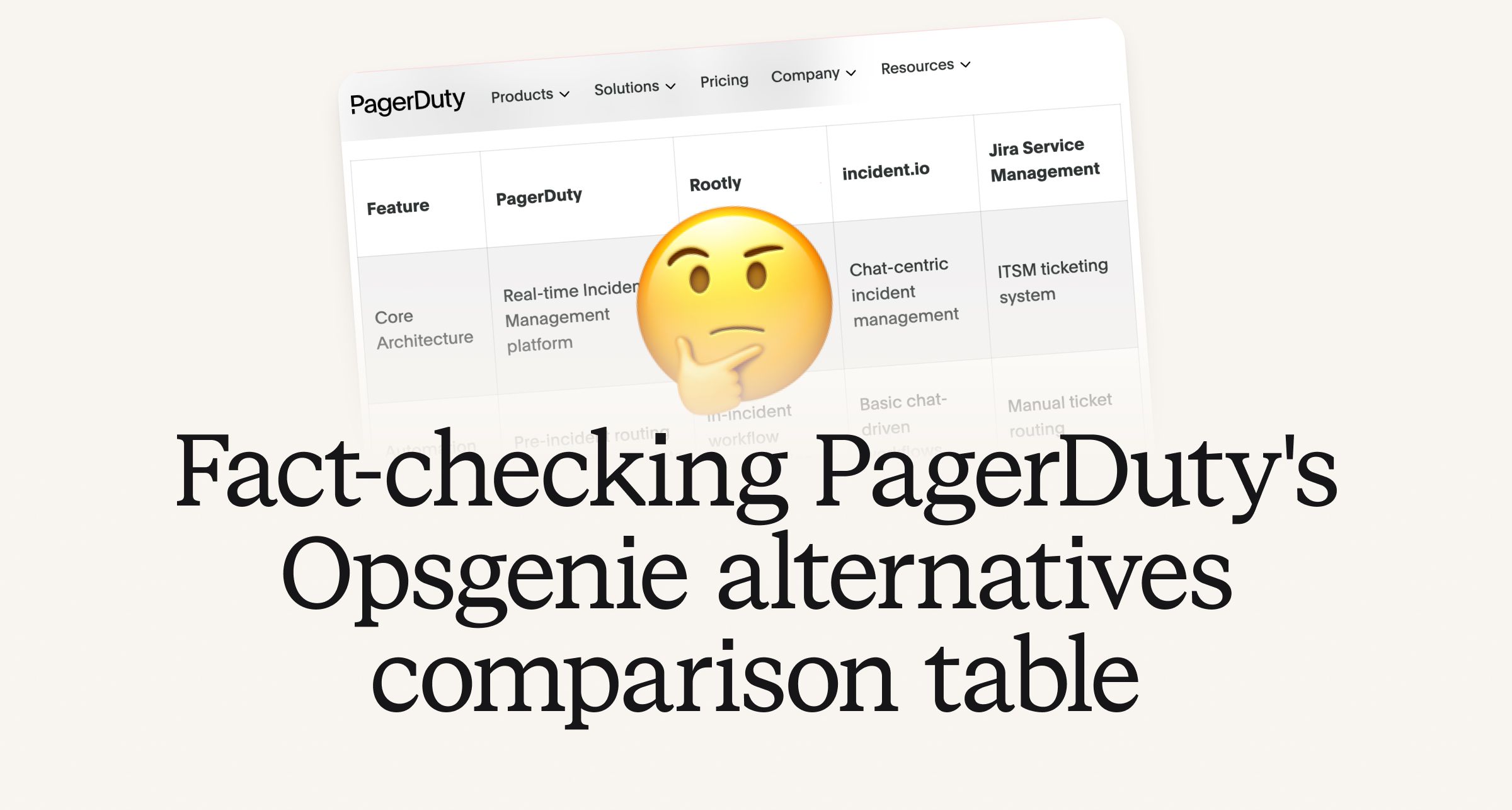
Fact-checking PagerDuty's Opsgenie alternatives comparison table
PagerDuty published a new comparison table about incident.io. Once again, it describes a product we don't recognize. So once again, we're correcting the record, row by row, with receipts.

July 28, 2026
Your genie is vanishing: introducing the Opsgenie rescue program
Today, we're launching the Opsgenie Rescue Program to make that landing soft: simplified migration and free overlap so you never pay two vendors at once.
July 9, 2026
So good, you’ll break things on purpose
Ready for modern incident management? Book a call with one of our experts today.
We’d love to talk to you about
- All-in-one incident management
- Our unmatched speed of deployment
- Why we’re loved by users and easily adopted
- How we work for the whole organization