incident.io pricing & migration costs vs. PagerDuty and DIY Jira Slack integration
December 16, 2025 — 15 min read
Updated December 16, 2025
TL;DR: The Opsgenie sunset on April 5, 2027 forces a choice: migrate to Jira Service Management (not built for real-time incidents), maintain a DIY Jira-Slack stack (hidden costs of $9,000+ annually), or adopt a unified platform. We offer transparent pricing where total cost ranges from $25–$31/user/month on the Team plan and $45/user/month on the Pro plan when on-call is included, consolidating scheduling, response, status pages, and post-mortems. For 100 engineers, this delivers $21,636 annual savings versus PagerDuty while eliminating maintenance overhead. Migration takes 30 days with zero-downtime parallel runs.
The state of incident management: Why the Opsgenie sunset forces a choice
Atlassian's March 2025 announcement hit engineering teams with a hard deadline: Opsgenie reaches end-of-life on April 5, 2027, with end of sale effective June 4, 2025. Current customers have uninterrupted access for two years, but after April 2027, all Opsgenie data gets deleted.
This isn't just a migration project. It's a forced decision point that exposes the real cost of incident management.
Your three paths forward:
- Migrate to Atlassian's recommended alternatives (Jira Service Management or Compass). Neither covers centralized alert dispatching and real-time incident coordination. JSM is designed for IT service management including production incidents, but teams coordinating live outages often find its service-desk workflow too heavyweight.
- Build a DIY stack by connecting Jira, Slack, Confluence, and your alerting tool. This looks cheaper on paper but carries hidden maintenance costs.
- Adopt a purpose-built platform that handles the complete incident lifecycle in one place.
Choosing incident management software determines not just your software budget, but how much engineering time you spend maintaining tools versus shipping product.
Option 1: The DIY route (High maintenance, hidden costs)
Before evaluating dedicated incident management software, many teams consider building incident workflows using existing Atlassian and Slack licenses. The logic makes sense: "We already pay for these tools, why add another vendor?"
Here's exactly how to wire them together, and what it actually costs.
How to integrate Jira with Slack for basic ticketing
The native Jira Cloud for Slack app provides basic two-way integration. Install from your workspace Apps section, authenticate your Atlassian account, and use /jira create to trigger ticket creation. Configure project-to-channel connections for notifications on issue creation, status changes, and comments. Setup takes about one minute for initial connection.
The catch: Slack doesn't display the full conversation thread for tickets created via /jira create. During a live incident, your team coordinates in Slack while incident details live in Jira. Context lives in two places.
How to integrate Confluence with Slack for runbooks
Confluence Cloud for Slack requires installing the app, then typing /confluence connect <space-url> in channels where you want runbook notifications. By default, this sends notifications for all events: page creation, edits, and comments. Type /confluence list to edit subscription settings.
Users can preview pages and reply to comments from Slack, but complex runbook updates require switching to Confluence. During incidents, responders context-switch between three tools: Slack for coordination, Jira for tracking, Confluence for documentation.
The hidden TCO of maintaining custom integrations
Native Jira-Slack integration provides basic functionality. For advanced features like true two-way sync, you need third-party marketplace apps that add subscription costs on top of existing licenses.
The maintenance burden that doesn't appear on invoices:
Custom workflows break. Slack API changes require updates. Webhook configurations drift. The engineer who built the original integration left six months ago, and nobody documented how it works.
Track the actual cost: Most teams spend 5 hours per month troubleshooting integrations, maintaining webhooks, and updating workflows. At a $150 loaded hourly rate, that's $9,000 annually in hidden costs that don't appear on software invoices.
"Incident has a very responsive and competent team. They have built a system with sane defaults and building blocks to customize everything. Their product is responsive and reliable, and the new features are all well thought out." - Bertrand J. on g2
The DIY approach works for small teams with simple workflows. Beyond that scale, coordination overhead compounds faster than license savings.
Option 2: The platform route (Our pricing breakdown)
We consolidate on-call scheduling, incident response, status pages, and post-mortems into one Slack-native platform with transparent pricing. No per-incident fees, no surprise charges for "premium integrations," no discovering essential features cost extra.
Team vs. Pro plans: Which fits your engineering org?
Team Plan: Best for growing teams establishing incident practices
Our Team plan delivers multi-team coordination, Slack and Microsoft Teams integration, at $15-19 per user per month for incident response.
Base features included:
- Slack-native incident response with unlimited incidents
- 2 on-call schedules
- 3 workflows and 3 custom fields
- 1 status page
- Unlimited integrations (Datadog, Prometheus, New Relic, Jira, Linear)
- API and webhooks
On-call add-on: $10-12 per user per month
Real all-in cost: $25-31/user/month depending on annual vs. monthly billing.
Pro Plan: Best for mature engineering organizations
Our Pro plan costs $25 per user per month for incident response. On-call management costs an extra $20 per user per month.
Everything from Team plus:
- Unlimited workflows, custom fields, and on-call schedules
- Microsoft Teams support (in addition to Slack)
- AI-drafted post-mortems using captured timeline data
- Custom incident types and post-incident flows
- Private incidents for security issues
- 3 custom dashboards in Insights
- Escalation paths and compensation calculator
Real all-in cost: $45/user/month with on-call included. For a 100-person team, this totals $54,000 annually.
When Pro makes sense: You handle 20+ incidents monthly, need private incidents for security issues, want AI-powered post-mortem generation, or require Microsoft Teams in addition to Slack.
Enterprise Plan: For large teams with compliance requirements
Enterprise pricing is custom. Contact sales for quotes.
Everything from Pro plus:
- SAML SSO and SCIM provisioning
- Slack Enterprise Grid support
- Unlimited custom dashboards, incident policies, and status pages
- Dedicated Customer Success Manager
- Live phone support with SLAs
Understanding the on-call add-on model
We price on-call separately because not every user needs a pager. Your engineering org likely has responders (join incidents when needed) and on-call rotation members (carry the pager and get alerted first).
How blended pricing works for a 100-person team:
Assume 50 users are responders-only, 50 are in on-call rotations:
Pro Plan math:
- 50 responders: 50 × $25/month × 12 = $15,000/year
- 50 on-call: 50 × ($25 + $20)/month × 12 = $27,000/year
- Total: $42,000/year
Pricing transparency that matters: You can purchase on-call as a standalone product, giving you flexibility to mix responder and on-call licenses based on your team's actual needs. No forced bundles. No "contact sales to understand your true cost."
"incident.io provides a one stop shop for all the orcestrations involved when managing an incident...hugely improving our communication capabilities and response times. The product is intuitive and is low effort to configure and maintain." - Kay C. on G2
TCO showdown: incident.io vs. PagerDuty vs. DIY
Total Cost of Ownership extends beyond sticker price to include implementation time, maintenance overhead, and hours spent coordinating incidents across fragmented tools.
Comparing the hard costs
Here's the annual software spend for a 100-person engineering team:
| Category | incident.io Pro | PagerDuty Business | DIY (Jira + Slack) |
|---|---|---|---|
| Base platform | $30,000 (100 users) | $49,200 (100 × $41 × 12) | Included in existing Jira |
| On-call management | $12,000 (50 users) | Included in base | PagerDuty required: $24,600 |
| Status pages | Included | $1,068 per 1k subscribers | Statuspage.io: $29-99/month |
| AI capabilities | Included | PagerDuty Advance: $4,980/year | Not available |
| Noise reduction | Included | AIOps: $8,388/year | Manual alert tuning |
| Integration maintenance | Zero (native) | Zero (native) | ~$9,000/year |
| Annual total | $42,000 | $63,636 | $33,600 + $9,000 |
Key insights:
PagerDuty Business starts at $41 per user per month but requires separate add-ons for features we include. The DIY approach appears cheaper initially, but the $9,000 annual maintenance burden (conservative estimate at 5 hours per month) closes the gap.
Savings comparison by team size:
| Team Size | Our Annual Cost | PagerDuty Annual Cost | Annual Savings |
|---|---|---|---|
| 50 engineers | $21,000 | $39,036 | $18,036 (46%) |
| 100 engineers | $42,000 | $63,636 | $21,636 (34%) |
| 250 engineers | $105,000 | $137,436 | $32,436 (24%) |
Comparing the soft costs (Engineering time)
Software licenses are just the baseline. The real TCO includes engineering hours spent coordinating incidents.
DIY Jira-Slack workflow:
- Manual channel creation, @ mentions, Jira ticket via
/jira create - Copy context between Slack and Jira throughout incident
- Manual status page updates, follow-up task creation
- Time to assemble team: 12+ minutes
Our workflow:
- Alert fires from Datadog, Prometheus, or New Relic
- We auto-create #inc-2847-api-latency-spike channel (30 seconds)
- We auto-page on-call engineer and pull in service owner (30 seconds)
- Timeline captures automatically, no manual notes needed
- Follow-up tasks auto-create in Jira or Linear with incident context
- Time to assemble team: 2 minutes
The coordination savings multiplied:
For a 100-person team handling 20 incidents monthly at a $190 loaded hourly cost, coordination savings alone total $11,400 annually.
Manual post-mortems take 60-90 minutes. Our AI-drafted post-mortems take 10 minutes to refine, saving 80 minutes per incident.
"Incident.io is extremely helpful when dealing with Incidents, it helps to follow a clear and intuitive process...it enables great functionality to track mortem analysis and follow-up actions as per agreed mitigation plan." - Verified user review of incident.io
Migration guide: Moving from Opsgenie in 30 days
The forced migration from Opsgenie creates legitimate anxiety about downtime and lost data. Our migration approach runs both systems in parallel, validating the new platform without risking missed pages.
Parallel Run means a migration strategy where both platforms receive alerts simultaneously, allowing validation without risk.
The 4-step migration roadmap
- Week 1: Audit and export Export your user list via the Opsgenie List Users API. Remove inactive accounts. Export on-call schedules in iCalendar format or via the Schedule API. Review for gaps or outdated rotations.
- Week 2: Map integrations and routing Document routing rules showing which teams get paged based on alert tags. We integrate with PagerDuty during migration, and the same applies to Opsgenie. Configure your monitoring tools to send alerts to both platforms. This parallel run validates routing before full cutover.
- Week 3: Train and test Our platform requires minimal training because it feels like using Slack. Run test incidents while keeping Opsgenie active.
"A seamless Slack integration, easy to set up and always adding great features regularly." - Verified user review of incident.io
Watch how Intercom migrated from PagerDuty and Atlassian Status Page in a matter of weeks.
Focus training on /inc commands: /inc declare to start incidents, update severity and assignments within the channel, /inc resolve to close with summary.
- Week 4: Cutover and validate After validating parallel alerts for 1-2 weeks with zero missed pages, switch monitoring integrations to send alerts only to us. Keep Opsgenie read-only for 30 days as a safety net. After validation, deprecate Opsgenie.
Zero-downtime guarantee: The parallel run means you never risk missing a page. If our platform has routing issues during testing, Opsgenie still catches the alert.
Download our complete Opsgenie migration playbook for detailed guidance, API scripts, and parallel-run strategy.
Security and compliance: SOC 2, GDPR, and access controls
- SOC 2 compliance: We've completed SOC 2 Type I audit, with external auditors validating security controls. We use Vanta for continuous compliance monitoring.
- GDPR compliance: Full GDPR adherence with formal data retention procedures. Our primary data residence is in the EU (GCP's Belgium region).
- Access controls by tier: Team tier offers workspace-wide visibility. Pro tier adds Private Incidents, restricting visibility to designated responders for security vulnerabilities or sensitive issues. Enterprise tier provides SAML SSO and SCIM provisioning for centralized identity management, plus audit logs tracking who accessed what incident data.
- Integration security: All integrations use encrypted connections. API access requires authentication tokens with 1,200 requests per minute rate limits. Webhook configurations support signature verification.
The Opsgenie sunset isn't just a migration deadline. It's a forcing function to evaluate whether your incident management infrastructure serves your team or adds cognitive load during critical moments.
Schedule a demo to see our Slack-native workflow in action, and run your first incident without sales pressure.
Key terminology
MTTR (Mean Time To Resolution): Average time from incident detection to resolution, measuring how quickly your team restores service.
Service Catalog: Centralized registry of services, owners, and dependencies used to automatically route incidents to the right team.
Private Incidents: Restricted-visibility incidents (Pro tier) where only designated responders view details, used for security vulnerabilities.
Parallel Run: Migration strategy where both platforms receive alerts simultaneously, allowing validation without risk.
AI-drafted Post-mortems: Automatically generated incident reports using captured timeline data, requiring only 10 minutes of refinement versus 60-90 minutes of manual writing.
FAQs

Tom Wentworth
Chief Marketing Officer
See related articles
Introducing Investigations, powered by Nexus.
Today we're launching Investigations: agentic root cause analysis that starts the moment you're paged, figures out what broke and why, and works with your team through to resolution. Here's what we built, what's powering it, and why it took some time to get right.

August 5, 2026
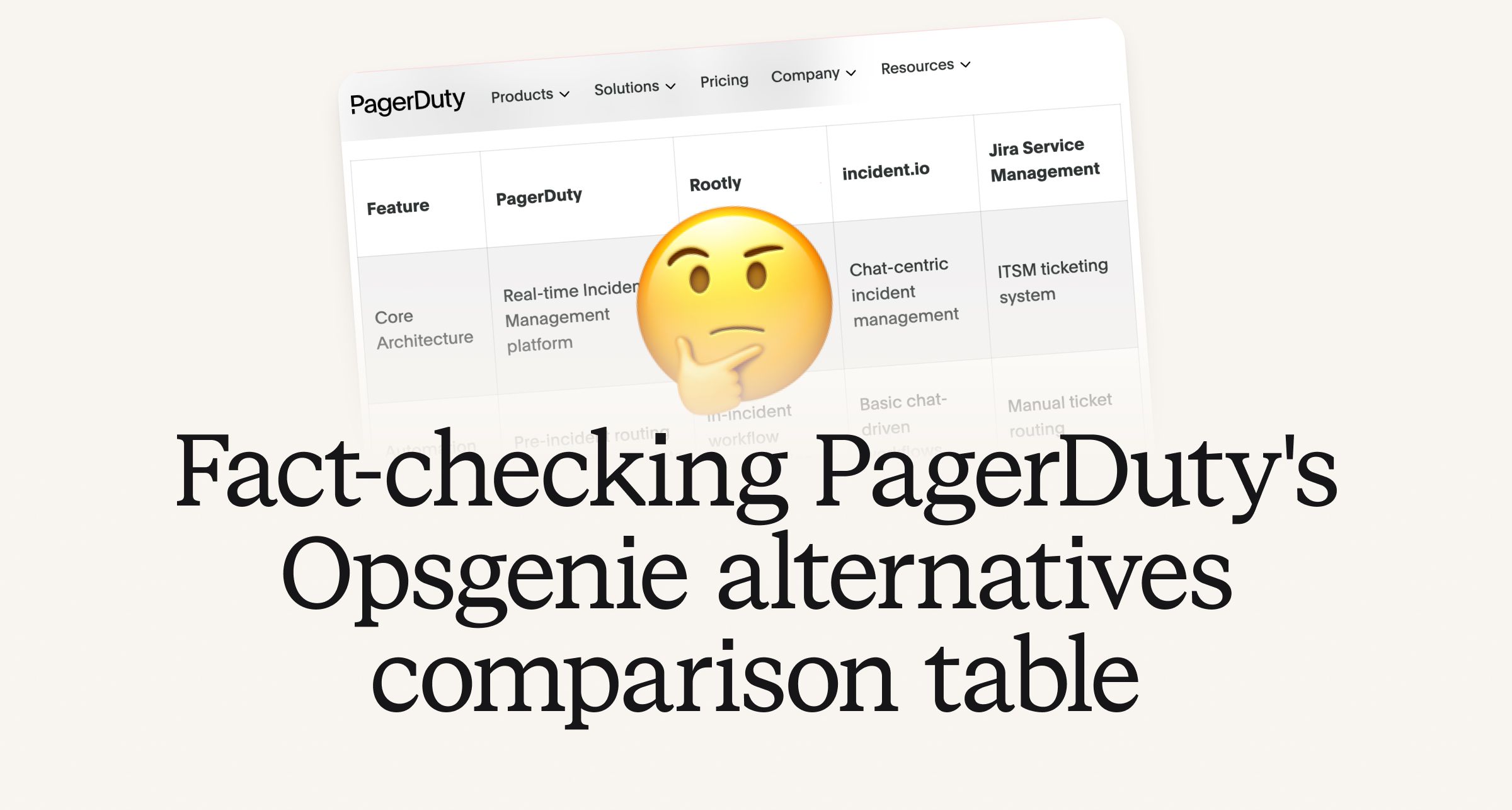
Fact-checking PagerDuty's Opsgenie alternatives comparison table
PagerDuty published a new comparison table about incident.io. Once again, it describes a product we don't recognize. So once again, we're correcting the record, row by row, with receipts.

July 28, 2026
Your genie is vanishing: introducing the Opsgenie rescue program
Today, we're launching the Opsgenie Rescue Program to make that landing soft: simplified migration and free overlap so you never pay two vendors at once.
July 9, 2026
So good, you’ll break things on purpose
Ready for modern incident management? Book a call with one of our experts today.
We’d love to talk to you about
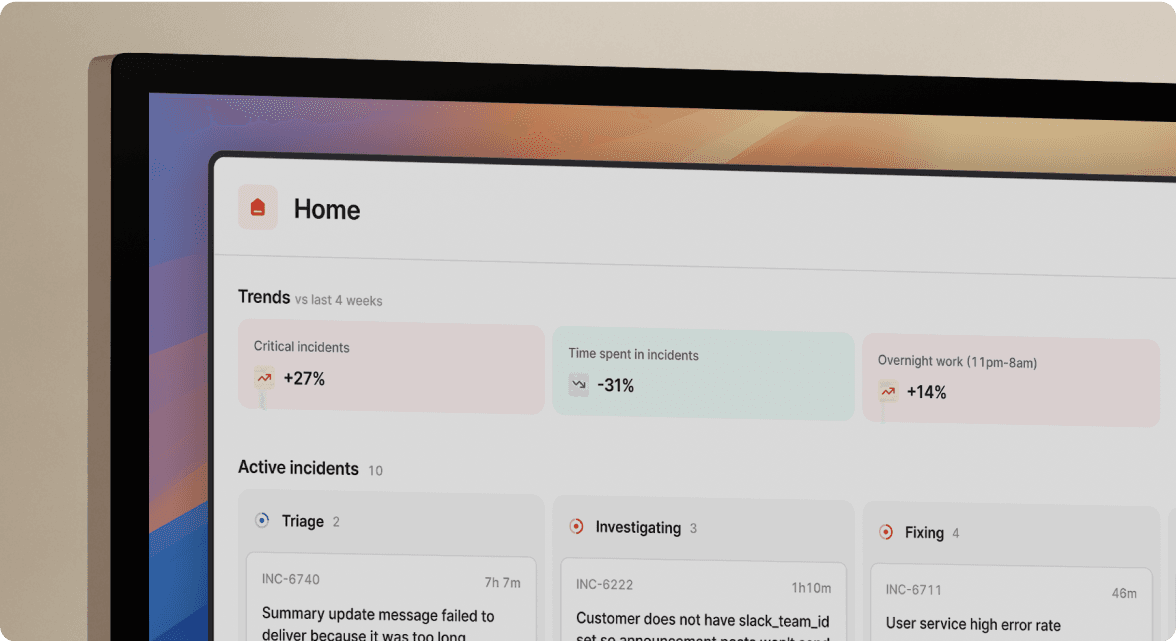
- All-in-one incident management
- Our unmatched speed of deployment
- Why we’re loved by users and easily adopted
- How we work for the whole organization