Software factory vs. agentic SDLC: Which model fits your team?
TL;DR: Software factory and agentic software development lifecycle (SDLC) describe the same delivery model from different angles. The factory model emphasizes pipeline constraints, and the agentic model emphasizes agent autonomy. The real decision is governance: human approval gates, agent role-based access control (RBAC), and audit trail integrity. Passing a SOC 2 Type II audit requires a traceable log entry for every autonomous action, access control that covers agent identities, and human approval gates at production deployments. Teams with strong platform engineering and heavy compliance requirements tend to start factory-first, and teams with AI expertise and high deployment frequency lean agentic. incident.io provides that control layer with an Enterprise audit log, private incidents, and granular RBAC.
The debate between Software Factory and Agentic SDLC is partly a vocabulary problem. Both terms describe the same change: AI agents that can run CI/CD pipelines, write tests, and open pull requests while humans approve production deployments. The harder question is whether your audit trail holds up when an autonomous agent deploys code. A SOC 2 Type II auditor tests evidence, not terminology. The evidence test is whether every autonomous action left a log entry traceable to a human decision or an approved policy.
By the end, you will know which governance controls your team needs regardless of which label you use, and whether incident.io's Enterprise audit log, RBAC, and private incidents produce the evidence your auditor requires.
Defining the software factory production model
The software factory model applies manufacturing principles to software delivery, emphasizing standardized pipelines, repeatable processes, quality gates, and predictable outputs. In software, the factory model means continuous integration and continuous delivery (CI/CD) pipelines, automated testing gates, and deployment approvals that constrain what can happen at each stage.
Running software delivery like an assembly line
A software factory treats code delivery like an assembly line. Each stage has a defined input, a defined output, and a quality gate that must pass before the next stage begins. The pipeline definition is the control plane: it determines what tools run, in what order, and under what conditions. Human approval gates sit at high-risk steps such as production deployments, and the pipeline logs every action for audit purposes.
The factory model already assumes automation. The question is how much autonomy the automated steps have. A traditional factory pipeline executes predefined scripts. An AI-native factory pipeline lets agents make decisions within the pipeline's constraints, such as choosing which tests to run or which canary deployment strategy to use. The agents follow the same pipeline structure but decide which steps to run and how.
Managing risk in software factories
Risk management in factory models relies on quality gates, staged rollouts, and canary deployments. A canary limits the blast radius of a bad release by routing only a small percentage of traffic to the new version. If error rates spike, you can configure the pipeline to roll back automatically.
The compliance implication is that factory models produce logs at each gate, but those logs are only as good as the gate's enforcement. If a gate can be bypassed or if the logs do not capture who approved what, the audit trail breaks. SOC 2 Type II change management requirements state that all changes to infrastructure must follow documented change management procedures with audit trails. A pipeline that enforces gates but logs them incompletely leaves gaps an auditor can flag, just as a pipeline with no gates would.
Defining the agentic SDLC framework
The agentic SDLC framework describes a software development lifecycle where autonomous agents perform planning, coding, testing, and deployment tasks under human oversight. Agentic language stresses autonomy, adaptation, and goal-directed behavior, but agents can run on the same pipeline structure as a factory.
Delegating lifecycle tasks to autonomous agents
Agentic SDLC is a development model in which AI agents autonomously execute specific tasks across the software lifecycle, such as generating code, running tests, reviewing proposed changes, and responding to pull-request feedback without waiting for a human to direct every individual action. In this model, autonomous agents collaborate across the entire SDLC, moving delivery toward more end-to-end automation.
Human attention becomes a governance and verification resource rather than an execution resource. A recent academic paper on the Agentic SDLC notes that AI-SDLC allows coding agents to operate with substantial autonomy within individual lifecycle phases, creating or modifying required artifacts without requiring human approval after every individual action. The shift is not from manual to automated but from human-executed steps to agent-executed steps within the same pipeline structure.
Following an agentic workflow from goal to merge
A typical agentic workflow looks like this: an agent receives a goal, plans the steps, executes code changes, runs tests, opens a pull request (PR), and a human reviews and merges. The agent does not take action on production systems without that review. Our Investigations product, a paid add-on that is not included in any plan, requires the Response product and is available on Pro and Enterprise only. It follows this pattern for incident response. The agent analyzes telemetry, deployments, code changes, and past incidents to surface likely root causes and opens a pull request that a human reviews and merges. Investigations handles the first 80% of incident response by connecting telemetry, code changes, and incident history, and a human reviews any fix before it ships.
The key difference from a traditional pipeline is that the agent decides which tools to call and in what order, rather than following a predefined sequence. That freedom lets agents handle more varied work, but it makes each run harder to audit. A second academic paper on agentic discipline argues that agentic speed does not eliminate engineering discipline. It relocates discipline upstream into specification precision, explicit gates, and auditable provenance.
Setting guardrails for AI autonomy
Guardrails in agentic workflows include human-in-the-loop gates, approval workflows, sandboxed execution, and the principle that agents propose changes and humans approve or reject them before execution. The human-in-the-loop spectrum runs from fully manual to fully autonomous, with mandatory human gates at high-risk steps. Production deployments and security policy changes should always require human approval, even in a highly agentic model.
Our AI governance controls let you enforce these guardrails. Several AI features are on by default, including incident channel message storage, Meeting Notes, transcript viewing, Scribe auto-join, and the Remote MCP server. Investigations and Scribe transcription are off until you turn them on. Permissions govern who can change those settings. By default, AI features also work in private incidents, an admin can restrict that, and a private incident never surfaces in search results or suggestions for a different incident.
Finding common ground in AI-native SDLC
Software Factory and Agentic SDLC are not competing architectures. They describe overlapping parts of the same delivery model from two different angles. Both standardize outcomes, both require security gates and audit trails, and both depend on continuous delivery flows. Treating them as rivals redirects evaluation effort away from governance design, where the real decisions are.
Standardizing outcomes for AI workflows
Both models aim for predictable, repeatable, measurable software delivery. The factory model achieves standardization through the pipeline definition, and the agentic model achieves it through the agent's operating constraints. The common ground is that standardization is what makes the process auditable.
| Operational Outcome | Software Factory Approach | Agentic SDLC Approach |
|---|---|---|
| Delivery speed | Pipeline automation reduces manual handoffs | Agents execute steps in parallel without waiting for human direction |
| Quality consistency | Quality gates enforce standards at each stage | Agents run tests and checks autonomously within constraints |
| Auditability | Pipeline logs capture each gate's actions | Agent logs capture each decision and tool call |
| RBAC complexity | Pipeline permissions govern what stages can do | Agent permissions govern what the agent can read, modify, and deploy |
| Human oversight | Approval gates at high-risk steps | Human review of agent proposals before execution |
| Compliance readiness | Logs trace actions to pipeline definition | Logs trace actions to agent goals and human approvals |
The models converge on the same outcomes. The real difference is implementation: factory models constrain what can happen, agentic models constrain what the agent is allowed to try.
Verifying security gates and audit trails
International Organization for Standardization (ISO) 27001 includes controls that limit access to what is necessary and require privileged activity to be logged, reviewed, and retained. Event-logging controls such as A.12.4.1 require records of user activities, exceptions, faults, and information security events to be produced, kept, and regularly reviewed, while A.12.4.2 covers protecting log information from tampering and A.12.6.2 places formal restrictions on software installation.
SOC 2 Type II auditors test real evidence such as access logs, change records, and monitoring data rather than relying on policy documents alone. Type II assesses both the design and operating effectiveness of controls over an audit period, so your audit trail must cover the entire observation window.
incident.io's Enterprise audit log, an Enterprise-plan feature, captures configuration, permission, and security changes, API key activity, access attempts, access requests, and membership changes on private incidents, plus deleted timeline items, with comma-separated values (CSV) export and security information and event management (SIEM) streaming. Entries are not available through the API. Entries are retained for one year starting from April 18, 2023. Check that this retention covers your audit period. Day-to-day incident history lives in the incident activity log, which has an API for programmatic access.
Standardizing continuous delivery flows
Both models standardize continuous delivery. The factory model standardizes the pipeline, and the agentic model standardizes the agent's operating constraints. An agentic workflow lets the agent decide which tools to call, but within guardrails that you define. The control objective is the same: log every autonomous action with the actor that took it, and trace each entry to a human decision or an approved policy. This is a design principle derived from the general logging controls in ISO 27001, not a verbatim control requirement.
ISO 27001 A.8.15 is a general logging control, not an agent-specific one: it requires organizations to produce, store, protect, and analyze records of relevant events, capturing who did what and when in enough detail to reconstruct events, with the logs themselves protected as sensitive assets. Applied to agentic workflows, an implemented control logs the events that matter for agents: prompts, tool calls, approvals, and grants, each attributed to an actor.
Comparing structural differences between software factory and agentic SDLC
The models are similar in outcomes but differ in structure. Factory models concentrate authority in the pipeline definition. Agentic models distribute authority to the agent's goal specification and the human reviewer. These structural differences have compliance implications, particularly for audit trail validation and RBAC design.
Comparing authority in AI SDLC models
Authority in factory models sits with the pipeline definition and the gate approvers: the pipeline determines what can happen, and gate approvers determine whether it does happen. Authority in agentic models sits with the agent's goal specification and the human reviewer: the agent decides how to pursue the goal, and the human reviewer decides whether the proposal is acceptable.
A factory pipeline might hard-code that production deployments require two approvals. An agentic workflow might let the agent propose a deployment, but the human reviewer must approve it before execution. The compliance requirement is the same: the approval must be logged, attributed, and traceable.
Validating automated audit logs
Both models produce logs, but agentic models tend to produce far more log entries than factory pipelines because every agent decision is a discrete event. Auditors must trace each entry to a policy or a human approval, which makes log validation more demanding. A factory pipeline produces logs at each gate, which are easier to validate because the sequence is predetermined.
The incident.io Enterprise audit log addresses this by capturing access attempts, access requests, membership changes on private incidents, and deleted timeline items. It provides 12-month retention with CSV export and SIEM streaming. Entries are not available through the API. Vanta automated a manual five-step incident process and now alerts the right people within minutes.
Comparing tool and agent orchestration
Factory models orchestrate tools: the pipeline calls the right tool at the right stage. Agentic models orchestrate goals: the agent decides which tools to call. Tool orchestration is easier to audit because the sequence is predetermined, while agentic orchestration requires logging the agent's decision process, not just its actions.
Prompt injection tops the Open Worldwide Application Security Project (OWASP) GenAI and large language model (LLM) Top Ten list for the third year in a row as the most vulnerable practice to be exploited. A Prompt Injection Vulnerability occurs when user prompts alter the LLM's behavior or output in unintended ways. In an agentic SDLC, prompt injection is a risk at the orchestration layer, where a malicious input could manipulate the agent's goal pursuit. Sandboxed execution and human approval gates can reduce this risk.
Automating rollbacks in agentic workflows
Rollbacks in factory models are pipeline stages: if a canary fails, the pipeline can roll back automatically. Rollbacks in agentic models are agent decisions: the agent detects a regression and proposes or initiates a rollback, and a human approves it wherever your policy requires approval for production changes. The compliance requirement is the same: the rollback must be logged, attributed, and traceable.
incident.io Workflows can start your response when an alert fires, and each step is recorded in the incident timeline. The rollback itself runs in your deployment pipeline or by a human responder, so capture that action in your own change records as well.
Assessing the security impact of your SDLC framework
The security impact of either model is determined by log quality, RBAC design, and where you place human approval gates. The terminology you choose matters less than whether your controls hold up under audit scrutiny.
Verifying logs for compliance audits
Auditors look for who did what, when, with what authorization, and what the outcome was. The incident.io Enterprise audit log covers configuration, permission, and security changes, API key activity, access attempts, access requests, and membership changes on private incidents, plus deleted timeline items, with CSV export and SIEM streaming to Datadog, Splunk, or an Amazon Simple Storage Service (S3) bucket. incident.io holds an active SOC 2 Type II certification covering Security, Availability, and Confidentiality. Your auditor decides whether the audit log exports and RBAC records meet your evidence needs.
The audit log has 12-month retention. You can export audit log entries as a CSV file or stream them to your SIEM. Day-to-day operational data lives in the separate incident activity log, which has an API and gives you a programmatic path for routine incident history.
Managing RBAC for agent identities
RBAC in agentic workflows must cover agent identities, not just human users. The agent needs scoped permissions: what it can read, what it can modify, what it can deploy. Our RBAC system governs org-level permissions and sensitive-data actions, with three base roles plus custom configuration. The current role names are Standard, Admin, and Owner. RBAC gates settings access, billing, private-incident visibility, and sensitive-data actions like the "Permanently erase data" permission.
Beyond org and account-level permissions, RBAC also governs alert and escalation actions. By default, anyone in your organization can resolve any alert and acknowledge, snooze, or cancel any escalation, but the “Take actions on alerts and escalations” permission controls those actions and team-based restrictions can be applied. For agentic workflows, scope the agent’s own access in your pipeline and identity systems so it can read telemetry and draft PRs but cannot deploy to production without human approval. incident.io’s RBAC governs your human users, not your agent identities. Security Assertion Markup Language (SAML) single sign-on (SSO) is available on Pro and Enterprise plans, and System for Cross-domain Identity Management (SCIM) provisioning with group-to-role mapping is Enterprise-only, letting you map identity provider groups to incident.io roles and seats.
Governing automated deployment gates
Automated deployment gates are where security and velocity collide. Production deployments and security policy changes must have human approval gates, even in a highly agentic model: the more autonomous the agent, the stronger the gate must be.
Handling data in AI features
incident.io's AI features run on OpenAI, Anthropic, and Google Vertex. Customer data is never used to train models, and Investigations and Scribe are off until you turn them on. Investigations runs under Zero Data Retention agreements with all three providers. AI data redaction is optional and off by default. When on, it strips credit card numbers, US Social Security numbers, and phone numbers from incident channel messages, attachments read by AI, and Scribe transcripts before they reach a model. incident.io sends incident updates, summaries, and custom fields to AI providers. When you enable redaction, it replaces matches with [REDACTED] before that content reaches a model. Redaction covers only those three data types, so use incident.io's sensitive data tools to prevent other sensitive data from entering the platform and to erase it if it does.
Confirming data residency and certifications
Our transactional data is hosted in Google Cloud's Belgium region with a hot standby in the Netherlands, and analytical data is stored within Europe. Several sub-processors are US-based, including the AI and transcription providers OpenAI, Anthropic, and Recall. ElevenLabs, another transcription provider, is headquartered in the UK. Do not assume that no customer data leaves Europe. The public sub-processor list and data processing addendum disclose this.
Choosing between agentic SDLC and software factory
Which model fits your team depends first on your compliance posture and second on team strengths. Compliance requirements, team composition, and toolchain compatibility drive the decision, and the verdict below follows from them. Both models need the same controls, so start with the evidence your auditor needs to see.
Matching team composition to models
Team composition affects who can operate the controls and produce the evidence. Teams with strong platform engineering and pipeline discipline often lean factory, because pipeline gates already produce logs. Teams with strong AI and autonomy experience may lean agentic, but they must add log validation and RBAC for agent identities. The fit ratings in the table below are directional guidance based on general adoption patterns, not a verified benchmark. Some organizations run a hybrid: factory-style pipelines for core services and agentic workflows for experimental or internal tools.
| Team Characteristic | Factory Model Fit | Agentic SDLC Fit |
|---|---|---|
| Strong platform engineering team | High: these teams usually already run pipelines with defined quality gates | Medium: existing pipelines give agents defined stages to work within, but the team must add agent-specific guardrails and logging |
| Strong AI and machine learning (ML) expertise | Medium: AI and ML skills can help tune pipeline stages, but the factory model does not depend on them | High: teams with AI and ML skills are better placed to design agent guardrails and validate agent output, though they still need pipeline and RBAC discipline |
| Heavy compliance requirements | High: predetermined sequences are easier to audit | Medium: requires stronger log validation and RBAC |
| High deployment frequency | Medium: pipeline bottlenecks can slow velocity | High: agents can parallelize work without waiting for human direction |
| Small team (under 20 engineers) | Medium: pipeline overhead may not justify the investment | Medium: agent autonomy may outpace the team's ability to validate |
Reaching a verdict
Start with your compliance requirements. If you have heavy compliance requirements or a strong platform engineering team, start factory-first, because predetermined sequences are easier to audit. Lean agentic if you have strong AI and ML expertise and high deployment frequency, and add agents stage by stage under human approval gates. If your team fits neither pattern, start factory-first and expand agent autonomy as your log quality improves. Whichever you choose, the same controls apply: a traceable log entry for every autonomous action, RBAC that covers agent identities, and human approval gates at production deployments.
Mapping compliance to SDLC models
Compliance requirements map to both models the same way: audit trail integrity, RBAC, data residency, and human approval gates. The difference is implementation effort: agentic models require more log validation and more careful RBAC design because the agent's decision process must be captured, not just its actions.
| Compliance Requirement | Software Factory Must Provide | Agentic SDLC Must Provide |
|---|---|---|
| Audit trail integrity | Logs at each pipeline gate, traceable to the pipeline definition | Logs for each agent decision and tool call, traceable to a goal or approval |
| RBAC for agents | Pipeline permissions scoped to what each stage can do | Agent permissions scoped to what the agent can read, modify, and deploy |
| Data residency | Pipeline execution in approved regions | Agent execution in approved regions, with disclosure of AI sub-processors |
| Human approval gates | Approvals at production deployments and security policy changes | Human review of agent proposals before execution, with mandatory gates at high-risk steps |
| Incident isolation | Private pipelines for sensitive work | Private incidents for sensitive investigations, with RBAC-enforced access |
Designing compliance controls into the SDLC
Compliance controls should be designed into the SDLC, not bolted on after. The controls that matter most are audit trail integrity, RBAC for agents, data residency for autonomous systems, and human approval gates for production deployments. incident.io's Enterprise audit log captures configuration changes and permission updates, such as a user being given a new role or granted access to a private incident.
Private incidents are invite-only, granted via direct invitation, incident Team membership, or the org-wide "Manage private incidents" permission, plus a Slack workspace admin override. This gives you a way to isolate a sensitive incident, such as a suspected breach or a zero-day, without risking personally identifiable information (PII) or remediation details leaking into a public Slack channel.
Evaluating current toolchain compatibility
Toolchain compatibility determines whether your current stack supports agentic workflows with logs your auditor can use as control evidence. The evaluation criteria are SIEM integration, identity provider compatibility, ticketing tool integration, and whether your incident management tool captures agent actions as control evidence. incident.io streams audit logs to Datadog, Splunk, or an Amazon S3 bucket, supports SAML SSO on Pro and Enterprise, and SCIM provisioning with group-to-role mapping on Enterprise.
Migrating toward agentic SDLC models
Migration from a factory model to an agentic model is a capability progression, not a linear timeline. Start with factory workflows, add agents to specific stages, and expand autonomy as trust and log quality improve. A practical progression runs from ad hoc agent use at the tool level, to coordinated agent workflows across a team, to platform-level autonomy with governance built in. Confirm at each step that audit trail integrity, RBAC for agents, and human approval gates still hold.
Integrating agents into factory workflows
Start by adding agents to specific stages of your existing factory pipelines, and pick stages where you can capture control evidence for each agent action. incident.io's Scribe transcribes incident calls and flags key decisions in real time. Investigations, a paid add-on that is not included in any plan, requires the Response product and is available on Pro and Enterprise only, and it analyzes telemetry, deployments, code changes, and past incidents to surface likely root causes and opens a pull request that a human reviews and merges. Keep a human reviewer on each output and confirm the actions land in your audit trail.
How Contentful built trust in Investigations, one incident at a time, shows this pattern in practice: start with the agent proposing changes and the human approving or rejecting them, and expand the agent's scope as you validate its outputs. Keep the human approval gate in place until you have enough log data to prove that the agent's decisions are consistent and auditable.
Applying compliance controls to agents
Compliance controls for agents include scoped RBAC, mandatory human gates, log validation, and data redaction. Several AI features are on by default, including incident channel message storage, Meeting Notes, transcript viewing, Scribe auto-join, and the Remote MCP server. Investigations and Scribe transcription are off until you turn them on. AI features also work in private incidents by default, and an admin can restrict that access. Customer data is never used to train models. Investigations runs under Zero Data Retention agreements with OpenAI, Anthropic, and Google Vertex. Redaction of credit card numbers, US Social Security numbers, and phone numbers is optional and off by default.
Spotting compliance gaps during model migration
Migration creates compliance gaps: parallel runs, mixed human-agent workflows, and inconsistent logging. If audit trail quality drops during migration, check whether agent actions are being logged, whether RBAC covers agent identities, and whether human approval gates are still enforced. One failure mode to watch for is agent actions logged in a separate system from the human's actions, which makes it harder to reconstruct the full timeline.
Our timeline builds from incident updates, and responders add events from the activity log. Deleted timeline items are captured in the Enterprise audit log, so you have a record even if someone edits the timeline after the fact. This gives you one place to review the migration period, and your auditor decides whether it meets their evidence needs.
Book a demo of incident.io to see private incidents, role-based access control, and the Enterprise audit log with CSV export live, and judge whether the evidence they produce fits your audit needs.
Key terms glossary
Software Factory: A software production model applying manufacturing principles to delivery, emphasizing standardized pipelines, repeatable processes, and quality gates.
Agentic SDLC: A software development lifecycle where autonomous agents perform planning, coding, testing, and deployment tasks under human oversight.
Human-in-the-loop: A spectrum of human involvement in automated workflows, from fully manual to fully autonomous, with mandatory human gates at high-risk steps.
Audit trail: A chronological record of actions, decisions, and changes that auditors can trace to a human decision or an approved policy.
RBAC: Role-based access control, a system governing org-level permissions and sensitive-data actions through assigned roles.
Prompt injection: A security attack where malicious input manipulates an agent's behavior, relevant to the orchestration layer of agentic pipelines.
Control evidence: Documentation that demonstrates a compliance control is operating effectively, such as log entries, approval records, and access reviews.
FAQs

See related articles
Is AI just another third-party dependency? Yes, right up until it isn't
Should you treat the AI model behind your product like any other third-party dependency? Two engineers, one at Skyscanner and one at incident.io, say mostly yes for SLAs, SLOs and observability, and mostly no for debugging. Here's where the analogy holds and where it breaks.

Degrade gracefully: designing AI features that keep working when the model doesn't
AI is now in the critical path for a lot of engineering teams, and the models behind it will have bad days. We asked Skyscanner's Michael Tweed and incident.io's Sahaj Sawhney how to build AI that degrades gracefully instead of falling over.
Introducing Investigations, powered by Nexus.
Today we're launching Investigations: agentic root cause analysis that starts the moment you're paged, figures out what broke and why, and works with your team through to resolution. Here's what we built, what's powering it, and why it took some time to get right.

So good, you’ll break things on purpose
Ready for modern incident management? Book a call with one of our experts today.
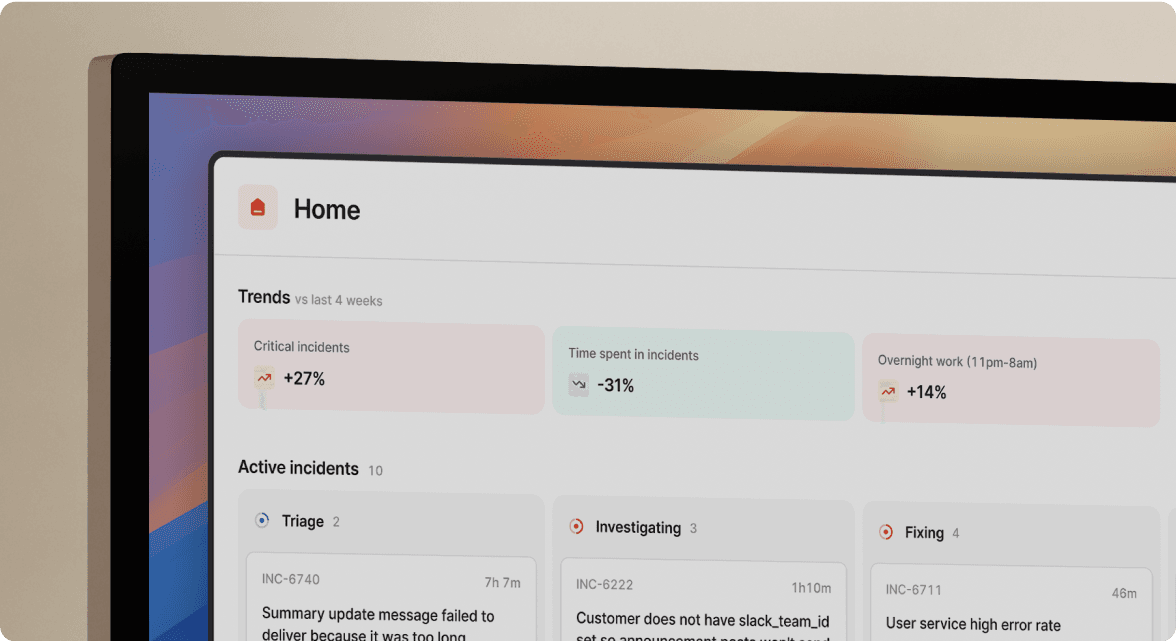
We’d love to talk to you about
- All-in-one incident management
- Our unmatched speed of deployment
- Why we’re loved by users and easily adopted
- How we work for the whole organization