Join live: What happens when your AI goes down?
PagerDuty vs Grafana OnCall vs incident.io: which platform wins for your team?
April 24, 2026 — 18 min read
Updated Apr 24, 2026
TLDR: Your incident management platform choice depends on what's actually slowing you down. PagerDuty is the battle-tested enterprise alerting tool for organizations with complex legacy routing requirements, but its pricing model layers on add-ons that can significantly increase costs. Grafana OnCall was archived in March 2026, with Grafana IRM now available as a cloud-based option. incident.io wins for modern engineering teams by unifying on-call, response, and post-mortems natively inside Slack and Microsoft Teams, reducing MTTR by up to 80%. The Pro plan starts at $25/user/month for incident response, with on-call management available as a $20/user/month add-on.
At 3 AM, your engineers shouldn't be toggling between PagerDuty alerts, ad-hoc Slack threads, Jira tickets, and a blank Google Doc. The biggest hidden cost of your incident management platform isn't the per-seat license fee but the engineering hours burned on manual coordination and post-mortem archaeology. This guide breaks down how PagerDuty, Grafana IRM, and incident.io compare across workflows, AI automation, and true cost of ownership so you can make a data-backed decision.
Platform matrix: PagerDuty & alternatives
The three platforms come from fundamentally different philosophies, and understanding that distinction saves weeks of evaluation time.
| Category | PagerDuty | Grafana OnCall / IRM | incident.io |
|---|---|---|---|
| Key focus | Enterprise alerting and on-call management | Incident management within Grafana Cloud | Chat-native, full incident lifecycle |
| Ideal customer | Large enterprises, regulated industries | Teams using Grafana observability | 50-500 FTE engineering teams on Slack or Teams |
| Pricing model | Tiered subscription with add-ons | $20/user/month | $25/user/month Pro + $20/user/month on-call add-on |
| Where work happens | Web app with Slack notifications | Grafana Cloud dashboards | Slack/Teams slash commands and channels |
PagerDuty: core alerting & on-call
PagerDuty has been a widely-adopted enterprise alerting platform with sophisticated routing across hundreds of integrations and certifications trusted by regulated Fortune 500 organizations. Teams migrating from PagerDuty often cite escalating costs and complex UI as primary drivers. For organizations with deeply customized alert routing rules built over years, the depth is real. For everyone else, you're paying for complexity you don't need.
Grafana OnCall: key capabilities
Grafana archived OnCall in 2026 after entering maintenance mode in 2025. Grafana IRM replaced it as a cloud platform within the Grafana Cloud ecosystem. Teams using Grafana alerts with incident.io keep Grafana for monitoring while incident.io handles response coordination.
incident.io: automated post-mortems & data
We built incident.io to eliminate the coordination tax that slows down every incident. The entire workflow happens inside Slack and Microsoft Teams via /inc commands, not in a web app that sends notifications to chat. When an alert fires, incident.io auto-creates a dedicated channel, pages on-call, surfaces service catalog context, and starts capturing the timeline without anyone opening a browser tab. Our AI SRE automates up to 80% of incident response, and post-mortems auto-draft after resolution. You can choose incident management software by evaluating the full lifecycle, not just the alerting layer.
End-to-end incident response workflows
The platform that wins isn't always the one with the most features. It's the one that removes friction at every step of the incident lifecycle.
Alert routing and on-call scheduling
PagerDuty: Alert routing is its core strength, with sophisticated rules-based configuration. Advanced alert grouping requires the AIOps add-on, which uses event-based pricing on top of base subscription.
Grafana IRM: Handles scheduling and escalation policies within Grafana Cloud, coherent if your monitoring stack is already Grafana-native.
incident.io: Our on-call scheduling lets you configure rotations, escalation paths, and coverage rules. Alert priorities can map to incident severity using configurable rules. The key difference: once an alert fires, we auto-create the Slack channel and pull in the right engineers without manual handoff.
Real-time incident handling
PagerDuty offers Slack /pd triggerintegration with interactive buttons for acknowledgment and escalation. While key incident actions are available in Slack, teams often move to the PagerDuty web interface for full runbook access and detailed timeline management during complex incidents.
incident.io handles everything in a single Slack channel. /inc assign @sarah-sre assigns the incident lead. /inc severity high updates severity. /inc escalate @database-team pages additional responders. Every command auto-populates the timeline without a dedicated note-taker.
Automated post-mortem generation
The claim: Post-mortem completion rate is the hidden MTTR killer.
The evidence: Manual reconstruction is time-consuming, and most engineering teams simply skip post-mortems for lower-severity incidents because the effort outweighs the benefit. Post-incident timelines often require manually gathering data from multiple systems to build a complete picture.
How we solve it: Our Scribe AI transcribes incident calls in real time via Google Meet or Zoom, captures Slack messages and /inc commands from incident channels, and auto-drafts a post-mortem after you type /inc resolve. The draft includes the timeline, transcribed notes, and key decisions from the incident. Engineers spend minutes refining rather than hours reconstructing.
The result: Intercom saved 40% of their incident time after migrating to incident.io.
Real-time customer status pages
PagerDuty includes status pages on Business and Enterprise plans, with automated updates available via business service configuration for higher-severity incidents. incident.io includes status pages on the Pro plan with automatic updates triggered by incident state changes. When an incident moves from "investigating" to "resolved," the status page updates automatically without anyone remembering to do it.
MTTR & reliability metrics
PagerDuty provides analytics dashboards with MTTR trends, acknowledgment times, and incident volume data. Grafana IRM ties metrics to Grafana Cloud dashboards, which works well when incidents map cleanly to Grafana alert sources.
incident.io's Insights dashboard auto-populates from captured timeline data without manual entry. MTTR and incident volume trends all appear automatically. Favor's SRE team achieved a 37% MTTR reduction after adopting incident.io, measured directly from the Insights dashboard.
On-call onboarding and ramp time
New on-call engineers shouldn't need weeks of shadowing before their first incident.
Because incident.io runs entirely inside Slack where engineers already work, there's no separate web app to learn. New responders learn the workflow in the same commands they'll use during real incidents, not in a separate UI. Most engineers are productive on their first on-call shift without dedicated training sessions.
The benchmark we hear from engineering leaders: new on-call engineers are fully productive within 3 days, not 3 weeks. That number comes from removing the web-app learning curve entirely. Runbooks surface inside the incident channel via /inc. Escalation paths are pre-configured so the new responder never has to remember who to call next. The result is faster ramp time and fewer "sorry, first on-call shift" moments during a live P1.
Automating incident response workflows
AI capabilities have become a genuine differentiator, not a marketing talking point. The question is what the AI actually does during a live incident.
PagerDuty's AI-driven alert reduction
PagerDuty's AIOps add-on focuses on alert noise reduction, grouping related alerts to reduce volume before your on-call engineer's phone rings. This is genuinely useful for high-volume environments where alert fatigue is the primary problem. The add-on uses event-based pricing on top of your base subscription, and it focuses on alert reduction rather than response coordination. We take a different approach by focusing AI on the response phase itself, auto-drafting post-mortems from captured timelines rather than filtering what reaches your engineers.
Scribe: AI for faster post-mortems
incident.io's Scribe feature transcribes incident calls via Google Meet or Zoom in real time. It extracts key decisions, flags root cause mentions, and captures follow-up actions so nothing discussed on the call gets lost when the timeline auto-drafts into the post-mortem. The AI SRE assistant also analyzes alert context to identify the likely change behind the incident.
Boost MTTR with automated timelines
Every /inc command, Slack thread, and role change automatically populates the incident timeline. That matters because traditional timeline capture can require dedicated coordination overhead, reducing team efficiency during critical incidents.
The result is that every incident, regardless of severity, gets a complete timeline that feeds both the auto-drafted post-mortem and the Insights dashboard.
Platform costs & ROI: get the full picture
Base pricing tells you very little. What you actually pay 12 months in depends entirely on which add-ons are required for a functional solution.
Evaluating PagerDuty's billing model
PagerDuty's Professional plan starts at approximately $21/user/month and Business at approximately $41/user/month. For a team that needs alert noise reduction, AI capabilities, and a status page, here's what gets added on top:
- AIOps (alert noise reduction): event-based pricing
- PagerDuty Advance (AI capabilities and runbook automation): additional monthly fee
- External status pages: included on Professional plan and above (250 subscribers on Professional, 500 on Business, premium on Enterprise)
For a 100-person team on the Business plan, the base subscription plus AI/automation add-ons can total over $54,000 annually before implementation costs.
Grafana OnCall TCO: self-hosted vs. SaaS
Grafana IRM eliminates self-hosting overhead at $20/user/month with a $19/month platform fee (3 users included), which for a 100-person team totals approximately $23,508 annually. Enterprise tier carries a $25,000/year minimum commitment worth factoring in early if you're evaluating at that scale. This positions it competitively against incident.io's Pro plan cost for teams of this size. If your entire observability stack is already on Grafana Cloud, the integrated experience can justify the investment.
incident.io's true cost & ROI
The Pro plan costs $25/user/month for incident response plus $20/user/month for on-call, totaling $45/user/month. For 100 engineers, that's $54,000 annually with AI SRE, automated post-mortems, status pages, and workflows all included.
The ROI case rests on coordination overhead, not just tool cost. Incidents that eliminate coordination friction directly reduce MTTR. Favor's implementation showed what happens when that overhead disappears at scale.
TCO comparison by team size
| Platform | 100-engineer annual cost | Status page included? | AI post-mortems included? |
|---|---|---|---|
| PagerDuty (Business + AI add-ons) | ~$54,000+ | Professional plan and above (external only; internal status pages on Business+) | Advance add-on required |
| Grafana IRM | ~$23,508 (includes $19/month platform fee) | Separate tool needed | Limited |
| incident.io (Pro + on-call) | $54,000 | Yes | Yes |
Unified incident toolchain & integrations
Better alerts for incidents
We connect to Datadog monitors directly, plus Prometheus, New Relic, Grafana, and other monitoring sources. PagerDuty's extensive integration catalog remains a genuine advantage for massive, multi-vendor monitoring stacks.
Post-incident task assignment & tracking
incident.io can auto-create follow-up tasks in Jira or Linear after /inc resolve runs, with status tracking visible in the incident channel. PagerDuty's Jira bidirectional sync works well for alert-to-ticket workflows.
Slack & Teams for incident response
This is the architectural distinction that matters most. PagerDuty sends notifications to Slack with interactive buttons. incident.io operates as the Slack interface itself. The entire lifecycle runs through slash commands in the incident channel, minimizing context switching. For Microsoft Teams users, incident.io's Pro plan includes full Teams support.
SOC 2, GDPR, and data protection
Enterprise security requirements can kill a deal at the final stage. Here's what you need to know upfront.
incident.io is SOC 2 Type II certified with AES-256 encryption at rest, GDPR compliance, and DPAs available. SAML SSO and SCIM provisioning ship on the Enterprise plan, covering advanced access controls and sandbox environments. PagerDuty holds SOC 2 Type II certification and other enterprise certifications. PagerDuty achieved FedRAMP Low authorization in 2025, making it viable for federal environments where FedRAMP Low meets requirements note that FedRAMP Moderate authorization is still being pursued, so verify your agency's specific requirements before evaluating it for that tier. Grafana Cloud maintains enterprise certifications, though specific Grafana IRM details vary by deployment. For larger organizations, incident.io's Enterprise controls with SCIM automate user provisioning without requiring a separate identity management project.
Choosing your best incident response tool
PagerDuty: when to retain your stack
PagerDuty makes sense if you're running a large enterprise organization with complex alert routing across hundreds of legacy services built over years. It's also the right choice if you need FedRAMP compliance or if migration friction outweighs the pricing difference because your organization is deeply integrated into the PagerDuty ecosystem.
Grafana OnCall for SRE & DevOps teams
Grafana IRM fits teams already running their observability stack on Grafana Cloud where incident management integrates with existing dashboards and alerts. If you're evaluating it as a standalone incident tool without that existing Grafana investment, the $24,000 annual cost and limited post-mortem automation make it harder to justify.
Choose incident.io if...
Choose incident.io if you want to cut MTTR, eliminate tool sprawl, and automate post-mortems natively in Slack or Microsoft Teams. We win for engineering teams at growing companies tired of paying for five tools that don't talk to each other. Pro plan pricing starts at $25/user/month with $20/user/month on-call add-on, shared Slack support channels, and opinionated defaults that get teams operational quickly make incident.io the strongest choice for modern growth-stage and mid-market engineering organizations.
Platform scalability by team size
| Team size | Best fit |
|---|---|
| 5-50 engineers | incident.io Pro plan |
| 50-200 engineers | incident.io Pro with on-call add-on |
| 200-500 engineers | incident.io Pro or Enterprise |
| 500+ engineers (legacy stack) | PagerDuty Enterprise or incident.io Enterprise |
| Grafana-native observability teams | Grafana IRM |
Decision matrix by technical sophistication
- Complex legacy alert routing across hundreds of services: PagerDuty
- Grafana Cloud-native observability stack: Grafana IRM
- Slack or Teams as your engineering nervous system, fast deployment needed: incident.io
- Need post-mortems, status pages, and on-call in one tool: incident.io
- FedRAMP compliance required: PagerDuty
- Small team evaluating options: incident.io Pro plan
Planning your incident platform migration
Migration is the objection that kills every platform evaluation. The reality is less painful than the fear.
Your PagerDuty migration path
incident.io provides dedicated PagerDuty migration tooling covering schedule export, escalation policy mapping, and integration reconfiguration. A recommended approach is a parallel run: keep PagerDuty active for alerting while running incident response through incident.io. This minimizes disruption to production paging while the team builds confidence in the new coordination layer.
Opsgenie sunset: your next steps
Atlassian announced Opsgenie will no longer accept new purchases or trials as of June 4, 2025, with end of support in April 2027. If you're currently on Opsgenie, you have a mandatory migration ahead. Our Opsgenie sunset guide covers evaluation criteria and migration timelines in detail, and incident.io offers direct Opsgenie migration tooling to map existing schedules and escalation policies.
How fast is your platform switch?
incident.io's opinionated defaults get teams operational quickly. Because the entire workflow runs in Slack where engineers already work, the platform adoption is faster than traditional incident management tools.
Want to see the ROI math tailored to your team size and current toolchain? Schedule a demo and we'll walk through the numbers with you.
Key terms glossary
MTTR: Mean Time To Resolution. The average time from incident declaration to full resolution, including team assembly, troubleshooting, and coordination overhead.
AI SRE: An artificial intelligence assistant that automates up to 80% of incident response handling routine tasks like root cause identification, timeline capture, and post-mortem drafting so your engineers can focus on the technical fix.
Slack-native: An architectural design where the entire application workflow runs directly inside Slack via slash commands and channel interactions, rather than pushing notifications from a separate web app.
P0, P1, P2 incidents: Incident severity levels used to classify the impact and urgency of incidents. P0 is the highest severity (critical production outage), P1 is high severity (major feature degraded), and P2 is medium severity (minor impact to users).
FAQs

Tom Wentworth
Chief Marketing Officer
See related articles
Introducing Investigations, powered by Nexus.
Today we're launching Investigations: agentic root cause analysis that starts the moment you're paged, figures out what broke and why, and works with your team through to resolution. Here's what we built, what's powering it, and why it took some time to get right.

August 5, 2026
Fact-checking PagerDuty's Opsgenie alternatives comparison table
PagerDuty published a new comparison table about incident.io. Once again, it describes a product we don't recognize. So once again, we're correcting the record, row by row, with receipts.

July 28, 2026
Your genie is vanishing: introducing the Opsgenie rescue program
Today, we're launching the Opsgenie Rescue Program to make that landing soft: simplified migration and free overlap so you never pay two vendors at once.
July 9, 2026
So good, you’ll break things on purpose
Ready for modern incident management? Book a call with one of our experts today.
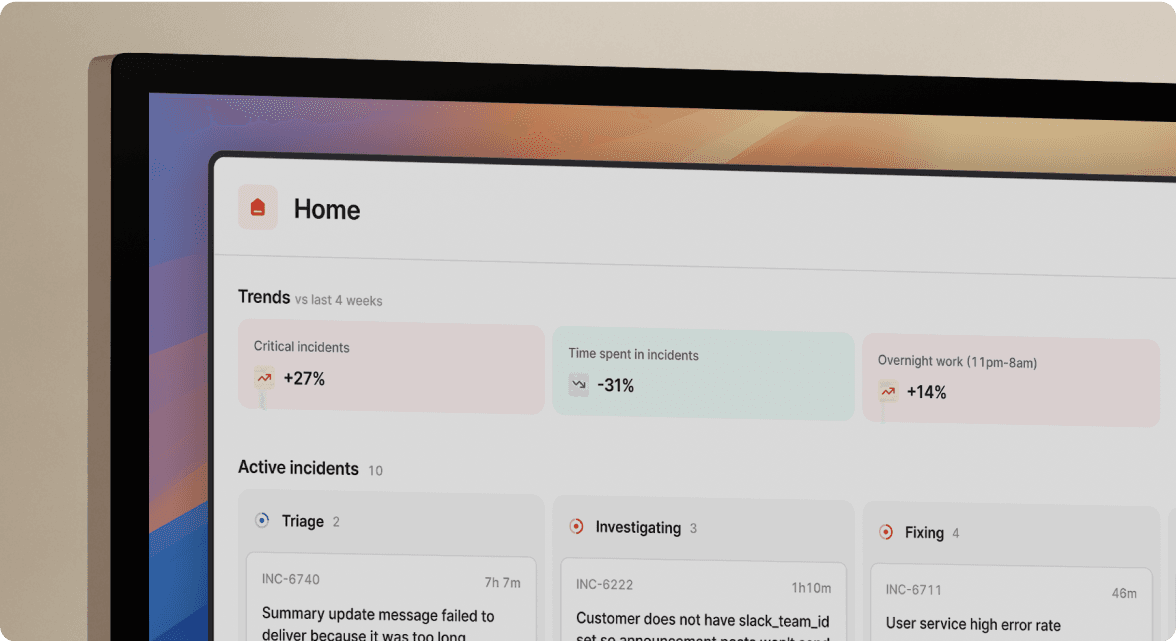
We’d love to talk to you about
- All-in-one incident management
- Our unmatched speed of deployment
- Why we’re loved by users and easily adopted
- How we work for the whole organization