Join live: What happens when your AI goes down?
PagerDuty vs FireHydrant: Feature parity, pricing, and when to choose each
April 24, 2026 — 20 min read
Updated April 24, 2026
TL;DR: PagerDuty delivers the most sophisticated alerting engine on the market, but it charges enterprise prices for mid-market teams and gates AI and noise reduction behind costly add-ons. FireHydrant improves incident workflows and runbook automation but remains a web-first tool that pushes updates into Slack rather than living there natively. If your team runs Slack or Microsoft Teams and wants to cut MTTR by up to 80%, incident.io consolidates on-call paging, coordination, and post-mortems into a single channel without any browser tab-switching. For a deeper look at all the options, see our guide on how to choose incident management software.
Your PagerDuty renewal just hit approximately $62,568 a year for 100 users once you add AIOps and the PagerDuty Advance AI package. Finance wants a justification. Your VP of SRE is already asking about FireHydrant. This PagerDuty vs FireHydrant guide breaks down feature parity, total cost of ownership, and implementation realities of both tools, then introduces a third path that eliminates the web UI context-switching problem entirely.
Key differences: PagerDuty vs FireHydrant
PagerDuty focuses on alert routing. It pages the right person at the right time, and it does that job extremely well. FireHydrant focuses on the full incident lifecycle, guiding teams through structured response from first alert to final retrospective. Both tools add Slack integrations, but neither was architected to live inside Slack natively.
Use the table below to map the core differences across dimensions that matter most when evaluating a PagerDuty migration.
| Dimension | PagerDuty | FireHydrant | incident.io |
|---|---|---|---|
| Platform architecture | Web-based with integrated Slack actions | Web-first, Slack integration | Slack-native, web optional |
| Pricing transparency | Public base pricing, add-ons raise real cost | Public pricing | Public: $45/user/month (Pro + on-call) |
| AI capabilities | AIOps add-on (event-based pricing) | Bundled at Enterprise tier | AI SRE included, automates up to 80% of incident response |
| Post-mortem automation | Post-Incident Reviews included; limited AI drafting compared to alerting capabilities | Strong, template-driven | Auto-drafted from live Slack timeline |
| On-call scheduling | Included, highly configurable | Included | Included, add-on pricing |
| Microsoft Teams support | Yes | Yes | Yes (Pro and above) |
| Enterprise compliance | SOC 2 Type II | SOC 2 Type II | SOC 2 Type II, GDPR, SAML/SCIM |
Core strengths comparison
PagerDuty strengths:
- Complex escalation logic with conditionals and loops
- Intelligent alert grouping and noise suppression via AIOps
- Broad enterprise compliance (SOC 2 Type II)
- 750+ integrations across monitoring and observability tools
PagerDuty weaknesses:
- AIOps and AI features require separate add-ons at additional cost
- Post-mortem tooling is less developed than alerting capabilities
- UI complexity requires training for advanced workflow configuration
FireHydrant strengths:
- Runbook automation that removes guesswork during live incidents
- AI-generated retrospectives from incident data on Enterprise tier
- SOC 2 compliance and transparent public pricing
FireHydrant weaknesses:
- Web-first architecture means engineers still switch between browser and Slack
- Smaller integration ecosystem compared to PagerDuty's 750+ connectors
- AI features gated to the Enterprise tier
Feature & cost differentiators
At scale, sticker price alone won't tell you what you'll actually pay. PagerDuty charges separately for the capabilities modern teams consider table stakes: noise reduction and AI require the AIOps add-on (event-based pricing, typically around $699/month for most teams), while the Advance AI package costs an additional $415/month. FireHydrant bundles AI into its Enterprise tier, which simplifies budgeting compared to PagerDuty's add-on model. Both platforms use subscription-based, per-seat pricing rather than usage-based models.
Incident playbooks: PagerDuty vs FireHydrant
Configuring on-call & alert policies
PagerDuty's escalation policies handle complex multi-team routing, and teams manage their own on-call schedules with flexible rotation options including daily, weekly, or custom types. The Business plan unlocks basic incident workflows for scenarios like automated escalation if no one acknowledges within a specified timeout period. Workflows with conditionals, loops, and delays require the Enterprise plan. For teams migrating from PagerDuty, incident.io provides dedicated migration tooling to rebuild on-call schedules without starting from scratch.
Automated incident channel setup
Both platforms create Slack channels when incidents are declared, but the mechanism differs. PagerDuty pushes a notification to Slack and links back to the web UI for management. FireHydrant creates a Slack channel for the incident, but complex management actions still route through the web interface.
Automated incident timelines & post-mortems
This is where the platforms diverge most sharply. PagerDuty's post-mortem capabilities focus primarily on its alerting engine. Post-mortem reconstruction typically wastes 60-90 minutes per incident as teams search through chat history, monitoring tools, and call recordings trying to piece together what happened.
FireHydrant built a significantly stronger retrospective system. Its AI Copilot uses incident data to answer custom template questions automatically, and templates adapt based on incident type or severity. For teams struggling with post-mortem completion, FireHydrant's structured retrospective workflow can meaningfully improve documentation consistency.
Attributing incidents via service maps
PagerDuty's service dependency mapping shows which upstream services triggered downstream alerts. FireHydrant offers a service catalog that helps teams understand service relationships during active incidents. Both provide service attribution, though PagerDuty's mapping connects more tightly with its alert routing logic.
Automating incident playbooks for speed
Runbook automation reduces manual steps during the critical first minutes of an incident. PagerDuty's incident workflows trigger automated actions when an incident is declared at a given severity: paging additional teams, updating a status page, or creating a Jira ticket. Basic incident workflows are available on the Business plan; workflows with conditionals, loops, and delays require the Enterprise plan.
FireHydrant's Runbooks execute automation sequences when incidents are declared. Teams configure steps that can create a Slack channel, page the on-call engineer, notify stakeholders, and start a retrospective template. While steps are designed to execute quickly (often in parallel), the platform ensures all configured actions complete. Both platforms integrate with monitoring tools like Datadog, Prometheus, New Relic, and Grafana to accelerate triage.
Real-time incident collaboration: end the ad-hoc model
The coordination tax during a P0 is not a monitoring problem. Engineers toggle between PagerDuty (alert origin), Slack (coordination), Datadog (metrics), Jira (ticket creation), and Confluence (post-mortem doc). Teams typically lose around 12 minutes on coordination before any remediation starts.
On-call response via slash commands
A chat-native platform solves this by handling the entire lifecycle inside Slack or Teams. When a Datadog alert fires, incident.io auto-creates #inc-2847-api-latency-spike, pages the on-call engineer, pulls in service owners from the Service Catalog, starts a live timeline, and surfaces runbooks, all without leaving Slack. Every subsequent action happens via /inc commands:
/inc assign @sarah-sreassigns the incident lead/inc severity highsets severity and triggers appropriate workflows/inc escalate @database-teampages additional responders
Automating status page updates
PagerDuty requires a separate Statuspage subscription. FireHydrant includes unlimited public status pages on Platform Pro, with private status pages available on Enterprise. incident.io auto-updates the status page as the incident state changes (investigating, monitoring, resolved), with no manual engineer action required. That eliminates the scenario where an engineer resolves an issue but forgets to update the status page, leaving customer support absorbing the fallout the next morning.
Automated post-mortem reports
incident.io's Scribe AI transcribes incident calls in real time, captures Slack messages and role changes as structured timeline entries, and auto-drafts a post-mortem within minutes of /inc resolve. Engineers spend minutes refining rather than an hour or more reconstructing.
Microsoft Teams incident hub
For teams running Microsoft Teams, incident.io's Teams support is available on the Pro plan. PagerDuty and FireHydrant both support Teams integrations, though like their Slack integrations, they function as notification layers rather than native interfaces.
Pricing breakdown and total cost of ownership
Sticker price comparisons are misleading. The honest comparison includes every add-on that makes a tool functional for a modern engineering team.
PagerDuty pricing tiers and add-ons
PagerDuty charges $41/user/month for the Business plan on annual billing. Add the features most teams need and the real cost climbs:
- Business plan base: $41/user/month
- AIOps (noise reduction, alert grouping): event-based pricing, typically ~$699/month
- PagerDuty Advance (AI features): ~$415/month
- Status Page: separate subscription required, billed from $89/1,000 subscribers/month.
For a 100-user team, the loaded annual cost totals approximately $62,568 before implementation excluding Status Page costs.
FireHydrant's subscription plans
FireHydrant publishes two paid tiers: Platform Pro ($9,600/year) and Enterprise (custom pricing), without PagerDuty's layered add-on complexity. Platform Pro appears to be a flat annual rate rather than a per-seat fee, though FireHydrant does not publicly confirm whether seat limits apply for larger teams. Pricing terms may change, so confirm with FireHydrant's sales team before finalizing a budget.
Scaling costs: PagerDuty vs FireHydrant
| Platform | Base plan (100 users/year) | Add-ons needed | Annual total |
|---|---|---|---|
| PagerDuty Business | $49,200 | AIOps + Advance: ~$13,368(Status Page billed separately from $89/1,000 subscribers/month) | ~$62,568 |
| FireHydrant Platform Pro | $9,600/year (flat platform rate, seat limits apply at larger sizes) | AI on Enterprise tier only | $9,600 (Platform Pro, no AI)Enterprise with AI: contact vendor |
| incident.io Pro + on-call | $54,000 ($45/user/month) | None (all-in) | ~$54,000 |
incident.io's all-in pricing is $45/user/month on the Pro plan with on-call ($25 base + $20 on-call add-on). PagerDuty runs higher per year when you include necessary add-ons for noise reduction and AI features.
ROI calculation: engineer time savings
The real ROI comes from engineer hours reclaimed. Here's the math for a team handling 15 incidents per month:
- Coordination savings: Reducing coordination assembly time from the industry-baseline 15 minutes can save up to 13 minutes per incident × 15 incidents = 195 minutes monthly. At a $150 loaded engineer cost per hour, that represents $487.50/month.
- Post-mortem savings: Reducing post-mortem time from 90 minutes to 10 minutes saves 80 minutes per incident × 15 incidents = 1,200 minutes = 20 engineer hours. At $150/hour, that represents $3,000/month.
- Potential monthly ROI: These examples suggest roughly $3,500/month in reclaimed capacity, though your actual savings will depend on incident volume, team size, and workflow efficiency.
This framework applies regardless of which tool you choose, but only a chat-native platform that eliminates context-switching can capture the full coordination savings. incident.io's AI SRE compounds that further by compressing the investigation phase, reducing MTTR by up to 80%. See how Favor reduced MTTR by 37% after switching.
Best-fit scenarios for FireHydrant adoption
When FireHydrant makes sense
FireHydrant works best for teams consolidating away from multiple incident management tools. It rolls post-mortem automation, runbook workflows, and status page management into one platform, reducing the number of tools engineers switch between during live incidents. For teams whose post-mortem completion rate is low, FireHydrant's retrospective templates and AI drafting meaningfully improve that rate by removing the blank-page problem that causes engineers to skip documentation entirely.
Faster onboarding and coordination
FireHydrant's guided Runbooks reduce the onboarding burden compared to outdated documentation that engineers rarely maintain. New engineers follow Runbook steps rather than relying on tribal knowledge. A Slack-native platform accelerates this further because new on-call engineers use commands inside a tool they already know, rather than learning a new web UI.
PagerDuty's edge: robust on-call escalations
Enterprise scale and complexity
PagerDuty's breadth of routing logic, flexible rotation types, and multi-team dependency mapping is purpose-built for large organizations. Its 750+ integrations and Enterprise plan automation capabilities (10 custom incident roles, up to 100 custom incident types) serve use cases that most mid-market tools have not yet replicated. The platform's depth matters for enterprise coordination scenarios where complex escalation logic is critical.
Entrenched workflows and compliance requirements
If your team built custom escalation policies, event orchestration rules, and integration configurations over 3+ years, the migration cost is real. Rebuilding that institutional knowledge in a new tool takes time that cannot always be justified by cost savings alone. Factor migration effort honestly before initiating an RFP.
For regulated industries where PagerDuty is already an approved vendor, FireHydrant and other alternatives may require additional compliance review before adoption.
Migration considerations: switching from PagerDuty to FireHydrant
Technical migration work
Rebuilding on-call schedules is a significant migration task for larger teams. Each schedule requires recreating rotation logic, escalation paths, and override rules. Re-mapping Datadog monitors and other monitoring integrations requires additional configuration work, depending on your monitoring stack's complexity. If you choose incident.io, the PagerDuty migration tooling automates a significant portion of schedule rebuilding, and dedicated Datadog migration tooling imports existing monitors rather than requiring manual re-configuration.
Training and historical data
Budget time for team training regardless of which tool you choose. FireHydrant requires familiarization with its web UI, Runbook structure, and retrospective workflow. A Slack-native tool can shorten this ramp because engineers use commands inside a familiar interface, but any migration requires at least a short parallel-run period where both systems handle incidents.
Historical incident data does not transfer automatically from PagerDuty. Neither FireHydrant nor incident.io imports PagerDuty historical timeline data natively, so document key past incidents in your new platform before decommissioning PagerDuty, or accept that historical context lives in the old system through the transition.
Is FireHydrant right for your PagerDuty migration?
FireHydrant's PagerDuty feature parity
FireHydrant offers strong post-mortem automation with AI-generated retrospectives and template-driven workflows on its Enterprise tier, structured runbook workflows, and status page management. PagerDuty still leads on: alert routing sophistication, escalation policy depth, and raw integration breadth (750+ integrations).
Unpacking PagerDuty vs FireHydrant costs
A realistic migration for a 100-person engineering team requires careful planning: rebuilding on-call schedules and re-mapping integrations, followed by a parallel-run period where both systems handle incidents, and finally full team cutover and decommissioning.
SAML and SCIM support in FireHydrant
FireHydrant includes SSO and audit logs on its paid tiers for enterprise security requirements. incident.io includes SAML and SCIM on the Enterprise plan. PagerDuty includes comparable features on Business and Enterprise plans. All three platforms publish SOC 2 compliance documentation.
AI for MTTR & post-mortems?
This is where the three platforms diverge most significantly for teams trying to reduce MTTR.
PagerDuty's AIOps reduces noise and groups alerts intelligently, and its Advance tier includes AI features that accelerate incident documentation. FireHydrant's AI on the Enterprise tier generates retrospective drafts from incident data and enables root cause analysis, though it operates primarily as a documentation assistant rather than an active investigative agent.
incident.io's AI SRE investigates across your connected tools (Slack, GitHub, Datadog, Prometheus, and others), surfaces a likely root cause, and can open a fix PR directly in Slack during the first minutes of the incident. As one user put it:
"Amazing incident management tool. I love the fact that it creates a dedicated channel. This way every incident is treated singularly and there is no mash-up of info coming from different sources... The best feature for me is the integration with Jira, as all my tasks are automatically created once I enter followups on the incident channel." - Roberta R. on G2
If reducing MTTR by up to 80% is the goal and your team lives in Slack, the tool that handles the entire lifecycle natively in chat is worth comparing directly against both PagerDuty and FireHydrant. Schedule a demo of incident.io to see the AI SRE generate a root cause hypothesis and fix PR in a live incident.
Key terms glossary
MTTR (Mean Time To Resolution): The average time from incident declaration to full resolution, measured in minutes and used as a key engineering reliability KPI in board and executive reporting.
On-call rotation: A schedule defining which engineers respond to alerts outside business hours, typically rotating weekly and configured inside the incident management platform.
Incident commander: The engineer assigned to lead and coordinate an active incident, responsible for communication, escalation decisions, and resolution sign-off.
Post-mortem: A structured document written after an incident that captures the timeline, root cause, contributing factors, and follow-up actions to prevent recurrence.
Runbook: A documented procedure guiding an on-call engineer through diagnosing and resolving a specific incident type, typically surfaced automatically by the incident platform during active response.
AIOps: PagerDuty's add-on module that uses machine learning to group related alerts and suppress noise, priced based on event volume with costs typically starting around $699/month for most teams.
Chat-native: An architecture where the incident management tool treats Slack or Microsoft Teams as the primary interface, so all core actions happen via chat commands without requiring engineers to open a browser.
Service catalog: A structured registry mapping each engineering service to its owners, dependencies, runbooks, and health status, surfaced automatically during incidents to reduce triage time.
FAQs

Tom Wentworth
Chief Marketing Officer
See related articles
Introducing Investigations, powered by Nexus.
Today we're launching Investigations: agentic root cause analysis that starts the moment you're paged, figures out what broke and why, and works with your team through to resolution. Here's what we built, what's powering it, and why it took some time to get right.

August 5, 2026
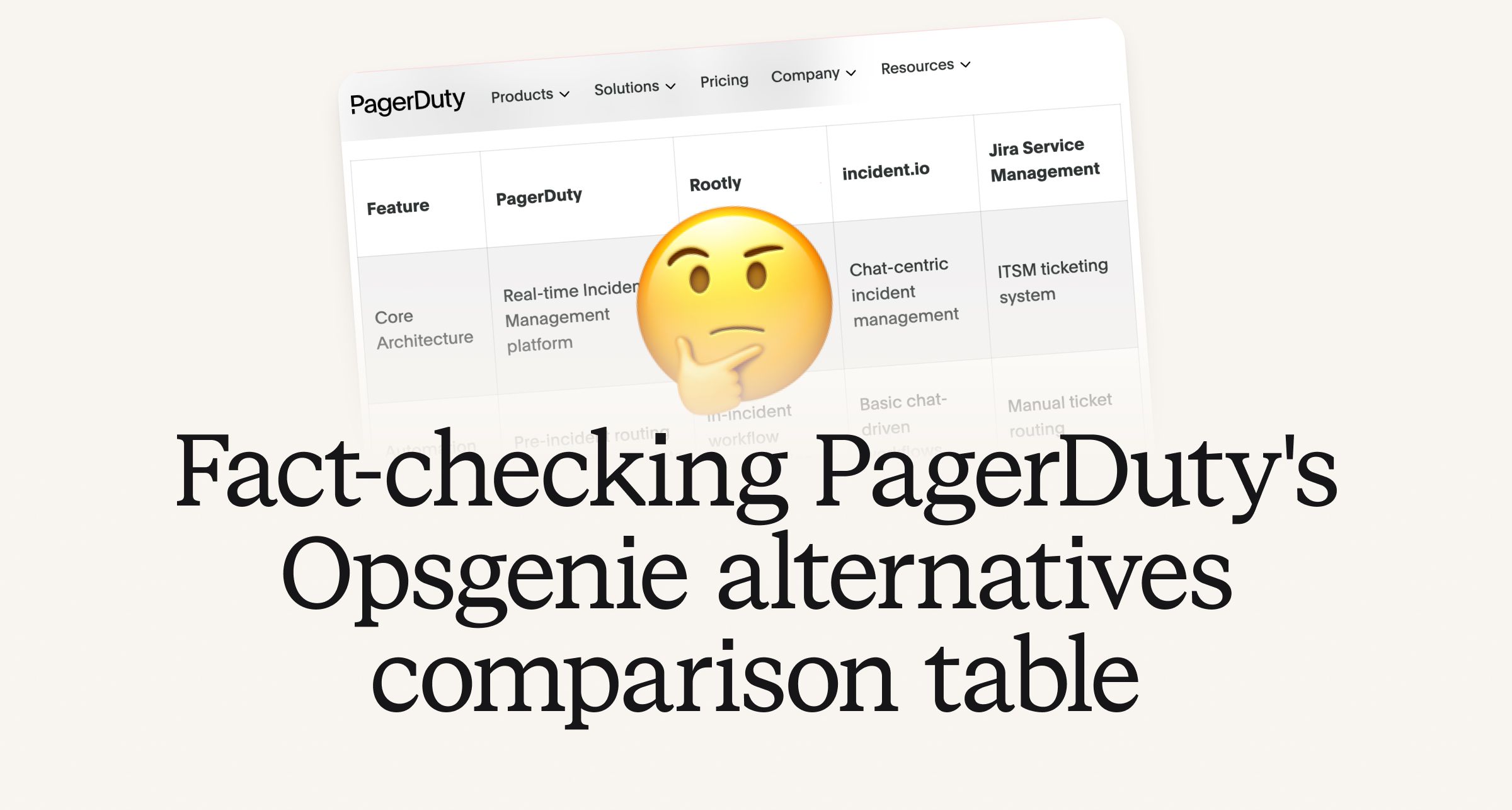
Fact-checking PagerDuty's Opsgenie alternatives comparison table
PagerDuty published a new comparison table about incident.io. Once again, it describes a product we don't recognize. So once again, we're correcting the record, row by row, with receipts.

July 28, 2026
Your genie is vanishing: introducing the Opsgenie rescue program
Today, we're launching the Opsgenie Rescue Program to make that landing soft: simplified migration and free overlap so you never pay two vendors at once.
July 9, 2026
So good, you’ll break things on purpose
Ready for modern incident management? Book a call with one of our experts today.
We’d love to talk to you about
- All-in-one incident management
- Our unmatched speed of deployment
- Why we’re loved by users and easily adopted
- How we work for the whole organization