incident.io vs Rootly After Opsgenie: Pricing, AI & On-Call Compared
December 23, 2025 — 21 min read
Updated December 23, 2025
TL;DR: Atlassian is shutting down Opsgenie on April 5, 2027, forcing every engineering team to migrate. Both incident.io and Rootly offer modern, Slack-native incident management, but with fundamentally different approaches. We deliver a unified platform that replaces Opsgenie, PagerDuty, and Statuspage with opinionated defaults, getting you operational in days. You'll manage the entire lifecycle in Slack with native on-call scheduling, AI SRE that automates up to 80% of incident response, and automatic timeline capture through Scribe. Rootly offers deep customization and extensive integrations but often requires professional services and more complex configuration. For mid-market teams (50-500 engineers) who value speed over infinite configurability, our Pro plan at $45/user/month (with on-call included) offers clearer ROI than piecing together multiple tools. This guide compares AI capabilities, on-call depth, migration support, and total cost of ownership to help you choose the right platform.
The Opsgenie sunset isn't optional
Atlassian announced the end-of-sale for Opsgenie on June 4, 2025, with full shutdown on April 5, 2027, forcing every engineering team to migrate. After end-of-sale, you can't upgrade plans or add new features. After end-of-support, Atlassian will delete all remaining data. This isn't a suggestion—it's a hard deadline.
Atlassian is consolidating IT operations tools into Jira Service Management and Compass, which drives this forced migration. But for most engineering teams, JSM is a downgrade. Atlassian built JSM as a ticketing system, not a dedicated incident response platform. Users report horrible Slack integration, loss of granular permissions for on-call schedules, and more manual work during incidents.
You have two choices: migrate to JSM and accept a clunkier workflow, or upgrade to a modern incident management platform built for how engineering teams actually work. This guide compares the two leading Slack-native alternatives: incident.io and Rootly.
Unified platform vs. Configurable framework
The core philosophical difference between incident.io and Rootly shapes everything else: implementation time, ongoing maintenance burden, and total cost of ownership.
incident.io: Opinionated and Unified
We built incident.io as an integrated platform that handles on-call scheduling, incident response, status pages, and post-mortems in one tool. The entire incident lifecycle happens in Slack using slash commands like /inc declare, /inc escalate, and /inc resolve. You don't toggle between PagerDuty for alerting, Slack for coordination, and Confluence for post-mortems. Everything is in one place.
This opinionated approach means we make architectural decisions for you, so you don't spend weeks in configuration. On-call schedules work a specific way. Escalation policies follow a flowchart-style interface. Post-mortems auto-generate from captured timeline data. You get strong defaults that accelerate time-to-value. Most teams are operational in days, not quarters.
Thrive Learning completed their full rollout in one month, including a two-week proof of concept and a two-week parallel run alongside their previous system.
The trade-off: if you need infinite customization, you'll hit our guardrails. We're deliberate about this. Teams wanting "everything configurable" often spend six months in configuration hell before handling their first incident.
Rootly: Highly configurable automation engine
Rootly positions itself as an AI-native platform with over 100 integrations, designed for deep customization. They offer extensive workflow automation, allowing teams to orchestrate complex incident response processes across their existing toolchain.
The platform includes native on-call capabilities, so you're not forced to keep PagerDuty. However, the high degree of configurability means you need to invest time defining workflows, setting up automations, and mapping integrations. For larger, more complex deployments, Rootly offers professional services packages, suggesting that sophisticated implementations require paid support.
Which philosophy fits your team?
- Choose incident.io if you want to replace Opsgenie quickly with minimal configuration effort. You get a complete platform with sensible defaults that work immediately. You'll sacrifice some flexibility for speed.
- Choose Rootly if you have complex workflows that require extensive customization and the engineering bandwidth to configure and maintain those workflows. You'll invest more time upfront but gain more control over the process.
AI showdown: Scribe vs. Rootly AI
Both platforms leverage AI to reduce manual work during incidents, but their focus and implementation differ significantly.
Incident.Io’s AI approach: Augment humans, Don’t replace them
Our AI capabilities center on eliminating cognitive overhead while keeping engineers in control. We call this building "exoskeletons, not robots."
Scribe: Automatic Timeline Capture
Scribe acts as an AI notetaker during incident calls on Zoom and Google Meet, providing real-time transcription and summaries. It captures critical information without requiring a dedicated note-taker. Every decision, every "we tried X and it didn't work," every correlation someone mentions gets recorded automatically. When the incident resolves, you have a complete record for the post-mortem.
This eliminates the post-incident archaeology problem. No more scrolling through Slack trying to remember who said what at 3 AM. No more spending 90 minutes reconstructing timelines from memory. Customers consistently report saving hours per incident on documentation tasks, with one noting the time reclaimed for proactive work instead of manual timeline reconstruction.
AI SRE: Autonomous Investigation and Fix Generation
Our AI SRE automates up to 80% of incident response by analyzing alerts, identifying root causes, and suggesting resolutions. It can spot the likely change behind an incident, pull metrics and logs into Slack, and even open pull requests to fix the issue.
"incident.io makes incidents normal. Instead of a fire alarm you can build best practice into a process that everyone - technical or no n-technical users alike - can understand intuitively and execute." - Verified user review of incident.io
A Netflix engineer noted the tool worked intuitively even at 3 AM.
Related Incidents and Suggested Actions
By analyzing the context of current incidents, incident.io surfaces similar past incidents with their resolution steps. Users can interact with the bot in Slack using natural language to create follow-ups or draft communications.
Rootly's AI-native platform
Rootly embeds AI throughout the incident lifecycle with a focus on automation and predictive insights.
AI-generated Summaries and Timelines
Rootly's AI automatically generates summaries and timelines by synthesizing data from Slack conversations, timeline events, attached graphs, and action items. The AI analyzes alert payloads, labels, and historical data to create accurate, context-rich summaries on demand.
Conversational AI Assistant
The conversational AI assistant lives directly in Slack, allowing users to ask questions about incidents in natural language and receive tailored answers based on incident data. You can say "catch me up on this incident" and get an instant summary without reading through the entire channel history.
Automated Root Cause Analysis and Predictive Insights
Rootly's AI automates root cause analysis by correlating data from various sources and suggesting potential fixes. The platform can analyze historical incident data to identify patterns and predict potential future issues, helping teams move from reactive to proactive stances. Intelligent alert grouping reduces noise by analyzing alert payloads and historical data to group related alerts.
The AI differentiation
The primary difference in scope: our AI is designed to be a powerful assistant, automating tedious tasks and providing valuable context to human responders who remain at the center of the incident response process. Rootly emphasizes a more autonomous AI-driven approach, aiming to automate the entire lifecycle and provide predictive capabilities to prevent future incidents. Both offer AI-powered summaries, but Rootly's conversational interface provides more interactive exploration of incident data.
For MTTR reduction, we have documented evidence. Favor reduced MTTR by 37% using incident.io. While Rootly customers report time savings, specific quantitative MTTR data is less readily available in public case studies.
On-call capabilities: incident.io vs. Rootly
Both platforms offer native on-call scheduling, positioning themselves as direct PagerDuty replacements. This is crucial: you're not adding another integration to maintain, you're consolidating tools.
incident.io on-call
Our on-call management features include:
- Intuitive escalation policies: Flowchart-style setup for routing alerts based on incident priority and time of day
- Flexible scheduling: Supports concurrent shifts for pairing and plain language overrides like "Alice today from 6 pm to 10 pm"
- Multi-channel alerts: Notifications via phone, SMS, email, Slack, and push notifications
- Alert triage state: Holds new alerts in triage to reduce noise, requiring an incident declaration before triggering escalation
Intercom migrated hundreds of engineers off PagerDuty and Atlassian Status Page in just a few weeks. An engineering leader at Intercom described the outcome:
"The biggest outcome we've had is improved availability [and] improved engineer experience... What we've seen is we have more incidents now... that are well organized, they're discoverable, they're findable, and they allowed like a space of where people can collaborate on just fixing that problem." - Mark Gorman, Technical Program Manager, Intercom
Rootly on-call
Rootly offers native on-call scheduling with features including schedules, escalation policies, and a mobile app. Their on-call solution provides a unified experience within the incident management platform, including shadow rotations and an on-call calculator. While Rootly can integrate with PagerDuty for teams who prefer it, their native solution eliminates that dependency.
The On-call comparison
| Feature | incident.io | Rootly |
|---|---|---|
| Native scheduling | Yes, included in on-call add-on | Yes, included in platform |
| Escalation policies | Flowchart-style visual interface | Policy-based configuration |
| Schedule overrides | Plain language commands | Standard override interface |
| Alert routing | Conditions-based (priority, time) | Extensive customization options |
| Mobile app | Modern, intuitive interface | Included with on-call |
| Triage state | Yes, reduces alert noise | Alert grouping via AI |
Both platforms offer mature on-call capabilities. The difference lies in the overall integration: our on-call feels like part of a unified system where everything happens in Slack. Rootly's on-call is equally capable but sits within a more configurable framework.
Step-by-step opsgenie migration playbook
Migrating from Opsgenie requires a phased approach to avoid gaps in alerting or missed incidents. Both platforms support parallel runs to validate configurations before cutover.
Phase 1: audit and cleanup (week 1)
Before exporting anything from Opsgenie, clean up your configuration:
- Remove inactive users: Delete accounts for employees who've left
- Review on-call schedules: Verify current rotations are accurate
- Delete outdated routing rules: Eliminate alert routing that points to deprecated services
- Document custom integrations: Note any custom scripts or API calls that need recreation
Phase 2: Data export and mapping (Week 2)
Opsgenie provides a REST API for data export, allowing you to extract users, schedules, routing rules, and historical incidents in your preferred format.
incident.io migration support:
Our platform includes an automated importer that pulls Opsgenie configurations, including user accounts and contact information, in minutes. The Opsgenie integration automates schedule migration, mapping users and escalation policies to corresponding features in incident.io.
Rootly migration support:
Rootly offers automated migration for schedules, escalation policies, configurations, users, and integrations from Opsgenie. Their migration specialists, including former Opsgenie and PagerDuty employees, provide hands-on assistance.
Phase 3: Parallel run (Weeks 3-6)
The parallel run is critical. Both Opsgenie and your new platform receive alerts simultaneously, allowing you to validate the new setup without risking missed notifications. Run parallel for 2-4 weeks minimum.
Validation checkpoints:
- Confirm all monitoring system alerts reach the new platform
- Verify on-call engineers receive notifications through all channels
- Test escalation policies trigger correctly
- Ensure on-call schedules and overrides are accurate
- Validate integrations with ticketing and communication platforms
- Check incident data (severity, priority, services) populates correctly
Phase 4: Cutover (Week 7)
Once validated and your team feels comfortable, execute the final switch. Update monitoring tool configurations to send alerts only to the new platform. Decommission Opsgenie access.
Common migration risks:
- Missed alerts: Gaps in alerting during transition
- Configuration errors: Incorrect schedules or routing sending pages to wrong people
- Integration failures: Incompatibility with existing tools
- Data loss: Failure to properly export and import necessary data
Mitigation requires thorough planning, the parallel run validation period, and comprehensive testing before cutover.
Pricing and total cost of ownership
Understanding the true cost requires looking beyond base license fees to include on-call capabilities, implementation time, maintenance burden, and potential professional services.
incident.io pricing structure
Our transparent, tiered pricing includes:
- Pro: $25/user/month for incident response + $20/user/month for on-call = $45/user/month total (recommended for teams migrating from Opsgenie)
- Team: $19/user/month for incident response + $12/user/month for on-call = $31/user/month total (for smaller teams)
- Enterprise: Custom pricing with dedicated CSM, SAML/SCIM, advanced access controls
- Basic: Free forever for up to 5 users (1 on-call schedule, 1 status page)
For a 100-person engineering team on the Pro plan with on-call, the annual cost is $54,000 ($45 × 100 × 12). This replaces:
- Opsgenie/PagerDuty for alerting (~$25,200/year at $21/user/month)
- Atlassian Statuspage (~$6,000/year)
- Confluence for post-mortems (included in Atlassian but adds cost)
- Custom Slack bots for coordination (engineering maintenance time)
Rootly pricing structure
Rootly's pricing is less transparent publicly. AAvailable data indicates pricing varies by tier and team size, while incident.io’s Pro plan is priced at $25 per user per month for incident response. For larger deployments, professional services packages add to total implementation cost.
Non-license TCO factors
Implementation time:
- incident.io: Small teams (15 people) can complete rollout in under 20 days. Larger organizations (200+ people) achieve full implementation in 45 days.
- Rootly: Offers quick initial setup, though complex workflows may require more configuration time.
Training requirements:
- incident.io: Minimal formal training needed. Customers report the tool is intuitive and requires light onboarding:
"Huge fan of the usability of the Slack commands and how it's helped us improve our incident management workflows. The AI features really reduce the friction of incident management." - Verified user review of incident.io
- Rootly: Also designed for simplicity, with automation reducing manual operational effort.
Professional services:
- incident.io: No required professional services. Self-service setup is the standard path.
- Rootly: Offers professional services packages for complex implementations.
TCO comparison for 100-user team
| Cost Category | incident.io | Rootly + Potential Add-ons |
|---|---|---|
| Annual license (Pro/Scale) | $54,000 | $42,000-$54,000 (estimate) |
| Professional services | $0 | Optional for complex setups |
| Implementation time | 30-45 days (internal only) | Varies by complexity |
| Replaced tools | PagerDuty, Statuspage, post-mortem docs | PagerDuty, Statuspage (if used separately) |
The real ROI comes from operational improvements. When Favor reduced MTTR by 37%, that translated to faster customer recovery, less downtime cost, and reclaimed engineering time for building features instead of fighting fires.
Migration target comparison
Here's how incident.io, Rootly, PagerDuty, and Jira Service Management compare for Opsgenie refugees:
| Feature | incident.io | Rootly | PagerDuty | JSM |
|---|---|---|---|---|
| Native on-call | ✓ | ✓ | ✓ | Limited |
| Slack-native | ✓✓ Full lifecycle in Slack | ✓✓ Full lifecycle in Slack | △ Notifications only | △ Notifications only |
| AI automation | 80% incident response automation | AI summaries, predictions, RCA | AIOps add-on | Limited |
| Status pages | Included (1 free, unlimited on Enterprise) | Included | Add-on cost | Requires Statuspage |
| Auto post-mortems | ✓ From timeline data | ✓ AI-generated | Manual/templates | Manual |
| Setup time | Days | Minutes-Weeks | Weeks | Weeks-Months |
| Integrations | 100+ growing | 100+ | 700+ | Extensive |
| Starting price | $45/user/mo (Pro + on-call) | ~$20-35/user/mo | $21/user/mo (+ add-ons) | Bundled pricing |
| Best for | Teams wanting unified platform with fast ROI | Teams needing deep customization | Enterprises with complex alerting | Atlassian-committed orgs |
Note: ✓✓ indicates full native implementation, ✓ indicates supported, △ indicates limited support
The migration decision comes down to velocity vs. Flexibility
The Opsgenie sunset forces a choice between two legitimate approaches. We built incident.io as a unified platform that eliminates tool sprawl—you replace Opsgenie, PagerDuty, and Statuspage with one system that works immediately. Scribe captures timelines automatically, AI SRE automates up to 80% of incident response, and your team stays in Slack for the entire lifecycle. Most teams are operational in days, not quarters.
Rootly offers deep customization and extensive integrations for teams who need infinite configurability and have the bandwidth to maintain complex workflows.
The wrong choice is waiting until April 2027 when Atlassian pulls the plug. You need 2-4 weeks minimum for a parallel run to validate your new setup. That timeline shrinks every month you delay.
When Etsy evaluated alternatives, they noted that in the time it had taken them to get one vendor to respond to product feedback, incident.io had shipped four features they requested.
That support velocity matters when production is down at 3 AM.
Schedule a demo to see our Opsgenie migration tool in action and run your first incident in Slack today.
Key terminology
Parallel run: A migration phase where both the old system (Opsgenie) and new platform receive alerts simultaneously, allowing validation of the new setup without risking missed notifications.
Escalation policy: Rules defining how alerts move up the chain if not acknowledged. Includes timing (e.g., escalate after 5 minutes) and recipient hierarchy (e.g., on-call engineer → team lead → director).
MTTR (Mean Time To Resolution): Average time from incident detection to full resolution. Lower MTTR means faster recovery and less customer impact.
Slack-native: Platform architecture where you run the entire workflow inside Slack using slash commands, not just receive notifications. Contrast with "Slack integration" where the tool is web-first with Slack bolted on.
On-call add-on: Separate pricing tier for scheduling and alerting features. incident.io charges $12-20/user/month for on-call on top of base incident response pricing.
Post-mortem: Document analyzing what happened during an incident, root cause, impact, timeline, and action items to prevent recurrence. Also called post-incident review or retrospective.
Timeline capture: Automatic recording of all incident events, Slack messages, role changes, and decisions during response. Eliminates manual note-taking and post-incident reconstruction.
AI SRE: Autonomous assistant that investigates incidents, identifies root causes, and suggests or implements fixes. Distinct from simpler AI features that only summarize or correlate data.
FAQs

Tom Wentworth
Chief Marketing Officer
See related articles
Introducing Investigations, powered by Nexus.
Today we're launching Investigations: agentic root cause analysis that starts the moment you're paged, figures out what broke and why, and works with your team through to resolution. Here's what we built, what's powering it, and why it took some time to get right.

August 5, 2026
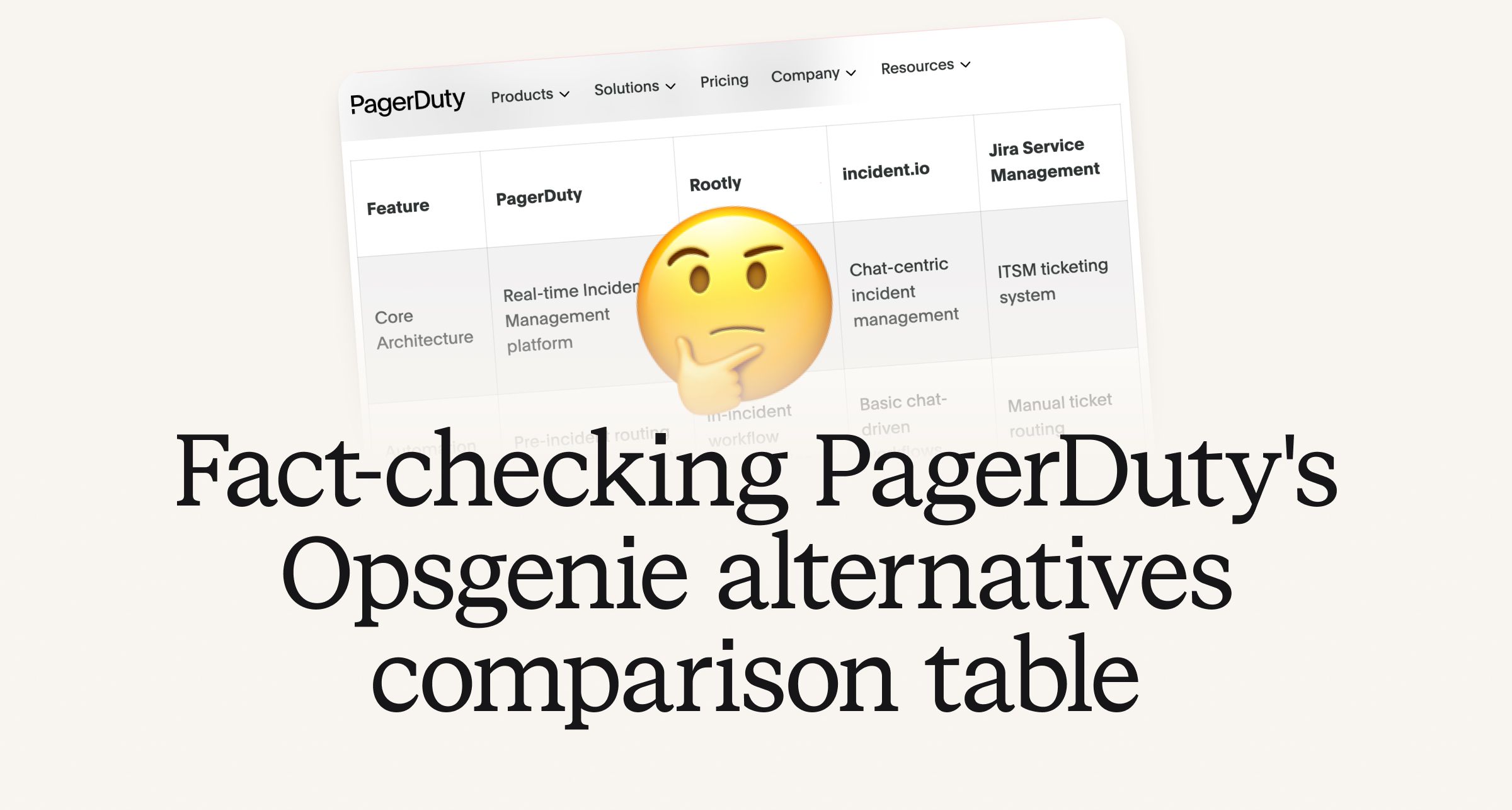
Fact-checking PagerDuty's Opsgenie alternatives comparison table
PagerDuty published a new comparison table about incident.io. Once again, it describes a product we don't recognize. So once again, we're correcting the record, row by row, with receipts.

July 28, 2026
Your genie is vanishing: introducing the Opsgenie rescue program
Today, we're launching the Opsgenie Rescue Program to make that landing soft: simplified migration and free overlap so you never pay two vendors at once.
July 9, 2026
So good, you’ll break things on purpose
Ready for modern incident management? Book a call with one of our experts today.
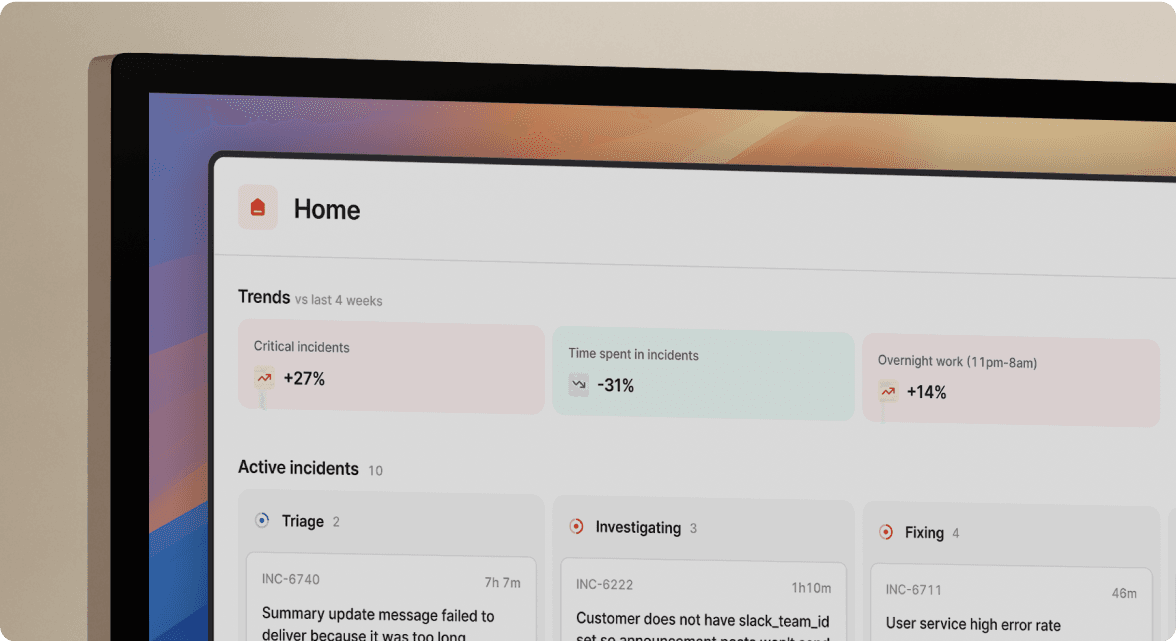
We’d love to talk to you about
- All-in-one incident management
- Our unmatched speed of deployment
- Why we’re loved by users and easily adopted
- How we work for the whole organization