How Intelligent Alert Routing Works: Routing Rules vs. Escalation Policies
June 11, 2026 — 25 min read
TL;DR: If you manage on-call rotations and your site reliability depends on fast incident response, choose a platform that unifies alert routing and escalation in one place. Routing rules classify incoming alerts based on payload data to find the right team, while escalation policies define the backup path if the primary responder is unavailable. Fragmented setups using separate tools for alerting and coordination add 12 minutes of tool-switching tax to every incident. incident.io unifies on-call scheduling, alert routing, and Slack-native coordination, reducing team assembly time from 15 minutes to 2 minutes and improving Mean Time To Resolution (MTTR).
Most on-call configurations fail not because your alerting tool broke, but because you routed the alert directly to a single schedule level with no defined fallback. When that primary responder misses the page, there's no automatic next step. No secondary. No manager notification. Just a silent channel while a P1 cascades.
To keep MTTR low and prevent alert fatigue, you must separate alert routing from escalation. Routing rules determine which team receives an alert based on payload data, while escalation policies dictate how that alert escalates if the primary responder does not acknowledge it. This guide explains how to orchestrate both mechanisms cleanly, avoid common configuration traps, and run your entire incident response directly inside Slack.
How routing rules improve incident management
Manual alert routing is a liability. Before you adopt automated routing rules, your alerts land in a shared inbox or a generic #incidents Slack channel. Whoever sees the message first figures out who to ping. If that person is wrong, the alert bounces across DMs. Twelve minutes later, the right engineer finally joins a thread while the incident runs unmanaged.
Intelligent alert routing replaces manual decision-making with policy-driven automation. Modern routing platforms parse incoming alert payloads, match them against configured routing rules, and direct alerts to the appropriate team or escalation chain. The result is a repeatable, auditable system where every alert has a defined owner from the moment it fires.
Fixing costly alert routing errors
Alert routing errors create operational catastrophes. Sending a database latency alert to the frontend team doesn't just waste their time. It delays the right team's response by minutes, compounding directly into higher MTTR and extended customer impact.
The same failure mode exists in alert routing. Misconfigured rules can black-hole alerts or send them to the wrong team, creating an operational outage in your incident response before anyone has started troubleshooting.
We built the Service Catalog to eliminate this class of error by connecting alerts to services, services to owning teams, and teams to on-call schedules. When a Datadog alert fires for your payments API, the routing is already handled, with no guessing and no manual lookup.
Alert routing vs. escalation policies
You must configure these two concepts as separate layers because they serve distinct functions.
Alert routing typically classifies and directs an incoming alert to the correct team based on what the alert contains. It answers: "Where does this alert go first?"
Escalation policies typically define the backup path when the primary responder fails to acknowledge the alert within a set window. They answer a different question entirely: "What happens if they don't respond?"
| Dimension | Alert routing | Escalation policies |
|---|---|---|
| Primary function | Directs incoming alerts based on classification | Defines backup responders when primary doesn't acknowledge |
| Trigger | Incoming alert from monitoring tools | Acknowledgment timeout |
| Key criteria | Alert metadata and payload content | Time delays and responder tiers |
| Configuration layer | Alert routing configuration | Escalation path configuration |
| Example | Route database alerts to Database SRE team | Page primary SRE, wait 5 mins, page secondary SRE, then manager |
Collapsing these two layers into a single step by routing to a one-level schedule with no fallback tiers is a common and costly misconfiguration in on-call setup.
How routing rules direct incoming alerts
Alert routing works in two stages: source routing and IRM system routing.
Source routing is configured by adding incident.io as a webhook destination in your monitoring tool. Datadog, Prometheus, and Grafana send alerts to specific incident.io sources based on alert rules. This is the first filter, and it's coarse. You might route all Datadog alerts to one source and all Prometheus alerts to another.
Incident Response Management (IRM) system routing happens inside incident.io. This is where the real classification logic lives. Alert Routes evaluate the alert payload against configured rules and determine which escalation path fires, which incident type gets created, and how the alert is enriched.
Setting up incident routing criteria
Your routing rules pull criteria directly from the alert's JSON payload. Common attributes used in routing logic include:
- Severity (P0, P1, P2, P3)
- Affected service (payments-api, auth-service, checkout-worker)
- Source (Datadog, Prometheus, Grafana)
- Team label (database-sre, platform-eng, frontend)
- Custom tags (customer-tier, region, feature-flag)
When connecting alert sources to incident.io, custom alert attributes can be configured to pull values from the alert payload into structured incident data that drives routing decisions downstream.
Optimizing primary alert routing flows
Smart alert routing can evaluate multiple payload attributes in combination. For example: "If service is checkout-api AND severity is P1 AND environment is production, route to Tier 1 Escalation Path." Basic setups may filter only on severity, potentially creating bottlenecks where every P1 hits the same on-call rotation regardless of service or team.
Smart escalation paths in incident.io let you encode this conditional logic directly. You can build a clean hierarchy without overlapping rules or conflicting assignments.
Mapping services to on-call squads
The Service Catalog is the foundation that makes routing accurate at scale. When every monitored service has a defined owner in Catalog, the routing logic becomes declarative: "Route this service's alerts to its owning team's escalation path."
Without Catalog, your routing rules accumulate as a growing list of manually maintained service-to-team mappings. Any service re-ownership or architecture change requires a routing rule update, and configuration drift is inevitable. With Catalog, you update service ownership once and every downstream routing rule inherits the change automatically.
"Works well with PagerDuty integration and our escalation paths." - Verified user on G2
How to set conditional routing logic
Conditional routing in incident.io uses expressions against the alert payload. A two-branch example:
- If
alert.servicematches a Catalog entry for the Payments team ANDalert.priority = P1, escalate to the Payments Tier 1 Escalation Path. - If
alert.servicematches Payments ANDalert.priority != P1, escalate to the Payments standard path with lower-urgency notifications.
You can also stack multiple escalation rules on a single alert route, for example escalating to the team labeled against the alert AND to the Infrastructure team if alert priority is P1. This builds a secondary notification layer for cross-functional impact.
Configuring escalation flows for faster resolution
An escalation policy defines who gets paged when the initial responder needs help, and what happens if the on-call person doesn't acknowledge the incident within a given timeframe. It's not a routing mechanism. It's a fallback chain.
Without a properly configured multi-tier escalation policy, you risk a single point of failure at every on-call boundary. If the scheduled engineer misses the page and your escalation path has no additional tiers defined, there's no automatic backup, no manager notification, and no guarantee the incident gets picked up before it cascades.
Setting precise escalation conditions
Escalation conditions typically use time-based rules that fire when a primary responder fails to acknowledge within a set window. The right delay depends on the incident type and the expected blast radius. A P1 database outage affecting checkout can't wait long for a second page. A P3 logging pipeline slowdown probably can.
Consider matching the escalation window to severity: tight timeouts for customer-facing P0/P1 incidents, more relaxed windows for P2/P3. incident.io's smart escalation paths support separate timeout configurations for in-hours and out-of-hours alerts.
Configuring escalation and fallbacks
Escalation Paths in incident.io can define each tier of the fallback chain explicitly. A typical three-tier path looks like:
- Level 1: Page primary on-call engineer. Wait 5 minutes for acknowledgment.
- Level 2: Page secondary on-call engineer. Wait 5 to 10 minutes for acknowledgment.
- Level 3: Page engineering manager. Wait 10 minutes for acknowledgment.
Every level should have a fallback. The incident.io documentation covers the edge case where the same engineer appears on consecutive escalation levels. When the same person is on consecutive levels, the platform cannot skip levels to reach a different person at a higher level, so you must design your escalation paths to avoid this configuration for critical alerts.
When to automate escalation policies
Automated escalation is recommended for P0 and P1 incidents affecting critical infrastructure or customer-facing services. Manual escalation can introduce human delay in the handoff, and that delay may compound into higher MTTR. Automated escalation helps ensure the fallback path fires when the acknowledgment window expires, regardless of whether the primary responder is asleep, in a meeting, or overwhelmed.
Automated escalation with alert grouping can address both problems: it fires the fallback path reliably and combines related alerts into a single incident to reduce noise volume.
Orchestrating alert routing and escalation flows
Routing and escalation work together as an orchestrated system. Routing directs the initial alert to the appropriate team. Escalation ensures that if the team doesn't respond, the alert escalates automatically. Together, they reduce manual decision points in the critical path from alert to acknowledged incident.
The flow in incident.io looks like this:
- Datadog alert fires with
service: payments-api,severity: P1,env: production. - Alert Route matches the payload and routes to the Payments Team Escalation Path.
- Escalation Path pages the primary on-call engineer via Slack and push notification.
- If no acknowledgment fires within the configured timeout, the path automatically pages the secondary engineer, then the engineering manager.
- incident.io auto-creates
#inc-2847-payments-api-latency, pulls in service context from Catalog, and starts capturing the timeline.
This entire sequence runs without any human coordination. The engineer who joins the channel finds a structured incident with context already populated, roles available to assign, and a live timeline in progress.
"Having the ability to manage an incident through raising - triage - resolution - post-mortem all from Slack is wonderful. Anyone in our business is able to interact and contribute to incidents frictionless-ly, which allows for better feedback loop on issues and fixes." - Terry A. on G2
Watch how incident.io powers this kind of end-to-end incident workflow in practice: incident.io's full incident workflow.
When to use routing vs. escalation
A clean decision matrix for when to adjust each layer:
| Scenario | Adjust routing | Adjust escalation |
|---|---|---|
| Wrong team is getting paged for a service | Typically yes | Typically no |
| Primary responder consistently takes 8+ mins to acknowledge | Typically no | Yes (tighten timeout) |
| New service with no owning team defined | Yes (update Catalog) | Typically no |
| Escalation fires too quickly for P2 alerts | Typically no | Yes (extend delay) |
| Alert from monitoring tool hitting wrong destination | Yes (update routing) | Typically no |
| Manager being paged for every P2 | Typically no | Yes (add tier or adjust path) |
Reducing alert fatigue with smart routing
Alert fatigue occurs when engineers receive a high volume of frequent, non-actionable alerts, which can train them to tune out pages and undermine the effectiveness of your escalation policy. Smart routing reduces fatigue at two points:
- Grouping: Combine related alerts into a single incident group instead of firing separate pages for each individual alert. One grouped incident page is actionable. Dozens of individual pages for a single cascading failure create noise.
- Threshold tuning: Route low-priority alerts to a non-paging channel for async review instead of triggering escalation paths. Reserve the escalation chain for alerts that genuinely require immediate human response.
Escalation paths for incident accountability
A well-defined escalation path establishes a chain of explicit ownership. At every level, one specific engineer or manager is responsible for the alert. This eliminates the diffusion of responsibility that happens when alerts land in a shared channel where everyone assumes someone else will handle it.
Round robin escalation in incident.io can distribute pages across a pool of engineers at a given level, helping ensure no single engineer carries disproportionate on-call load while still maintaining clear point-in-time ownership.
Fixing broken incident routing and escalation paths
The sections below cover the most common routing and escalation failure modes and the concrete steps to resolve them.
Avoid configuration anti-patterns
Two failure modes account for most broken routing configurations.
Severity threshold miscalibration: Non-actionable P1 alerts are more damaging than missed P3s. If engineers receive high-severity pages for alerts that don't require immediate action, they start treating high-severity as background noise. Tune thresholds so that severity reflects the actual blast radius: customer-facing impact at P0/P1, degraded performance and internal impact at P2/P3.
Single-team routing bottlenecks: Routing all alerts to a catch-all team creates a processing bottleneck. That team has to triage every alert and manually re-route it to the owning team, adding unnecessary delay to every incident before troubleshooting starts. Distributed routing, where each service maps directly to its owning team's escalation path via the Service Catalog, eliminates this triage step entirely.
We keep routing configuration in one place through centralized Alert Routes and Service Catalog, using dynamic lookups rather than static team lists.
Fixing aggressive alert escalation loops
Flapping alerts, where a service repeatedly transitions between healthy and degraded states, can trigger an escalation loop: alert fires, escalation starts, alert auto-resolves, escalation cancels, and then the alert fires again 30 seconds later. If the escalation window is short and the flap frequency is high, engineers receive dozens of pages in minutes.
incident.io lets you toggle auto-cancel escalations when an alert resolves, which is designed specifically for flappy alert sources. This prevents the loop while still ensuring escalation fires if the alert remains active.
How to prevent failed alert handoffs
The single most destructive configuration error is routing alerts to an escalation path with only one tier that points to a schedule and no defined fallback levels. Here's exactly why it breaks the fallback chain:
When your escalation path has just one level pointing to the current on-call schedule, the system pages whoever is on-call at that moment. If they don't acknowledge and no additional tiers exist in the escalation path, the alert may sit unacknowledged. The escalation policy requires multiple defined tiers to protect against this outcome.
The fix has two steps:
- Build escalation paths with explicit fallback tiers: primary on-call, secondary on-call, engineering manager.
- Point the alert route at the escalation path, ensuring each tier in the path has its own timeout and fallback level.
The escalation path itself references the schedule for the primary responder tier, but the path structure preserves the fallback chain at every level above it.
Configuring custom routing rules for alerts
The sections below explain how to define, configure, and validate routing rules inside incident.io.
Defining routing rules for alerts
Routing rules in incident.io parse incoming JSON payloads from monitoring tools. You write routing rules by matching payload fields against expected values or Catalog lookups.
Example routing rule logic: "If alert.labels.service matches a Catalog entry with owner database-sre-team, route to the Database Site Reliability Engineering (SRE) Escalation Path."
This rule can be dynamic. When the payments-api service is re-owned from the payments team to the platform team, updating the Catalog entry can update the routing for alerts that reference that service.
Routing incidents by severity level
Severity-based routing lets you adjust the escalation path, urgency level, and notification channel based on the severity field in the alert payload:
- P0/P1: Route to high-urgency escalation paths with immediate notifications.
- P2: Route to standard escalation paths with appropriate notifications.
- P3: Route to lower-urgency paths or non-paging channels for async triage during business hours. Dynamically setting an escalation path for incident workflows in incident.io uses expressions, so the severity lookup happens against the live alert payload rather than a static configuration.
Safe testing for incident workflows
Before deploying new routing rules to production, test them in a staging environment or by sending low-severity test alerts through the new route to verify the escalation path and incident channel match expectations.
Designing your incident.io escalation strategy
The complete guide to incident escalation policies outlines a structured approach that can scale across engineering organizations of different sizes. The core principle: routing and escalation must be unified in one platform, managed through the same interface, and visible to every engineer on the team.
"Organizing and structuring incidents. Hands down. You can configure the product to suit your process and priorities; once that's done, you use the product and refine iteratively." - Patrick B. on G2
Defining team-level escalation flows
Each team that carries a pager needs its own escalation path, not a shared one. Shared escalation paths create ambiguity when alerts fire. The on-call roster might include engineers from multiple teams, and the first to acknowledge may not be the right person for that service.
Team-specific escalation paths ensure that database alerts page database engineers, platform alerts page platform engineers, and cross-cutting P0 alerts can fan out to multiple team paths simultaneously. This structure also makes on-call ownership transparent: every engineer knows exactly which alerts will page them and under what conditions.
Configuring acknowledgment timeouts
Acknowledgment timeouts are the core mechanism of the escalation system. Best practices for incident.io configuration:
- Set P1 timeout at 5 minutes. This gives the primary responder enough time to see and acknowledge the page without allowing an unmanaged P1 to run for more than a few minutes.
- Set P2 timeout at 10 to 15 minutes. Lower-urgency incidents tolerate slightly longer acknowledgment windows.
- Configure working hours and out-of-hours timeouts separately. Aggressive timeouts at 2 AM for lower-severity alerts create unnecessary fatigue.
- Never set an unlimited timeout. An escalation path with no timeout at the final level means an unacknowledged alert can sit indefinitely without reaching a manager. Every path needs a terminating level with a defined maximum escalation.
Building multi-tier escalation paths
A production-grade escalation path scales from the primary on-call engineer up to the engineering manager for sustained, high-impact outages:
- Tier 1: Primary on-call engineer (5-minute timeout for P1).
- Tier 2: Secondary on-call engineer (5 to 10-minute timeout).
- Tier 3: Engineering manager (10-minute timeout).
You can migrate schedules from PagerDuty or Opsgenie into incident.io. For teams evaluating this migration: Opsgenie has been announced for end of support in April 2027, creating a defined migration window for existing users.
Once your escalation paths are live, the entire incident lifecycle runs in Slack. An engineer types /inc escalate @database-team and the escalation path fires automatically, paging the database on-call rotation. No browser tabs. No manual lookups. No tool switching.
"The Slack commands feel natural and approachable for team members in our workspace." - Carmen G. on G2
If you're running fragmented alerting across PagerDuty, Slack, and a separate status page today, you're losing time to tool-switching during every incident before troubleshooting begins. A unified routing and escalation configuration in incident.io eliminates that overhead and makes the system auditable, testable, and maintainable by any engineer on the team, not just the one who built it.
Book a demo of incident.io to see how alert routing and escalation run end-to-end in Slack.
Key terms glossary
Alert routing: The process of classifying and directing incoming monitoring alerts to the correct team or escalation chain based on payload data such as service name, severity, and environment tags.
Alert escalation: The process of stepping up responsibility or paging backup responders when an initial alert is not acknowledged within a set timeframe, ensuring incidents always have an active owner.
MTTR (Mean Time To Resolution): The average time between when an incident begins and when it is fully resolved, a primary metric for measuring incident response effectiveness and the impact of routing and escalation improvements.
SRE (Site Reliability Engineer): An engineering role focused on building and maintaining reliable, scalable systems through automation, monitoring, and incident response practices.
Primary responder: The first engineer on an on-call schedule assigned to acknowledge and triage incoming alerts. The entire escalation chain depends on this engineer responding within the configured acknowledgment window.
Subsequent responders: Backup engineers or managers who are paged sequentially if the primary responder misses an alert, forming the fallback tiers of the escalation policy.
Alert fatigue: The cognitive exhaustion experienced by engineers who receive a high volume of frequent, non-actionable alerts, which trains them to tune out pages and degrades the reliability of the escalation system.
Alert grouping: The process of combining related alerts into a single incident group to reduce noise and prevent alert storms, so a cascading failure produces one actionable incident rather than dozens of individual pages.
MTTA (Mean Time To Acknowledge): The average time between an alert firing and a responder acknowledging it, and a primary metric for evaluating routing and escalation configuration quality. Shorter MTTA indicates a tighter, more reliable fallback chain.
Critical infrastructure: Essential systems such as core databases, authentication services, or payment APIs that are vital to operational continuity and require the most aggressive escalation timeouts and fallback coverage.
FAQs

Tom Wentworth
Chief Marketing Officer
See related articles
Introducing Investigations, powered by Nexus.
Today we're launching Investigations: agentic root cause analysis that starts the moment you're paged, figures out what broke and why, and works with your team through to resolution. Here's what we built, what's powering it, and why it took some time to get right.

August 5, 2026
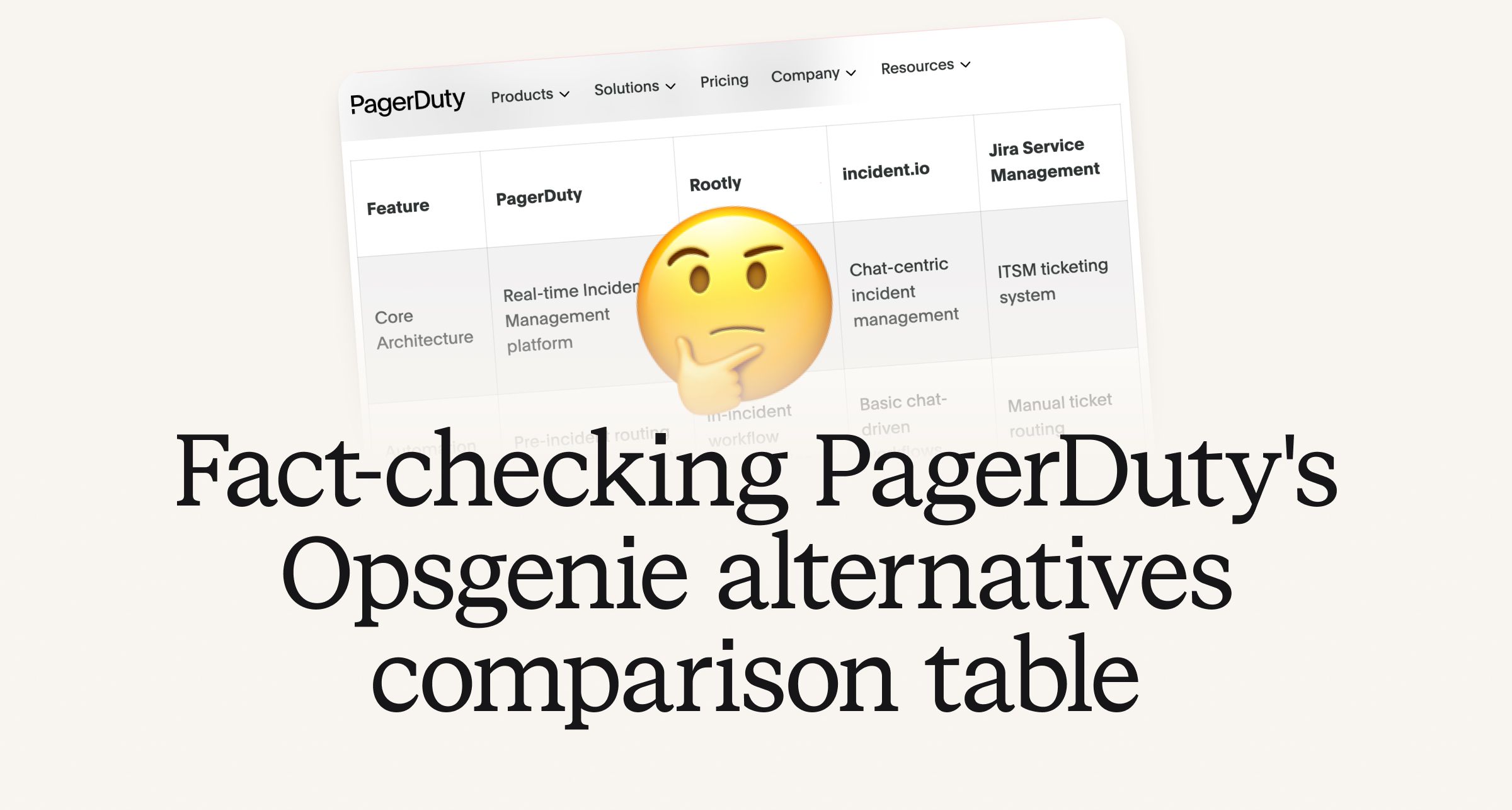
Fact-checking PagerDuty's Opsgenie alternatives comparison table
PagerDuty published a new comparison table about incident.io. Once again, it describes a product we don't recognize. So once again, we're correcting the record, row by row, with receipts.

July 28, 2026

Your genie is vanishing: introducing the Opsgenie rescue program
Today, we're launching the Opsgenie Rescue Program to make that landing soft: simplified migration and free overlap so you never pay two vendors at once.
July 9, 2026
So good, you’ll break things on purpose
Ready for modern incident management? Book a call with one of our experts today.
We’d love to talk to you about
- All-in-one incident management
- Our unmatched speed of deployment
- Why we’re loved by users and easily adopted
- How we work for the whole organization