Join live: What happens when your AI goes down?
Escalation policy failures: How to ensure the right person gets paged every time
May 15, 2026 — 13 min read
TL;DR: Automated escalation policies are reliable when built on accurate service ownership data, validated with dry-runs, and monitored for gaps before a real incident fires. Known failure modes include timezone misconfigurations, stale on-call rosters, and service-to-team mapping errors. Following on-call best practices, treat your escalation policy like production code: test it before it runs in anger. incident.io prevents routing failures by combining schedule gap detection, real-time escalation status visibility, and a Service Catalog (a structured mapping of every monitored service to its owning team and on-call schedule) that ties every alert to the team that owns the service.
Most SREs (Site Reliability Engineers, responsible for the reliability and performance of production systems) obsess over execution latency while ignoring the time lost when an automated page routes to an engineer who's unavailable. That delay doesn't just add to MTTR. It cascades: a P2 (high-severity incident) becomes a P1 (critical incident requiring immediate executive attention), executives start pinging Slack, and the on-call engineer (the engineer currently designated to respond to production incidents) who eventually gets paged joins with zero context before they even type their first command.
Automated escalation policies promise to eliminate the chaos of finding the right responder. But when they fail, they actively inflate MTTR. Here is how to design, test, and trust your escalation paths so the right engineer gets paged the first time, every time.
Getting the right team paged for outages
The core SRE job during a production incident is getting the right eyes on the problem immediately. Manual escalation slows this down because every minute spent hunting for the right team is a minute lost on diagnosis and resolution. Understanding on-call scheduling rotation models is the foundation before you layer automation on top.
The cost of failed escalations on MTTR
Over-escalation triggers alert fatigue, where engineers get paged when they're not needed and start treating every alert as noise. Under-escalation means the right subject matter expert never arrives. Both destroy trust in the alerting system. As the Google SRE recommendation on actionable incidents notes, a maximum of 2-3 actionable incidents per shift is a sustainable baseline, and alert fatigue adds serious psychological burden on top of an already stressful job.
Mean Time to Acknowledge (MTTA) measures the gap between an alert firing and a human starting work. The manual alternative to automated routing involves sifting through documentation and identifying the right responder, which can waste valuable minutes per incident before any diagnosis has started. Automated policies eliminate that lookup time, cutting the coordination overhead significantly and adding minutes back to your incident response capacity every time an alert fires.
Ensuring accurate automated paging decisions
Your on-call tools replace the manual "who is on call?" lookup with strict automation: alert fires, service maps to team, team maps to schedule, schedule maps to engineer. That chain is only as strong as its weakest link. Review the on-call tool selection framework to confirm whether your current tooling enforces this chain correctly.
Paging someone is not the same as paging the right subject matter expert. A generic on-call engineer may not have context on a specific microservice. Routing alerts to the correct team requires mapping services to owning teams and owning teams to on-call schedules, not just routing to whoever is on duty. This specificity separates a fast mitigation from a prolonged outage where the wrong engineer spends precious minutes triaging before manually escalating to the correct team.
Pitfalls that derail incident escalation
Even well-designed policies — as catalogued in escalation policy anti-patterns — break under real-world conditions. Distributed teams, rapid headcount changes, and complex rotation configs introduce failure modes that are invisible until a P1 fires at 3 AM. See how on-call is changing, covering how distributed team structures and complex rotation configs expose the limits of static, manually maintained legacy tooling, for context on why these edge cases are increasingly common.
Preventing schedule gaps and timezone errors
Distributed teams often suffer from misconfigured handoffs. A rotation that looks correct in your local timezone can create a 1-hour gap at shift changeover when Daylight Saving Time (DST) transitions or regional calendars aren't accounted for. Building schedules correctly requires specifying rotations in each team's actual timezone rather than a shared UTC offset that silently breaks twice a year.
Gaps and overlaps in on-call schedules are both routing failures — nobody assigned, or two people paged for the same tier. Gap detection, where the tool automatically flags unstaffed coverage windows, is non-negotiable. As part of SRE alerting best practices, daily notifications about upcoming schedule gaps give you time to resolve conflicts before a shift starts, not after an alert falls into a void.
Stale data and mapping errors
When an engineer leaves the company or moves to a different team, their on-call assignments can become stale if the offboarding process doesn't include updating the schedule. In incident.io, deactivating a user via SCIM (System for Cross-domain Identity Management, a protocol for automatically syncing user provisioning and deprovisioning between an identity provider and connected tools) can help ensure escalations continue routing to the next available responder during an active escalation. Without safeguards like this, alerts may go unacknowledged if they are routed to inactive users.
Misrouted pages can occur when there is a disconnect between a firing alert and the actual service owner. If your alert-to-team routing relies on a manually maintained spreadsheet or stale wiki, that mapping drifts as your architecture evolves. Services get re-owned, teams split, and the routing logic never gets updated.
Handling override and vacation exceptions
Manual overrides break automated logic when the tool doesn't natively understand them. If an engineer schedules vacation without updating their on-call override in the same system, the policy still pages them. Native override management, built directly into the on-call scheduling tool, prevents this by making overrides part of the same data model the policy reads from.
How to trust your escalation policies
Confidence in automation comes from verification before production. incident.io surfaces validation errors at policy creation time. incident.io also lets you create test incidents from alert routes to verify your configuration without waiting for a real incident. Run a simulation, confirm the correct engineer gets paged, and review the escalation path end-to-end before any significant change goes live.
This is the equivalent of testing code in a staging environment. Before publishing any schedule change, generate a preview showing exactly who covers which shifts and catch timezone calculation errors before they reach production.
Escalation policies need monitoring just like infrastructure. A policy that worked in January may silently break by March due to team changes or new services. The Insights dashboard provides MTTA, MTTR, and team-level breakdowns that make policy health visible.
Detecting misrouted alerts via incident timeline
The incident timeline captures exactly who was paged, when, and when they acknowledged, building a precise audit trail for every escalation. The escalation status lifecycle, which includes states such as Pending, Triggered, Acknowledged, and Snoozed, among others, shows exactly where the routing broke down when you review the timeline after a failure.
Use Insights analytics to find services that frequently hit your fallback or catch-all policy. If a specific service consistently routes to a generic engineering path instead of a specific team, that's a mapping error waiting to cause a slow incident response. Spot the pattern in the data and fix the catalog entry before the next incident. Every modification to an escalation policy should also produce an audit trail: who changed it, what changed, and when, preventing silent drift from breaking a critical routing path.
Best practices for maintaining escalation accuracy
Use this checklist as your quarterly escalation policy audit. Run through it before major team changes and after any incident where routing failed.
Service ownership data:
- Map every monitored service to an owning team in the Service Catalog.
- Review catalog entries after any service re-ownership or architecture change.
- Alert routes tested after any service ownership or routing rule change.
On-call roster sync:
- Departing engineers removed from all on-call schedules on their last day.
- New engineers shadow existing rotations before going live on their own.
- SCIM or identity provider sync configured to auto-deprovision deactivated users.
Schedule validation:
- Gap detection enabled for all active schedules to identify unstaffed coverage windows.
- Daily gap notifications enabled for each schedule with timezone correctly set.
- Schedule previews reviewed after any rotation change before publishing.
Escalation path testing:
- Test incident created from alert routes after any routing configuration change.
- Fallback policy verified (every path has a level that catches unacknowledged alerts).
- Notification rule conflicts checked (incident.io flags these at policy creation time).
Audit trail:
- Escalation policy change log reviewed after any policy change to confirm edits are intentional and expected.
- Incident timelines reviewed after any routing failure to identify unexpected escalation steps.
- On-Call Readiness Insights reviewed for engineers with missing notification rules.
Documentation:
- Escalation paths clearly documented with transparent fallback rules.
- Manual
/inc escalatecommand available for manual escalation when needed. - Clear ownership assigned for each escalation schedule.
Stop treating escalation policies as "set and forget" configuration. The Service Catalog maps alerts to services, services to teams, and teams to on-call schedules, so when a Datadog alert fires for your payments API, the routing is already handled. Combine accurate catalog data, validated paths, and the manual fallback of /inc escalate inside the incident Slack channel, and you have a system that works at 3 AM whether or not everything goes to plan.
Reliable escalation policies are built, tested, and monitored, not assumed. If you want to see how incident.io handles complex multi-team routing and schedule conflict detection in practice, schedule a demo with our team.
Key terms glossary
SRE (Site Reliability Engineer): An engineering role focused on the reliability, performance, and availability of production systems. SREs are typically responsible for defining and maintaining on-call policies, escalation paths, and incident response processes.
MTTA (Mean Time to Acknowledge): The average time between an alert firing and a human beginning work on the incident. Directly affected by escalation policy accuracy and on-call roster health.
Escalation policy: A defined set of rules specifying who to page, in what order, and after how long at each level when an alert goes unacknowledged. The policy is only as reliable as the schedule and service ownership data it reads from.
Service Catalog: A structured mapping of every monitored service to its owning team, on-call schedule, and runbooks. Serves as the routing source of truth for automated paging decisions.
Alert fatigue: The desensitization that occurs when engineers receive too many pages, particularly misdirected or low-signal ones, leading them to treat alerts as noise and increasing the risk of missing a genuine critical incident.
FAQs

Tom Wentworth
Chief Marketing Officer
See related articles
Introducing Investigations, powered by Nexus.
Today we're launching Investigations: agentic root cause analysis that starts the moment you're paged, figures out what broke and why, and works with your team through to resolution. Here's what we built, what's powering it, and why it took some time to get right.

August 5, 2026
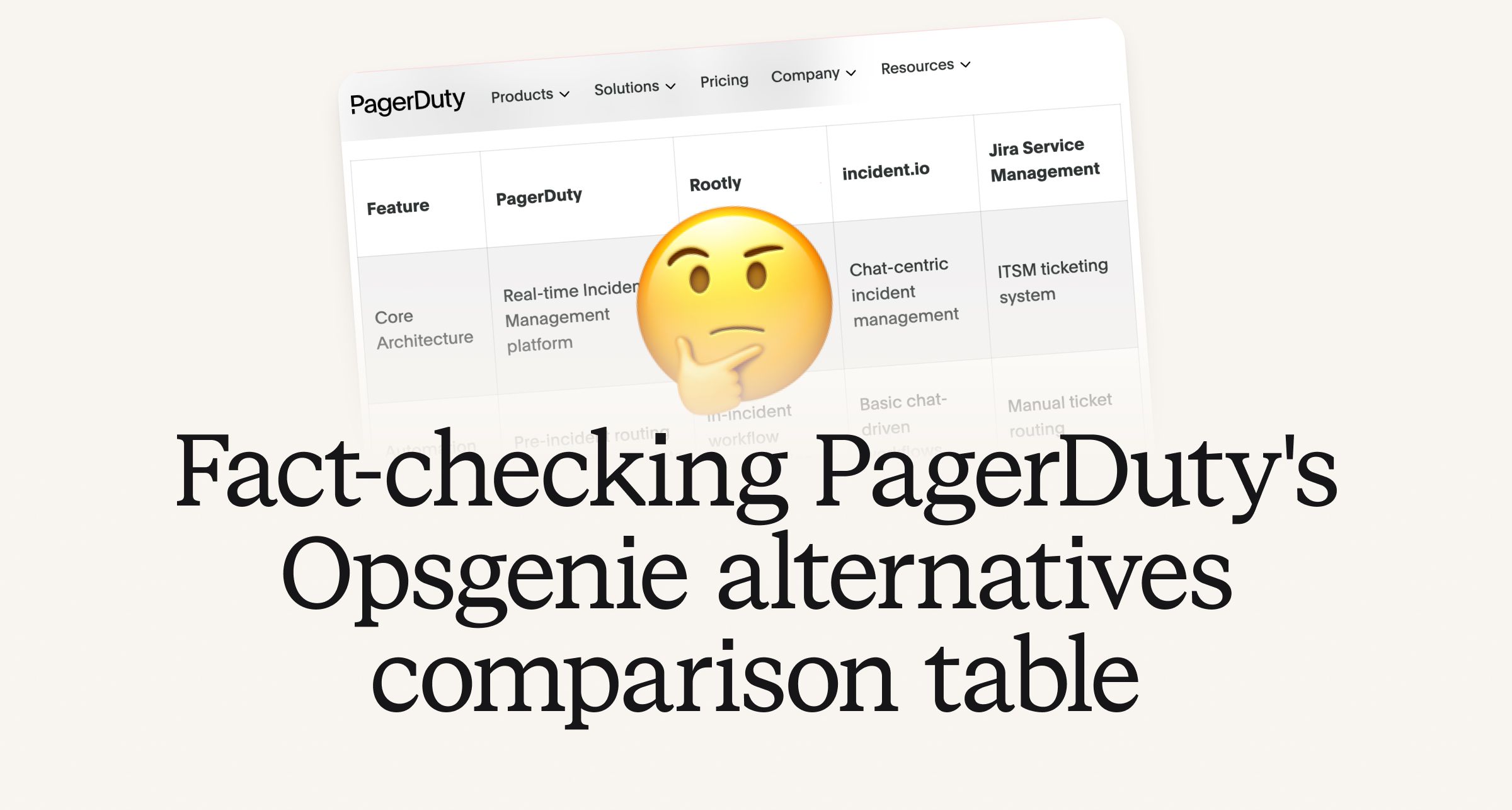
Fact-checking PagerDuty's Opsgenie alternatives comparison table
PagerDuty published a new comparison table about incident.io. Once again, it describes a product we don't recognize. So once again, we're correcting the record, row by row, with receipts.

July 28, 2026

Your genie is vanishing: introducing the Opsgenie rescue program
Today, we're launching the Opsgenie Rescue Program to make that landing soft: simplified migration and free overlap so you never pay two vendors at once.
July 9, 2026
So good, you’ll break things on purpose
Ready for modern incident management? Book a call with one of our experts today.
We’d love to talk to you about
- All-in-one incident management
- Our unmatched speed of deployment
- Why we’re loved by users and easily adopted
- How we work for the whole organization