Join live: What happens when your AI goes down?
incident.io vs PagerDuty: Feature comparison for 2026 on-call programs
May 4, 2026 — 19 min read
Updated May 4, 2026
TL;DR: PagerDuty has battle-tested alerting and deep routing customization, but it's a web-first tool that bolts Slack on as an afterthought. We built incident.io Slack-native from the ground up, which means the entire incident lifecycle, from alert to resolved post-mortem, happens where your team already works. For SRE teams handling 15+ incidents per month who want to eliminate the coordination tax, cut post-mortem reconstruction time, and onboard junior engineers in days, incident.io wins. For enterprises needing infinite alert routing flexibility already deep in the PagerDuty ecosystem, switching carries real migration cost worth evaluating honestly.
The best alerting tool on the market won't make your team faster at resolving incidents if your coordination process is broken. Most SRE teams obsess over alert noise and routing rules while ignoring the coordination tax that burns 15 minutes of every P1: the overhead of assembling the response team, gathering context across multiple tools, and tracking down the right people. This article compares incident.io and PagerDuty feature by feature to help you choose the right incident management platform for your 2026 on-call program.
Value proposition: incident.io vs PagerDuty
PagerDuty built alerting and on-call paging first, then layered coordination features on top over time. We built incident.io as a coordination platform first, then added alerting and on-call into it. That architectural difference drives almost every tradeoff when choosing incident management software, as the comparison below shows.
| incident.io | PagerDuty | |
|---|---|---|
| Core strength | Slack-native coordination and post-mortems | Alert routing and escalation depth |
| Slack integration | Native (incident lifecycle lives in Slack) | Add-on (web UI sends notifications to Slack) |
| AI automation | Automates up to 80% of incident response | AIOps noise reduction from $699/month add-on; generative AI credits included in Business plan |
| Post-mortems | Auto-drafted from captured timelines | Manual reconstruction from multiple sources |
| Unified platform | On-call, response, status pages, post-mortems | On-call and alerting strong; AIOps noise reduction and advanced features are separate add-ons; external and internal status pages included in Business plan |
| Pricing transparency | Published pricing, on-call add-on disclosed | Published pricing with additional feature-specific add-ons |
| Support model | Shared Slack channels, hours-to-days response | Email-based support with slower response times reported |
| Best for | Teams wanting fast, chat-native coordination | Enterprises needing complex alert routing |
Platform tradeoffs: customization vs speed
We built incident.io with deliberate opinions. Our strong defaults get your team operational fast, but if you need highly granular, rule-based alert routing with dozens of custom conditions per service, PagerDuty offers more flexibility there. We also don't replace your monitoring stack. You keep Datadog, Prometheus, or New Relic doing what they do, and we handle coordination. And we didn't purpose-build incident.io for deep microservice SLO tracking; if that's your primary requirement, consider a purpose-built observability platform.
PagerDuty's alerting reliability is not in question. A decade of production use across thousands of engineering teams means their on-call paging infrastructure is solid. Where it falls short is everything after the alert fires: the web-first UI requires engineers to context-switch out of Slack, support has shifted toward email-only workflows with longer response times, and advanced AI capabilities like AIOps are priced as separate add-ons, though the Business plan includes generative AI credits in the base price.
Slack-native workflows vs multi-channel coordination
The coordination tax is real and measurable. Teams using web-first tools lose 15 minutes per incident to logistics: manually creating a Slack channel and inviting responders, switching between tools to gather context, and hunting through tabs to find who covers the database team at midnight. Across 15 incidents per month, that's 225 minutes of wasted engineer time before a single line of diagnostic work starts.
How incident.io handles Slack-native response
When a Datadog alert fires, we auto-create a dedicated channel like #inc-2847-api-latency-spike, page the on-call engineer, pull in the relevant service owner from the Service Catalog, and start capturing the timeline automatically. No one touches a browser tab. The on-call engineer types /inc assign @sarah, /inc severity high, /inc escalate @database-team, and those commands feel like sending Slack messages because they are Slack messages.
PagerDuty's incident communication workflows
PagerDuty's Slack integration lets teams trigger incidents via /pd trigger or /pd declare and receive notifications in channels. Engineers can acknowledge and escalate from Slack for common actions, but for full runbook access, detailed timeline management, and complex coordination steps, most teams navigate to PagerDuty's web dashboard. That's the coordination tax: two tools, two contexts, doubled cognitive load during a 3 AM P1.
Both platforms support Microsoft Teams. We create a dedicated Teams space for incident coordination when an incident is declared, as the Flagstone case study shows, where their team modernized incident management using Teams natively. PagerDuty can trigger incident workflows from Teams but operates on the same web-first model as its Slack integration.
Automating incident team assembly
With incident.io, automated escalation removes the manual steps between alert and assembled response team. Our escalation paths route to the right team based on alert source and service ownership pulled from the Catalog, with configurable delay nodes that hold escalations until working hours if the severity doesn't warrant a 3 AM page.
Reduce MTTR: automated paging and escalation
Teams using incident.io report reducing MTTR by up to 80%. That improvement comes primarily from eliminating the coordination tax, not from faster troubleshooting. The engineers didn't get smarter overnight. The tool stopped making them slower.
incident.io Slack-native on-call
We built on-call schedules into the same platform where you manage incidents, so new engineers see exactly who's on-call, what the escalation path looks like, and how to invoke it with a slash command they already know. Teams report getting new on-call engineers operational within days, not weeks. Our alert priorities let you configure high-severity pages to wake people up at midnight while low-severity alerts wait until business hours.
PagerDuty's granular rota controls
PagerDuty's scheduling engine is mature. It supports simple rotations, follow-the-sun schedules with timezone-based handoffs, multi-layer schedules with overrides, and the ability to restrict on-call shifts to specific times. If you've spent months tuning PagerDuty's scheduling to handle complex on-call structures across 10+ time zones, that investment is real and migrating it takes planning.
Configuring escalation workflows
Our dynamic escalation paths route alerts to the right on-call team based on which service triggered the alert, with no manual lookup required. The configuration is straightforward and designed to get you operational quickly. PagerDuty offers more granular routing rule conditions but requires significantly more configuration time to reach the same result, and that configuration lives in a web UI rather than where your team works.
Taming alert noise for SREs
Both platforms support alert grouping to reduce noise. We route alerts based on service ownership from the Catalog, which means the right team gets paged without a flood of notifications to the wrong people. PagerDuty includes basic alert grouping and noise reduction across plans, but advanced AI-powered noise reduction (AIOps) is a separate $699/month add-on for teams needing ML-based event intelligence beyond basic grouping.
AI-drafted post-mortems and timelines
The 90-minute post-mortem reconstruction tax happens because incident data scatters across four or five tools after resolution. You scroll Slack threads, check PagerDuty alert history, pull Datadog event annotations, and reconstruct which decision happened at 2:47 AM versus 3:12 AM. That's archaeology, not analysis.
AI-powered post-mortems in incident.io
We capture every /inc command, every role assignment, every Slack message, and every decision made on a call in real-time. When the incident commander types /inc resolve, we've already built the complete timeline. The AI SRE assistant drafts the post-mortem using that captured data, producing a document that's approximately 80% complete by the time anyone opens it.
"Structured our incident process and greatly reduced the pain of handling incidents... The customization of incident.io is fantastic. It allows us to refine our process as we learn." - Nathael A. on G2
Reconstructing PagerDuty incident timelines
With PagerDuty, post-mortem construction requires manually pulling data from Slack scroll-back, PagerDuty's incident log, Datadog event history, and Zoom recording transcripts. Most teams report no automated way to stitch these sources together. The result is a post-mortem written 3-5 days after the incident when memories are stale, usually assigned to whoever is available last-minute.
Reliable incident timelines
Our automatic timeline capture makes post-mortems possible within 24 hours of resolution. The Service Catalog walkthrough shows how service ownership, recent deployments, and dependencies surface directly in the incident channel, so context is captured in the timeline rather than reconstructed from memory later.
Faster incident report generation (15 min)
Editing an 80% complete AI draft takes roughly 10 minutes. Writing from scratch from scattered notes takes 90 minutes. Across 15 incidents per month, that's approximately 20 hours of engineer time reclaimed monthly from post-mortem work alone. At a $150 loaded hourly cost, that's $3,000 per month in productivity recovered before you count the coordination tax savings.
Critical integrations for your SRE stack
We connect to your existing monitoring and ticketing tools, so incident data moves automatically at key points in the incident lifecycle without manual copying between systems.
Monitoring and ticketing integrations
Datadog alerts trigger incident channel creation automatically. The alert payload, service context from the Catalog, and triggering metric appear in the channel immediately, so responders start troubleshooting with context rather than hunting for it. Prometheus and New Relic work through the same alert ingestion layer. This is the modern incident management stack that sits on top of your monitoring tools, not a replacement for them.
We also connect directly to Jira, creating follow-up tickets from the incident channel with full timeline context attached. When /inc resolve fires, follow-up tasks flow into Jira or Linear automatically, linked to the incident record. No one needs to remember to create tickets after the chaos subsides.
"incident.io provides a one stop shop for all the orchestrations involved when managing an incident... hugely improving our communication capabilities and response times." - Kay C. on G2
Real-time status page updates
Status page guilt is a real phenomenon: you're 40 minutes into debugging a P1 and suddenly remember you haven't updated the public status page in 35 minutes. We eliminate this by automatically updating the status page when incident state changes. The /inc resolve command triggers the update without a manual step, and your customer support queue stops filling up with "is this fixed?" tickets.
incident.io vs PagerDuty: total cost
Hidden pricing is PagerDuty's most consistent pain point in user reviews. We publish all pricing publicly, including the on-call add-on.
incident.io pricing tiers and on-call add-ons
Our Pro plan costs $25 per user per month for incident response, with on-call scheduling available as a $20 per user per month add-on, bringing the total to $45 per user per month with on-call. The Pro plan includes unlimited workflows, custom incident types, Microsoft Teams support, AI-powered post-mortem generation, private incidents, and 3 custom dashboards in Insights.
PagerDuty pricing structure and hidden costs
PagerDuty publishes base pricing: the Professional plan runs $21/user/month (annual) and the Business plan runs $41/user/month (annual). Additional features like AI capabilities, noise reduction, and advanced runbook features often come with extra fees on higher tiers, and pricing can increase at renewal.
incident.io vs PagerDuty: 100-user TCO
| Cost item | incident.io Pro (100 users) | PagerDuty Business (100 users, estimated) |
|---|---|---|
| Base platform | $25/user/month = $30,000/year | ~$41/user/month = ~$49,200/year |
| On-call scheduling | $20/user/month = $24,000/year | Included |
| AI features | Included | Advanced AI (AIOps) $699/month add-on; generative AI credits included |
| Status pages | Included | External and internal status pages included; advanced subscriber limits may require upgrades |
| Total annual (tools) | $54,000/year | Varies by add-ons selected |
Pricing based on published rates. PagerDuty costs vary based on selected add-ons and features.
ROI calculation: tool cost vs engineer time saved
Teams using incident.io report reducing MTTR by up to 80%, which translates to meaningful time savings on every incident. Beyond MTTR improvements, the post-mortem time savings alone are substantial: editing an 80% complete AI draft takes roughly 10 minutes versus 90 minutes for manual reconstruction from scattered notes. That's 90 minutes × 15 incidents = 22.5 hours/month under manual reconstruction, versus 10 minutes × 15 incidents = 2.5 hours/month with incident.io. Across 15 incidents per month, that's approximately 20 hours of engineer time reclaimed monthly from post-mortem work alone.
Using Favor's 37% MTTR reduction as a baseline: if your team handles 15 P1 incidents monthly and reduces MTTR by 37%, you're reclaiming meaningful troubleshooting minutes on every incident. Beyond MTTR, the post-mortem time savings alone recover $36,000 per year in engineer productivity (22.5 hours/month vs 2.5 hours/month at $150/hour). Combined with MTTR and coordination tax savings, the total productivity recaptured typically exceeds the tool cost within the first year.
AI-assisted migration and faster onboarding
The most common objection to migrating from PagerDuty is risk. You can't pause incoming incidents while you switch tools. You don't have to.
PagerDuty to incident.io migration steps
We provide migration tooling for PagerDuty customers that imports your schedules, escalation policies, and alert integrations. A realistic migration timeline looks like this:
- Days 1–7: Start by getting incident.io set up, connecting your monitoring tools and Slack, and importing PagerDuty schedules using the migration tool. Run a parallel validation by routing alerts through incident.io while PagerDuty stays active, so your team can verify the new workflows before committing to a full cutover.
- Days 8–14: During this phase, set up custom workflows, status page sync, and ticketing integrations as needed. Familiarize the team with slash commands and work toward completing the Live Cutover to incident.io as your primary coordination platform.
- Day 15+: Optionally retain PagerDuty for specific alerting needs, or migrate alert ingestion fully to incident.io.
Teams typically complete migration without downtime using a parallel-run approach, with Datadog, Jira, and other critical tools integrated.
Phased rollout: incident.io and PagerDuty
Think of PagerDuty as the smoke detector and incident.io as the fire response team. During migration, run both: PagerDuty continues firing alerts while we handle everything after the page. This parallel-run approach means a production incident during migration week doesn't catch you without a functioning coordination platform.
Fast setup, zero implementation toil
We don't require professional services or multi-week onboarding sessions to get operational. Opinionated defaults mean you're running real incidents through the platform within days, not configuring 47 settings before your first workflow runs. The Opsgenie migration guide covers similar phased migration patterns for teams coming from Atlassian's sunset platform.
Driving team buy-in via Slack
Engineers don't need to learn a new tool when our interface is /inc commands in Slack channels they already use. Adoption doesn't require a training mandate because the workflow feels natural from the first incident.
If you want to see the TCO analysis and MTTR reduction modeled for your team size, Schedule a demo and we'll run the numbers with you.
Key terms glossary
MTTR (Mean Time To Resolution): The average time from when an incident is declared to when it is resolved. A primary metric for measuring on-call program health.
P1 (Priority 1) incident: The highest severity incident classification, typically indicating a critical production outage or severe service degradation requiring immediate response.
P2 (Priority 2) incident: A high-priority incident with significant impact but not requiring the same urgency as P1, often handled during business hours unless escalated.
Coordination tax: Time lost during incidents to logistics such as assembling the response team, creating channels, and switching between tools, rather than diagnosing and fixing the problem.
Slack-native: An architecture where the incident lifecycle runs entirely inside Slack via slash commands and channel interactions, not through a web UI that pushes notifications to Slack.
On-call add-on: A separate pricing component for scheduling who responds to alerts outside business hours. In incident.io's Pro plan, this is $20/user/month on top of the $25/user/month base.
Post-mortem: A structured document written after an incident that captures the timeline, root cause, contributing factors, and follow-up actions, used to prevent recurrence and build team knowledge.
FAQs

Tom Wentworth
Chief Marketing Officer
See related articles
Introducing Investigations, powered by Nexus.
Today we're launching Investigations: agentic root cause analysis that starts the moment you're paged, figures out what broke and why, and works with your team through to resolution. Here's what we built, what's powering it, and why it took some time to get right.

August 5, 2026
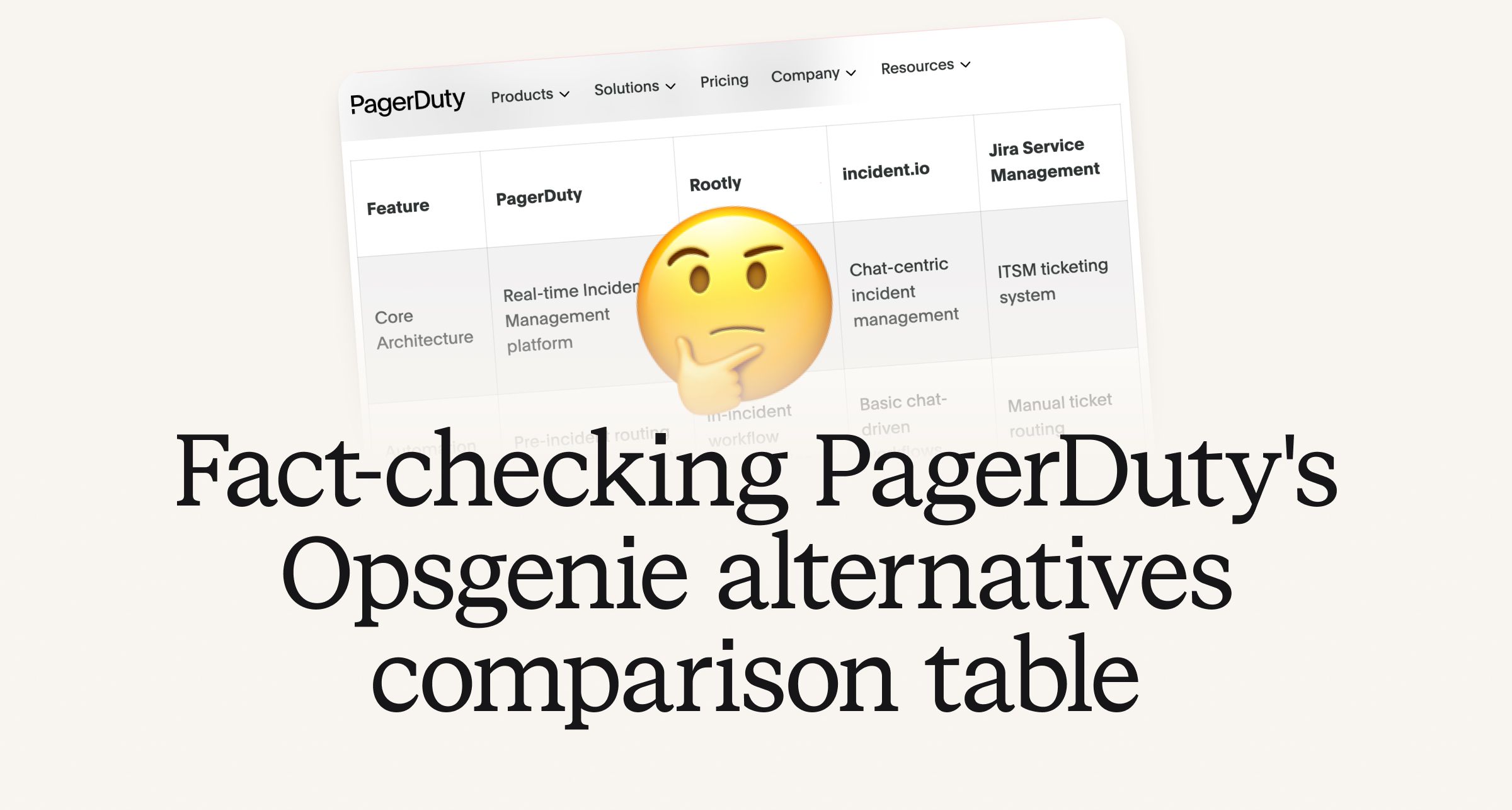
Fact-checking PagerDuty's Opsgenie alternatives comparison table
PagerDuty published a new comparison table about incident.io. Once again, it describes a product we don't recognize. So once again, we're correcting the record, row by row, with receipts.

July 28, 2026
Your genie is vanishing: introducing the Opsgenie rescue program
Today, we're launching the Opsgenie Rescue Program to make that landing soft: simplified migration and free overlap so you never pay two vendors at once.
July 9, 2026
So good, you’ll break things on purpose
Ready for modern incident management? Book a call with one of our experts today.
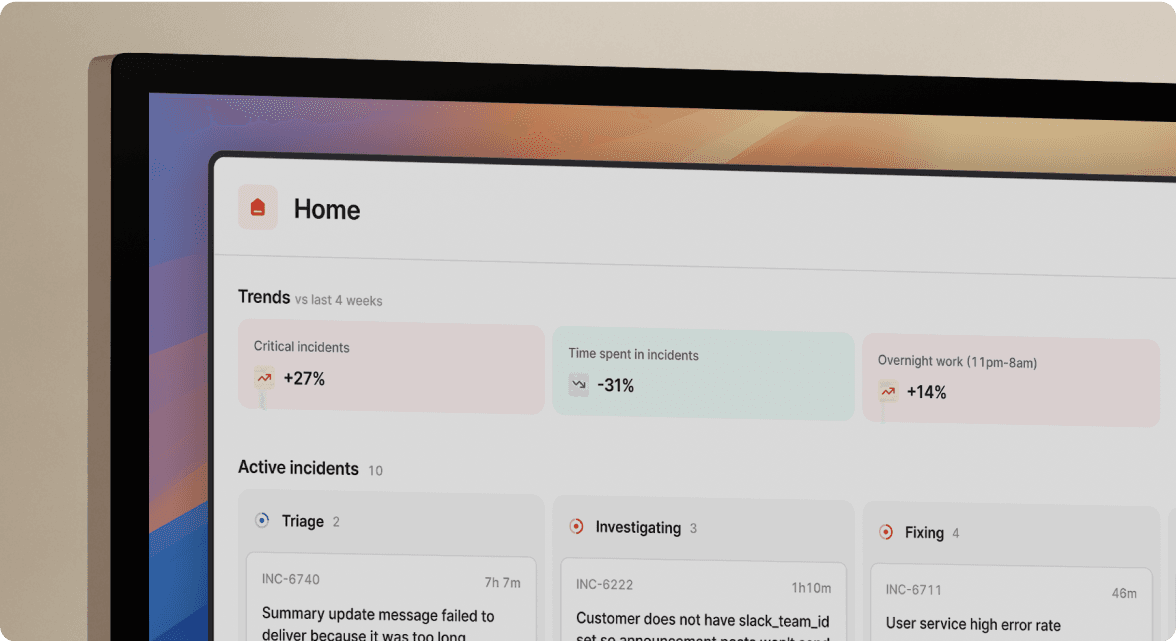
We’d love to talk to you about
- All-in-one incident management
- Our unmatched speed of deployment
- Why we’re loved by users and easily adopted
- How we work for the whole organization