Escalation policy metrics: measuring the success of your routing strategy
June 7, 2026 — 18 min read
TL;DR: Four metrics tell you whether your escalation policy is working: Time-to-First-Acknowledgment (TTFA), escalation frequency, false escalation rate, and team satisfaction. Industry guidance commonly targets TTFA below 5 minutes for most production services. A climbing escalation frequency can point to runbook gaps or alert fatigue. A false escalation rate above 5% may mean your routing rules need tuning. Team satisfaction surveys catch systemic problems before burnout sets in. incident.io's platform captures escalation events automatically in the incident timeline, so you can track performance without exporting Slack logs.
You built an escalation policy. Alerts route to the right on-call engineer, timeouts trigger the next level, and severity labels map to response tiers. But how do you know it's actually working? Escalation policies are living systems, and without the right metrics, you have no way to see where performance is degrading while your Mean Time To Resolution (MTTR) quietly climbs.
This guide covers the four escalation policy KPIs that matter, how to collect them without heroic manual effort, and what a healthy escalation performance dashboard looks like.
Why most teams don't measure escalation effectiveness
The default incident tracking stack captures when an alert fires and when an incident resolves, but everything in between, including time to acknowledge, escalation hops, and whether the escalation was even necessary, lives in Slack scroll-back and half-remembered Zoom calls.
That gap is expensive. When your escalation policy silently breaks, the signal shows up months later as rising MTTR or burned-out on-call engineers. The incident.io good incident management report analyzed real-world incidents to identify where incident response actually breaks down. Measuring your escalation policy doesn't require a data warehouse project. It requires four metrics and a consistent review cadence.
The four escalation policy key performance indicators (KPIs)
| Metric | What it measures | Target |
|---|---|---|
| Time-to-First-Acknowledgment (TTFA) | Speed of initial response | Under 5 min for most production services |
| Escalation frequency | % of incidents requiring escalation | Track trend over time |
| False escalation rate | % of escalations that were unnecessary | Under 5% |
| Team satisfaction | Engineer wellbeing and process confidence | Track trend on rotation surveys |
Metric 1: time-to-first-acknowledgment (TTFA)
Here is a closer look at how TTFA works, how to calculate it, and what to do when it starts trending in the wrong direction.
What TTFA measures
TTFA (also called MTTA, Mean Time To Acknowledge) measures the time from when an alert fires to when a responder acknowledges it. It's the first checkpoint in your escalation chain, and it measures whether your routing policy is getting alerts to someone positioned to act on them.
A consistently high TTFA almost always traces to one of three problems:
- Routing failure: The alert is landing with the wrong person or team.
- On-call scheduling gaps: Nobody is actually scheduled or reachable at that time slot.
- Alert fatigue: The on-call engineer has learned to delay acknowledging because too many alerts are noise.
How to calculate and benchmark TTFA
You calculate TTFA by summing acknowledgment times across your incidents and dividing by incident count. For example, if five incidents had acknowledgment times of 3, 7, 2, 8, and 5 minutes, the average would be 5 minutes.
The key prerequisite is agreeing on what "acknowledged" means in your system. In incident.io, a responder acknowledges an incident by accepting the escalation notification, which creates a timestamped event in the incident timeline automatically through escalation paths. You don't define this manually. The platform captures it. Industry guidance commonly targets TTFA under 5 minutes for standard production services.
How to improve TTFA when it's trending up
If your TTFA is climbing, work through this checklist:
- Audit your routing rules. Check whether alerts hit the correct team's escalation path using incident.io's team routing from alerts to trace which rule fired.
- Review schedule coverage. TTFA spikes during handoffs and holidays often signal scheduling gaps.
- Check alert volume. If one engineer is handling a disproportionate share of alerts per week, delayed acknowledgment may be fatigue, not a performance problem. The humanizing on-call webinar covers this pattern in depth.
Metric 2: escalation frequency
This section covers what escalation frequency reveals about your routing strategy, how to track it at the right level of granularity, and the steps to bring it down over time.
What escalation frequency tells you
Escalation frequency (or escalation rate) is typically measured as the percentage of incidents that require escalation to a higher support tier. When the first responder resolves the incident without escalating to another person or tier, that counts as zero hops. An incident that escalates from on-call Site Reliability Engineer (SRE) to senior SRE to database lead counts as two hops.
A high escalation rate is not necessarily bad. Complex infrastructure incidents may legitimately require multiple specialists. But a climbing escalation rate can signal that your front-line responders lack what they need to resolve incidents at the correct level. That gap is usually one of three things:
- Runbook gaps: The on-call engineer can acknowledge but can't act without escalating for guidance.
- Mis-scoped alert routing: Alerts consistently go to the wrong first responder.
- Severity miscalibration: The team escalates lower-severity issues to senior engineers because severity thresholds are unclear.
incident.io's smart escalation paths use if-else conditions to route alerts based on priority, time of day, or custom attributes, reducing mis-routing before a timeout forces an unnecessary hop.
How to track and reduce escalation rate
Track escalation frequency per service and per team, not just org-wide. An org-wide rate can hide individual services or teams with higher escalation burdens while the rest of the org looks healthy.
To reduce escalation rate:
- Identify your top-5 escalated services and prioritize runbook investment there, not alert tuning.
- Schedule a runbook sprint to reduce cognitive load on on-call engineers, especially valuable for junior engineers joining rotation.
- Run simulation training to build engineer confidence before they carry the pager independently, distributing the on-call burden as intended.
incident.io policies let you enforce follow-ups on escalated incidents by priority level, creating a systematic record of which escalations recur on the same service, which you can use to prioritize runbook work.
"incident.io is incredibly flexible and integrates smoothly with the tools we rely on. It makes it easy to collaborate at key moments, which helps us maintain SLAs and fix things quickly." - Verified user on G2
Metric 3: false escalation rate
The following sections define what qualifies as a false escalation, how to calculate your rate, and a three-step process for reducing it.
What counts as a false escalation
You're dealing with a false escalation when an escalation shouldn't have happened at all.
Common categories of false escalations include:
- Self-resolving alerts that cleared before anyone could act
- Misrouted pages that went to a team without ownership of the affected service
- Non-actionable alerts that fired because a threshold was misconfigured
- Alert storms where a single underlying issue generates multiple escalations across teams
False escalations can differ from alert noise at the monitoring layer. An alert can be real but still trigger a false escalation if your routing logic sends it to the wrong team, or if the escalation fires before the alert has time to self-resolve.
67% of alerts are ignored daily across engineering teams. When escalations are indistinguishable from noise, responders start filtering before acting, and real incidents get delayed. When you reduce false escalations, responders trust their queue instead of filtering before acting, which tightens acknowledgment times directly. A 2025 State of Observability report found that 43% of respondents report they spend too much time responding to alerts. Unnecessary escalations compound that load directly.
How to measure and reduce false escalations
Start by establishing your current rate, then work through a structured reduction process to bring it down over time.
Calculating your false escalation rate:
(Number of false escalations / Total escalations) x 100
A commonly cited target for a healthy system is below 5%, with a clear downward trend over time. Perfect elimination can be difficult because some alerts self-resolve faster than routing rules can adapt, but continuous reduction is often the goal.
The three-step reduction process:
- Tag false escalations during post-incident reviews. You can add a custom field in incident.io to mark whether an escalation was necessary. This creates the dataset you need for trend analysis without manual log exports.
- Identify repeat offenders. If the same alert triggers false escalations repeatedly, that's a configuration problem. Pull the workload metrics in incident.io Insights to surface which alerts generate the most unnecessary escalation activity.
- Tune or remove non-actionable alerts. A recommended process is: identify alerts that don't provide a meaningful signal, flag them in your next team meeting, and either raise the threshold or decommission them. As the effective incident escalations guide explains, if an alert never triggers a meaningful action, it's a candidate for removal.
"The End to End Incident Management process and integrating with our blameless post-mortems. The AI summaries of incidents in Slack is very useful too and startlingly accurate." - Verified user on G2
Metric 4: team satisfaction
This section explains how to measure on-call satisfaction in a lightweight, consistent way, and how to translate the results into concrete policy changes.
Why quantitative metrics alone aren't enough
TTFA, escalation frequency, and false escalation rate tell you what happened. Team satisfaction tells you what's about to happen. Burnout, declining engagement, and on-call avoidance can show up in satisfaction data before they show up in MTTR.
Gut feelings about on-call health are unreliable. Engineers on the same rotation can experience the same workload differently depending on factors like runbook quality, tooling confidence, and whether they feel supported when they escalate. A satisfaction metric turns that subjective experience into a trackable trend. When acknowledgment delays increase alongside declining survey scores, that may indicate a motivation or trust problem, not a routing problem.
How to measure on-call satisfaction
Two approaches work well in practice, one tied to the rotation handoff and one run on a quarterly cadence.
Rotation handoff survey (most effective, lowest friction):
Run a brief anonymous survey after every rotation. Keep it short enough that engineers complete it in under five minutes with questions like:
- "How sustainable was your on-call shift this week?" (scored on a scale)
- "Did you feel our alerts were actionable?"
- "Did you have the right tools and runbooks to resolve incidents during your shift?"
Track the trend, not just the absolute score. A lower score that has been climbing steadily may be healthier than a higher score that has been dropping for several rotations in a row.
Quarterly burnout assessment:
Standardized tools like the Maslach Burnout Inventory can measure emotional exhaustion, depersonalization, and reduced personal accomplishment. Regular administration helps identify individuals who need support before the situation becomes a retention risk. The humanizing on-call experience webinar from incident.io covers how engineering leaders use these tools alongside on-call data to structure rotation relief.
Turning satisfaction feedback into policy changes
Satisfaction data only adds value when you close the feedback loop. Map common feedback themes to specific policy changes:
| Feedback pattern | Policy action |
|---|---|
| "I keep getting paged for the same issue overnight" | Consider automating the fix or adjusting the alert's notification rules |
| "I don't know how to fix these alerts" | Consider scheduling a runbook sprint for that service |
| "One person always gets escalated to" | Review the routing rules and on-call schedule for that service |
| "There's no coverage during handoff" | Review rotation schedule for overlap or coverage gaps |
incident.io's escalating incidents workflow lets engineers escalate within the incident Slack channel using /inc escalate, capturing escalation events in the timeline. That data can help identify which services and rotation slots generate the most escalation stress.
"I really appreciate the support from incident.io staff. Whether it's on the technical side, or related to licensing and billing, they've been incredibly responsive." - David H. on G2
Building an escalation policy health dashboard
You don't need a custom analytics pipeline to build an escalation health dashboard. You need components that surface trends rather than snapshots.
Dashboard components:
- TTFA trend line: A time series graph of TTFA, which can be segmented by severity level to help separate high-severity routing problems from low-severity noise.
- Escalation frequency by service: A bar chart showing escalation rate per service over a rolling period.
- False escalation rate KPI: A single percentage for the period, ideally showing trend direction.
- Team satisfaction trend: Average rotation survey score over time.
- Filters: Date range, team, service, severity level. Isolating one team's metrics from the org-wide view can help target improvements.
How incident.io tracks escalation performance automatically
We built Insights to surface these metrics. Escalation events get captured in the incident timeline automatically when you use escalation paths. Your escalation data appears in the platform when you resolve an incident. That means you can benchmark your team's performance against your own trends and make policy adjustments based on real data, not gut feel.
incident.io Insights tracks workload and resolution metrics, so you can build this review cadence with reduced manual maintenance effort.
"The customization of incident.io is fantastic. It allows us to refine our process as we learn by adding custom fields, severity types or workflows to tailor the tool to our exact needs." - Nathaël A. on G2
Tracking escalation performance with incident.io
incident.io builds escalation tracking into the incident lifecycle. When an alert fires and routes through an escalation path, escalation activity gets captured in the incident timeline. You don't rely on engineers to remember to log what happened.
The platform's smart escalation paths can use conditional routing logic, so you can configure different escalation chains by service priority, time of day, and alert type. The platform provides configurable escalation behavior to help reduce routing gaps.
The going beyond MTTx video from the incident.io team covers how engineering organizations use Insights data to move past raw MTTR into the underlying drivers of escalation performance.
For teams running PagerDuty alongside incident.io, the escalation performance data integrates cleanly because incident.io works with PagerDuty's alerting layer while centralizing coordination and measurement in Slack. As incident.io's analysis of PagerDuty explains, the coordination gap is where most MTTR time actually disappears.
If your team isn't measuring any of these metrics today, TTFA is a good starting point. TTFA has direct impact on overall incident duration, acknowledgment timestamps are captured automatically by most incident management tools, and high TTFA almost always traces to a scheduling or routing problem, which means you can act on the fix immediately.
Schedule a demo and run your next real incident through it. Your first escalation event gets captured in the timeline automatically, giving you baseline escalation data from day one.
Key terms
TTFA (Time-to-First-Acknowledgment): The average time from when an alert fires to when a responder acknowledges it. Also called MTTA (Mean Time To Acknowledge).
Escalation frequency: The percentage of incidents that require escalation to a higher support tier. Tracked per service and per team.
False escalation rate: The percentage of escalations that were unnecessary, including misrouted pages, self-resolving alerts, and non-actionable alert triggers.
Escalation path: A configured routing chain that defines who gets paged in sequence if the first responder doesn't acknowledge within a defined timeout window.
Rotation handoff survey: A short anonymous survey run after each on-call rotation to measure team satisfaction and track early warning signals for burnout.
Alert fatigue: The state where on-call engineers begin ignoring or delaying alert acknowledgment because too many alerts are non-actionable or repeat without resolution.
FAQs

Tom Wentworth
Chief Marketing Officer
See related articles
Introducing Investigations, powered by Nexus.
Today we're launching Investigations: agentic root cause analysis that starts the moment you're paged, figures out what broke and why, and works with your team through to resolution. Here's what we built, what's powering it, and why it took some time to get right.

August 5, 2026
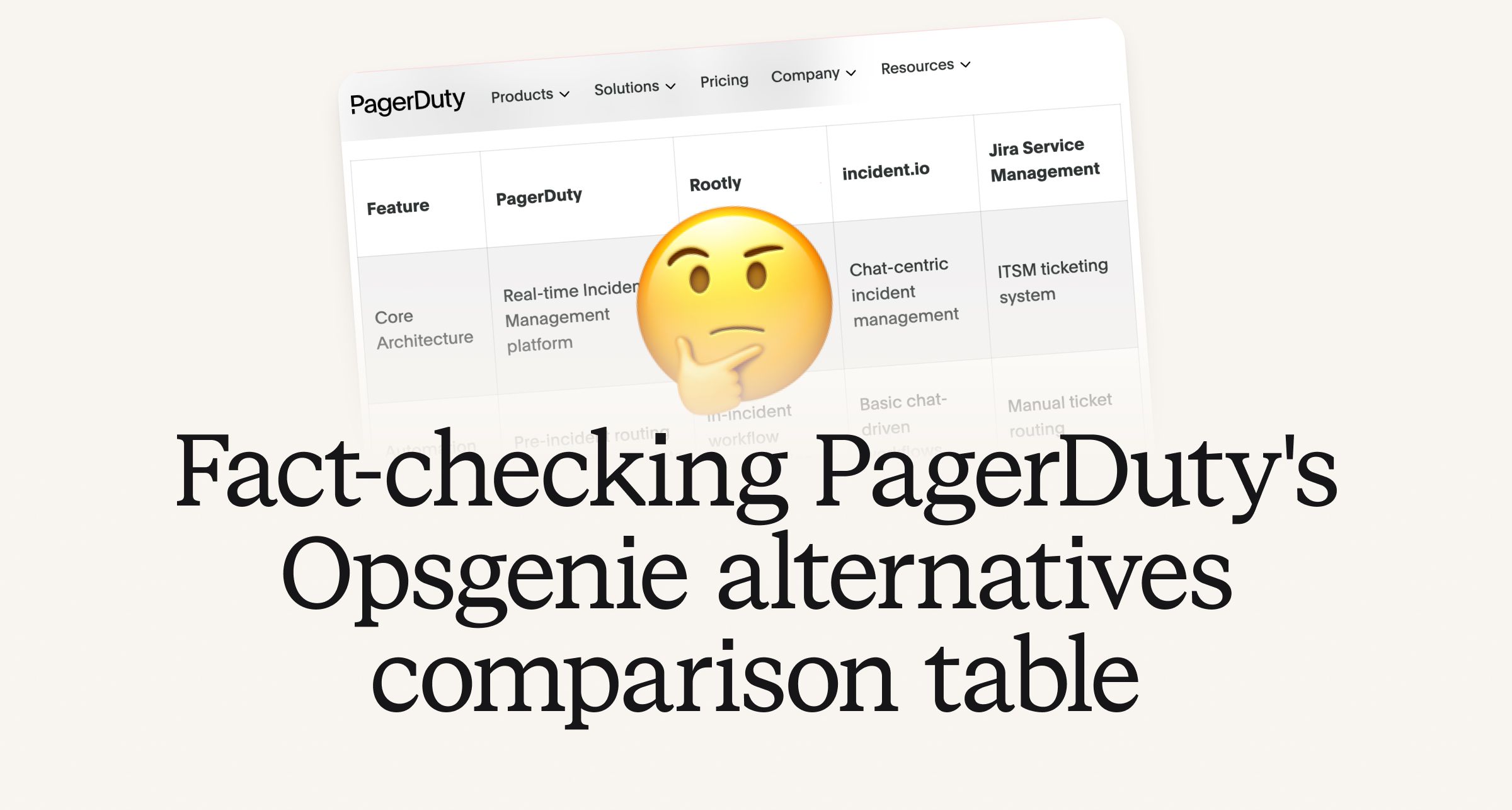
Fact-checking PagerDuty's Opsgenie alternatives comparison table
PagerDuty published a new comparison table about incident.io. Once again, it describes a product we don't recognize. So once again, we're correcting the record, row by row, with receipts.

July 28, 2026

Your genie is vanishing: introducing the Opsgenie rescue program
Today, we're launching the Opsgenie Rescue Program to make that landing soft: simplified migration and free overlap so you never pay two vendors at once.
July 9, 2026
So good, you’ll break things on purpose
Ready for modern incident management? Book a call with one of our experts today.
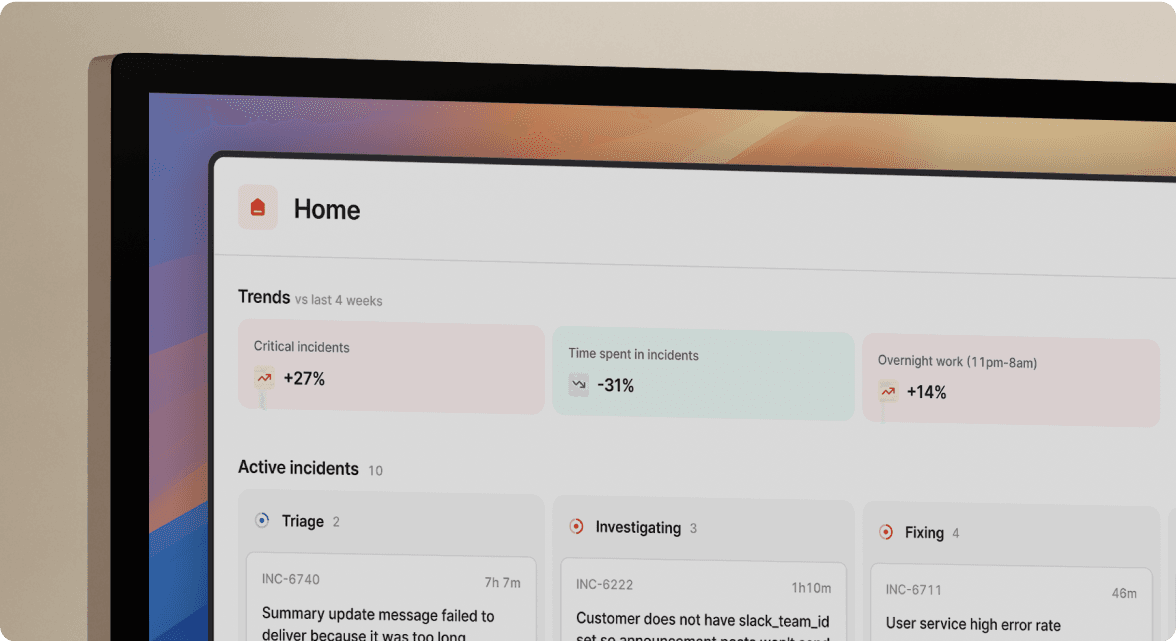
We’d love to talk to you about
- All-in-one incident management
- Our unmatched speed of deployment
- Why we’re loved by users and easily adopted
- How we work for the whole organization