Rootly AI root cause analysis accuracy: Verified claims vs. reality
April 14, 2026 — 14 min read
Updated Apr 14, 2026,
TL;DR: Rootly offers AI-powered incident management features. incident.io's Investigations analyzes incidents by examining GitHub pull requests, Slack messages, logs, and historical data to automate up to 80% of incident response including timeline capture, context gathering, and service owner identification, and suggests fix PRs directly in Slack. Pricing is transparent at $45/user/month with on-call on the Pro plan ($25 base plus a $20 on-call add-on), versus Rootly's negotiated tiers. If you need transparent AI capabilities and predictable pricing before committing, incident.io is the stronger choice.
Most SREs obsess over AI incident management features without asking the only question that matters: what are the precision and recall metrics (precision: the percentage of AI root cause suggestions that are correct; recall: the percentage of real root causes the AI detects at all)? A tool that surfaces the wrong deployment as the root cause at 3 AM does not reduce Mean Time To Resolution (MTTR). It sends you on a 15-minute wild goose chase while customers are offline, which is worse than no AI at all.
This article breaks down what Rootly's AI actually does, how its root cause analysis (RCA) claims hold up against available evidence, and how incident.io's Investigations compares on verified accuracy, pricing, and workflow. If you're carrying a pager, this is the data you need before signing a contract.
Rootly's AI RCA: Features and capabilities
Verified root cause data
Rootly positions itself as an AI-native incident management platform. Its AI capabilities include a Meeting Bot that joins virtual meetings (Zoom, Google Meet, Microsoft Teams, Webex, Slack Huddles) to transcribe calls and capture context in real time.
For developers, Rootly ships a Model Context Protocol (MCP) server that plugs into editors like Cursor, Windsurf, and Claude to resolve production incidents from within an IDE. These are useful automation capabilities that reduce post-incident toil, and the platform's Slack-native workflow is well-executed.
The gap appears when you ask the harder question: how accurate is the root cause identification itself?
AI root cause analysis claims
Rootly's AI Labs team runs benchmarks on LLM models including GPT-4o, Gemini 2.0 Flash, DeepSeek v3.1, Claude 3.5 Sonnet, and Qwen2.5 for SRE tasks, and reports a 2x improvement in benchmark performance for Claude 3.5 Sonnet through prompt engineering compared to baseline configurations. These numbers describe model performance under controlled test conditions, not Rootly's actual RCA accuracy rate inside your production incidents.
A review of Rootly's product documentation, AI Labs reports, and G2 customer feedback found no published precision or recall metrics for root cause analysis in production environments. There is no statement along the lines of "our AI correctly identifies the root cause in X% of incidents." For an SRE evaluating AI tools, these metrics are critical for assessing reliability. incident.io's AI RCA accuracy testing guide discusses the importance of precision and recall data for evaluating AI-powered incident management tools.
Before committing to any AI-enabled incident management platform, ask vendors these six questions:
- Precision metric: In what percentage of incidents does the AI correctly identify the root cause? (Precision is the percentage of AI root cause suggestions that are correct.)
- Recall metric: What percentage of all root cause events does the AI detect at all? (Recall is the percentage of real root causes that the AI detects.)
- Data sources accessed: Does the AI query service catalog, recent deployments, historical incidents, logs, and traces, or only Slack logs?
- False positive rate: How often does the AI surface an incorrect hypothesis that engineers must investigate and dismiss?
- Time to hypothesis: From incident declaration to first AI root cause suggestion, measured in minutes.
- Confidence signaling: How does the tool surface AI confidence levels so engineers can quickly validate or dismiss hypotheses during a live incident?
If a vendor cannot answer questions 1 and 2 with documented numbers, the AI RCA capability is unverified.
Rootly AI feature pricing tiers
Rootly's pricing scales with team size and tier. Based on available vendor information, the Essentials tier list price starts near $12,000 for 50 users ($20/user/month). The Scale tier list price runs approximately $42,000 for 100 users ($35/user/month). On-call costs are a separate component of the overall pricing and vary by contract.
By contrast, incident.io's Pro plan is $25/user/month for incident response, with on-call available as a $20/user/month add-on, totaling $45/user/month. For a 25-person on-call team, that is $13,500 annually with full AI SRE capabilities, published on a public pricing page with no negotiation required.
Rootly AI accuracy: How it compares to alternatives
incident.io AI RCA: Verified accuracy
incident.io's Investigations uses a multi-agent investigation architecture. When an incident opens, the system can search across GitHub PRs, Slack message history, historical incidents, logs, metrics, and traces. Sub-agents formulate hypotheses and present findings directly in the incident Slack channel. If the AI identifies a code issue as the root cause, engineers can ask it to generate a fix and open a pull request, all without leaving Slack.
Consider a database connection pool exhaustion incident at 2:47 AM on a Saturday. Datadog fires the alert. incident.io auto-creates the channel, pages the on-call engineer, and the AI SRE begins investigating. In under two minutes, it surfaces three possibilities: a connection leak from a PR merged Thursday, a config change to pool size limits on Friday afternoon, or an unexpected traffic spike. You start with the most recent change. The config change set max_connections too low. You revert it and the incident resolves quickly. The AI's rapid hypothesis generation cut time-to-hypothesis from over 15 minutes to under 2 minutes.
Now run the same scenario with an AI that only correlates Slack messages. It flags a deployment from three weeks ago because someone mentioned "database" in an unrelated thread. You spend time ruling it out before manually checking recent changes. The incident takes longer to resolve, adding 10 to 15 minutes of ruled-out hypotheses to every investigation.
"Now engineers are comfortable that when the proverbial alarm bells ring at 3am, they won't miss out important process while dealing with chaos, or have to be reading through long incident-management runbooks that aren't related to the problem at hand." - Jack S. on G2
Side-by-side accuracy comparison
| Platform | AI RCA capabilities | Pricing transparency | Slack-native workflow |
|---|---|---|---|
| incident.io | AI-assisted RCA that pulls metrics and logs, suggests next steps based on past incidents. Automates up to 80% of incident response. | Public: $45/user/month with on-call (Pro: $25 base + $20 on-call add-on) | Full lifecycle in Slack via /inc commands. No browser required. |
| Rootly | Meeting transcription, summaries, retrospectives, MCP IDE server. No published precision/recall metrics found in documentation. | Negotiated: ~$240/user/year (Essentials) to ~$420/user/year (Scale). On-call costs vary by contract. | Slack-native automation with strong workflow tools. |
| PagerDuty AIOps | Alert noise reduction (87-91%). Event correlation. MTTR improvement of ~14%. Primary focus is alert management, not deep RCA. | Event-based: priced per accepted event ingested via email or API. Specific per-event rates vary by contract. | Web-first with Slack notifications; agentic workflows require the PagerDuty UI for key steps. |
Rootly AI's operational blind spots and SRE feedback
What SREs report about Rootly AI
Public feedback on incident management tools often emphasizes workflow efficiency and integration quality. However, specific feedback on AI RCA accuracy during production incidents remains limited across the category. Reviews tend to focus on AI-generated summaries and retrospective drafts rather than cases where AI correctly identified root causes that engineering teams would otherwise have missed.
The cost of AI false positives
Engineering toil in SRE terms is the repetitive, manual work that does not reduce the long-term incident burden. When an AI tool surfaces the wrong root cause during a live incident, the on-call engineer spends 10-15 minutes investigating and dismissing the false lead before resuming the real investigation. This is not just wasted time. It trains engineers to distrust the AI, at which point they stop using it and you are paying for shelfware.
Without published precision and recall data, the false positive rate is impossible to estimate before purchase for Rootly's RCA feature. You run an experiment with your production incidents.
Missing incident context and how incident.io closes the gap
Rootly's AI Meeting Bot joins virtual meetings (Zoom, Google Meet, Microsoft Teams, Slack Huddles) and transcribes calls in real time, capturing context that would otherwise be lost. incident.io's Scribe does the same for Google Meet and Zoom calls, but feeds transcriptions directly into the incident timeline. Scribe extracts key decisions, flags root cause mentions, and uses that structured data to generate AI summaries and follow-up recommendations. Every captured decision makes the next AI suggestion more accurate. The system compounds in ways that isolated transcription cannot.
Rootly's AI Meeting Bot joins virtual meetings (Zoom, Google Meet, Microsoft Teams, Slack Huddles) and transcribes calls in real time, capturing context that would otherwise be lost. incident.io's Scribe does the same for Google Meet and Zoom calls, but feeds transcriptions directly into the incident timeline. Scribe extracts key decisions, flags root cause mentions, and uses that structured data to generate AI summaries and follow-up recommendations. Every captured decision makes the next AI suggestion more accurate.
Does Rootly's AI justify the premium cost?
Justifying AI investment: ROI guide
The math for a 25-person engineering team handling 15 incidents per month at a $150 loaded hourly engineer cost:
| Metric | Manual process | With incident.io AI SRE |
|---|---|---|
| Coordination overhead per incident | ~15 min (estimated) | ~2 min (estimated) |
| Time saved per incident | 0 min | ~13 min |
| Total coordination time saved monthly | 0 hrs | 3.25 hrs |
| Post-mortem time per incident | ~90 min (estimated) | ~10 min (estimated) |
| Post-mortem time saved monthly | 0 hrs | 20 hrs |
| Post-mortem cost savings monthly | $0 | ~$3,000 |
| Total monthly value | $0 | ~$3,000+ |
| incident.io Pro cost (25 users with on-call) | $0 | $1,125/month |
The tool pays for itself on post-mortem savings alone, before counting the MTTR reduction benefit. incident.io achieves this through three specific mechanisms: automated channel creation drops assembly time from 10-15 minutes to under 5 minutes, the multi-agent AI investigation surfaces the likely PR or config change within 1-2 minutes, and Scribe's call transcription produces post-mortems that are 80% complete at incident resolution.
Rootly AI RCA: What SREs need to know
Rootly's publicly available information focuses on AI Labs benchmarks that test LLM models under controlled conditions, which measures model capability rather than production incident outcomes. This makes it difficult to assess whether the AI will correctly identify the cause of your 3 AM database failover.
incident.io's Investigations runs a multi-agent investigation across GitHub, Slack, logs, metrics, and historical incidents, generates a root cause hypothesis within 1-2 minutes, and offers to open a fix PR if the issue is code-related. Favor documented a 37% MTTR reduction using this approach.
For SRE leads who need to prove reliability investments to engineering leadership, incident.io's Insights dashboard tracks MTTR trends, incident volume by service, and on-call load distribution over time, giving you the quarter-over-quarter data your VP of Engineering is asking for.
"Clearly built by a team of people who have been through the panic and despair of a poorly run incident. They have taken all those learnings to heart and made something that automates, clarifies and enables your teams to concentrate on fixing, communicating and, most importantly, learning from the incidents that happen." - Rob L. on G2
Schedule a demo of incident.io to see Investigations in action on a real incident scenario, including the multi-agent root cause workflow and fix PR generation in Slack.
Key terms glossary
MTTR (Mean Time To Resolution): The average time from incident detection to full resolution, including coordination, investigation, and fix deployment. Reducing MTTR is the primary operational goal of incident management tooling.
Precision (AI): The percentage of AI root cause suggestions that are correct. A precision rate of 80% means 8 out of 10 AI suggestions match the actual root cause.
Recall (AI): The percentage of real root causes that the AI detects at all. A recall rate of 60% means the AI misses 4 out of 10 actual root causes entirely.
Engineering toil: Repetitive, manual work in SRE that does not reduce the long-term incident burden. Investigating and dismissing a false-positive AI hypothesis during a live incident is a direct example of AI-generated toil.
Slack-native: A platform architecture where the full product workflow runs inside Slack channels and commands, as opposed to a web-first tool that sends notifications to Slack. The distinction determines whether engineers must context-switch during a live incident.
FAQs

Tom Wentworth
Chief Marketing Officer
See related articles
Introducing Investigations, powered by Nexus.
Today we're launching Investigations: agentic root cause analysis that starts the moment you're paged, figures out what broke and why, and works with your team through to resolution. Here's what we built, what's powering it, and why it took some time to get right.

August 5, 2026
Fact-checking PagerDuty's Opsgenie alternatives comparison table
PagerDuty published a new comparison table about incident.io. Once again, it describes a product we don't recognize. So once again, we're correcting the record, row by row, with receipts.

July 28, 2026
Your genie is vanishing: introducing the Opsgenie rescue program
Today, we're launching the Opsgenie Rescue Program to make that landing soft: simplified migration and free overlap so you never pay two vendors at once.
July 9, 2026
So good, you’ll break things on purpose
Ready for modern incident management? Book a call with one of our experts today.
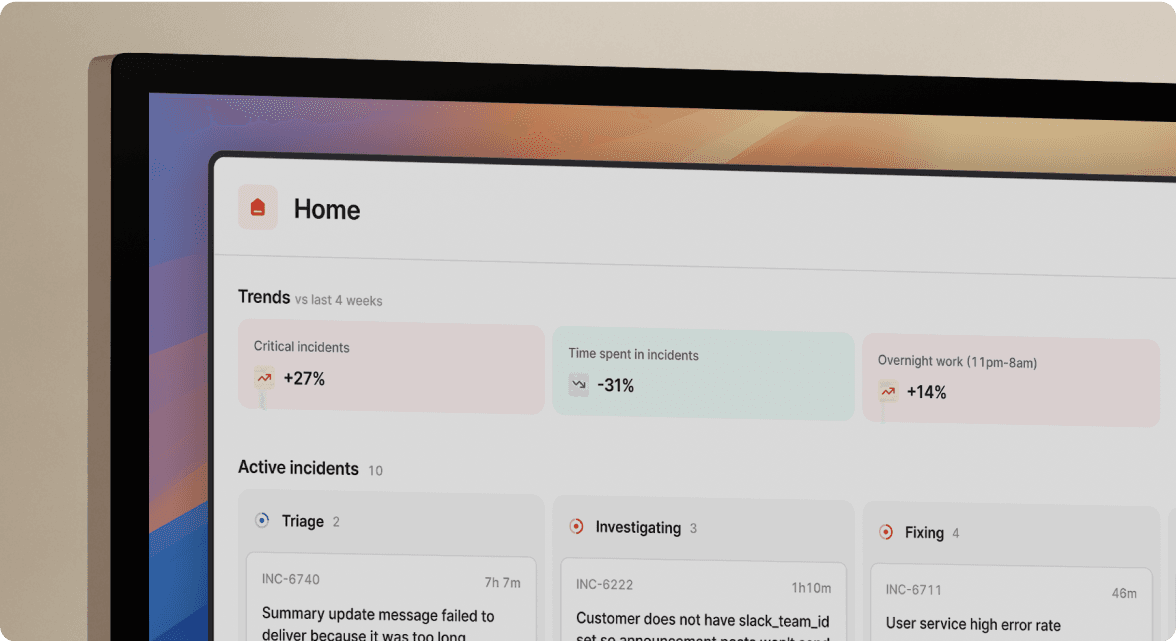
We’d love to talk to you about
- All-in-one incident management
- Our unmatched speed of deployment
- Why we’re loved by users and easily adopted
- How we work for the whole organization