Opsgenie vs. Alternatives: Which Microsoft Teams integrated tool wins
January 14, 2026 — 10 min read
Teams running on Microsoft Teams (and often Slack) need an Opsgenie replacement that meets them where the work happens: inside chat. With Atlassian discontinuing Opsgenie sales in 2025 and setting a full shutdown for 2027, the shift isn’t optional—it’s urgent. Incident management software helps organizations detect, respond to, and resolve operational alerts or disruptions by automating notifications, routing responses, and facilitating team collaboration. The best fit depends on how deeply a tool integrates with Teams and Slack, its automation depth, on-call scheduling, and total cost. In short: AlertOps is a strong choice for Teams-first workflows; incident.io leads for Slack with rapidly expanding Teams support; Splunk On-Call and PagerDuty suit enterprise-scale needs; and TaskCall or Callgoose can be cost-effective for smaller teams. This guide lays out the trade-offs so you can choose confidently.
Key Criteria for choosing a Microsoft Teams integrated incident tool
Use this checklist to quickly assess fit for Teams-centric engineering and SRE organizations:
- Teams and Slack integration: Native chatops integrations allow incident responders to receive alerts, coordinate, and resolve incidents directly within chat tools like Microsoft Teams and Slack, improving collaboration speed, as highlighted in a roundup of Opsgenie alternatives for Teams and Slack by Desk365.
- On-call scheduling and escalations: Look for flexible rotations, timezones, and multi-step escalations so the right person is always paged—a core capability described by Zendesk on incident management software.
- Automation depth: AIOps, runbooks, auto-remediation, and customizable workflows that cut manual toil, reduce noise, and accelerate resolution.
- Migration complexity: How easily existing schedules, services, and routing can be mapped from Opsgenie, plus available tooling and support.
- Predictable pricing and TCO: Transparent per-user pricing, clear add-on costs (e.g., SMS/voice), and low administrative overhead.
Quick reference:
| Criterion | Why it matters | What good looks like |
|---|---|---|
| Teams/Slack integration | Work where responders already collaborate | Two-way actions in chat: ack, escalate, run runbooks, post updates |
| Scheduling & escalations | Reliable, uninterrupted on-call coverage | Rotations, overrides, multi-level rules, on-call handoff reports |
| Automation & AIOps | Reduced toil and faster MTTR | Noise reduction, deduplication, auto-remediation, suggested actions |
| Migration effort | Lower risk, faster time-to-value | Import tools, mapping guides, trial sandboxes, support from vendor |
| Pricing & TCO | Forecastable spend as you scale | Clear per-user tiers, no hidden fees, channel costs surfaced upfront |
Overview of leading Opsgenie alternatives for Microsoft Teams
These vendors consistently appear in shortlists for Teams-centric organizations:
- incident.io: Chat-first, modern UX, deep Slack integration with growing Teams support and strong automation.
- AlertOps: Microsoft Teams–oriented routing with granular notifications, stakeholder updates, and runbooks.
- Splunk On-Call: Enterprise-grade, strong observability alignment, analytics, and incident timelines.
- PagerDuty: Mature automation and AIOps at scale, massive integration ecosystem.
- TaskCall and Callgoose: Cost-focused options with simplified migration paths and baseline automation.
At-a-glance comparison:
| Vendor | Teams integration depth | Automation | Pricing range (indicative) | Notes |
|---|---|---|---|---|
| incident.io | Developing toward parity | Advanced playbooks and AI-assisted workflows | Free; from ~$15/user/month | Slack-first; Teams features expanding |
| AlertOps | Deep, chat-first actions | Strong, customizable workflows | From ~$10–$20/user/month | Granular routing, stakeholder comms |
| Splunk On-Call | Solid enterprise integration | Strong with analytics | Mid-to-high | Best with Splunk observability stack |
| PagerDuty | Robust, enterprise-ready | Advanced AIOps and event intelligence | Mid-to-premium | Broad ecosystem, complex setups |
| TaskCall | Basic-to-moderate | Moderate automation | Budget-friendly | Emphasizes simple Opsgenie migration |
| Callgoose | Basic-to-moderate | Moderate with self-service | Budget-friendly | Focus on cost and quick onboarding |
incident.io: Microsoft Teams-native
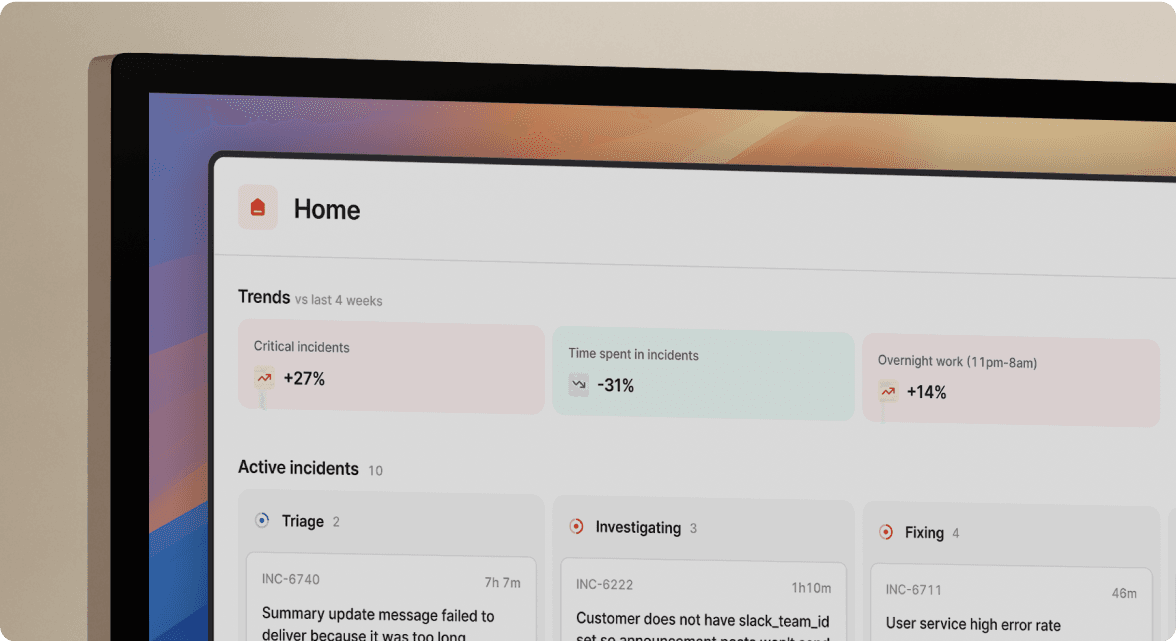
incident.io is a chat-first incident management platform engineered for fast-moving teams, offering robust automation, a modern interface, and deep Microsoft Teams integration. Transparent pricing includes a free plan and paid tiers starting around $15 per user per month.
Planning a move? You can get a demo of incident.io and Microsoft teams at https://incident.io/demo.
AlertOps: Strong Microsoft Teams integration and flexible routing
AlertOps provides robust on-call schedules, multi-step escalations, and workflow playbooks—paired with explicit Microsoft Teams integrations noted across community roundups. Its strengths include granular routing rules, stakeholder notifications, and customizable runbooks suited to teams who need precise control over who gets paged and when. The trade-off: setup and UI can feel complex, so organizations that value fine-grained routing and centralized stakeholder communications will benefit most.
Splunk On-Call: Enterprise reliability with Teams support
Splunk On-Call (formerly VictorOps) targets larger organizations that need analytics, deep timelines, and context-rich alerting. It’s a natural fit for teams already invested in Splunk’s observability stack, bringing incident visualizations and correlation alongside mobile apps and multi-channel notifications for responders on the move. Expect powerful capabilities, but also plan for higher complexity and cost as usage scales and integrations multiply.
PagerDuty: Mature automation and broad ecosystem for teams
PagerDuty offers mature automation, a broad integration ecosystem, and advanced event intelligence—ideal for distributed, large-scale teams willing to invest in enterprise tooling. Microsoft Teams integration is robust, but implementation can be complex, and pricing sits above many rivals. It shines when you need granular control, sophisticated routing, and proven reliability across thousands of services and responders.
Emerging vendors: TaskCall, Callgoose, and cost-effective options
Vendors like TaskCall and Callgoose focus on cost savings, self-service, and rapid migration from Opsgenie, with plans marketed from around $10 per user per month and simple onboarding, as outlined in Callgoose’s pricing overview. These tools often deliver the essentials—alerts, escalations, basic automation, and chat notifications—though their Teams integrations may not match the depth of enterprise incumbents. They’re attractive for small to mid-sized teams seeking predictable spend and quick time-to-value.
Comparing features: Automation, on-call scheduling, and alert routing
Automation in incident management refers to workflows that automatically escalate, route, resolve, or document incidents with minimal human intervention, aiming to reduce manual toil. Evidence suggests AI in incident tools can speed investigations and reduce MTTR and on-call burnout, as shown in incident.io research on AI in incident management.
Feature comparison highlights:
| Capability | What to look for | Typical vendor strengths |
|---|---|---|
| On-call scheduling | Rotations, overrides, multi-level escalation, handoff reports | incident.io, PagerDuty, Splunk On-Call excel; incident.io covers core needs; budget tools meet basics |
| Automation & AIOps | Noise reduction, deduplication, runbooks, auto-remediation, suggested actions | PagerDuty and incident.io lead; Splunk On-Call strong; AlertOps configurable; emerging tools improving |
| Alert routing | Service-based routing, schedules by team, suppression windows | AlertOps, PagerDuty highly granular; incident.io and Splunk On-Call strong defaults |
| Chat collaboration | Two-way actions in Teams/Slack, timeline, status updates, postmortems | incident.io leads in Microsoft Teams; AlertOps strong in Teams; others vary by integration depth |
Microsoft Teams integration depth and collaboration workflows
Native integration means two-way workflows inside Microsoft Teams—acknowledge, escalate, run playbooks, and update incident timelines without leaving chat. Basic integrations (e.g., webhooks) push notifications but force responders back to a web console, while deep apps keep work in-channel and improve speed and transparency.
Tiers of Teams capabilities:
- Deep integration: Two-way alerts and actions, in-channel runbooks, timeline sync, post-incident exports, and stakeholder broadcasts. Examples: AlertOps; PagerDuty and Splunk On-Call in enterprise setups.
- Moderate integration: Two-way alert actions, basic runbook triggers, timeline updates via bot messages. Examples: incident.io (evolving), some cost-focused tools in progress.
- Basic integration: Notifications only via webhook or simple bot, limited or no actions in-channel. Examples: budget tools in starter tiers.
Pricing models and total cost of ownership considerations
Typical ranges: incident.io starts free and from roughly $15 per user per month; AlertOps often markets entry tiers around $10–$20 per user monthly. Alerting SaaS costs commonly scale with seats, feature tiers, integrations, and paging channels (SMS/voice). Total Cost of Ownership includes software subscriptions, migration and configuration effort, training, and ongoing operational overhead. Watch for “hidden” costs such as advanced AIOps add-ons, premium integrations, compliance features, and telephony charges.
Migration planning: Transitioning from Opsgenie to a Teams-focused platform
Atlassian stopped new Opsgenie sales on June 4, 2025, with full shutdown set for April 5, 2027, per TaskCall’s Opsgenie deprecation summary. A pragmatic migration plan:
- Audit: Export Opsgenie schedules, escalations, services, routing rules, and integrations.
- Map: Identify must-have features and data for your target tool; design equivalences for schedules and services.
- Validate: Stand up a pilot with Teams (and Slack if used), test paging paths, runbooks, and reporting.
- Cutover: Use a runbook with a rollback plan, communicate timelines, and conduct training.
- Harden: Monitor noise, tune routing and automation, and run a post-migration review.
For deeper guidance, see Opsgenie is shutting down: how incident.io can help.
Recommendation: Selecting the best fit based on team size and needs
- Teams prioritizing native Teams integration: Favor vendors with deep, documented Teams workflows—AlertOps is a strong contender.
- Teams needing best-in-class automation: Consider incident.io for modern, AI-assisted workflows (especially if you’re Slack-first) and assess its Teams roadmap against your requirements.
- Budget-focused teams: Evaluate TaskCall or Callgoose for predictable pricing and simplified Opsgenie migration.
- Enterprises with observability needs: Splunk On-Call fits well with Splunk stacks; PagerDuty suits large, distributed organizations needing mature AIOps.
Run a production-like trial before committing: mirror real on-call rotations, integrate monitoring sources, and validate Teams actions end-to-end.
FAQs

Tom Wentworth
Chief Marketing Officer
See related articles

Introducing Investigations, powered by Nexus.
Today we're launching Investigations: agentic root cause analysis that starts the moment you're paged, figures out what broke and why, and works with your team through to resolution. Here's what we built, what's powering it, and why it took some time to get right.

August 5, 2026

Fact-checking PagerDuty's Opsgenie alternatives comparison table
PagerDuty published a new comparison table about incident.io. Once again, it describes a product we don't recognize. So once again, we're correcting the record, row by row, with receipts.

July 28, 2026

Your genie is vanishing: introducing the Opsgenie rescue program
Today, we're launching the Opsgenie Rescue Program to make that landing soft: simplified migration and free overlap so you never pay two vendors at once.
July 9, 2026
So good, you’ll break things on purpose
Ready for modern incident management? Book a call with one of our experts today.
We’d love to talk to you about
- All-in-one incident management
- Our unmatched speed of deployment
- Why we’re loved by users and easily adopted
- How we work for the whole organization


