Future of reliability engineering: 7 trends shaping SRE in 2026 and beyond
October 14, 2026 — 17 min read
TL;DR: The SRE trends that matter most in 2026 sit in incident response. Coordination overhead, often 10-15 minutes per incident before diagnosis starts, is the first MTTR lever to fix, ahead of AI. Consolidating on-call, response, status pages, and post-mortems into one Slack-native platform such as incident.io removes that overhead. It also captures the timeline data you need to prove MTTR is improving. AI investigation comes next: incident.io's Investigations handles the first 80% of incident response, with a human reviewing every fix. If you run Opsgenie, plan your migration before the April 2027 shutdown.
Your 2026 reliability roadmap hinges on one question: can you prove Mean Time To Resolution (MTTR) is improving, or are you still guessing when leadership asks? Many SRE trend pieces lead with AI, but the biggest MTTR lever is the coordination tax that eats the start of every incident before diagnosis begins.
SRE is moving from niche methodology to mainstream standard. Gartner predicted that by 2027, 75% of enterprises will use SRE practices organization-wide to optimize product design, cost, and operations, up from 10% in 2022. That growth points to a shift from raw uptime metrics toward SLO-driven user experience, and from ad-hoc incident response toward systematic reliability engineering.
Trend 1: AI-assisted incident investigation and root cause analysis
AI serves as both risk factor and solution. Reported AI-related incidents rose 56.4% in 2024 to a record high. At the same time, AI-assisted investigation can shorten diagnosis, provided human review remains mandatory: AI suggests root causes and drafts fix PRs, but engineers validate every change before merge.
Automating root cause analysis for faster resolution
incident.io's AI SRE product, Investigations, handles the first 80% of incident response by connecting telemetry, code changes, and incident history to surface likely culprits. It drafts a pull request that a human reviews and merges, so no change reaches production systems without a person approving it. This differs from basic summarization: Investigations performs root cause analysis and fix generation, not just timeline aggregation.
Setting accuracy expectations for automated triage
AI accuracy requires honest expectations. Google's SRE team has found that roughly 70% of outages stem from changes in a live system, so a recent deploy or config change is the most likely culprit for AI to flag. Novel failures still require human expertise. Expect AI to handle routine incidents and triage steps, reserving engineer time for the complex, high-judgment work.
Budgeting for AI investigation tools
Budget for AI SRE tools as add-ons to your coordination platform, not replacements for human judgment. ROI evidence for AI agents is maturing: in PwC's May 2025 survey, two-thirds (66%) of executives at companies adopting AI agents said the agents were delivering measurable value through increased productivity. Your own return still depends on your mix of routine versus novel failures.
Investigations is a paid add-on to Response on incident.io's Pro and Enterprise plans. To estimate ROI, take the diagnosis time AI saves per P1, for example 20 minutes, and multiply it across your monthly incident volume.
Trend 2: Platform consolidation over point solutions
Tool sprawl creates a coordination tax: the time spent before anyone starts diagnosis. Engineers can burn 10-15 minutes assembling people, finding context, and opening the right tool before they touch the actual problem. Consolidation removes this by unifying on-call, response, status pages, and post-mortems in one platform.
Financial impact of redundant tooling
Expect budget conversations to favor consolidated platforms over point solutions, since one platform can replace fragmented alerting, status page, and documentation tools. Run the math for your own team: assembly time per incident, multiplied by your monthly incident volume and loaded engineer cost, turns coordination overhead into a concrete dollar figure. Redundant tools also carry hidden costs: integration maintenance, context switching, and training overhead for multiple systems.
Centralized reliability data
A centralized platform captures severity changes, status changes, and pinned Slack messages on the incident timeline automatically. Role changes land in the activity log, ready to add to the timeline. That removes the dedicated note-taker role and gives post-incident analysis a single source of truth.
Platform engineering for incident coordination
Platform engineering treats internal tooling as a product, and your SRE team builds self-service platforms that abstract infrastructure complexity so developers deploy safely without deep operational knowledge. incident.io plays the same role for incident coordination: developers trigger incidents with /inc commands in Slack or through the API instead of learning a web UI, which reduces cognitive load and shortens onboarding.
Phased migration for SRE tooling
PagerDuty offers battle-tested alerting with deep customization. If you keep PagerDuty, incident.io integrates with it, coordinating the response around that alerting by auto-creating channels and capturing timelines in Slack. If you're replacing it, run a parallel migration: operate both systems until the new platform earns trust, then cut over. Fin migrated off PagerDuty and Atlassian Status Page in a matter of weeks, briefly running incident.io alongside PagerDuty before switching.
Trend 3: On-call burnout reduction for retention
On-call work regularly disrupts sleep. Over time, that strain can build into chronic fatigue and burnout, a real retention risk on teams that are expensive to backfill.
Tracking MTTR for on-call retention
Track MTTR trends alongside on-call load metrics such as pages per shift and overnight interruptions. When MTTR drops, on-call stress typically follows, because each page costs the responder less time and less late-night work. Teams using incident.io reduce MTTR by up to 80% by consolidating incident coordination, which directly cuts the cognitive load on your on-call rotation.
Scaling on-call without team burnout
Three friction reductions compound to lower on-call stress:
- Auto-created channels and auto-paging cut assembly overhead.
- Auto-drafted post-mortems remove the manual reconstruction work that follows every incident.
/inccommands reduce cognitive load for new engineers and shorten onboarding.
Minimizing incident response friction
incident.io's on-call scheduling connects directly to escalation paths so the right person is paged automatically. When an alert fires, the platform creates the channel, pages the current on-call, and pulls in service owners based on the affected Catalog entries, eliminating the 3 AM scramble to find the right person.
Trend 4: Toil reduction through proactive reliability design
Toil is manual, repetitive operational work that scales linearly as a service grows. Google's SRE Book sets a goal of keeping it below 50% of each SRE's time, and proactive reliability design attacks toil at the source.
Investing in proactive reliability work
Proactive work includes automating manual responses, improving monitoring coverage, and hardening systems against known failure modes. Automating incident documentation frees engineering hours you can redirect to these preventive tasks.
Prioritizing work via SLO thresholds
SLOs can help you decide when to invest in reliability versus shipping features. A common approach is to let error budgets drive the call: teams ship features while budgets are healthy and shift focus to reliability work as budgets deplete. This data-driven approach takes much of the emotion out of prioritization decisions.
Measuring prevention gains
Measure prevention by tracking incident recurrence rates and toil hours eliminated. A recurring incident type is a sign that post-mortem follow-up actions aren't landing, so review those first.
Trend 5: Real-time incident tracking for SRE teams
Incident documentation is shifting from after-the-fact reconstruction to real-time capture. Reconstructing incidents from Slack scroll-back three days later is like solving a crime scene with no photos. Timeline capture records key events as they happen.
Cutting hours from incident reporting
Manual post-mortem reporting eats engineering time after every incident. incident.io drafts the post-mortem in seconds, pulling from the incident's timeline, Slack threads, PRs, and custom fields. A human edits and refines the draft instead of reconstructing it from memory.
Streamlining response with auto-timelines
Auto-timelines capture severity changes, status changes, and pinned Slack messages without a dedicated note-taker. From the first alert to /inc resolve, every update lands in one timeline, ready for compliance reviews and post-incident learning.
Turning incident data into team insights
The Insights dashboard turns captured timeline data into MTTR trends and incident patterns. When leadership asks whether incidents are getting better, you can answer with trend data instead of piecing performance together from scattered reports.
Trend 6: Slack-native workflows without context switching
Incident response is moving into the chat tools where engineers already work. Slack-native architecture puts the entire incident lifecycle in chat, not a web UI that posts updates to Slack. This eliminates the context switching that adds to cognitive load during an incident.
Bridging gaps in multi-tool stacks
Many teams run a stack like Datadog for monitoring, PagerDuty for alerting, Jira for tracking, and Slack for communication. Slack-native incident management bridges these gaps by triggering channels from Datadog alerts, syncing Jira tickets, and capturing timelines in Slack automatically. Your monitoring stack stays in place, and the coordination layer sits on top.
Automating incident workflows in Slack
Workflows automate the steps around an incident through a trigger, conditions, and steps you configure in the dashboard. When a P1 is declared, incident.io creates the channel and starts the timeline. A workflow then pages the on-call through an escalation path and invites the service owner.
Optimizing SRE with Slack-native tools
PagerDuty is the smoke detector, and incident.io is the fire response team. One alerts you, the other organizes the response, fills incident roles automatically, and documents what happened.
"I really like how incident.io makes it extremely straightforward to create and manage incidents, with all relevant stakeholders being added automatically." - Ege T. on G2
Trend 7: A data-backed reliability case
Leadership funds what you can prove. Without consolidated data, you cannot answer whether reliability investment is paying off.
Validating MTTR data for leadership
Validate MTTR by tracking coordination time separately from technical resolution time. If your MTTR is 48 minutes but 15 minutes is assembly overhead, the technical fix is only 33 minutes. Show leadership the breakdown to demonstrate where tooling improvements will have the most impact.
Choosing metrics for reliability budgets
Track incident volume, MTTR, and coordination overhead as core metrics. Show leadership the math: 15 minutes saved per incident times 15 incidents monthly times $150 loaded hourly cost per engineer equals $562.50 monthly for each engineer pulled into assembly. Multiply by the responders on a typical P1 for your team's real figure, then show where that reclaimed time goes, such as platform improvements or better monitoring coverage.
Tracking ROI on reliability investments
Compare your metrics against named customer results. Favor reduced MTTR by 37% with incident.io, after a setup where Opsgenie handled alerting and Atlassian Status Page needed manual updates through a separate login. Etsy automated roughly 95% of incident lead procedures with incident.io Workflows. These are the proof points that defend budget requests.
Your 2026-2027 reliability roadmap
Roadmap planning starts with your current maturity, then sequences improvements by team size, migration timing, and readiness.
Scaling SRE practices by team size
Smaller teams should prioritize opinionated defaults and automation to compensate for limited headcount. Larger teams need custom incident types and private incidents, both on incident.io's Pro plan, built for organizations of 100-500 people, at $45/user/month with on-call ($25 base + $20 on-call add-on). Enterprise adds advanced access controls and SCIM for more complex organizational structures.
Planning your 2026 tooling migration
Atlassian is sunsetting Opsgenie in April 2027. If you run Opsgenie, plan your migration now. Benchmark MTTR and assembly time before cutover, then compare after it, so the decision rests on data.
Assessing your 2026 readiness
Run this checklist before you commit budget:
- Measure coordination tax: Track time from alert to first troubleshooting action for your next five incidents. If assembly consistently eats a meaningful share of your MTTR, you have coordination overhead to eliminate.
- Audit tool sprawl: Count how many tools engineers touch during a typical incident. The more tools involved, the more consolidation stands to improve MTTR.
- Benchmark post-mortem time: Track hours spent writing post-mortems. If post-mortems take significant engineering time, auto-drafting will likely reclaim it.
- Review on-call load: Survey your rotation on burnout indicators. High context-switching frequency indicates a need for better automation.
- Test AI readiness: Evaluate whether your incident data is structured enough for AI investigation. Clean timelines and a populated Catalog give Investigations more incident history to work from.
Next steps for your team
The order matters more than any single tool. Fix coordination first. It's the most direct MTTR win. It also produces the timeline data that AI investigation and ROI reporting depend on. Then layer AI on top, and use the data to defend the budget.
Book a demo of incident.io and see your first incident coordinated in Slack, from alert to auto-drafted post-mortem.
Key terms glossary
MTTR: Mean Time To Resolution, the average time from when an incident is first detected to when the resolution is confirmed and the incident is fully closed. It covers detection to close-out, not just service restoration. Lower MTTR means faster recovery and less customer impact.
SLO: Service Level Objective, a target reliability level for a service, measured by Service Level Indicators (SLIs). Teams commonly use SLOs to guide when to invest in reliability versus shipping features.
On-call rotation: A schedule assigning engineers to respond to incidents during specific time windows. Sustainable rotations reduce the risk of burnout and attrition.
Post-mortem: A blameless review of an incident that captures timeline, root cause, and action items. Auto-drafted post-mortems replace manual reconstruction with a draft the team edits.
Toil: Manual, repetitive operational work that scales with service growth. Reducing toil frees engineers for proactive reliability design.
FAQs

Tom Wentworth
Chief Marketing Officer
See related articles

Introducing Investigations, powered by Nexus.
Today we're launching Investigations: agentic root cause analysis that starts the moment you're paged, figures out what broke and why, and works with your team through to resolution. Here's what we built, what's powering it, and why it took some time to get right.

August 5, 2026
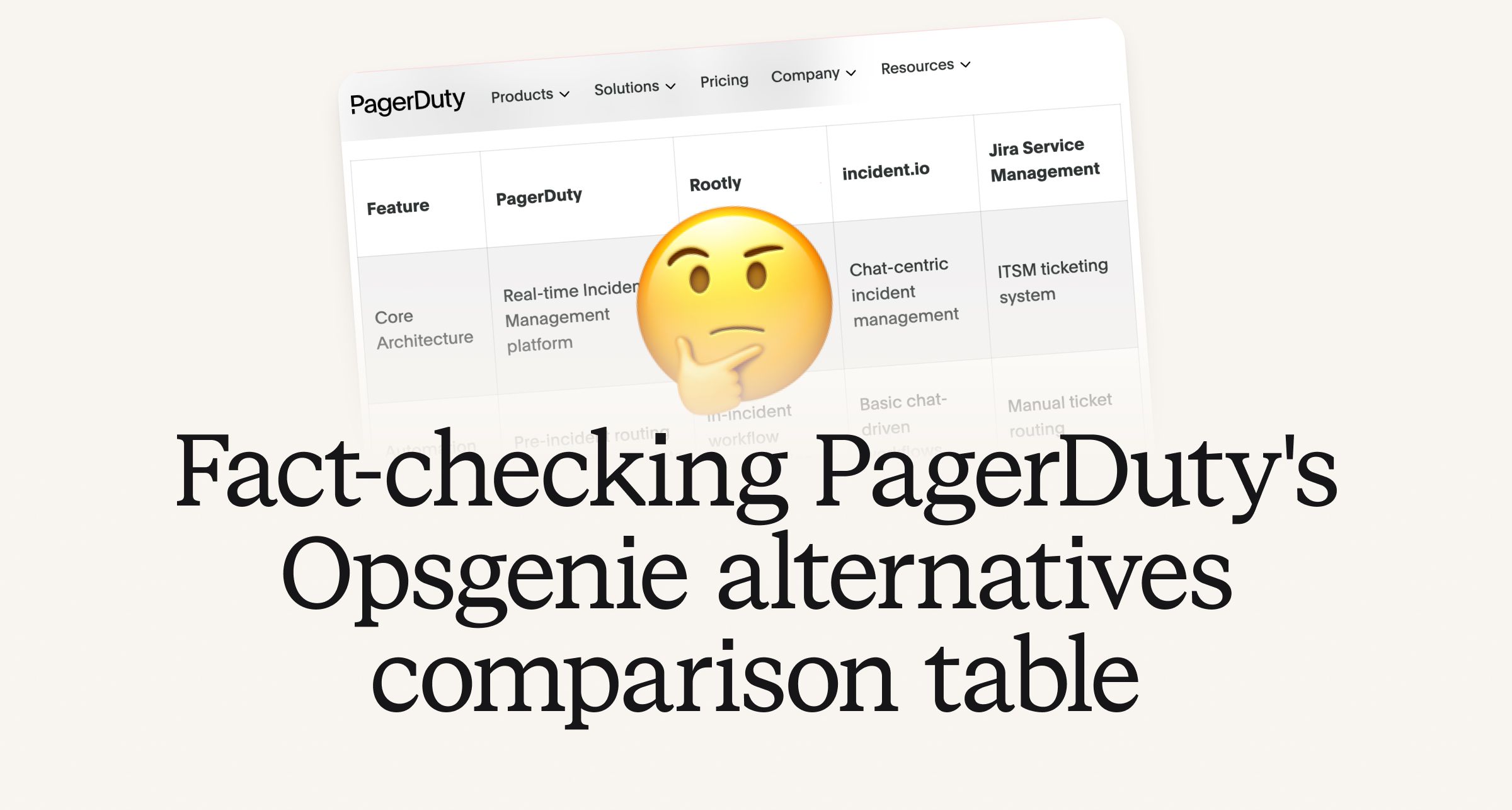
Fact-checking PagerDuty's Opsgenie alternatives comparison table
PagerDuty published a new comparison table about incident.io. Once again, it describes a product we don't recognize. So once again, we're correcting the record, row by row, with receipts.

July 28, 2026
Your genie is vanishing: introducing the Opsgenie rescue program
Today, we're launching the Opsgenie Rescue Program to make that landing soft: simplified migration and free overlap so you never pay two vendors at once.
July 9, 2026
So good, you’ll break things on purpose
Ready for modern incident management? Book a call with one of our experts today.
We’d love to talk to you about
- All-in-one incident management
- Our unmatched speed of deployment
- Why we’re loved by users and easily adopted
- How we work for the whole organization