Join live: What happens when your AI goes down?
Building a fair on-call rotation across European and North American timezones
August 25, 2026 — 29 min read
TL;DR: A fair cross-timezone on-call rotation between Europe/Middle East/Africa (EMEA) and North America requires a dual-metric model that balances shift counts with subjective costs like sleep disruption and weekend coverage. Manual wiki handoffs and tool-switching add 10-15 minutes of coordination overhead before anyone touches the actual problem. Anchor every schedule in UTC, automate handoffs inside Slack with incident.io's on-call scheduling, and treat follow-the-sun as a coverage model for high alert volume, not a permanent fix for noisy infrastructure.
Picture a typical night on a two-region rotation: an EMEA engineer wakes overnight to debug a database lock triggered by a US-centric late-afternoon deploy. The fix takes hours. Post-mortem reconstruction adds more time because context lives across three Slack threads, a PagerDuty timeline, and a half-remembered Zoom call. The engineer logs on the next morning on a fraction of a normal night's sleep, while the US team that shipped the deploy slept through the night and is already planning the next release. Equal hours on the calendar does not mean equal burden, and your rotation is not fair if one region absorbs every post-deploy fire.
Designing a cross-timezone on-call rotation between Europe and North America requires more than splitting a calendar. To prevent burnout and retain senior talent, engineering teams must implement a dual-metric fairness model, automate handoffs to eliminate the coordination tax, and use Slack-native tooling to keep context intact across borders.
Building fair schedules across timezones
Two distinct dimensions drive whether a rotation is genuinely fair or merely balanced on paper.
How to solve the timezone-bias productivity gap
True fairness is a dual-metric problem, not a single-metric one.
Mathematical fairness covers what you can measure directly: shift count per engineer per month, total hours on-call weighted by timezone, page frequency per shift, and Mean Time to Acknowledge (MTTA). For high-urgency incidents, a commonly recommended MTTA target is under 5 minutes.
Subjective fairness covers the costs that don't appear in a spreadsheet: sleep disruption from overnight pages, weekend and holiday frequency, and the cognitive overhead of passing context between regions.
The coordination tax connects these two metrics. It is the accumulated friction of cross-timezone handoffs when context transfer happens asynchronously across multiple disconnected tools. incident.io's own research into on-call practices shows the importance of understanding on-call burden patterns.
How to avoid regional coverage bias
Regional bias often follows a repeatable pattern: US teams may deploy late in their afternoon, which can land in EMEA's sleep hours. If the rotation is not designed around deploy windows, EMEA engineers can absorb the post-deploy instability fallout.
Two strategies eliminate this directly:
- Deploy window alignment: Consider a deploy freeze that prevents changes during EMEA sleep hours. Any change late in the US day requires an active US on-call engineer to hold coverage through the stability window.
- Active shift ownership: Assign deploy accountability to whichever regional team is currently on-call. EMEA owns the stability of any deploy during their active shift. US owns theirs. Accountability follows the schedule.
How to break the burnout-attrition cycle in SRE
Burnout in on-call rotations follows a predictable escalation path: too many night pages leads to chronic sleep debt, which leads to slower incident response, which leads to more night pages. Industry best practices recommend that SREs spend no more than 50% of their time on operational work (toil), and cap on-call incident load at a reasonable threshold. When your team consistently exceeds sustainable levels, prioritize reliability improvements until volume drops.
Recovery policies make the difference between a team that manages this cycle and one that breaks under it:
- Time-in-lieu: Many teams grant paid recovery time for paged hours during unsociable times or weekends, typically taken within two weeks.
- Delayed start: An engineer paged overnight often receives a delayed start the next day. This should be policy, not negotiation.
- No-deploy windows: Restricting production changes during weekends or recognized holidays reduces engineer-caused incidents in unsociable hours.
Structuring global on-call coverage
The following approaches cover the core scheduling structures, shift models, and tooling configurations that distributed engineering teams use to maintain reliable cross-timezone coverage.
Implementing true follow the sun
A classic two-region follow-the-sun (FTS) model splits coverage into two active windows with an automated night routing window handling alerts outside both regions' business hours.
Here is a standard EMEA-US shift structure using UTC as the anchor:
EMEA Active:     08:00 UTC – 16:30 UTC  (example: 09:00-17:30 London / BST)
Handoff Window:  16:00 UTC – 16:30 UTC  (30-minute synchronous overlap)
US Active:       16:30 UTC – 00:30 UTC  (example: 11:30-19:30 US Eastern)
Night Routing:   00:30 UTC – 08:00 UTC  (automated escalation to backup)
Consider a 5-minute escalation threshold within each active window. If the primary responder does not acknowledge within 5 minutes, escalate to the secondary tier. Cap your escalation policy at three tiers. Beyond three, you add decision latency without improving coverage, according to escalation policy best practices.
Scheduling cross-timezone coverage
Cross-timezone on-call scheduling works when handoff windows include deliberate overlap time for synchronous briefing, not a baton-pass at a fixed clock time. A 15-to-30-minute overlap at each boundary can give the outgoing engineer time to brief the incoming one on active incidents, recent deploys, and flapping metrics that have not yet triggered a page.
Sync on-call schedules to Google Calendar so each engineer sees shifts in their local calendar without manually converting UTC. Syncing schedules with Slack user groups means the right people are automatically notified at every shift change rather than relying on engineers to check a shared document.
Balancing timezones with split-week rotations
A full-week rotation assigns one engineer the entire week, including the weekend. If you alternate EMEA and US engineers on full weeks, weekend burden distributes unevenly across calendar months because the number of Saturdays and Sundays per cycle does not always align.
A split-week rotation solves this directly:
- Monday to Thursday shift: EMEA engineer carries primary, US carries secondary backup.
- Friday to Sunday shift: US engineer carries primary, EMEA carries secondary backup.
This ensures the US team absorbs the Friday night and weekend surge while EMEA takes the Monday morning European business hour window. incident.io supports overrides and schedule changes to accommodate shifts in team availability.
Choosing the right team size model
| Dimension | Follow-the-Sun (FTS) | Primary/Secondary |
|---|---|---|
| Shift structure | Regional handoffs during business hours | 24/7 weekly shifts with local backup |
| Best for | Globally distributed teams (EMEA + US) | Single-region or concentrated teams |
| Coordination tax | Higher (requires daily handoffs) | Lower (fewer handoffs per week) |
| Burnout risk | Lower (reduces regular night pages) | Moderate (primary carries initial page, backup escalates automatically) |
Key insight: Informal, ad-hoc on-call scheduling systems often fail as engineering organizations scale. The coordination tax of manual swaps and untracked overrides leads to coverage gaps and SRE burnout.
When the schedule lives in a shared Google Sheet, nobody checks it during an overnight incident. Everyone waits for someone else to respond, and you lose 10-15 minutes before anyone acts. Automated scheduling tools help eliminate the gap-filling that manual schedules miss.
Auditing on-call fairness by region
Auditing fairness requires tracking specific metrics across three dimensions: time of day, day of week, and shift window performance.
Standardizing night coverage metrics
Start by defining "unsociable hours" in local time for each region. A common approach is overnight hours in the engineer's local timezone (typically around 22:00 to 06:00, though this varies by organization). Once defined, weight incidents by time of day as a recommended framework:
- Standard hours: 1x weight.
- Unsociable hours (overnight local time): Consider 2-3x weight.
- Weekend pages: Consider 1.5-2x additional multiplier.
- Holiday pages: Consider 2x additional multiplier. Apply these weights to your incident timestamp data per engineer, sum the weighted burden per month, and compare across the rotation. A variance of less than 20% between the highest- and lowest-burden engineers is a reasonable target, though specific thresholds should be tailored to your organization. Higher variance signals structural bias that requires a schedule adjustment.
Solving weekend timezone coverage gaps
The Friday night window and the Sunday night window are where follow-the-sun schedules often experience coverage challenges. The US active window ends around 00:30 UTC, and the EMEA window does not start until 08:00 UTC, leaving an overnight window where your night routing automation must carry the load.
Simulate a P1 alert at 03:00 UTC and verify that escalation reaches a live responder within 5 minutes. If your on-call schedules have coverage gaps, failures in that night window appear as silent failures.
Quantifying on-call sleep disruption
Track consecutive night pages per engineer, not just total night pages per month. An engineer paged three nights in a row is in a categorically different state than one paged three nights spread across four weeks. Set a threshold, for example two consecutive nights with pages, where the engineer is automatically swapped out of the primary rotation for 48 hours regardless of schedule.
When your EMEA on-call carries 12 night pages in a month and your US on-call carries 4, that is a 3-to-1 disparity. At meaningful productivity loss per night page, you are asking EMEA to absorb 3× more unrecoverable time than US. That gap compounds across quarters.
Analyzing quarterly on-call balance
Run a fairness audit every quarter by pulling three data points per engineer:
- Weighted burden score: shift count, night pages, weekend pages, and holiday pages combined.
- MTTR by shift window: persistent MTTR gaps between EMEA and US windows signal context loss at handoff or insufficient staffing.
- Self-reported burnout rating: a simple 1-5 monthly survey surfaces trends before they become resignations.
Compare across both regions and adjust the rotation before the next quarter begins. If EMEA has grown from 3 to 5 engineers since the rotation was designed, on-call frequency for EMEA engineers has already changed, even if the schedule document has not.
Handling DST in on-call schedules
Daylight Saving Time creates predictable, calendar-fixed windows of schedule drift that require deliberate handling before they become coverage gaps.
Understanding EMEA and North America DST misalignment
Twice a year, EMEA and North America transition to and from Daylight Saving Time on different dates, creating a window where your shift boundaries shift by one hour without anyone updating the schedule.
In 2026, DST transition dates are:
- US: begins March 8, 2026 at 02:00 AM local, ends November 1, 2026 at 02:00 AM local.
- Europe/UK: begins March 29, 2026 at 01:00 AM UTC, ends October 25, 2026 at 01:00 AM UTC.
This creates two misalignment windows each year:
- March 8-29 (approximately 3 weeks): The US has shifted but Europe has not. Your EMEA-US handoff boundary drifts by one hour relative to what both teams expect.
- October 25 to November 1 (approximately 1 week): Europe has reverted but the US has not. The same drift happens in the opposite direction.
Fixing three-week coverage gaps
During the March DST misalignment window, when the US has shifted to daylight time but Europe hasn't yet, a handoff hard-coded to a clock time rather than UTC means the EMEA engineer starts their briefing an hour before the US engineer expects it. Three steps prevent this from creating coverage gaps:
- Build schedules in UTC: Set each on-call schedule's timezone to UTC when you create it. incident.io on-call schedules carry their own timezone setting, separate from any org-wide default, and the schedule's timezone can't be changed after creation, so get this right upfront rather than fixing it later.
- Display local time at notification: Engineers see their own timezone. The schedule runs on UTC.
- Set a DST review reminder: A calendar reminder on March 8 and October 25 each year prompts a manual check that UTC anchoring is still correct.
Adjusting schedules for DST shifts
Store all timestamps in UTC and convert to local time at display, not the reverse. If your tool stores shifts in local time and converts to UTC, any DST transition can corrupt the stored shift boundary.
incident.io lets you set a schedule's timezone once, at creation, and renders shift times in each engineer's local view from there. Because the schedule's timezone locks after creation rather than being a display toggle you can flip later, anchoring in UTC from day one avoids a costly rebuild down the line.
Managing PTO and holidays across timezones
Holiday calendars and PTO windows create asymmetric gaps that require advance coordination rather than reactive coverage fixes.
Cross-region holiday coverage
EMEA and US teams observe different holidays. US Thanksgiving typically falls in late November when UK engineers are working normally. UK Boxing Day falls December 26 when US engineers are often back from Christmas. Treat asymmetric holidays as swap opportunities rather than coverage gaps.
An agreed trade pattern: EMEA covers US Thanksgiving in exchange for US covering UK Boxing Day. Document these trades in the schedule before the quarter begins, not two days before the holiday. incident.io's on-call schedules let you view holidays in the schedule view so gaps are visible during planning, not after a coverage failure.
Required notice for on-call swaps
Establish clear notice requirements for on-call swaps and holiday coverage changes. Swaps with short notice need manager approval, not peer approval, to ensure accountability.
Log every swap in your scheduling tool rather than in Slack messages. If swaps exist only in chat history, your fairness metrics become inaccurate. incident.io lets you build a Slack notification workflow for schedule changes that posts to a chosen channel whenever a swap is recorded, creating a visible audit trail without relying on someone remembering to announce it.
Failover strategies for PTO gaps
Build a three-tier escalation path for any shift where the primary is on PTO:
- Tier 1: Designated secondary (explicitly assigned in the schedule override, not a general backup pool).
- Tier 2: On-call manager or incident commander.
- Tier 3: Cross-region primary (EMEA covers US gaps and vice versa).
Test this path with a fire drill during a low-traffic period before the PTO window begins. A failover path that has never been tested will fail at the worst possible moment.
Meeting infrastructure requirements for follow-the-sun
Running a distributed on-call rotation reliably depends on the right tooling foundations and handoff discipline.
Setting scheduling criteria for distributed teams
A scheduling tool for distributed on-call should satisfy key requirements:
- UTC source of truth: All shift definitions stored in UTC, local time rendered at display.
- Multi-timezone display: Each engineer sees their own local time, not the schedule's home timezone.
- Override flexibility: Single-shift overrides without rebuilding the full rotation.
- Local calendar sync: iCal or Google Calendar feeds so shifts appear in engineers' personal calendars automatically.
- DST-aware rendering: Automatic local time adjustment during DST without corrupting UTC shift boundaries.
Automating handoffs for distributed teams
The single highest-leverage fix is a structured, written handoff that replaces verbal briefings. This template eliminates reconstruction time during the overlap window:
### Active shift handoff
- Current system status: [Green / Yellow / Red]
- Active incidents:
  - #inc-123: Database CPU spike (Lead: @user, Status: Monitoring)
- Recent deploys/changes:
  - Service-A v2.1.4 deployed at 15:30 UTC (no observed anomalies)
- Outstanding alerts/flapping metrics:
  - `service.auth.latency` spiked twice during the shift. No page triggered.
- Key context for next shift:
  - Keep an eye on the replica lag on DB-02; it peaked during the US West Coast morning rush.
Post this template to a dedicated #on-call-handoff Slack channel at the end of every shift. The outgoing engineer fills it in, the incoming engineer reads it, and the coordination tax drops from a significant manual reconstruction effort to minutes.
Measuring fairness across timezones
Three metrics prove to leadership that your rotation is healthy:
- Weighted burden variance: Target reasonable difference in weighted burden scores across engineers.
- MTTR by shift window: Persistent MTTR gaps between EMEA and US windows signal context loss at handoff or understaffing.
- Page volume per shift window: If night routing pages account for more than roughly a third of total monthly pages, your alert noise problem is larger than your scheduling problem, and follow-the-sun will not fix it. Run these metrics from your incident management dashboard and bring them to your quarterly fairness review as a clean export, not a manual spreadsheet.
Consider a team split between Israel and Costa Rica: it surfaces every variable a scheduling tool can break on, different public holidays, a Friday–Saturday weekend versus Saturday–Sunday, and non-overlapping core hours. incident.io's holiday view surfaces upcoming bank holidays and time-off overlaps directly on the schedule, so you can arrange cover in advance instead of discovering the gap during the incident. Engineers can also add personal calendar feeds directly into their schedules, so regional holidays that fall outside standard bank holiday lists are visible during planning, not discovered the morning someone fails to respond.
incident.io's Pro plan on-call scheduling routes alerts directly in Slack based on the active timezone schedule, so the right engineer is paged without anyone manually checking who's on shift. The alert, the incident channel, the escalation path, and the service context all surface in the same place where the engineer is already working.
Implementing cross-timezone scheduling
Rolling out a new cross-timezone rotation requires a staged approach, starting with a controlled pilot before expanding across your full service catalog.
Building support for distributed on-call
Follow-the-sun distributes on-call burden equitably. It does not reduce alert volume. If your team runs 120 pages per month split evenly across two regions, each region now handles 60 pages instead of 120. But the infrastructure still generates 120 pages. FTS is an organizational patch for high alert volume, not a replacement for proactive reliability work.
The correct model uses FTS to cover the human availability problem (people need to sleep) while reliability engineering attacks the alert noise problem. When page volume is consistently high, address reliability improvements to reduce noise. This backpressure mechanism prevents FTS from becoming an excuse to tolerate noisy infrastructure indefinitely.
incident.io's Investigations product automates up to 80% of incident response by analyzing telemetry, code changes, and past incidents to surface root causes, which reduces cognitive load and accelerates the work of eliminating noisy alerts at their source.
Piloting with a single service
Run a pilot on a single non-critical service before rolling the new rotation across your stack. The pilot validates three things: handoff templates are being completed consistently, the UTC anchoring survives the overnight window without manual intervention, and MTTR in the pilot service holds steady or improves versus the previous baseline.
If the pilot shows MTTR degradation, the cause is almost always context loss at handoff, not insufficient staffing. Iterate on the handoff template before expanding the rotation.
Optimizing shifts via performance logs
Use your incident timeline data to identify systematic patterns. If MTTR spikes consistently in the first 30 minutes of the EMEA shift, the incoming engineer is losing context from the handoff. If MTTR spikes in the last 30 minutes of the US shift, the outgoing engineer is distracted by the upcoming handoff rather than the current incident. Both patterns have structural fixes.
The data tells you which problem you are solving. Fin reduced cognitive overhead by migrating from PagerDuty to incident.io, centralizing context that previously required manual aggregation across multiple separate tools.
Addressing timezone coverage gaps
Uneven team sizes and non-uniform alert volume are the two most common causes of coverage gaps once a rotation is live.
Managing on-call loads by team capacity
If one region has significantly more engineers (6 SREs in the US versus 3 in EMEA), a simple alternating rotation doubles EMEA on-call frequency, defeating the fairness model. Two approaches balance this:
- Weighted rotation: US engineers rotate 1 week per 6-week cycle. EMEA engineers rotate 1 week per 3-week cycle. Track the weighted burden score, not shift count alone, to ensure higher frequency is compensated appropriately.
- Shared night shift model: The US team carries EMEA nighttime backup for the automated routing window, distributing overnight burden across the larger team rather than leaving it with EMEA's smaller group.
Some engineering organizations operate under formal contractual constraints that govern on-call scheduling directly: maximum on-call frequency by level (such as no more than once every four weeks for engineers below a defined seniority threshold), and mandatory seniority-based assignment ordering.
Each region typically needs 3-5 engineers to run a sustainable follow-the-sun rotation, with a total team size of 9-15 engineers across all locations combined, as smaller teams face challenges managing concurrent PTO gaps. If EMEA cannot reach this threshold, scope the follow-the-sun model to US-primary with EMEA as secondary backup until hiring catches up.
Addressing timezone-specific alert volume
Alert volume is not uniform across the day. Map your alert volume by hour of day across three months and compare against your shift boundaries. If more than roughly 30% of your alerts fire during the night routing window, that window needs a dedicated on-call tier.
incident.io's Datadog integration connects directly: when a Datadog monitor fires, incident.io can auto-create a Slack channel, page the correct on-call engineer based on your schedule, and start capturing the timeline automatically, without routing the alert through a separate paging tool first.
Pricing night shifts for on-call teams
Compensation for out-of-hours on-call work varies by contract and jurisdiction, but the structural model is consistent: a flat retainer for being available during the shift, plus per-incident compensation for any pages that fire. incident.io's Pro plan includes a compensation calculator within the on-call scheduling module, so you can model the cost of a new rotation structure before presenting it to finance.
Reassessing fairness metrics quarterly
Fairness is not a configuration you set once. Teams grow unevenly, alert volumes shift with product launches, and engineers move between regions. A quarterly fairness review that runs the weighted burden audit, checks MTTR by shift window, and surveys self-reported burnout takes less than two hours and catches structural drift before it becomes a resignation.
Build the review into your quarterly incident retrospective so it happens automatically, not only when someone complains. If your rotation generates 3 AM pages for EMEA engineers more than twice a month, that is the clearest signal the rotation needs redesign, not a policy document about recovery time. Fairness in a cross-timezone rotation isn't a schedule you set once and forget. It's the dual-metric discipline of shift counts plus subjective burden, checked every quarter, that keeps equal hours on the calendar from quietly becoming unequal burden in practice.
Choosing a scheduling tool
PagerDuty's alert routing is mature and battle-tested, and incident.io integrates with it so you keep that reliability while adding Slack-native coordination that eliminates post-alert tool-switching. Where PagerDuty pages the engineer, incident.io auto-creates the channel, surfaces service context, and captures the timeline, all in Slack. incident.io's Pro plan costs $45/user/month with on-call ($25 base plus $20 on-call add-on). PagerDuty's Business tier costs $41/user/month billed annually ($49/user/month monthly) before AI add-ons, which start at $415/month for generative AI features.
Opsgenie reached end of sale on June 4, 2025 and support ends April 5, 2027. incident.io gives Opsgenie teams a migration path that adds unified incident coordination, status pages, and post-mortem generation, not just a like-for-like paging replacement.
Book a demo of incident.io to see how on-call scheduling and Slack-native routing work together to build a rotation your team can sustain.
Key terms
Coordination tax: The accumulated time and cognitive overhead from passing incident context between tools and teams when using manual wikis and chat history rather than structured handoff templates.
Dual-metric fairness: An on-call fairness model that combines mathematical fairness (equal shift counts and hours) with subjective fairness (weighted night pages, weekend frequency, and holiday burden).
Follow-the-sun (FTS): A scheduling model where on-call coverage rotates between geographically distributed teams across sequential time windows, so each region carries primary coverage during its business hours rather than 24/7.
MTTA (Mean Time to Acknowledge): Defined as the average time between an alert firing and the on-call engineer acknowledging it. A commonly recommended target for high-urgency (P1) incidents is under 5 minutes.
MTTR (Mean Time to Resolution): The average time from incident detection to full resolution.
Night routing window: The automated escalation tier that handles alerts firing outside both active regional shift windows, typically 00:30-08:00 UTC in a two-region EMEA-US model.
Recovery policy: A documented set of rules that mandate rest time after overnight incident pages, including delayed start times, time-in-lieu for paged hours, and no-deploy windows following significant overnight incidents.
Toil: Defined as repetitive, manual operational work that does not produce lasting value. Industry best practices recommend keeping toil below 50% of an SRE's time.
UTC source of truth: The practice of storing all on-call shift definitions in Coordinated Universal Time (UTC) and rendering local time only at display, ensuring DST transitions do not corrupt shift boundaries.
Weighted burden score: A per-engineer metric that multiplies raw incident count by time-of-day, weekend, and holiday factors to produce a comparable measure of true on-call burden across a rotation.
FAQs

Tom Wentworth
Chief Marketing Officer
See related articles
Introducing Investigations, powered by Nexus.
Today we're launching Investigations: agentic root cause analysis that starts the moment you're paged, figures out what broke and why, and works with your team through to resolution. Here's what we built, what's powering it, and why it took some time to get right.

August 5, 2026
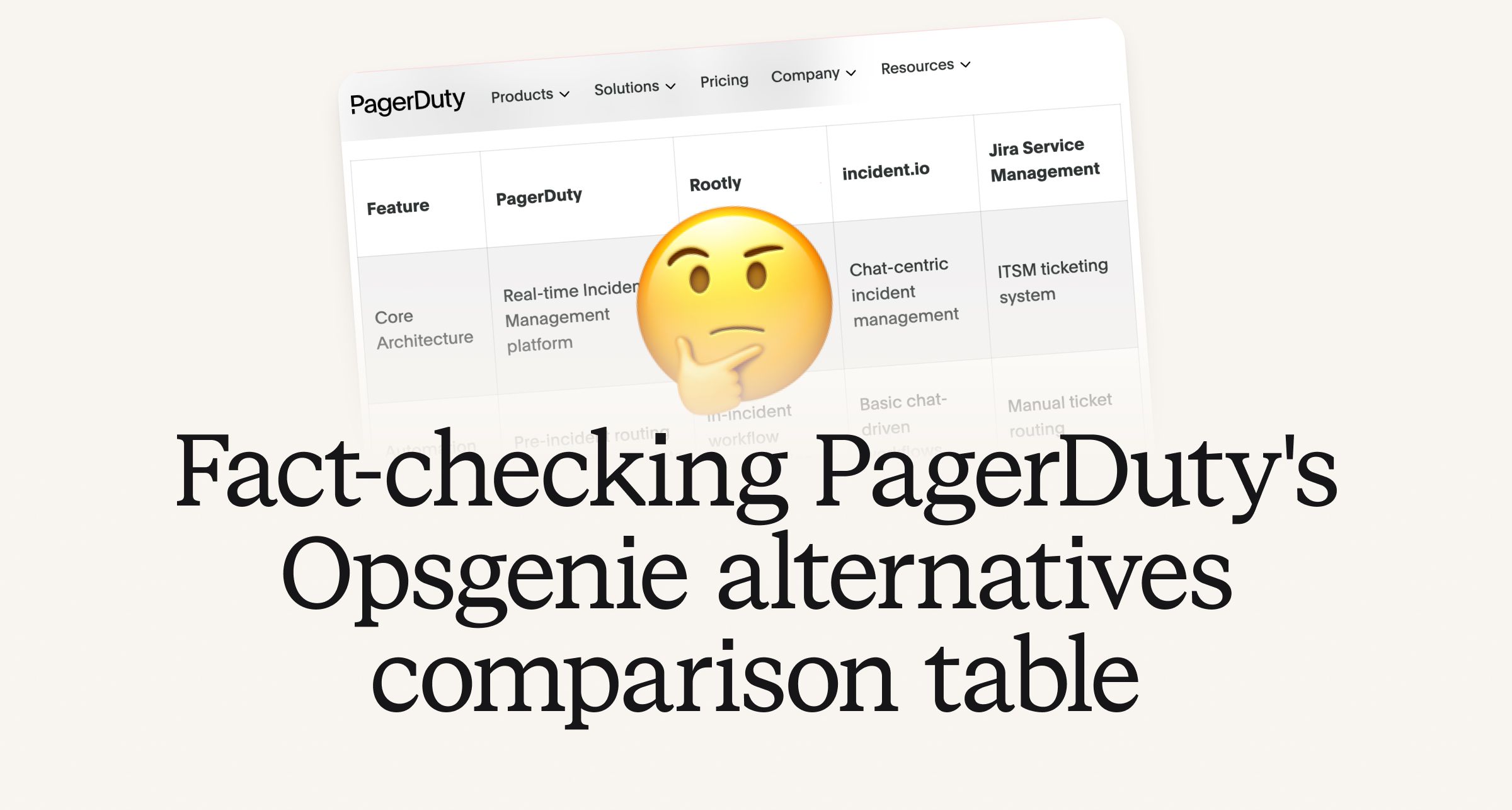
Fact-checking PagerDuty's Opsgenie alternatives comparison table
PagerDuty published a new comparison table about incident.io. Once again, it describes a product we don't recognize. So once again, we're correcting the record, row by row, with receipts.

July 28, 2026
Your genie is vanishing: introducing the Opsgenie rescue program
Today, we're launching the Opsgenie Rescue Program to make that landing soft: simplified migration and free overlap so you never pay two vendors at once.
July 9, 2026
So good, you’ll break things on purpose
Ready for modern incident management? Book a call with one of our experts today.
We’d love to talk to you about
- All-in-one incident management
- Our unmatched speed of deployment
- Why we’re loved by users and easily adopted
- How we work for the whole organization