Join live: What happens when your AI goes down?
How to set up a Datadog on-call schedule that won't burn out your team
August 5, 2026 — 19 min read
TL;DR: A sustainable Datadog on-call schedule requires technically sound routing and human-centric guardrails. Keep rotations at a minimum of eight engineers to cap on-call frequency at roughly once per month, align every handoff to regional business hours, and automate escalation paths so a missed acknowledgment never means a missed alert. If you're migrating off Opsgenie ahead of the April 2027 sunset, run a 14-30 day parallel period before cutting over. Moving coordination work into Slack eliminates the 3 AM context-switching tax that web-first tools impose.
On-call schedules often prioritize maximum system coverage over engineer cognitive load, which can lead to alert fatigue, missed pages, and eventually attrition.
With Atlassian sunsetting Opsgenie in April 2027, platform leads are under real deadline pressure to rebuild their on-call rotations, not just copy and paste old schedules into another complex web UI. This guide walks through configuring a sustainable Datadog on-call schedule, from shift lengths to follow-the-sun modeling, with a validation checklist you can run before your first production alert fires. It also shows where a Slack-native workflow closes the coordination gaps that web-first tools leave open.
Designing on-call schedules for team health
Configuring a schedule is a technical task. Designing one that keeps engineers productive, alert, and not quietly job-searching is the actual work.
The real cost of poorly configured rotations
Every incident has two clocks running: the technical clock (time to diagnose and fix) and the coordination clock (time to assemble the right people and tools). The coordination clock is where bad schedules hurt you.
Switching between Slack, Datadog's web console, and Jira to manage a single alert can burn 10-15 minutes before anyone touches the actual problem. Across 15 monthly incidents, that's potentially 150-225 minutes of pure overhead every month, per team. At a $150 loaded hourly cost per engineer, that's approximately $375-562 monthly spent entirely on coordination, not resolution.
The incident.io research on on-call culture surfaces a consistent pattern: disrupted personal life (30%) and a lack of incident context (24%) are the top-cited frustrations, with lack of sleep (12%) and false alerts (10%) close behind.
Common mistakes that lead to burnout
A common configuration mistake is running understaffed rotations. A rotation of 4-5 engineers sounds manageable at first glance, but once you factor in holidays, sick leave, and the reality that consecutive on-call shifts after a major outage destroy morale, the math breaks down fast. Google's SRE Book sets the target at no more than 50% of an SRE's time on operational work (toil), with at least 50% reserved for project work. That ratio directly informs rotation size.
Google's SRE Book puts the minimum at eight engineers for a primary-plus-secondary rotation running week-long shifts, keeping each person on-call roughly once per month. Rotations below eight create burnout. Teams that scale toward 10 engineers per rotation report even better sustainability because a single absence no longer stresses the entire schedule.
Choosing the right shift length for your team
Shift length controls how much context an engineer carries into their rotation and how much pain they absorb if a major outage hits on their watch.
Comparing one-week and two-week rotations
Engineering teams widely use one-week rotations for good reasons: they keep context fresh, limit the blast radius of a bad week, and make it psychologically easier to commit to being fully available. A major P0 event can still impact the week for whoever is on-call, but the damage is bounded.
Two-week rotations can work for teams with low alert volumes and stable, well-documented services, where the first few days of each shift are genuinely productive. For teams with high-velocity codebases and frequent deploys, two weeks can feel like a long time to be primary on-call, and this discussion on improving on-call processes covers similar tradeoffs.
Choosing daily shifts
Daily rotations can make sense for two specific scenarios: very high-volume services where a single engineer handling a full week of alert volume would be unsustainable, and incident commander roles that rotate separately from primary technical responders. Daily shifts require strict handoff discipline because dropped context between days compounds quickly.
Balancing coverage and cognitive load
The framework for choosing:
- Low alert volume (roughly 0-5 actionable alerts per week): One-week rotations, 8+ engineers, single primary layer.
- Medium volume (roughly 5-15 alerts per week): One-week rotations with a dedicated secondary backup layer, 8+ engineers per layer.
- High volume (roughly 15+ alerts per week): Daily primary rotations or dedicated on-call SREs for the highest-volume services, combined with aggressive alert tuning to push volume down. Google's SRE Book sets the target at no more than 2 actionable incidents per 12-hour on-call shift as a sustainable baseline. If your primary on-call is handling 10+ alerts per shift, the schedule isn't your problem, the alert noise is.
Setting handoff times that work across time zones
A handoff in the middle of the night disrupts both the outgoing and incoming engineer. The outgoing engineer is asleep, the incoming engineer is half-awake, and any lingering issue from the previous shift falls through the gap.
Avoiding middle-of-the-night handoffs
Research on night shift cognitive performance is consistent: fatigue slows reaction time, increases error rates, and degrades the executive function required for incident diagnosis. The fix is structural, not motivational: schedule every handoff during normal business hours for the incoming engineer's time zone. A morning handoff during the incoming engineer's local business hours leaves the incoming engineer alert and rested, gives the outgoing engineer time to walk through open alerts and active silences, and makes coverage changes visible to both parties.
Coordinating with distributed teams
Multi-timezone handoffs require explicit overlap windows, not just aligned clocks. If your EMEA team hands off to the Americas at the end of the EMEA business day, build a shared window where both engineers are active and the outgoing engineer walks through:
- Open alerts and their current status.
- Active silences and when they expire.
- Recent deploys in the last 24 hours and any associated risk.
- Any known flaky services or monitors to watch.
You can sync on-call schedules with Slack user groups so incident.io automatically adds the incoming engineer to relevant Slack groups when their shift starts.
Building in handoff rituals
The warm handoff is the difference between a rotation that works and one that leaks context. Beyond the verbal or async briefing, the tooling must capture what the outgoing engineer knows. Automatic timeline capture eliminates reconstruction work: instead of scrolling back through Slack, the incoming engineer reads a structured summary of the shift's incidents, actions taken, and open threads.
incident.io captures every status update, role assignment, and decision automatically throughout an incident, so the handoff briefing draws from complete captured context before the outgoing engineer types a word. You can assign on-call roles from schedules to incident roles directly, so the right context follows the right person automatically.
Configuring override rules and backup escalations
Schedules break when life happens. An engineer gets sick. Someone books a vacation before you publish the schedule. Conflicts arise with no notice. The question isn't whether overrides will happen, it's whether your tooling makes them easy or painful.
Swapping shifts
Web-based override UIs are notoriously confusing.
incident.io takes a Slack-native approach: with /inc cover me, engineers can request shift coverage directly from Slack without leaving chat. The overrides and schedules help doc covers the full flow. You can also set up Slack notifications for on-call schedule changes so every affected engineer gets notified the moment a swap is confirmed.
Setting up automatic escalation paths
An escalation policy answers the question: "What happens if the primary on-call doesn't acknowledge within 5 minutes?" Configure it to route automatically, not to require a manager's manual intervention.
A common structure for a P1 alert:
- Step 1: Page the primary on-call. Allow 5 minutes for acknowledgment.
- Step 2: If unacknowledged, page the secondary backup. Allow 5 minutes.
- Step 3: If still unacknowledged, page the on-call manager or engineering lead.
For P0 events (production down, revenue impacted), consider compressing the acknowledgment interval at each step. Every unacknowledged minute during a P0 is a minute your status page is silent and your customers are noticing.
incident.io's reassign escalations feature lets you dynamically reassign mid-incident, so the escalation path adjusts to reality without anyone touching the web UI.
Preventing single points of failure
The most reliable way to version-control your escalation paths and prevent configuration drift is Infrastructure as Code. Managing this in code means schedule changes go through pull request review. A practical hybrid: define the skeleton (shift type, handoff time, escalation structure) in Terraform, and let team leads manage individual rotation assignments in the UI.
Modeling a follow-the-sun rotation
A follow-the-sun model eliminates night shifts by ensuring every engineer is on-call only during their local daytime hours. If your team spans Europe, the Middle East, and Africa (EMEA), the Americas, and Asia-Pacific (APAC), it's the single highest-leverage structural change you can make to on-call health.
Mapping shifts to regional working hours
The prerequisite for follow-the-sun is enough engineers per regional node to maintain coverage. Build each shift to run from approximately 9:00 AM to 5:00 PM local time, with overlap time at each handoff boundary where possible.
Each region can maintain its own schedule in its own timezone.
Coordinating EMEA, Americas, and APAC coverage
In a follow-the-sun model, shifts hand off in sequence as each region's workday ends and the next region's begins. The three handoff transitions are:
- APAC to EMEA: APAC's shift ends well before EMEA's morning begins, so there is no simultaneous overlap between these two windows. The handoff relies on an async briefing document completed before the APAC team signs off.
- EMEA to Americas: EMEA's shift end and the Americas' morning start meet exactly at the boundary, making this the cleanest handoff to coordinate live, even without a true overlap window.
- Americas to APAC: APAC's next shift begins while the Americas team is still in their afternoon, so a live handoff is possible before the Americas day ends.
Example: 24/7 coverage with three regions
Note that all UTC offsets shift by one hour during daylight saving transitions in each region.
| Region | Local shift | Approx. UTC window | Hands off to |
|---|---|---|---|
| APAC (Sydney, AEST UTC+10) | 9:00 AM - 5:00 PM local | ~23:00 - 07:00 UTC | EMEA (async briefing) |
| EMEA (London, GMT UTC+0 / BST UTC+1) | 9:00 AM - 5:00 PM local | 09:00 - 17:00 UTC (GMT) or 08:00 - 16:00 UTC (BST) | Americas (live overlap) |
| Americas (San Francisco, PST UTC-8 / PDT UTC-7) | 9:00 AM - 5:00 PM local | 17:00 - 01:00 UTC (PST) or 16:00 - 00:00 UTC (PDT) | APAC (live overlap) |
Build a structured async handoff document into the APAC-to-EMEA transition, since the two windows do not overlap. The incident.io on-demand session on building successful on-call teams covers practical approaches to follow-the-sun coordination for distributed SRE organizations.
Validating your schedule before going live
Configuring a schedule and validating it are two different tasks. A schedule that looks correct in the web UI can still have routing gaps, notification misconfigurations, or escalation paths that skip the right person at the worst moment.
Running the pre-launch checklist
Use this 5-step process before activating your schedule against production alerts:
| Step | Phase | Key actions | Completion signal |
|---|---|---|---|
| 1 | Team onboarding | Import users, confirm contact methods (SMS, phone, push) | Every engineer receives and acknowledges a test page via all configured channels |
| 2 | Profile config | Set notification delays, personal escalation paths | Each engineer confirms alerts arrived via all configured channels |
| 3 | Schedule definition | Define rotation shifts, handoff times, timezone alignments | Visual calendar shows correct coverage with no gaps |
| 4 | Escalation mapping | Link schedules to escalation policies, define primary, backup, and manager paths | Test alert escalates correctly through all three tiers |
| 5 | Routing rules | Map alert payloads (Datadog tags, severity levels) to correct escalation policies | P1 test alert routes to primary on-call, P3 test alert routes to lower-urgency path |
The migrating Datadog monitors to incident.io docs walk through redirecting your existing Datadog monitor webhooks to incident.io, using either a Terraform tag swap or the built-in migration tool.
Testing alert routing and escalations
Before your first production shift, trigger test alerts at each severity level and confirm:
- The correct primary on-call receives the page promptly.
- The backup escalation fires if acknowledgment doesn't happen within your configured interval.
- The notification method matches what the engineer configured (phone call vs. push vs. SMS).
- The Slack channel creation triggers correctly for P0 and P1 alerts if you're using automated workflows.
This testing is especially important if you're managing multiple on-call schedules, since misconfigured routing can silently break escalation paths and create coverage gaps.
Running a dry-run week
For new setups: shadow the schedule for a full week before activating it against production alerts. Configure your monitoring to page both the new and existing systems simultaneously. Compare which engineers the system pages, when, and through which channel. Any discrepancy is a configuration gap.
For Opsgenie migrators: the safest parallel-run strategy is:
- Configure incident.io (or Datadog On-Call) completely, including all schedules, escalation policies, and routing rules.
- Route every production alert to both the old Opsgenie setup and the new platform simultaneously for a parallel period (typically 14-30 days).
- Compare acknowledgment times, escalation patterns, and any missed pages between the two systems. After the parallel period with no discrepancies, deprecate Opsgenie.
Getting team sign-off
Every engineer in the rotation must confirm they have configured and tested their notification preferences, they have access to all required systems, and they know how to declare an incident and request overrides before the schedule goes live. incident.io's on-call tooling supports viewing holidays in on-call schedules so engineers can spot upcoming coverage gaps before they become emergencies.
Closing the coordination gap with incident.io
Datadog is a powerful monitoring platform. The core limitation for on-call coordination is architectural: Datadog's schedule definition, publishing, and incident coordination primarily use web-based interfaces. During a P0, navigating to a web console adds cognitive load to an engineer who is already at their limit.
"Super customizable, including automations. The team is constantly innovating and shipping useful new features. Great customer support. It's just a great platform for dealing with incidents - organization, record-keeping, policy enforcement, etc." - Verified user on G2
incident.io integrates directly with Datadog alerts, so you keep Datadog's powerful monitoring and add Slack-native coordination on top. When a Datadog monitor fires, incident.io can auto-create a Slack channel, page the correct on-call engineer based on your schedule, and start capturing the timeline automatically.
For teams on the Pro plan at $45/user/month with on-call ($25 base + $20 on-call add-on), Investigations also analyzes Datadog telemetry, code changes, and past incidents to surface likely root causes, automating up to 80% of incident response. That's the difference between your on-call engineer starting diagnosis with a hypothesis and starting it cold.
The incident.io on-call product vision session covers where on-call coordination is heading, with a specific focus on reducing the alert-to-response friction that web-first tools leave unresolved.
If you're migrating from Opsgenie, download our Opsgenie Migration Guide for a step-by-step parallel-run strategy and cutover timeline designed to hit the April 2027 deadline without disrupting active rotations. If you're configuring Datadog on-call today or evaluating alternatives for your Opsgenie migration, book a demo of incident.io to see a full Datadog alert flow handled entirely in Slack, from monitor trigger to auto-created channel to post-mortem draft.
Key terms glossary
Mean Time To Resolution (MTTR): The average time from the moment an alert fires to full incident resolution, including both coordination overhead and the technical fix.
On-call rotation: A structured schedule distributing 24/7 operational coverage across a group of engineers, with each person taking primary responsibility for a defined shift period.
Escalation path: A configured sequence of backup responders triggered automatically when the primary on-call fails to acknowledge an alert within a defined interval.
Follow-the-sun rotation: A multi-region on-call model where each engineer is on-call only during their local business hours, eliminating night shifts by handing coverage to the next timezone as each region ends its workday.
Investigations: incident.io's product that automates up to 80% of incident response by triaging alerts, analyzing root causes from Datadog telemetry and code changes, and drafting fix PRs directly in Slack.
Slack-native: Software designed to run its primary operational workflow inside Slack using slash commands and interactive UI elements, enabling engineers to respond to incidents without opening a web browser. incident.io also provides full Microsoft Teams support with equivalent functionality.
P0, P1, P2, P3: Severity levels for incidents, where P0 represents the highest severity (production down, revenue impacted) and P3 represents the lowest urgency within the on-call system.
FAQs

Tom Wentworth
Chief Marketing Officer
See related articles
Introducing Investigations, powered by Nexus.
Today we're launching Investigations: agentic root cause analysis that starts the moment you're paged, figures out what broke and why, and works with your team through to resolution. Here's what we built, what's powering it, and why it took some time to get right.

August 5, 2026
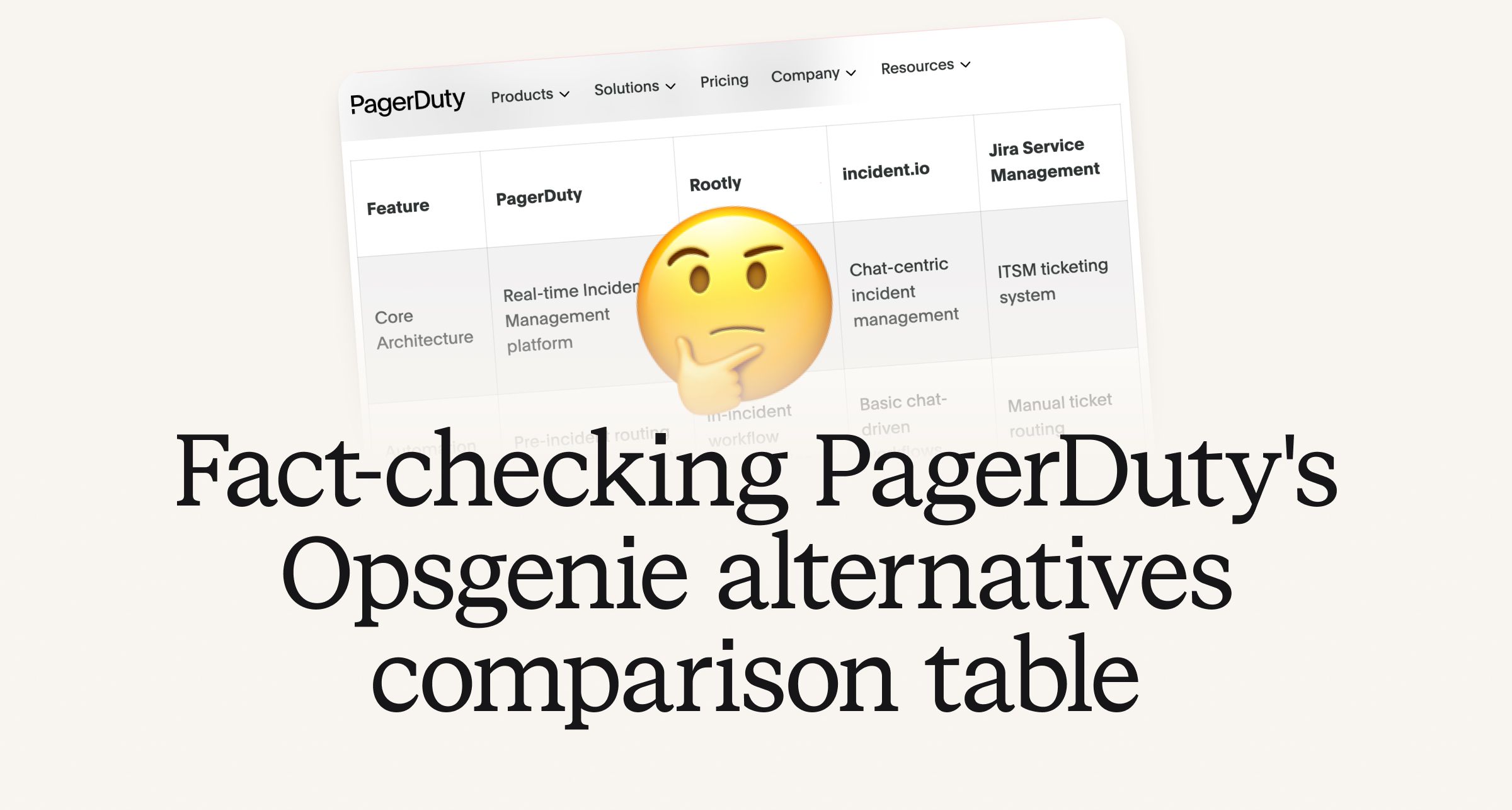
Fact-checking PagerDuty's Opsgenie alternatives comparison table
PagerDuty published a new comparison table about incident.io. Once again, it describes a product we don't recognize. So once again, we're correcting the record, row by row, with receipts.

July 28, 2026
Your genie is vanishing: introducing the Opsgenie rescue program
Today, we're launching the Opsgenie Rescue Program to make that landing soft: simplified migration and free overlap so you never pay two vendors at once.
July 9, 2026
So good, you’ll break things on purpose
Ready for modern incident management? Book a call with one of our experts today.
We’d love to talk to you about
- All-in-one incident management
- Our unmatched speed of deployment
- Why we’re loved by users and easily adopted
- How we work for the whole organization