Join live: What happens when your AI goes down?
Escalation policy anti-patterns: Common mistakes that increase alert fatigue
May 15, 2026 — 25 min read
TL;DR: Poorly designed escalation policies quietly drive alert fatigue and increase MTTR. Common anti-patterns include overly deep escalation chains, premature paging, lack of time-zone awareness, paging entire teams instead of named owners, and stale routing tied to outdated org structures. These issues compound as systems and teams scale, leading to slow acknowledgments, missed ownership, and unnecessary incidents. Audit your policy regularly, keep escalation paths to 3–4 levels with clear ownership, enforce sustained-breach alerting, and ensure routing reflects current service ownership and on-call schedules.
Your escalation policy looked fine when you wrote it 18 months ago. Your team was half its current size, you owned three services instead of thirty, and the on-call rotation covered six engineers in two time zones. Now it's 2:47 AM, production is down, and the policy is paging a developer who left the company two months ago.
Escalation policies are living systems, not static documents. They decay the moment your team changes, your service catalog grows, or your monitoring thresholds drift. The result is alert fatigue, missed pages, and MTTR numbers trending in the wrong direction — exactly what good on-call tools are designed to prevent. This guide identifies the five most common escalation anti-patterns and gives you a concrete framework to diagnose and fix each one.
Identifying escalation policy weaknesses
Identifying escalation anti-patterns
An escalation anti-pattern is any design decision in your alerting path that reliably produces a bad outcome: slow acknowledgment, wrong responder paged, or an engineer woken for a non-actionable alert. These are structural choices that seemed reasonable when your team was smaller but create compounding problems as your system scales.
Common signs your policy is broken include:
- High ignore rates, where on-call engineers silence the pager rather than acknowledge
- Frequent manual escalations beyond the configured path because the path no longer reflects team structure
- Repeated post-mortem action items calling for "better escalation" without specific changes being made
- Engineers who dread on-call and treat it as punishment rather than routine responsibility
If any of these sound familiar, tuning individual alert thresholds will not fix it. You need to audit the policy itself. For a framework to evaluate your current on-call tooling alongside your policy, the on-call tool selection framework is a useful starting point.
How policies fuel alert fatigue and slow MTTR
Alert fatigue is a conditioned response: engineers paged repeatedly for non-actionable events learn that most pages do not require immediate action. The 2026 State of Production Reliability Report found 83% of on-call engineers ignore or dismiss alerts at least occasionally, a direct consequence of noisy, poorly tuned policies. When the real P1 fires, the conditioned response is already degrading their response speed. Acknowledgment slows. MTTA rises. Customers feel it before your dashboards do.
Bad escalation policies inflate MTTR in two distinct ways. First, they delay routing: if the wrong engineer is paged, the clock runs while that person either ignores the alert or manually hunts for the right responder. Second, they erode alerting trust: engineers conditioned by noise respond more slowly to every alert, including the ones that matter. Downtime is expensive, and fixing your escalation policy is not housekeeping. It is a direct lever on your bottom line.
Anti-pattern 1: Unnecessary escalation steps
Diagnose overly complex escalation paths
A seven-level escalation path typically looks like this:
Many organizations run overly complex escalation paths that might look like this, note that the timeout values below are illustrative of a common pattern, not a recommended benchmark:
- Primary on-call engineer (5-minute timeout)
- Secondary on-call engineer (5-minute timeout)
- Team lead or senior engineer (10-minute timeout)
- Engineering Manager (10-minute timeout)
- Director of Engineering
This structure exists in more organizations than you would expect, usually because it evolved organically: each level was added after a different post-mortem identified a "gap" in the chain. The math is unforgiving. A five-level path where the first four levels each carry a 5-to-10-minute timeout burns 30 or more minutes before anyone with resolution authority is engaged. That is not troubleshooting time. It is dead time while the incident compounds and customer impact grows.
Why more levels slow incident response
OneUptime recommends limiting escalation to 3–4 levels maximum, with an average escalation depth target of fewer than 2 levels.More than four levels of signals either overly complex policies or unclear ownership structures. Each additional level adds a timeout window during which no one with resolution authority is engaged, and it diffuses accountability: when an alert traverses five levels, the implicit message is that no single person is primarily responsible.
Limit escalation paths to 3–4 levels
The practical fix is to cap escalation paths at three to four levels, if you need more, your initial service ownership routing is likely the root problem. Structure it this way:
- Primary: The designated on-call engineer for the affected service. Set a short timeout for P1s, short enough that an unacknowledged critical alert escalates quickly, using your own MTTA baseline as the calibration input rather than a fixed industry figure
- Secondary: The backup on-call engineer or team lead. Set a timeout long enough to give the primary a genuine window to respond, but short enough that a missed page does not meaningfully delay resolution
- Fallback: A Slack channel where any available senior engineer can acknowledge, with no timeout
incident.io's flexible routing capabilities let you configure each step with working-hours awareness, priority-based branching, and device-specific notification preferences, so the path stays clean even as team availability changes.
Anti-pattern 2: Paging too soon, causing alert fatigue
Red flags for early escalation
Some conditions do resolve without human intervention, a brief network latency blip, for example, is a reasonable candidate. CPU spikes during deployments may also clear once the deployment completes, but whether they do depends on the underlying cause: a spike driven by a short initialization burst behaves differently from one caused by a resource ceiling or a runaway process. Treating them as equivalent leads to misfired pages either way.
Database replica lag may also recover without intervention, but whether it does depends on the underlying cause and workload, which is precisely why sustained-breach requirements matter more than assuming lag will clear on its own. When your monitoring fires immediately on a first threshold breach rather than requiring sustained breach, you guarantee false positives.
Red flags that your timeouts are too short include:
- Alerts that fire and auto-resolve before the on-call engineer even opens Slack
- Post-mortems where "root cause" is listed as "brief traffic spike, self-resolved"
- Engineers who describe on-call as "90% noise, 10% signal"
- Acknowledgment times increasing quarter over quarter despite no change in incident complexity
Impact of over-paging on MTTR
Industry analysis of over one million production alerts found that 60-80% required no human action at all. In teams without sustained-breach requirements, this produces noise-to-signal ratios consistent with the 2026 State of Production Reliability Report's finding that 57% of on-call teams report fewer than 30% of their alerts are actionable, and MTTA rises predictably as a result.
Fine-tune escalation policy timeouts
The fix requires two changes: require sustained threshold breach before paging, and set timeouts that match incident severity. A practical starting point:
- P1 incidents: Short timeouts at the primary level to ensure rapid response
- P2/P3 incidents: Set a longer primary timeout than you use for P1s, long enough that transient conditions have a window to self-resolve before a page fires, but short enough that a genuine problem does not go unacknowledged. Your own historical auto-resolution rate for P2/P3 alerts is the most reliable input for calibrating this threshold
- Transient metrics: Apply hysteresis, requiring the metric to remain above threshold for a sustained window before triggering a page
incident.io lets you map alert severities to incident priorities directly through alert severity configuration, so the correct timeout logic applies automatically based on the incoming signal rather than relying on manual triage.
Anti-pattern 3: Paging engineers in wrong time zones
Identifying on-call time zone risks
A London-based engineer paged at 3 AM for a low-priority US-centric issue is not a scheduling accident. It is a policy failure. When escalation paths are configured without time zone awareness, every engineer in the rotation is equally likely to receive any page regardless of their local time. Signs of a time zone routing problem include:
- Consistently slow acknowledgment times during off-hours compared to business-hours incidents
- On-call feedback surveys where engineers in specific regions rate on-call quality significantly lower
- High secondary escalation rates for alerts that fire during business hours in one region but overnight in another
Burnout from global on-call shifts
The retention risk is direct: engineers whose sleep is regularly interrupted for alerts they cannot action, or for issues belonging to another region's team, burn out faster. The cost of losing an SRE spans recruitment, onboarding, and the institutional knowledge that leaves with them, all of which a well-designed follow-the-sun schedule is far cheaper than absorbing. The on-call scheduling rotation models guide walks through how to design one that actually holds up at scale.
Optimizing follow-the-sun on-call
Follow-the-sun is a core on-call scheduling strategy where primary responders rotate by region and responsibility passes between time zones at scheduled handoff points. Effective on-call rotation models like follow-the-sun eliminate night paging by ensuring each region is primary only during their business hours — best applied when teams span 8 or more hours of time difference. The success of this model depends entirely on reliable handoffs: if context does not transfer correctly at shift change, the incoming responder wastes minutes reconstructing what happened instead of mitigating the problem.
incident.io lets you define named working-hour sets for your escalation path, with separate configurations for UK and US teams, each with their own days, times, and time zones. The "delay until working hours" option holds escalations until configured working hours begin, so responders are not paged overnight for non-critical alerts. Watch the on-call improvements walkthrough to see this configured in practice.
Anti-pattern 4: Paging entire teams instead of on-call engineers
The SRE cost of wide team paging
When an alert routes to a Slack channel with 50 members instead of a designated on-call engineer, the bystander effect takes over. This well-documented social psychology phenomenon describes how individuals are less likely to act when others are present because they assume someone else will take responsibility. In incident response, this translates directly to slower acknowledgment times and higher MTTA.
In practice: alert fires in #platform-team, 50 engineers see the notification, 49 assume the on-call engineer will handle it, and the actual on-call engineer is in a meeting and misses the ping. The alert escalates five minutes later, by which point the P2 has drifted toward P1 territory.
Spotting team-wide alert fatigue
You can identify team-wide paging anti-patterns by watching for these symptoms:
- Engineers muting #alerts or #incidents channels because the noise-to-signal ratio makes them useless
- Post-mortems noting "it was unclear who owned the initial response"
- Acknowledgment times consistently at or near the escalation timeout, meaning no one is jumping on alerts promptly
- Junior engineers never acknowledging alerts because they assume more senior people are watching
Effective on-call schedule design
The fix is explicit ownership. Every alert must have a single named primary responder at the moment it fires. Effective on-call schedule design means:
- Single primary: One engineer is paged first, with no ambiguity about who that is
- Named secondary: One backup engineer is named, not a team channel
- Clear handoff times: Shift boundaries are documented and communicated so there is no grey zone where two engineers think the other is covering
incident.io's on-call schedule configuration supports this model directly, and if you are migrating from PagerDuty or Opsgenie, you can import existing schedules and policies rather than rebuilding from scratch.
Anti-pattern 5: Outdated playbooks hindering MTTR
5 signs of stale escalation policy
Escalation policies rot silently. They do not throw errors. They just produce wrong results at the worst possible moment. Here are the five clearest signs your policy has gone stale:
- Paging engineers who left: The rotation references people no longer at the company, and their pages go to disconnected numbers or ignored email addresses
- Referencing deprecated services: Alert rules mention a service that was decommissioned six months ago
- Broken runbook links: The alert message links to a Confluence page that was deleted or moved, leaving responders with no context at 3 AM
- Generic team routing for specific services: A new database microservice team exists, but alerts for that service still route to the general backend on-call because nobody updated the policy
- Frequent manual escalations: Responders regularly page people outside the configured path because the path no longer reflects who actually knows the system
Impact of team changes on escalation
Reorgs break static alerting rules immediately and silently. When a team restructures, service ownership shifts, but teams rarely update alert routing policies at the same time. The result is that the policy still reflects the org chart from six months ago, and the right subject matter experts are never in the channel during incidents involving those services. This kind of gap, where the system works but the routing is wrong, adds avoidable dead time to every incident, minutes spent locating the right responder rather than mitigating the problem.
Keep escalation policies current
Event-triggered policy reviews are more reliable than calendar-based ones alone. The following events each create a direct risk of stale routing, treat them as prompts to review:
- An engineer joins or leaves the on-call rotation, creating a risk that the configured path references a responder who is no longer available or that a new team member is not yet included in the path
- A service is launched, deprecated, or changes ownership, each of which directly invalidates the assumption that the current alert routing path reflects who actually owns the affected system, a launched service has no routing at all, a deprecated one may still generate alerts, and an ownership transfer means the configured path points to the wrong team
- Post-mortem action items that identify routing failures
- An organizational restructure changes team boundaries or reporting lines, which typically shifts service ownership, on-call responsibilities, and approval chains simultaneously, none of which are reflected in escalation paths automatically, meaning the policy can be comprehensively wrong the day after a reorg without producing any visible error
Additionally, conduct a quarterly audit of all escalation paths regardless of whether a trigger event occurred. The on-call team podcast covers the cultural practices that make policy maintenance a team habit rather than a chore that falls to one person.
How to audit your current escalation policies
Metrics and platforms for policy audits
A policy audit requires data, not intuition. Track these four metrics on a rolling 30-day basis:
- MTTA (Mean Time To Acknowledge): Average time from alert fire to first acknowledgment.Rising MTTA is the earliest signal of fatigue or routing failure.
- Escalation rate: The percentage of alerts that require intervention from a higher tier, secondary, Tier 3, or engineering, after the initial responder has handled or failed to handle the page. According to Upstat's escalation policy guide, escalation rates in the 10-30% range indicate healthy systems. Below 10% may indicate overly aggressive timeouts. Rates consistently above 30% warrant a policy review to identify whether a routing misconfiguration, coverage gap, or ownership change is driving the pattern.
- Off-hours alert volume: Total pages per engineer received outside their normal working hours. Compare across regions and rotation members to spot inequity.
- Signal-to-noise ratio:Actionable alerts divided by total alerts. If only a small percentage of alerts require immediate action in your environment, your thresholds likely need urgent tuning. Modern incident management platforms surface this data without manual aggregation. incident.io's Insights dashboard shows MTTR trends and incident frequency by service, so you can identify which services are generating the most noise and where to focus your policy tuning.
Interviewing your team for anti-patterns
Quantitative metrics tell you where the policy is failing. Your team tells you why. Run a 30-minute retrospective with your on-call rotation and ask these three questions:
- "When was the last time you were paged and could not do anything about the alert?"
- "Describe the last incident where we spent more than 5 minutes figuring out who needed to be in the channel."
- "If you could change one thing about our on-call process to make it less painful, what would it be?"
The answers will surface routing gaps, outdated runbooks, and process confusion that never appear in incident timelines. For a structured audit framework that doubles as an onboarding health check, the on-call onboarding checklist provides a reusable template.
Escalation policy audit checklist
Use this checklist during your quarterly review:
- Verify every engineer in the rotation is still at the company and reachable on all configured devices
- Confirm every service in the alert routing matches current ownership in the service catalog
- Test every runbook link in alert templates and update broken or stale links
- Review MTTA by on-call engineer to check for individual burnout signals
- Check escalation rate per policy to identify paths that consistently miss the primary
- Confirm follow-the-sun handoff times reflect current team locations
- Verify P1/P2/P3 timeouts match the current severity definitions in your post-mortem template
- Run one tabletop exercise or game day to validate the policy end-to-end
Optimizing escalations to reduce MTTR
Anti-patterns vs. best practices
| Anti-pattern | Consequence | Best practice | Tooling fix |
|---|---|---|---|
| Multi-step escalation path | Each timeout window passes before anyone with resolution authority is engaged. The article's own five-level example shows 30 or more minutes of dead time before the incident reaches a decision-maker | Max 3-4 steps: Primary, Secondary, Fallback | Configure 3-4 level paths with priority-based branching |
| Paging on first threshold breach | High false-positive rate, conditioned fatigue | Require sustained breach before paging | Map alert severities to priorities with delay windows |
| No time zone awareness | Overnight pages for non-critical off-region issues | Follow-the-sun with named working-hour sets per region | Define regional working-hour configs in escalation settings |
| Routing to team channels | Bystander effect, slow acknowledgment | Single named primary, single named secondary | On-call schedules with explicit ownership per shift |
| Outdated runbooks | Routing gaps, broken documentation | Event-triggered and quarterly policy reviews | Service catalog ownership tied to alert routing |
Build direct escalation workflows
The most effective escalation paths — as detailed in the guide to escalation policy accuracy — map alerts directly to service owners, using your service catalog as the source of truth. When a Datadog alert fires for API latency, incident.io automatically creates a dedicated Slack channel, pages the on-call engineer for that specific service, and pre-populates the channel with the triggering alert, service ownership context, recent deployments, and an auto-assigned incident lead, so your team starts with full context rather than spending the first minutes of an incident assembling it manually. The escalation from alerts docs walk through configuring this end-to-end.
Avoid alert fatigue, ensure rapid response
As our escalation policy tools comparison shows, protecting engineer sleep and maintaining low MTTR are not competing goals. They are both products of the same design principle: page the right person, at the right time, with enough context to act immediately. The escalation delay documentation explains how to handle edge cases like gaps in on-call coverage without defaulting to "page everyone."
Etsy and Favor both saw significant improvements in incident response efficiency after implementing Slack-native workflows. Both improvements came from reducing coordination overhead, not from engineers working faster. The same principle applies to adoption: when incident response runs inside Slack using clear /inc commands, engineers at every level can follow and contribute to the process.
Validate policies via incident simulations
You still need to test a policy that looks correct on paper under realistic conditions. Run a game day or tabletop exercise at least once per quarter using a realistic incident scenario. Page the on-call engineer through the actual alerting path, observe where routing delays or gaps occur, and update the policy based on what you find.
"We have also started using it to conduct game days, so that we can better prepare for a catastrophic scenario." - Saurav C. on g2.
If you are migrating from Opsgenie before the April 2027 sunset, the beyond the pager webinar covers how to validate your new policy configuration during the migration window. The incident.io vs PagerDuty comparison also covers operational differences in on-call management if you are evaluating a platform switch alongside a policy overhaul.
Ready to apply these frameworks? Schedule a demo to see how incident.io's unified incident management platform helps engineering teams reduce coordination overhead and cut MTTR, the same approach that delivered a 37% MTTR improvement at Favor.
Key terms glossary
MTTR (Mean Time To Resolution): The average time from when an incident is declared to when it is fully resolved and customer impact ends. MTTR is the primary operational metric for measuring incident response effectiveness.
Alert fatigue: The conditioned response where on-call engineers become desensitized to alerts due to high volumes of non-actionable pages. Alert fatigue increases MTTA and raises the risk of genuine P1s being slow-acknowledged.
On-call rotation: A scheduled arrangement where team members take turns being the primary responder for incidents during designated time windows. Healthy rotations distribute burden equitably and include clear handoff procedures.
Runbook: A documented procedure providing step-by-step instructions for responding to a specific incident or alert type. Runbooks reduce cognitive load during incidents and enable junior engineers to handle issues that would otherwise require senior escalation.
FAQs

Tom Wentworth
Chief Marketing Officer
See related articles
Introducing Investigations, powered by Nexus.
Today we're launching Investigations: agentic root cause analysis that starts the moment you're paged, figures out what broke and why, and works with your team through to resolution. Here's what we built, what's powering it, and why it took some time to get right.

August 5, 2026
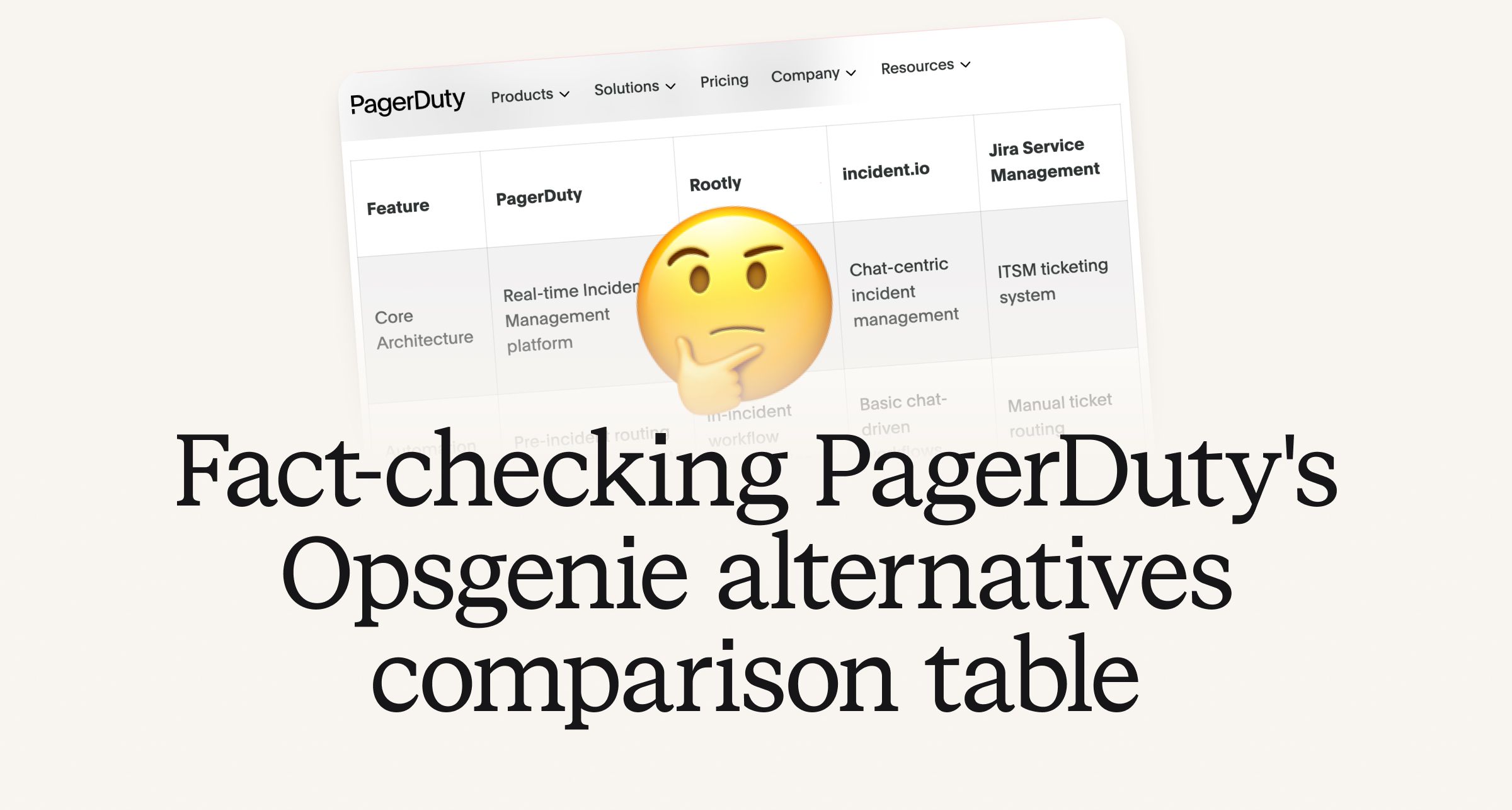
Fact-checking PagerDuty's Opsgenie alternatives comparison table
PagerDuty published a new comparison table about incident.io. Once again, it describes a product we don't recognize. So once again, we're correcting the record, row by row, with receipts.

July 28, 2026

Your genie is vanishing: introducing the Opsgenie rescue program
Today, we're launching the Opsgenie Rescue Program to make that landing soft: simplified migration and free overlap so you never pay two vendors at once.
July 9, 2026
So good, you’ll break things on purpose
Ready for modern incident management? Book a call with one of our experts today.
We’d love to talk to you about
- All-in-one incident management
- Our unmatched speed of deployment
- Why we’re loved by users and easily adopted
- How we work for the whole organization