Join live: What happens when your AI goes down?
Do you need AIOps? A diagnostic for SRE teams
October 7, 2026 — 19 min read
TL;DR: AIOps (artificial intelligence for IT operations) earns its cost when alert volume outruns human triage and your telemetry is already centralized. If incidents are manageable but your team loses 10-15 minutes assembling people and an hour or more rebuilding each post-mortem, that's a coordination problem. Workflow automation fixes it first. If diagnosis is the slow part, an AI SRE product such as incident.io's Investigations, which gets teams from alert to resolution an order of magnitude faster, targets it directly. If you can't measure your current MTTR or your telemetry is scattered across tools, fix that before buying any of the three. Six questions on alert volume, observability, team size, MTTR, manual steps, and post-mortem effort show which applies to you.
incident.io's analysis of customer data shows that coordination can consume up to 25% of total Mean Time To Resolution (MTTR): assembling the team, finding context, switching tools, updating status pages, and reconstructing timelines from memory.
AIOps platforms excel at correlating telemetry at scale. Some modern platforms have begun adding workflow features, but traditional AIOps strengths center on pattern detection and alert correlation. If your bottleneck is coordination overhead, workflow automation addresses that directly.
Understanding what AIOps and AI SRE each solve
AIOps and AI SRE are different categories solving different problems. Conflating them leads to wasted budget and delayed improvement.
Gartner introduced the term AIOps in 2016 to describe platforms that apply machine learning to IT operations data. These platforms typically focus on anomaly detection and event correlation across metrics, logs, and traces. They aim to reduce noise by grouping related alerts and surfacing patterns that may be difficult for humans to identify at scale.
We see AI SRE as a distinct, newer category for agentic software that automates SRE investigative work, going beyond detection. incident.io's Investigations is one example.
The critical distinction: AIOps centers on correlating telemetry. Datadog Watchdog and New Relic Applied Intelligence both ship automated root cause analysis on top of that. AI SRE goes further, investigating code changes and past incidents to draft a fix a human reviews.
Choosing AIOps over AI SRE
Choose AIOps when alert volume exceeds human triage capacity and cross-metric correlation is the bottleneck. Choose AI SRE when incidents are manageable but diagnosis eats the time. If coordination and documentation eat the time, start with workflow automation.
Here's how AIOps and AI SRE compare:
| Dimension | AIOps | AI SRE |
|---|---|---|
| Primary focus | Telemetry correlation at scale | Incident investigation and root cause |
| Data source | Metrics, logs, traces | Telemetry + code changes + past incidents |
| Output | Grouped alerts, anomaly detection | Root cause analysis, fix PRs |
| Human role | Reviews correlated alerts | Reviews and merges fix PRs |
| Example tools | PagerDuty AIOps, Datadog Watchdog, New Relic Applied Intelligence | incident.io Investigations, among others |
AIOps platforms like PagerDuty AIOps offer Intelligent Alert Grouping, Content-Based Alert Grouping, and Global Alert Grouping across services. Datadog's Watchdog provides automated anomaly detection and forecast alerts. These capabilities are valuable at scale.
We built incident.io to solve the coordination and documentation problems that AIOps doesn't touch: channel creation, role assignment, timeline capture, and post-mortem drafting.
AI SRE products like incident.io's Investigations get you from alert to resolution an order of magnitude faster, from surfacing root causes to drafting fix pull requests.
Mapping AIOps to your incident workflow
Here's a typical incident lifecycle:
- Alert: Monitoring detects an anomaly and fires an alert.
- Triage: Someone decides if it's real and how severe.
- Assembly: The team gathers in a channel and assigns roles.
- Investigation: Engineers diagnose the root cause.
- Resolution: The team deploys and verifies the fix.
- Post-mortem: The team documents what happened and why.
Traditional AIOps covers the first two stages: correlating alerts and detecting patterns. Incident management platforms handle creating channels, paging on-call engineers, assigning incident commanders, capturing timelines, and drafting post-mortems.
AI SRE products like Investigations focus on triage and investigation. If your bottleneck is assembly and post-mortem, neither AIOps nor AI SRE alone will fix it. You need workflow automation first.
Identifying your AIOps needs in 6 questions
Answer these six questions honestly. Your answers point to one of four outcomes: workflow automation first, AI SRE, AIOps, or neither yet.
1. How many alerts does your team handle each day?
Alert volume is the first signal to check for AIOps fit. Place yourself by alerts per on-call engineer per day, and by whether triage keeps up without a backlog building:
| Daily alert volume | Recommendation |
|---|---|
| Low volume | Rules-based deduplication is typically sufficient. |
| Moderate volume | Review alerting rules and workflow automation before adding AI correlation. |
| High volume | Consider correlation tools when human triage becomes a bottleneck. |
A single production failure can generate many distinct alerts from health checks, connection pools, dependent microservices, and load balancers. Alert correlation platforms can reduce raw alert volume by filtering duplicates and grouping related alerts.
But alert volume alone doesn't justify AIOps. Rules can deduplicate, group, and suppress related alerts without machine learning, an approach Google's SRE Book describes for alert routing.
2. How mature is your observability data?
AIOps platforms typically work best with structured, centralized telemetry: metrics, logs, and traces with consistent tagging.
If your observability is fragmented across multiple tools with no correlation, AIOps may produce unreliable results. You'll need centralized, structured data to get meaningful correlations.
Check your maturity:
- Centralized logging: All logs live in one platform (Datadog, New Relic, Splunk).
- Distributed tracing: You can trace requests across services.
- Service-level metrics: You define and measure SLIs for critical services.
- Consistent tagging: You tag services, environments, and teams consistently.
Anomaly detection models need enough history to learn your normal daily and weekly patterns, so plan for weeks of clean metric data, not days. The hidden cost of AIOps is often the data infrastructure work that has to happen first, not only the platform license.
If you can't answer "why are we having so many incidents in this service" without manually exporting data, fix observability before AIOps.
3. Is incident volume outgrowing your team?
AIOps helps when incident volume grows faster than headcount. At high alert volumes, alert correlation may cost less than hiring more SREs to triage alerts.
But if your team is small and handling moderate incident volume, you likely don't have a scale problem. You have a coordination problem.
For many mid-size companies, better alerting rules and workflow automation may deliver value faster than AI correlation.
4. Where does your MTTR go?
Break MTTR into components to identify where you lose time:
| MTTR component | What it measures |
|---|---|
| Time-to-detect | Monitoring fires an alert |
| Time-to-assemble | Team gathers and assigns roles |
| Time-to-diagnose | Team identifies the root cause |
| Time-to-fix | Team deploys and verifies the fix |
In incident.io's breakdown of a typical P1, assembling the team takes 12 minutes, troubleshooting 20, mitigation 4, and cleanup 12.
If time-to-detect is long because noise buries real alerts, AIOps correlation may help. If time-to-diagnose dominates, an AI SRE product such as Investigations targets it directly. If time-to-assemble dominates, coordination tooling is the answer. By incident.io's own measure, automating responder assembly cuts 10-15 minutes per incident.
5. Is your incident process too manual?
List the manual steps in your current process:
- Creating a Slack channel
- Paging the on-call engineer
- Assigning roles (incident commander, note-taker)
- Taking notes during the incident
- Updating the status page
- Creating follow-up tickets
If these steps take 10-15 minutes per incident, that's coordination overhead, not a telemetry problem, and AIOps won't fix it. Slack-native incident management will. incident.io auto-creates channels, pages on-call, assigns roles through workflows, and captures the timeline automatically.
6. How long do post-mortems take to write?
How long does it take your team to write a post-mortem after a major incident?
incident.io's post-mortem ROI analysis puts manual post-mortem documentation at 60-90 minutes, as teams search through chat history, monitoring tools, and call recordings trying to piece together what happened, often days after resolution.
Alert correlation doesn't draft post-mortems. Timeline capture does. incident.io auto-drafts post-mortems from the captured timeline, ready for human review.
If reconstruction regularly takes an hour or more, timeline capture is the fix, not AIOps.
Analyzing your team's automation fit
Before adopting any AI layer, eliminate manual toil. AI on top of a broken process amplifies the broken process.
Filtering noise from actionable incidents
Alert fatigue is real. Platforms with correlation features can group related alerts into a single incident. But better alerting rules and deduplication can achieve much of this without AI.
incident.io's alert grouping combines related alerts into a single group, so the team triages and escalates once, using a time window or attributes you choose. An optional AI mode, in beta, also groups alerts that look like the same problem. Alert deduplication uses a deduplication key, so a repeat alert with the same key doesn't create a new alert while the original is still firing.
Rules you can read are easier to debug than a correlation model, so start there before paying for a full correlation platform.
Reducing manual incident coordination
Coordination is where incident.io helps: auto-created Slack channels, automatic paging, and live timeline capture.
Favor reduced MTTR by 37% and increased incident detection by 214% after implementing incident.io. The platform cut the 20-30 minutes of manual coordination that used to delay Favor's troubleshooting.
Responders run the incident with /inc commands such as /inc assign, /inc severity, and /inc resolve. incident.io captures every command, status update, and decision automatically, so nobody has to act as a dedicated note-taker or rebuild the timeline from memory.
Fixing manual toil before adopting AI
Google's SRE Book defines toil as manual, repetitive, automatable work with no enduring value. Channel creation, note-taking, post-mortem reconstruction, status page updates, and follow-up tickets all fit that definition.
Eliminate toil with workflow automation before adding AI. On resolution, incident.io updates the status page, creates follow-up tasks in Jira or Linear, and drafts a complete post-mortem from the captured timeline.
Matching AIOps capabilities to your SRE needs
AIOps has real strengths, but it's not the right tool for every problem.
Streamlining alerts for SRE teams
AIOps is strong at alert correlation, anomaly detection, and root cause analysis.
Its honest limitation: correlation alone doesn't create the incident channel, assign roles, or capture the timeline. Those are coordination steps, and no amount of correlation accuracy produces them.
Correlating cross-metric issues
Consider a latency spike, an error rate increase, and CPU saturation across three services. AIOps correlates these signals into one incident.
Cross-service correlation is valuable at scale. If your incidents span multiple services with complex dependencies, AIOps earns its cost. New Relic Applied Intelligence, for example, correlates related alerts into a single issue to reduce noise. If your incidents are single-service and well-understood, this capability is overkill.
Knowing when you're ready for forecasting
Correlation platforms offer capacity forecasting and anomaly prediction. Both project your metric history forward, so both inherit whatever quality that history has.
Forecasting depends on clean history that covers your seasonal cycles. If your telemetry is still fragmented or inconsistently tagged, forecasting results won't be reliable yet. Fix observability and incident process first, then revisit forecasting once you have that history.
Solving the coordination problems AIOps doesn't touch
AIOps is worth it when you have high alert volume, mature observability, and cross-service correlation needs. When your bottleneck is coordination instead, workflow automation is the fix.
Automating coordination and timeline capture
incident.io integrates with Datadog, Prometheus, New Relic, and PagerDuty. When an alert fires, incident.io creates the channel, pages on-call, and starts the timeline. Responders start working on the problem instead of assembling the team.
Your monitoring stack stays where it is. incident.io coordinates the response around it rather than replacing it.
Drafting post-mortems from the timeline
Scribe transcribes incident calls and flags key decisions in real time, so nobody has to take call notes.
Because incident.io drafts the post-mortem from the captured timeline, post-mortems publish within hours instead of days. Editing a draft takes minutes, not an hour-plus rewrite.
Running incidents in Slack and Microsoft Teams
The entire incident lifecycle runs in Slack or Microsoft Teams: /inc commands, channel-based coordination, no tool-switching.
PagerDuty's alerting customization is more sophisticated, and we integrate with it rather than replace it. Our differentiation is coordination: incidents start, run, and close in chat, while PagerDuty is web-first with Slack bolted on.
Our Pro plan costs $45/user/month with on-call ($25 base + $20 on-call add-on). Investigations is available as an add-on on Pro and Enterprise. For smaller teams, Team costs $25/user/month with on-call on annual billing ($15 base + $10 add-on).
Strengthening your manual incident workflow
Before you buy AIOps or AI SRE, fix the manual workflow.
Fixing monitoring gaps before adopting AIOps
Correlation platforms work best with centralized, structured observability data. Before adopting AIOps, centralize logs and traces in one platform. Tag services consistently, then add alert routing rules so alerts reach the right team automatically.
Replacing manual timeline reconstruction
By incident.io's measure, manual timeline reconstruction runs 60-90 minutes per incident, time your team doesn't spend on fixes.
Automatic timeline capture eliminates that work: incident.io captures every status update, role assignment, and decision as it happens.
Math: 15 incidents per month × 60 minutes saved per post-mortem (75 minutes of manual reconstruction vs. 15 minutes editing a draft) = 15 hours per month reclaimed.
Checking team maturity markers
Markers that indicate AIOps readiness:
- Centralized observability (metrics, logs, traces in one platform)
- Defined SLOs with error budgets
- Consistent incident process (roles, severity levels, post-mortem template)
- Baseline MTTR data (you can measure current performance)
Markers that indicate you're not ready:
- Fragmented tools (observability scattered across 3+ platforms)
- Tribal knowledge (incident process lives in senior engineers' heads)
- No post-mortem process (or post-mortems take 60+ minutes to write)
- No MTTR tracking (you can't measure improvement)
If you can't measure your current MTTR, you can't measure the ROI of AIOps or any other tool. incident.io's Insights dashboard tracks MTTR trends and incident patterns, so you have a concrete answer when leadership asks if the SRE function is working.
Reading your results
Map your answers to one of four outcomes:
- Workflow automation first: question 4 shows time-to-assemble dominating, or questions 5 and 6 show manual steps or post-mortem reconstruction as your biggest time cost.
- AI SRE: question 5 shows coordination already automated, but question 4 shows time-to-diagnose dominating your MTTR.
- AIOps: questions 1 and 3 show alert volume outrunning your team's triage capacity. Question 2 confirms centralized observability, and your incidents span multiple services with real dependencies.
- Neither yet: you can't measure MTTR, or question 2 shows observability fragmented across tools. Fix those first.
If your answers point to coordination overhead, timeline capture, or post-mortem reconstruction, book a demo of incident.io. See your entire incident lifecycle run in Slack or Microsoft Teams, from alert to auto-drafted post-mortem, without the tool-switching.
Key terms glossary
AIOps: Artificial intelligence for IT operations. Platforms that apply machine learning to correlate telemetry data (metrics, logs, traces) and identify patterns humans miss. Best for high-volume, cross-service incident detection.
AI SRE: AI that automates investigative work in the incident lifecycle: triage, root cause analysis, and fix drafting. incident.io's Investigations is an AI SRE product that gets teams from alert to resolution an order of magnitude faster.
MTTR: Mean Time To Resolution. The average time from when an incident starts to when it's resolved. Break it into components (detect, assemble, diagnose, fix) to identify where you lose time.
Alert correlation: Grouping related alerts from multiple sources into a single incident. It reduces alert fatigue and can support root cause identification across services. Teams can implement it with rules or machine learning.
Observability maturity: The degree to which telemetry data (metrics, logs, traces) is centralized, structured, and consistently tagged. Correlation platforms typically require high observability maturity to produce meaningful results.
FAQs

Tom Wentworth
Chief Marketing Officer
See related articles
Building Investigations: what it takes to build an AI SRE
We spent the last two years building Investigations, our AI SRE. In this post, go behind the scenes of the work done and why build vs. buy is one of the most important decisions engineering teams are making right now.

October 1, 2026
Introducing Investigations, powered by Nexus.
Today we're launching Investigations: agentic root cause analysis that starts the moment you're paged, figures out what broke and why, and works with your team through to resolution. Here's what we built, what's powering it, and why it took some time to get right.

August 5, 2026
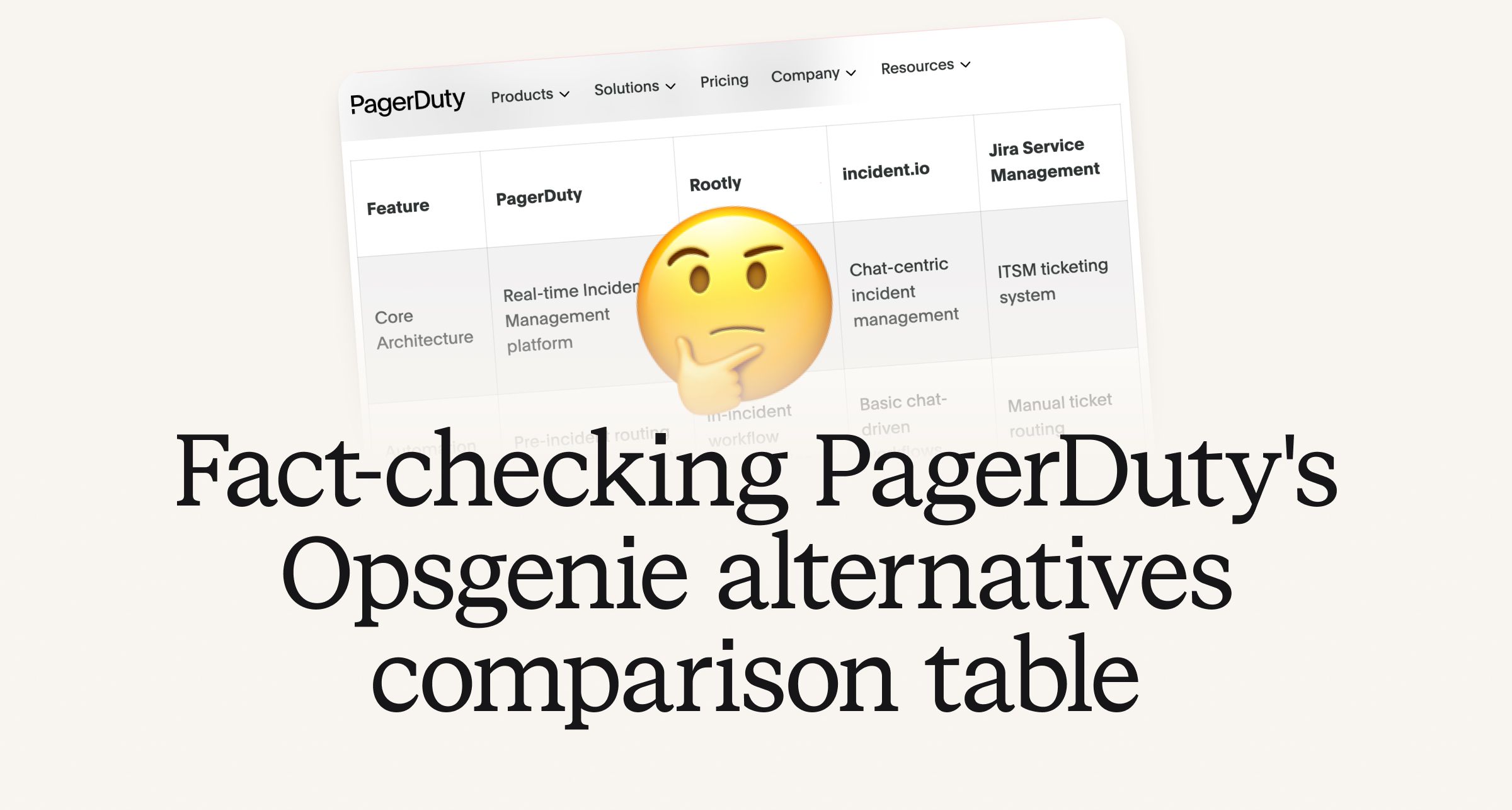
Fact-checking PagerDuty's Opsgenie alternatives comparison table
PagerDuty published a new comparison table about incident.io. Once again, it describes a product we don't recognize. So once again, we're correcting the record, row by row, with receipts.

July 28, 2026
So good, you’ll break things on purpose
Ready for modern incident management? Book a call with one of our experts today.
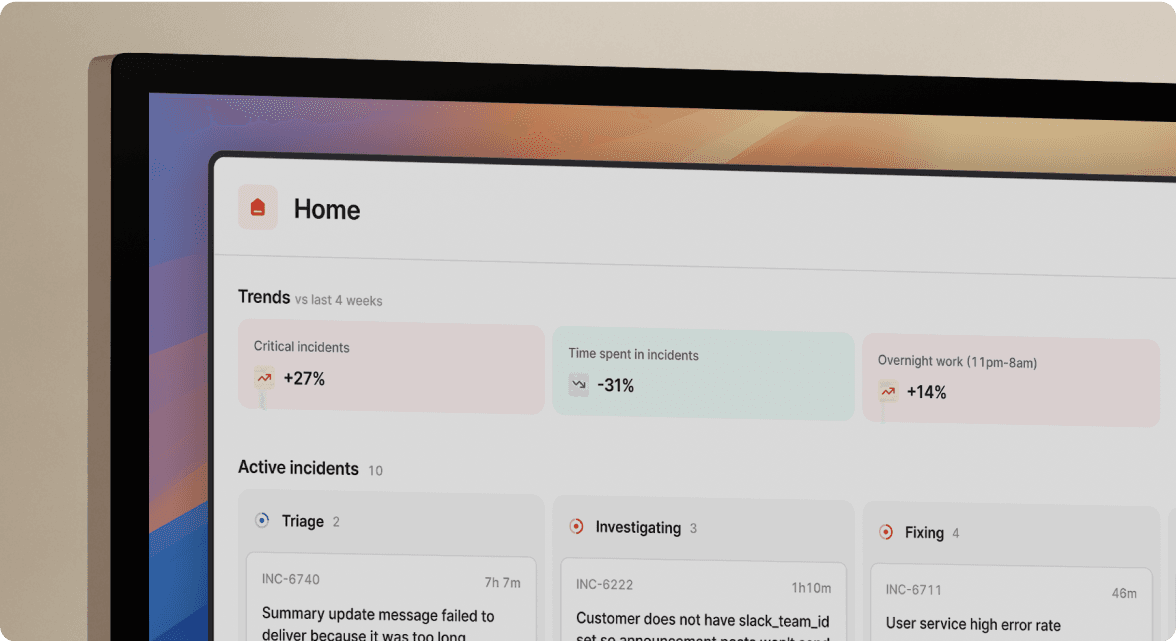
We’d love to talk to you about
- All-in-one incident management
- Our unmatched speed of deployment
- Why we’re loved by users and easily adopted
- How we work for the whole organization