Join live: What happens when your AI goes down?
Best Opsgenie alternatives for on-call engineer teams in 2026
February 20, 2026 — 21 min read
Updated February 20, 2026
TL;DR: With Opsgenie shutting down, Atlassian is discontinuing new sales on June 4, 2025 and ending support April 5, 2027, forcing teams to migrate to Jira Service Management or find a modern alternative. For SRE teams managing microservices and Kubernetes environments, JSM's ITSM-first design adds unnecessary complexity. The best alternatives consolidate on-call scheduling, incident coordination, and status pages into unified platforms. incident.io leads for Slack-native teams seeking MTTR reduction through workflow automation, while PagerDuty suits enterprise-scale requirements. Grafana OnCall works for Grafana-heavy stacks, and Better Stack serves simple infrastructure monitoring needs.
Atlassian is discontinuing new Opsgenie sales on June 4, 2025 and ending support April 5, 2027, forcing teams to migrate to Jira Service Management or find a modern alternative. If you're managing on-call rotations for a 50-500 person engineering org running microservices, this forced migration is actually an opportunity. You can either accept the "Jira-fication" of your incident response or upgrade to a purpose-built platform that reduces MTTR instead of adding coordination overhead.
The on-call software market has evolved beyond standalone alerting tools. Modern SRE teams need platforms that handle the full incident lifecycle: intelligent escalation, real-time coordination, automatic timeline capture, and post-mortem generation. This guide compares the top alternatives based on scheduling flexibility, escalation logic, Slack-native workflows, and total cost of ownership.
Why teams are migrating away from Opsgenie
The Opsgenie sunset isn't just a product consolidation. It's a fundamental mismatch between what SREs need and what Atlassian is building.
Jira Service Management is designed for IT ticketing workflows, not real-time incident response. Engineering teams consistently report that JSM's configuration complexity, cumbersome interface, and slow performance under load make it poorly suited for real-time incident response. When production is down at 3 AM, you need speed. JSM forces you into ticket queues, approval workflows, and Information Technology Infrastructure Library (ITIL) processes that make sense for employee laptop requests but add friction to Priority 1 (P1) incidents.
The "Atlassian tax" compounds over time. JSM integrates well within the Atlassian ecosystem (Confluence, Jira Software), but teams using Slack for coordination and Datadog for observability often find that while native integrations exist, they require extensive configuration or additional plugins to work smoothly in fast-paced incident workflows. You're paying for bundled ITSM features while building custom automation for the features you actually need.
Standalone Opsgenie development has stagnated. The critical question for SRE teams is whether JSM's ITSM-centric feature set serves teams focused on uptime and rapid response, or whether you're paying for asset management, change approval boards, and service catalog workflows designed for traditional IT operations that you'll never use. Most engineering teams don't need these features and would prefer a dedicated incident management platform.
The forced migration deadline creates urgency, but the real driver is this: you're paying for incident coordination complexity when modern platforms eliminate it entirely.
Critical criteria for evaluating on-call alternatives
When comparing Opsgenie replacements, focus on the capabilities that directly impact your MTTR and team burnout rates.
Good on-call scheduling flexibility determines whether your rotation fits your team or forces you to adapt. You need support for round-robin distribution across multiple engineers, follow-the-sun coverage spanning geographic time zones, custom rotation lengths beyond the standard weekly cycle, and override capabilities for planned time off or emergency swaps. incident.io's scheduling system handles all of these through a drag-and-drop interface.
Escalation capabilities separate basic paging from intelligent incident coordination. Look for multi-step escalation policies that automatically notify backup engineers if the primary on-call doesn't acknowledge within a defined timeout, if-no-response logic that routes alerts based on priority or affected service, and real-time override options when you need to manually escalate to a senior engineer or different team. Better Stack supports sophisticated escalation policies including time delays, metadata-based routing, and conditional steps.
Ecosystem integrations must go deeper than generic webhooks. Your monitoring tools (Datadog, Prometheus, AWS CloudWatch) should trigger incidents automatically with full context, not just fire a generic alert. Status page updates should happen automatically when incidents resolve, not require manual updates in a separate tool. Follow-up tasks should flow into your existing project management system (Jira, Linear) with complete timeline data, not empty ticket shells.
Mobile experience reliability can't be an afterthought. When you're on-call, the mobile app must bypass Do Not Disturb modes, deliver loud persistent notifications that actually wake you up, provide one-tap acknowledge and escalate actions without forcing you to open a laptop, and sync instantly with web and Slack interfaces when you transition from phone to desk. A missed alert at 3 AM because of notification delivery failures destroys trust in the entire system.
Pricing transparency prevents procurement surprises. Watch for per-user traps where stakeholders who just need visibility count against your license total, hidden add-on costs for features marketed as "included" (on-call scheduling, status pages, advanced workflows), and per-incident fees that spike your bill during major outages when you're already stressed.
Top Opsgenie alternatives for 2026
incident.io: Best for Slack-native incident management
Best for: Engineering teams of 50-500 people who live in Slack and want to consolidate on-call scheduling, incident coordination, status pages, and post-mortems into a single platform that reduces MTTR through automation.
incident.io treats Slack as your incident command center, not a notification endpoint. When a Datadog alert fires, incident.io automatically creates a dedicated Slack channel, pages the on-call engineer, pulls in service owners based on your catalog, and starts capturing the timeline without any manual setup. You acknowledge alerts, escalate to other teams, assign roles, and update severity using /inc slash commands that feel like natural Slack messages.
The platform's strength is workflow automation that eliminates coordination overhead. Smart escalation paths automatically route alerts based on affected service, time of day, or custom metadata. When you type /inc escalate, the system knows which schedule to query and which incident role to assign. A database issue automatically pages your database on-call engineer and assigns them the "Database Lead" role in the incident channel. No manual lookups, no context switching between tools.
incident.io's on-call scheduler supports complex rotations including round-robin, follow-the-sun, and custom rotation lengths. You can sync schedules to Google Calendar, configure Slack notifications for shift changes, and override individual shifts for planned time off. The interface is clean and visual, showing you exactly who's on-call at any time without hunting through configuration menus.
For teams migrating from Opsgenie, incident.io provides specific migration tools that import your existing schedules. You can run both systems in parallel during your transition, directing the same Datadog webhooks to both platforms until you've validated the new setup.
Pricing: Pro plan at $25 per user monthly plus $20 per user for on-call (total $45 per user) includes advanced workflows, private incidents, custom dashboards, and full on-call capabilities. Enterprise tier adds SAML/SCIM, dedicated customer success, and SLA guarantees.
Pros: Unified platform eliminating tool sprawl, Slack-native workflows requiring zero training, automated post-mortem generation from captured timelines, transparent pricing with no hidden add-ons, fast support response.
Cons: Opinionated defaults offer less customization than PagerDuty, newer platform with smaller market share, Microsoft Teams support requires Pro plan.
PagerDuty: Best for enterprise-scale requirements
Best for: Large enterprises with thousands of users, complex integrations, or regulatory requirements demanding the industry-standard incumbent with decade-plus operational history.
PagerDuty pioneered modern on-call management and maintains rock-solid alerting reliability. If you have 500+ engineers, integrate with legacy monitoring systems, or need to satisfy compliance auditors who want recognizable vendor names, PagerDuty delivers proven stability.
The challenge is cost and complexity. PagerDuty's Professional tier starts at $21 per user monthly but limits you to 2 predefined incident roles, 3 predefined incident types, and 2 teams. Most growing engineering orgs quickly hit these constraints. The Business tier at $41 per user monthly unlocks the features you actually need: custom incident types, advanced workflows, and expanded status page capabilities (up to 500 subscribers vs. 250 on Professional).
The PagerDuty Slack integration does support bidirectional actions including acknowledge, escalate, and resolve directly in Slack, though many teams find the workflow less native than platforms built Slack-first. You can handle incidents without opening a browser, but the experience feels like controlling PagerDuty remotely rather than working inside Slack naturally.
Pricing: Professional at $21 per user monthly, Business at $41 per user monthly, Enterprise at custom pricing.
Pros: Industry-standard reliability with 10+ years operational history, deepest integration catalog supporting legacy systems, robust enterprise features (audit logs, advanced Role-Based Access Control (RBAC), compliance certifications).
Cons: Higher total cost of ownership with tiered feature access, dated UI requiring extensive configuration, complex pricing structure, Slack integration less native than dedicated Slack-first platforms.
Grafana OnCall: Best for Grafana-heavy observability stacks
Best for: Teams already deeply invested in Grafana Cloud for metrics, dashboards, and observability who want tight integration with their existing monitoring workflows.
If you've built your observability stack on Grafana, OnCall provides natural integration. Alerts from Grafana dashboards flow directly into on-call rotations without webhook configuration. The on-call UI matches Grafana's aesthetic, and you manage everything from a unified platform.
The Grafana OnCall open-source version entered maintenance mode in early 2025, with the GitHub repository showing minimal commits. While the Cloud version (part of Grafana IRM) continues, teams should evaluate whether active development velocity matches their long-term needs. Grafana IRM does include automated incident timelines and post-incident review generation, though these features are part of the broader IRM suite rather than OnCall standalone.
Pricing: Grafana Cloud IRM pricing is available through Grafana's pricing page, based on monthly active IRM users.
Pros: Tight Grafana ecosystem integration, familiar interface for existing Grafana users, strong monitoring-to-alerting workflow.
Cons: OSS version in maintenance mode, smaller feature development velocity, best value when already using Grafana Cloud ecosystem.
Better Stack: Best for simple infrastructure monitoring
Best for: Startups and small teams (under 50 engineers) prioritizing quick setup and beautiful UI over advanced enterprise features.
Better Stack combines uptime monitoring with on-call management in an approachable package. The interface is clean and modern, and you can configure basic rotations and escalation policies quickly. For teams with straightforward infrastructure and simple alerting needs, it removes unnecessary complexity.
Better Stack's escalation capabilities support sophisticated policies including time delays, metadata-based routing, and conditional steps. You can escalate based on incident severity, configure different notification methods per step, and set up fallback paths when primary on-call engineers don't respond. The Slack integration allows you to acknowledge, reroute, resolve, and snooze incidents using buttons directly in Slack.
The trade-off is that Better Stack focuses on monitoring and alerting rather than comprehensive incident lifecycle management. Teams often outgrow Better Stack as incident volume increases and coordination complexity grows.
Pricing: Starts at lower tiers for small teams, scaling based on monitors and users.
Pros: Beautiful modern UI, fast setup requiring minimal configuration, combined uptime monitoring and on-call in single tool, affordable for startups.
Cons: Limited enterprise-grade incident coordination features, teams may outgrow as complexity increases, smaller integration ecosystem than established players.
Splunk On-Call (VictorOps): Best for existing Splunk users
Best for: Organizations deeply embedded in the Splunk ecosystem for log aggregation and security information management who want on-call capabilities from their existing vendor.
If you've invested heavily in Splunk infrastructure, adding On-Call provides vendor consolidation. Alerts from Splunk monitoring flow directly into on-call rotations, and you manage everything through Splunk's unified billing and support relationship.
Development velocity has slowed since Splunk acquired VictorOps in 2018. The platform delivers basic on-call paging but hasn't evolved to match modern incident management expectations around workflow automation or Slack-native coordination. The Splunk On-Call Slack integration does support acknowledge, reroute, resolve, and snooze actions directly in Slack using interactive buttons.
Pricing: Custom pricing through Splunk sales, typically bundled with other Splunk products.
Pros: Tight Splunk ecosystem integration, vendor consolidation for existing Splunk customers, proven basic alerting functionality.
Cons: Limited feature development since 2018 acquisition, dated user interface, smaller innovation velocity in incident management space.
Comparison of on-call features and pricing
| Platform | On-Call scheduling | Slack integration | Status pages | Pricing (per user/month) |
|---|---|---|---|---|
| incident.io | Round-robin, follow-the-sun, custom rotations, overrides | Full workflow (acknowledge, escalate, resolve in Slack) | Included (unlimited on Enterprise) | $45 Pro ($25 + $20 on-call) |
| PagerDuty | Advanced scheduling, multi-layer escalations | Bidirectional (actions possible in Slack) | Included on Professional+ (250 subscribers) | $21 Professional, $41 Business |
| Grafana OnCall | Basic rotations, Grafana-integrated | Actions via Slack buttons | Part of IRM suite | Contact for IRM pricing |
| Better Stack | Simple rotations, metadata routing | Actions via Slack buttons | Uptime monitoring included | Starts lower, scales with usage |
| Splunk On-Call | Standard rotations, team-based | Actions via Slack buttons | Limited | Custom (Splunk bundle) |
The pricing differences compound at scale. For a 100-person engineering team needing on-call scheduling, incident coordination, and status pages:
- incident.io Pro: $45 × 100 = $4,500/month = $54,000/year (all features included)
- PagerDuty Business: $41 × 100 = $4,100/month = $49,200/year (may require add-ons for advanced features)
incident.io provides comprehensive features with transparent all-in pricing for teams that work primarily in Slack.
Migrating from Opsgenie safely
Migrating on-call systems feels risky because you can't afford missed alerts during the transition. A parallel-run strategy eliminates this risk.
Audit your current Opsgenie configuration. Export all on-call schedules, including rotation participants, time zones, and custom shift patterns. Document every escalation policy with step-by-step notification rules, timeouts, and fallback paths. List all integrations sending alerts to Opsgenie. This audit becomes your migration checklist.
Configure your new platform while keeping Opsgenie running.
The tools to migrate from Opsgenie let you import your schedules while running both systems in parallel. Set up your monitoring tool integrations to send alerts to both Opsgenie and your new platform simultaneously using duplicate webhook configurations.
Run a "game day" test with a fake P1 incident. Trigger a test alert that fires to both systems. Validate that the right on-call engineer gets paged in both platforms, escalation paths work correctly if you delay acknowledgment, and timeline capture, role assignment, and status page updates work in the new platform. Fix issues before cutting over production traffic.
Execute the cutover during a low-risk window. Choose a time when your engineering team is online and incident volume is typically low. Update monitoring tool webhook configurations to point exclusively to the new platform. Keep Opsgenie enabled but passive for 24-48 hours as a fallback. Monitor the first 3-5 real incidents carefully. Once confidence is high, decommission Opsgenie before the April 5, 2027 deadline.
Ready to upgrade your incident response?
Don't treat the Opsgenie sunset as a forced migration. Treat it as an opportunity to consolidate your incident management stack, reduce MTTR, and eliminate the coordination overhead that's burning out your on-call rotation.
If you're a Slack-native team looking to unify on-call scheduling, incident coordination, status pages, and post-mortems in a single platform with transparent pricing, schedule a demo to see how Slack-native workflows eliminate tool-switching during real incidents.
If you need enterprise-scale features with decade-plus proven reliability, PagerDuty remains a solid choice — though teams searching for PagerDuty alternatives often find better value elsewhere. For Grafana-heavy observability stacks, Grafana OnCall provides tight integration.
The worst decision is staying with tools that add friction to your incident response. Your MTTR and team burnout rates depend on choosing incident management software that fits how your team actually works.
Key terminology
On-call rotation: The schedule determining which engineer is responsible for responding to alerts during a specific time period, typically organized in weekly shifts with provisions for follow-the-sun coverage and time off.
Escalation policy: A set of automated rules defining who gets notified next if the primary on-call engineer doesn't acknowledge an alert within a specified timeout, often including multiple fallback levels.
MTTR (Mean Time To Resolution): The average time from when an incident is detected until it's fully resolved, encompassing team assembly, investigation, fix deployment, and verification.
Ack (Acknowledge): The action confirming receipt of an alert, which stops the escalation policy from paging backup engineers and signals that someone is actively investigating.
Follow-the-sun rotation: An on-call scheduling pattern where responsibility shifts across geographic time zones, allowing teams to provide 24/7 coverage during business hours in each region rather than forcing night shifts.
FAQs

Tom Wentworth
Chief Marketing Officer
See related articles
Introducing Investigations, powered by Nexus.
Today we're launching Investigations: agentic root cause analysis that starts the moment you're paged, figures out what broke and why, and works with your team through to resolution. Here's what we built, what's powering it, and why it took some time to get right.

August 5, 2026
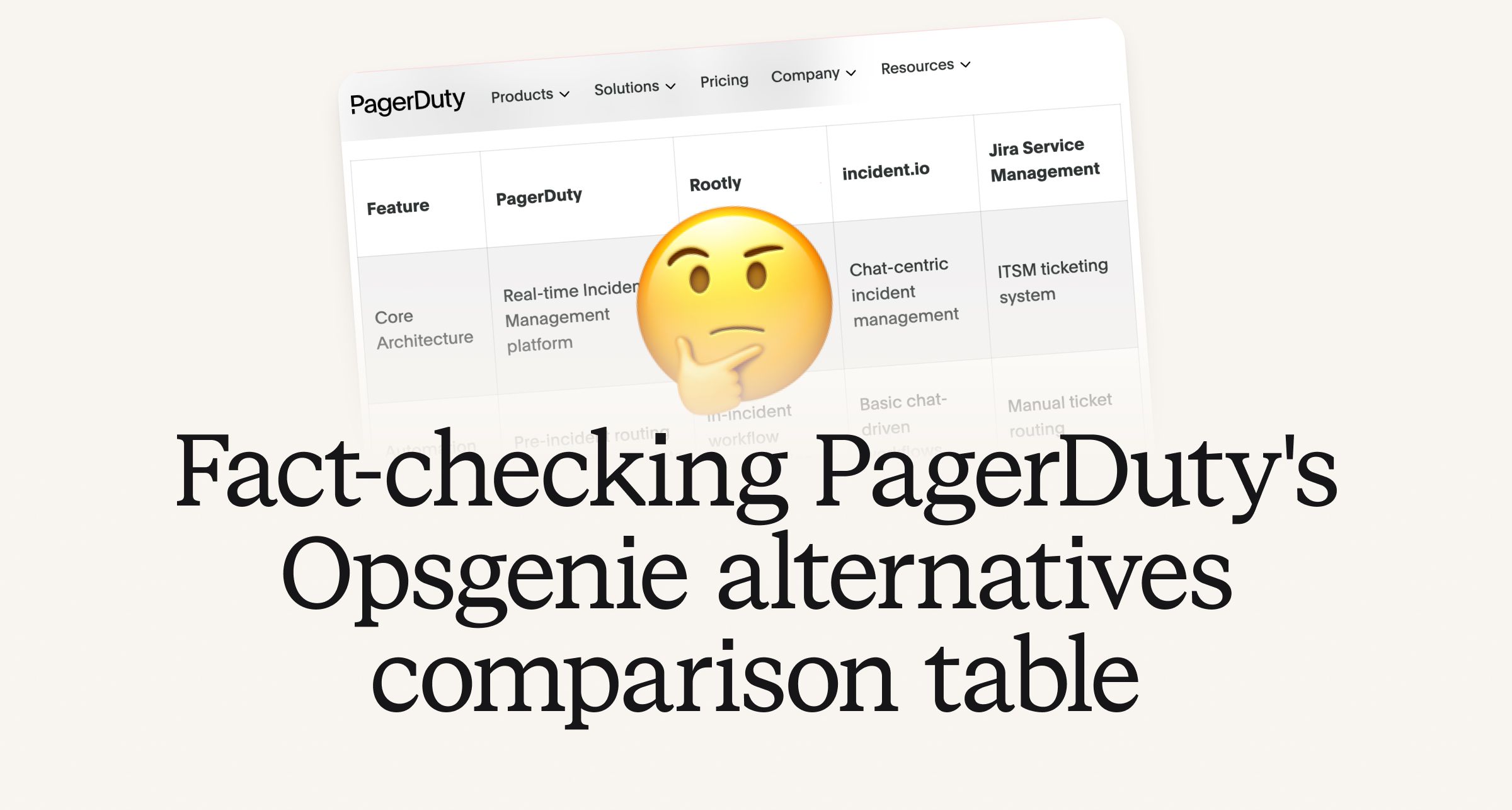
Fact-checking PagerDuty's Opsgenie alternatives comparison table
PagerDuty published a new comparison table about incident.io. Once again, it describes a product we don't recognize. So once again, we're correcting the record, row by row, with receipts.

July 28, 2026
Your genie is vanishing: introducing the Opsgenie rescue program
Today, we're launching the Opsgenie Rescue Program to make that landing soft: simplified migration and free overlap so you never pay two vendors at once.
July 9, 2026
So good, you’ll break things on purpose
Ready for modern incident management? Book a call with one of our experts today.
We’d love to talk to you about
- All-in-one incident management
- Our unmatched speed of deployment
- Why we’re loved by users and easily adopted
- How we work for the whole organization