Join live: What happens when your AI goes down?
Behind the Flame: Joe Hart
April 23, 2026 — 9 min read
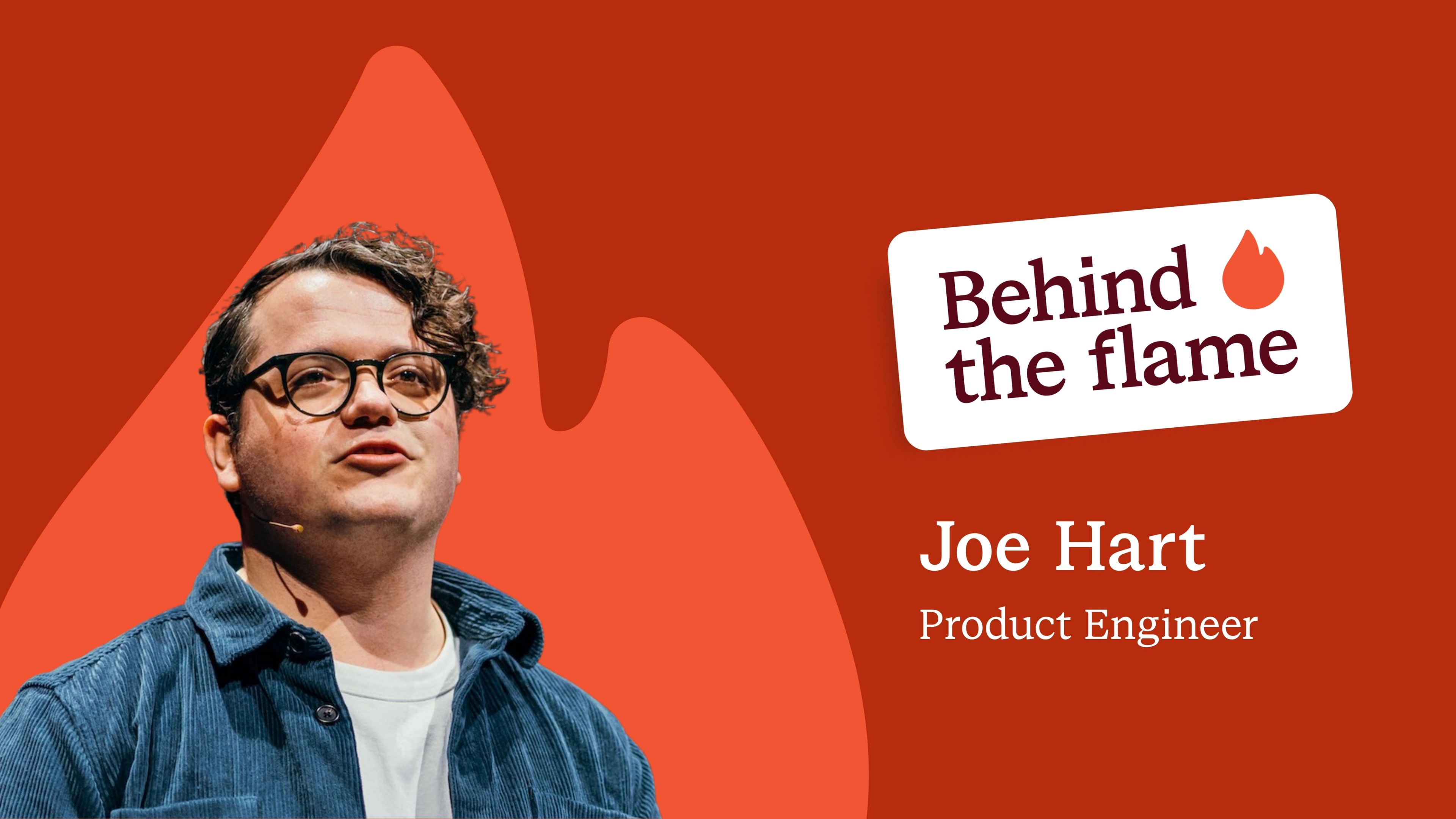
Welcome to Behind the Flame, a series created to showcase our incidentios.
Meet Joe Hart, Product Engineer here at incident.io.
Q: What is it like being a Product engineer at incident.io?
Very fast-paced, very exciting, and very close to building something that everyone uses every day. Very fun. We take the work seriously, but we don't take ourselves very seriously.
Q: What team are you on, and what does your work involve?
I am currently on the Response team, which covers everything outside our core incident product: status pages, the incident management lifecycle, integrations with tools like Jira or Slack. I also do a lot of work on the dashboard, making sure it's fast, efficient, and feels nice for our customers to use.
Q: What does a typical day look like for you?
Every day begins with the most important thing. That might be something you were already planning to work on, or a live incident affecting a customer that needs fixing, or a customer call that morning. Then it's onto business as usual: writing code, testing, project kickoffs, and unblocking other people. I'm a big believer that one of the best things you can do is unblock others.
Q: What are you most looking forward to with incident.io this year and beyond?
Shipping more product. One of the reasons I joined in the first place was that I wanted to ship stuff that people genuinely use. I'm a very simple man: I make the thing, people use the thing, I feel good about the thing. If I can do more of that this year, I'll be very happy.
Q: What does collaboration look like on your team?
Collaboration is like the heart of everything we do here. We run something called product responder, where problems and requests come in and we work out the most important thing to tackle next. That process isn't just an engineering decision: it involves our CSMs, who help us understand how important something is to a customer, and that often leads us to rethink a whole flow rather than just adding a tiny fix. What I also love is the collaboration across engineering teams. If you need to learn about something owned by a different team, people are genuinely generous with their time in coming to teach you.
Q: What was something that surprised you when you joined?
The most surprising thing was that everyone here really is a kind person. I know that sounds hard to convey to someone reading this, but here's the way I think about it: there's a difference between niceness and kindness. A nice person wouldn't tell you that you have something on your face. A kind person would, and your day would be better for it. Everyone here is like that: warm and friendly, but also genuinely direct, and always pointing you in the right direction. We just have a nice, silly time.
Q: What does incident.io do differently from anywhere else you've worked?
There's often lip service paid at other places to being developer-empowered, 'you own your roadmap', that sort of thing. But I've seen several times here where an engineer makes a case for something to be built, and our CTO or CEO genuinely just goes, 'Yeah, that sounds great, you've done the thinking.' But the opposite has also happened, where engineers have said, 'I don't think we should do this,' and that's been heard too. I was calibrated to having to win long, arduous battles. Here, it's the complete opposite: here's my thinking, here's my evidence, a bit of a challenge, and then, okay, let's go. That's somewhat shockingly nice.
Q: What is the value that most resonates with you?
Make it Magic, without question. A lot of B2B software gets away with shipping the most basic thing possible. But if you go that little bit further, if you make something feel genuinely nice to use, it changes everything. There's an old VW Golf advert where car doors would make a horrible thwack sound, and then they showed a Golf, and the door made this really lovely, premium click. On paper, both doors closed. But one of them made you feel something. If you can bring that to software, you're really onto something.
Q: What's a perk or benefit you didn't expect to love but actually do?
The coffee machines. There are about five different ways to make coffee in this office: a La Marzocco Mini, a Moccamaster, a few V60s, a bean-to-cup for when you don't have time for any of that. But what's interesting is that it's entirely run by the people who work here. Nobody brought it in from a catering company. It's: here's one of the best coffee machines you can buy, go for it, just clean it and keep it running. That's a weirdly good signal of the kind of trust and agency you're given here.
Q: What does First Friday of the month mean to you?
I live in London and it's very easy to not do any of the actual London things. My favourite museum is the V&A. First Friday gives me a slice of time in the middle of a weekday to actually go and do that. I went to a matinee of The Tempest at the Globe a few weeks ago. It was me and all the pensioners. It was amazing.
Q: What's something you've learned since joining?
The scale of on-call as a product. In my career so far, I'd used it in relatively small organisations where a handful of engineers share the pager and nothing major happens. But the way some of our larger customers orchestrate their schedules, with hierarchies and escalations going all the way from one engineer up through several layers to a CTO or CEO at the top, is genuinely complex in a way I'd never thought about before. It's combinatorially explosive. How do you make something that absolutely has to work for ten thousand people, and then wrap it up in a UI that looks clear to someone?
Q: What is your favourite incident.io memory so far?
When I bought a USB handset phone, the kind you plug into your computer to dictate with. I did it because I thought it was kind of funny. It happened to be in the company orange, which felt right. I worked from home one day and everyone in the office took a photo with it in some kind of wild pose. There's now this insane mosaic of the whole response team, including our stuffed duck mascot, all holding this bright orange phone. It just made me feel like I was in the right place.
Q: What is one piece of advice you would give yourself on your first day?
Go and ask more people questions. I started with a bit of trepidation about bothering people when they were busy, but everyone is incredibly open and will just tell you if they can't talk right now. Get those one-to-ones in early, especially with the GTM team, because the Customer Success Managers and Account Managers are the people most directly connected to the users, and they'll give you a much more holistic view of the product than you'd get talking to engineers.
Q: Why shouldn't you work at incident.io?
If you only want to work in a very narrow silo on one very particular slice, this probably isn't the place for you. If you just want to write code in a very niche way, there are plenty of organisations where you can do that and have a lovely time. But if you want to build stuff, and actually think about what you're building it for, come here.
Q: What made you say yes to incident.io?
I wanted to work on a product that I'd actually used before. I'd also heard there was a reputation here for doing high-quality work. And I really liked that it's big enough to be a community where I'm constantly learning from people, but small enough that I still know everyone's name. Big enough to be a community, not so large that it's thousands of people you can't keep track of.
Q: What advice would you give to candidates interviewing with us?
Interviewing is a two-way street. Figure out your non-negotiables beforehand and come and ask about them. We're very open about how we work. If you can be as transparent as we try to be, by the end of the process, you'll both know if it's a good fit. The goal isn't to pass an exam. It's to figure out if we're right for each other.
Megan Batterbury
Senior Talent Operations Specialist
See related articles
Behind the Flame: Nicole Hussein
Meet Nicole Hussein, Product Engineer here at incident.io. 🔥

July 30, 2026
Behind the Flame: Jack Broughton
Meet Jack Broughton, Business Development Representative here at incident.io. 🔥
July 16, 2026

Behind the Flame: Ellie Cherrill
Meet Ellie Cherrill, Product Engineer here at incident.io. 🔥
July 2, 2026
So good, you’ll break things on purpose
Ready for modern incident management? Book a call with one of our experts today.
We’d love to talk to you about
- All-in-one incident management
- Our unmatched speed of deployment
- Why we’re loved by users and easily adopted
- How we work for the whole organization