Join live: What happens when your AI goes down?
AIOps vs AI SRE: what's the difference and which does your team actually need?
October 7, 2026 — 17 min read
TL;DR: AIOps (artificial intelligence for IT operations) correlates anomalies across your telemetry to cut alert noise. AI SRE takes a correlated incident, investigates it, identifies the root cause, and drafts a fix a human reviews. If your main pain is alert volume or you handle fewer than 10 incidents a month, AIOps correlation may be enough. If your toil sits in investigation, AI SRE addresses it directly. Our Investigations product gets teams from alert to resolution an order of magnitude faster and never changes production systems without human review.
Coordination overhead often eats 10 to 15 minutes of an incident before troubleshooting starts. Across 15 incidents a month, that's up to 225 minutes spent assembling people, creating channels, and finding the right Slack thread. Alert correlation doesn't touch that overhead, and it doesn't touch the investigation that follows.
The gap between detecting an anomaly and resolving the incident is often where coordination overhead and investigation work accumulate. Understanding which layer your toil lives in is what lets you decide whether you need AIOps, AI SRE, both, or neither.
Understanding how AIOps affects incident toil
AIOps was first introduced by Gartner in 2016 to describe platforms that apply machine learning (ML) to operational data to detect and respond to system issues.
In practice, AIOps platforms ingest events from your observability stack, cluster related alerts, and surface a smaller set of correlated incidents for human review. These platforms typically focus on correlation rather than deep investigation. The manual work of digging through logs, checking recent deploys, and correlating service dependencies still falls on the on-call engineer.
Handling alert fatigue
Google's SRE Book warns that when pages fire too often, engineers skim or ignore alerts, sometimes missing a real page masked by the noise. AIOps platforms address alert fatigue by deduplicating and correlating alerts into grouped incidents, which can reduce the raw count hitting your pager.
But correlation alone does not resolve the incident. The on-call engineer still manually creates a Slack channel, pages the right people, opens the correlated group, checks Datadog or Prometheus dashboards, reviews recent deployments in GitHub, and pieces together what happened. Correlation addresses volume, but the cognitive load of investigation often remains.
Connecting AIOps to observability workflows
AIOps sits downstream of your observability stack. Tools like Datadog Watchdog apply models to observability data to detect anomalies and surface related issues.
AIOps is the statistical layer that detects anomalies and correlates events. AI SRE is the agentic layer that takes a correlated incident and investigates it with follow-up queries.
Recognizing the limits of current AIOps tools
AIOps hits its ceiling at the boundary between detection and action. These platforms excel at pattern recognition across large event volumes. However, they stop short of the deeper reasoning required for specific incident investigation, such as querying current metric thresholds or tracing code-level regressions through system behavior.
Alert noise alone can prolong outages by getting in the way of diagnosis. Siloed visibility, slow team coordination, and manual troubleshooting can add more time to Mean Time To Resolution (MTTR). Alert correlation addresses part of the problem. The remaining challenges require a different kind of tooling.
Separating AI SRE from traditional AIOps
AI SRE is a newer category that applies large language model (LLM) agents to the investigation and resolution phases of incident response. AI SRE typically refers to AI agents that investigate alerts, correlate telemetry across your stack, diagnose root causes, and propose fixes without waiting for a human to start the work.
AI SRE differs from AIOps through multi-step reasoning. An AIOps platform typically clusters alerts. An AI SRE agent takes a correlated incident, forms hypotheses, queries your infrastructure tools, checks recent code changes, and produces a reasoned root cause analysis with a proposed fix.
| Lifecycle stage | Core tech | Human role | Example pattern |
|---|---|---|---|
| Detection and correlation (AIOps) | ML models, anomaly detection | Reviews correlated alert groups | Datadog Watchdog flags anomalies across observability data |
| Action and resolution (AI SRE) | LLM agents, reasoning | Reviews drafted fixes, approves changes | incident.io Investigations drafts root cause analysis and fix PRs from declared incidents |
Handling active incidents
As soon as an incident is declared, an AI SRE agent can start investigating. Our Investigations connects telemetry, code changes, and past incidents to name what broke and why, with a confidence score and sources behind every finding.
The agent reasons across your telemetry, deployments, code, and incident history. It builds hypotheses, uses an adversarial agent to challenge its own conclusions, and shares its findings with the sources behind them.
AI SRE shifts from summarizing your data to investigating your incident. The output is not a cleaner dashboard but a working theory of what broke and why.
Automating end-to-end incident response
Investigations gets you from alert to resolution an order of magnitude faster, working from root cause analysis through to a drafted fix PR. The human reviews the proposed change and merges it. The agent never takes action on production systems without that review.
This matters because investigation consumes far more time than the alert itself. For many teams, the bottleneck is no longer detection but investigation. AI SRE compresses the manual investigation work in every incident.
Adding context to raw data
Raw telemetry might tell you a service is returning errors. An AI SRE agent can tell you the errors started minutes after a specific deploy that touched relevant middleware, and that a similar incident previously traced to the same code path. That context can turn a lengthy investigation into a shorter review of a drafted analysis.
The agent connects data across systems that a human would check separately, potentially querying them in parallel rather than sequentially. It builds this context by analyzing your telemetry, deployments, code changes, and past incident history.
Spotting the gaps in legacy AIOps platforms
AIOps platforms have real value for organizations drowning in alert noise. But reducing alert volume does not always translate proportionally into reduced toil or faster resolution.
Reducing alerts without reducing complexity
Correlation can reduce alert quantity without necessarily reducing complexity. Even with correlation in place, the alerts that remain often still require manual investigation. The correlated group may tell you multiple services are affected, but not which one caused the cascade.
Reasoning through complex incidents
Complex incidents in microservice architectures can be difficult for statistical models to capture. For example, a database connection leak in one service causes cascading timeouts in three downstream services, each firing their own alerts. AIOps correlates these into a group, but identifying the specific root cause often requires reasoning about system behavior, not just event patterns.
Our analysis of AI-powered tools notes that useful AI achieves measurable outcomes: identifying likely root causes, automating remediation suggestions, and timeline summarization that saves time.
Leaving post-mortem toil untouched
After the on-call engineer resolves the incident, someone still needs to write the post-mortem. In most teams, this means reconstructing what happened from Slack threads, alert history, and memory, often days after the incident.
Much of incident response fits Google's definition of manual, repetitive toil: alert triage, coordination, and post-incident documentation repeat with every incident. Alert correlation addresses triage, but investigation and documentation require different approaches.
Turning alert correlations into rapid resolutions
AI SRE focuses on investigation and resolution rather than just correlation. Instead of giving you a cleaner signal to investigate, AI SRE investigates on your behalf and presents findings for review.
Comparing agent-led and manual workflows
The practical difference becomes clear when you compare the workflows side by side.
Manual incident workflow:
- Alert fires, on-call engineer gets paged.
- Engineer creates a Slack channel, pages teammates, and opens multiple browser tabs across observability and deployment tools to investigate.
- Timeline is captured in a shared doc.
- Engineer identifies root cause and applies fix.
- Engineer writes post-mortem from memory and Slack scroll-back.
Our workflow with Investigations:
- Alert fires and the incident is declared. Investigations starts its first pass immediately.
- We auto-create the Slack channel, page on-call, and start timeline capture while Investigations analyzes telemetry, deploys, and incident history.
- Investigations presents a root cause hypothesis and can draft a fix PR for review.
- Human reviews and merges the fix.
- We draft the post-mortem from the captured timeline.
The Slack-native platform removes the coordination overhead in the manual path, and Investigations removes much of the investigation toil. The human remains in control, but the agent does the searching, correlating, and drafting.
Reducing MTTR and on-call burnout
Agent-led investigation builds on a Slack-native response process, and that process alone moves MTTR. Favor reduced MTTR by 37% after adopting incident.io and increased incident detection by 214%. Before that, spinning up an incident took the team 20-30 minutes.
Cutting repetitive, low-value work also eases the load on your on-call rotation. When Investigations handles triage and investigation, and incident.io drafts the post-mortem from the captured timeline, the on-call engineer focuses on decisions that require human judgment: whether to fail over, whether to roll back, whether to page the database team. This is the work SREs signed up for, not the Slack archaeology and browser-tab juggling.
Verifying AI SRE performance gains
If you are evaluating AI SRE tools, demand specific numbers. The questions to ask:
- How much faster does the tool get you from alert to resolution, and what evidence backs that number?
- Can you see an investigation report from a real incident, not a scripted demo?
- Does the agent require human review for every production change, or does it act autonomously?
- What observability and alerting tools does it integrate with natively?
Our AI governance settings let admins choose whether investigations run and whether they open draft pull requests without being asked. We designed Investigations with human review as a requirement, not a limitation. The only change it can make to your systems is a pull request you review and merge yourself.
Evaluating AIOps versus AI SRE needs
Not every team needs AI SRE today. The decision depends on where your toil lives and whether your incident volume justifies the investment.
Scaling reliability without full AI SRE
As a rule of thumb, teams handling fewer than 10 incidents monthly with mature observability may find AIOps correlation plus disciplined runbooks sufficient. If your on-call rotation rarely faces complex multi-service incidents, you'll see less value from agent-led investigation.
The same applies to teams whose primary pain is alert noise rather than investigation time. If you are getting 500 alerts a day and need to find the 5 that matter, AIOps correlation is the right first step.
Identifying your need for AI SRE
The signals that AI SRE will deliver measurable value:
- Your team handles 10+ incidents per month and investigation time is your biggest bottleneck.
- Engineers spend more of each incident checking recent deploys and dashboards than applying the fix.
- New on-call engineers take weeks to feel confident because the investigation process lives in senior engineers' heads.
If several of these apply, the investigation layer is likely where your toil lives, and AI SRE addresses it directly.
Comparing AIOps and AI SRE tools
| Criterion | AIOps | AI SRE |
|---|---|---|
| Primary function | Correlates alerts, reduces noise | Investigates incidents, drafts fixes |
| Human role | Reviews correlated groups | Reviews drafted root cause and fix PR |
| Toil reduced | Alert triage | Investigation, root cause analysis, fix drafting |
| Observability dependency | Consumes observability data | Observability data + code changes + incident history |
| Autonomy level | Automated grouping, humans act on results | Human-in-the-loop for production changes |
Choosing between AIOps and AI SRE tools
Choosing between AIOps, AI SRE, or both requires matching the tool to the specific bottleneck in your incident lifecycle.
Scaling AI tools to incident volume
Incident volume is the first thing to check. Below 10 incidents per month, the fixed cost of setting up and tuning an AI SRE agent may not pay back. Above 10 incidents per month, the math shifts quickly. Our Slack-native response cuts coordination from about 15 minutes to 2 per incident, reclaiming up to 195 minutes (3.25 hours) a month at 15 incidents, before counting any investigation time Investigations removes.
Fitting AI tooling to your stack
Your existing stack shapes the integration path. AIOps platforms layer onto your observability tools, but event correlation depends on accurate topology data, so a stale service map weakens the groupings. AI SRE requires deeper integration with your code repository, deployment pipeline, and incident history.
We integrate with Datadog, Prometheus, Grafana, New Relic, PagerDuty, GitHub, Jira, and Linear. We also group related alerts by time window, shared attributes, or AI-powered similarity (in beta), so you get AIOps-style noise reduction alongside Investigations.
Reducing onboarding friction
Both categories must deliver fast time-to-value. AIOps anomaly detection typically needs a 2 to 4 week cold start on historical data before its baselines are reliable. Our opinionated defaults get teams operational within days.
Our PagerDuty migration guide covers mirroring incident.io schedules into PagerDuty, so teams can switch alerting gradually while keeping coverage.
Calculating total cost of ownership
Pricing models differ across the category, so compare totals rather than headline prices.
PagerDuty's Professional plan runs $21/user/month on annual billing as of this writing, with AI features such as PagerDuty Advance and AIOps sold separately. Our Pro plan runs $45/user/month with on-call ($25 base + $20 on-call add-on), and Investigations is available as an add-on on Pro. Compare both vendors with their AI add-ons included, since neither headline price covers AI investigation.
The total cost comparison should include not just license fees but the engineering time spent on coordination, investigation, and post-mortem reconstruction that each tool eliminates or preserves.
The short version: if alert volume is your bottleneck, start with AIOps correlation. If your engineers lose most of each incident to investigation, that's where AI SRE pays off, and the two layers work best in sequence.
Book a demo of incident.io and see Investigations handle a real incident from alert to drafted fix PR.
Key terms glossary
AIOps: Gartner introduced this category in 2016 for platforms that apply machine learning to IT operations data for event correlation, anomaly detection, and alert noise reduction.
AI SRE: An emerging category of software that uses LLM agents to investigate incidents end-to-end: triaging alerts, analyzing telemetry and code changes, identifying root causes, and drafting fixes for human review.
Alert correlation: The process of grouping related alerts from multiple sources into a single incident, reducing raw alert volume. AIOps platforms perform correlation statistically. AI SRE agents use correlated groups as the starting point for investigation.
Agent-led resolution: A pattern where an AI agent investigates an incident, forms hypotheses, and drafts a fix while a human reviews and approves any production change. This preserves human accountability while replacing manual investigation.
FAQs

Tom Wentworth
Chief Marketing Officer
See related articles
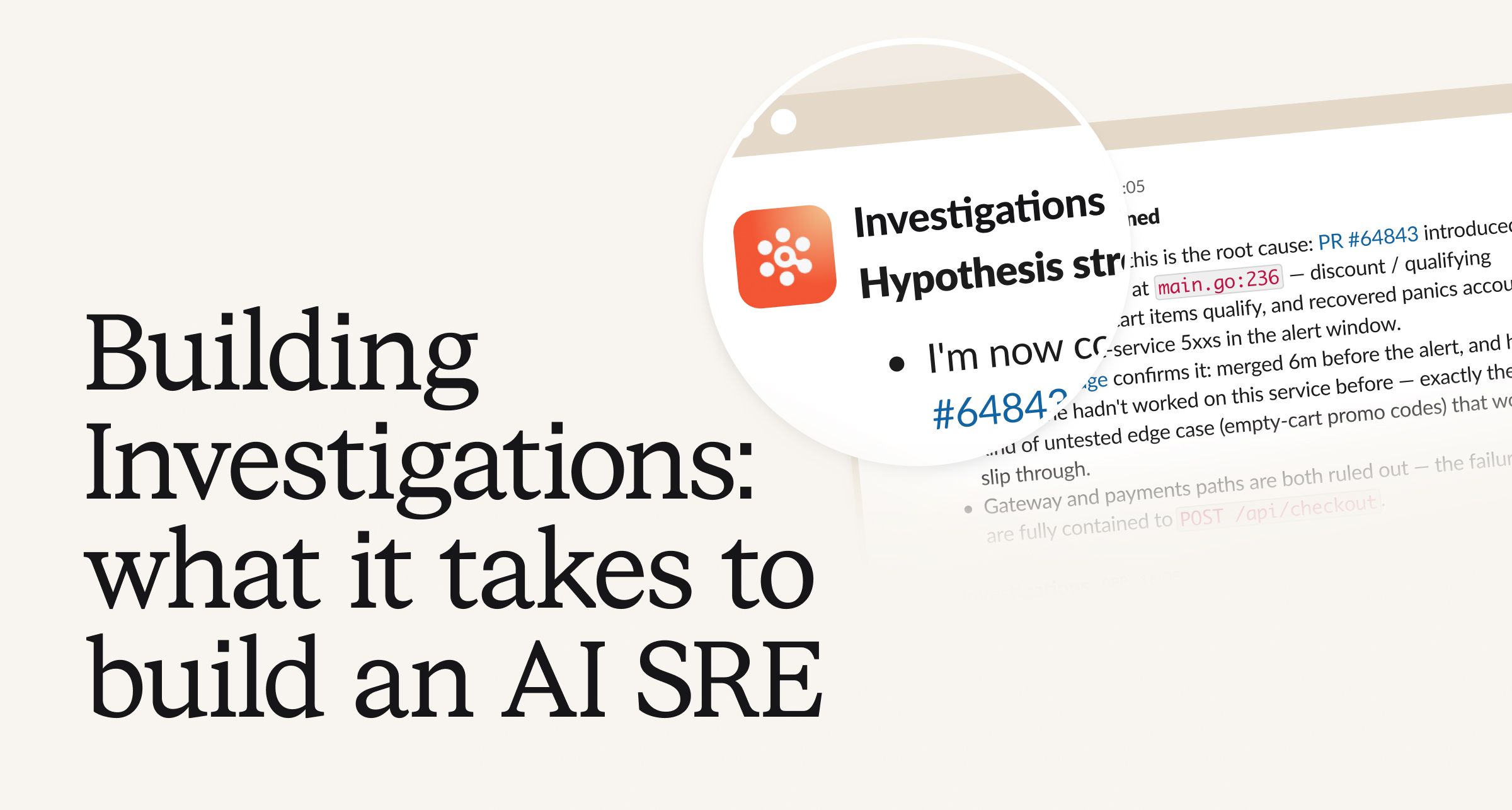
Building Investigations: what it takes to build an AI SRE
We spent the last two years building Investigations, our AI SRE. In this post, go behind the scenes of the work done and why build vs. buy is one of the most important decisions engineering teams are making right now.

October 1, 2026
Introducing Investigations, powered by Nexus.
Today we're launching Investigations: agentic root cause analysis that starts the moment you're paged, figures out what broke and why, and works with your team through to resolution. Here's what we built, what's powering it, and why it took some time to get right.

August 5, 2026
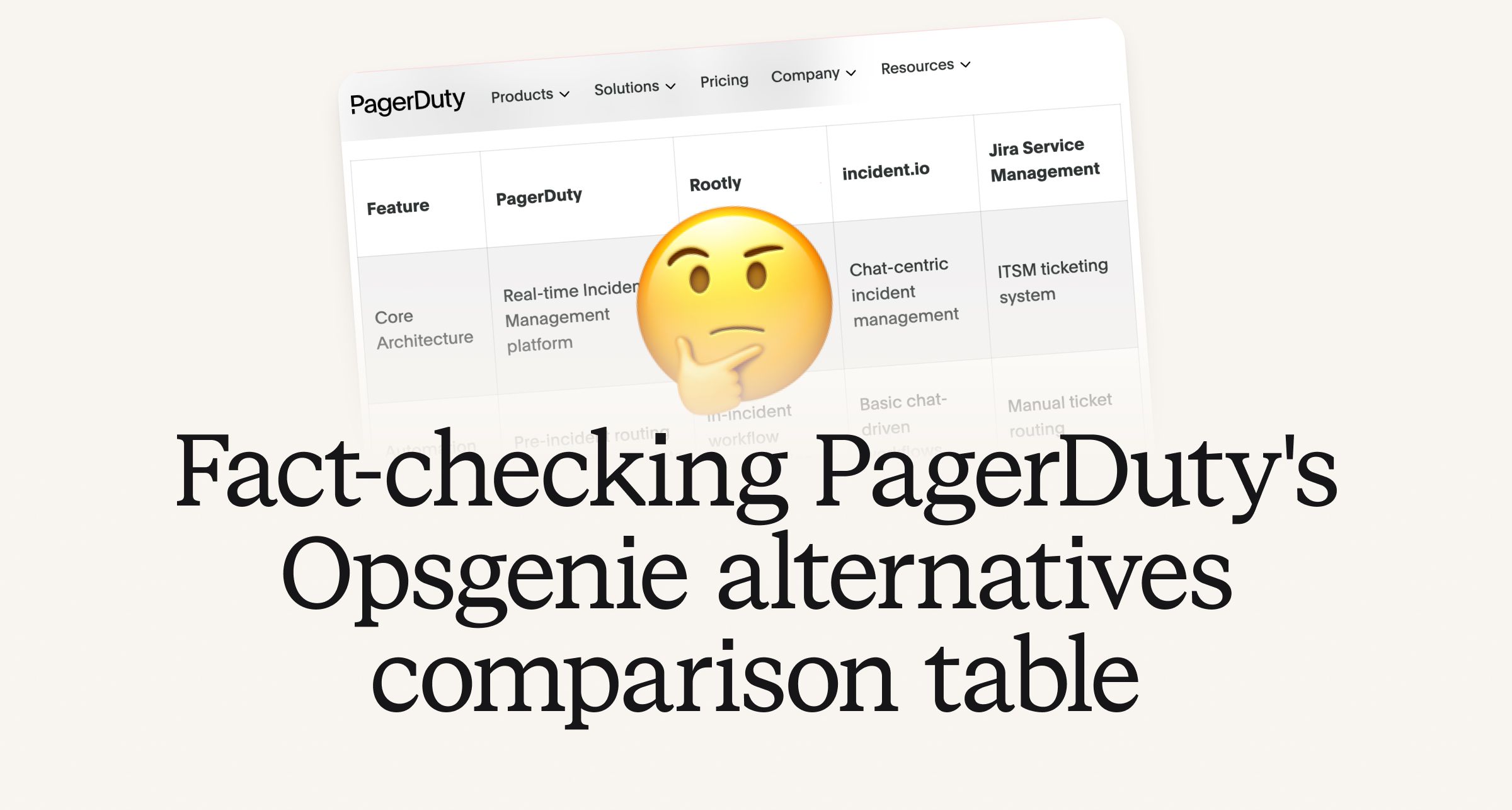
Fact-checking PagerDuty's Opsgenie alternatives comparison table
PagerDuty published a new comparison table about incident.io. Once again, it describes a product we don't recognize. So once again, we're correcting the record, row by row, with receipts.

July 28, 2026
So good, you’ll break things on purpose
Ready for modern incident management? Book a call with one of our experts today.
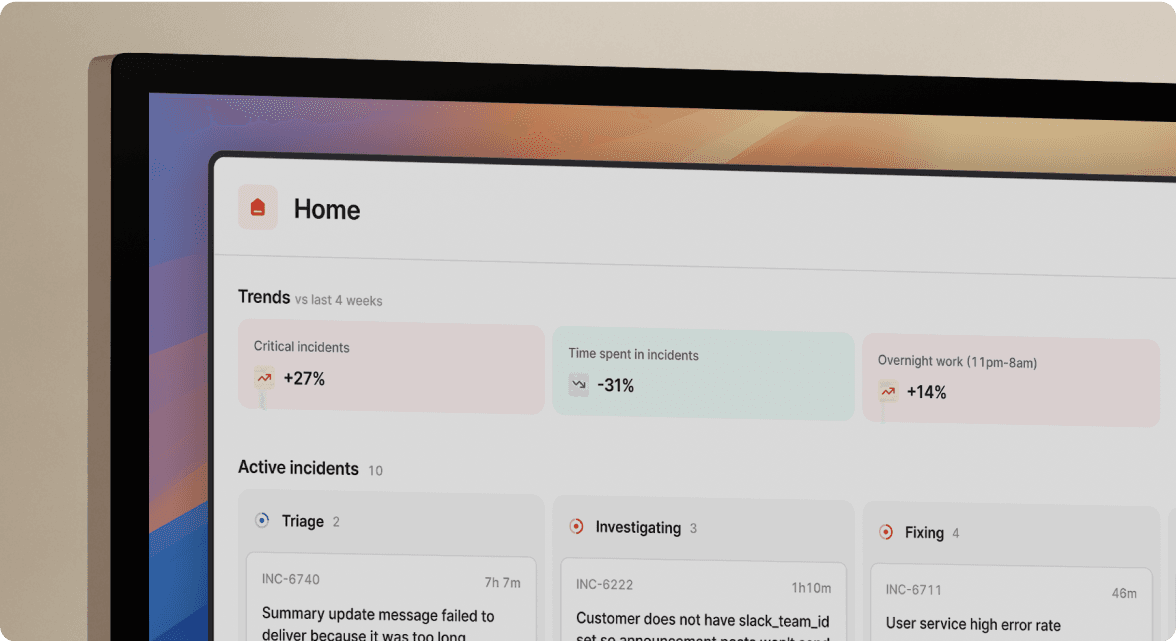
We’d love to talk to you about
- All-in-one incident management
- Our unmatched speed of deployment
- Why we’re loved by users and easily adopted
- How we work for the whole organization