AI-powered incident detection: a buyer's guide for engineering leaders
September 15, 2026 — 18 min read
TL;DR: AI incident detection typically addresses anomaly detection, alert correlation, and noise reduction. Before talking to vendors, baseline your current MTTR and false positive rate, then ask every vendor to run their model on your alert history. The best tools explain their reasoning, integrate with your existing monitoring stack, and show a clear human hand-off path. incident.io's Investigations analyzes root cause and drafts fix PRs a human reviews and merges.
Every AI incident detection vendor has a demo that looks like magic. Almost none of them will show you their false positive rate on your data. That gap between demo and reality is why so many engineering leaders walk out of vendor calls impressed and walk into procurement regretful six months later.
This guide gives you a vendor-neutral framework for evaluating AI-powered incident detection before you talk to anyone. You'll learn what the technology actually automates, which claims you can verify with your own alert history, and when your team is genuinely ready for it. The contrarian take up front: AI detection is real, but it's narrower than vendors claim, and the best evaluation tool you have is your own data, not a vendor's benchmark.
Separating hype from substance
The first step in any evaluation is understanding what the technology does under the hood, because vendors use the same words to describe very different capabilities.
Improving on traditional tools with AI
Traditional alerting runs on static thresholds: if a metric exceeds a fixed limit, page someone. That works for known failure modes with hard limits, like a full disk, but it misses everything else and generates a flood of false alarms. AI anomaly detection learns your system's baseline behavior and flags deviations from it, which matters because context changes everything. A latency spike during peak traffic might be normal, while the same spike overnight could point to a problem, and static thresholds can't tell the difference.
Defining the 3 pillars of AI detection
So what is AI incident detection, technically? It comes down to three verifiable pillars:
- Anomaly detection: Identifying deviations from learned baseline behavior.
- Alert correlation: Grouping related alerts into a single incident. AI Operations (AIOps) platforms typically group related incidents into one issue, so multiple alerts from a database outage become one incident instead of many pages.
- Noise reduction: Suppressing alerts that don't require human action, like transient issues that resolve themselves quickly.
Rule-based detection uses pre-defined thresholds that experts encode in advance, and it offers complete coverage of known failure modes while missing novel or unexpected failures entirely. If a vendor can't explain which pillar their product uses and how, you're looking at marketing, not engineering.
Knowing what AI doesn't replace
AI incident detection is a force multiplier for triage, not a replacement for human incident command. Root cause analysis under genuine uncertainty still requires human judgment, because the AI suggests and the human decides. Accountability doesn't transfer either: a human owns the incident, the post-mortem, and the follow-up actions. And incident command, meaning coordinating people, communicating with stakeholders, and managing customer expectations, remains a human job. Any vendor implying otherwise is selling you a liability.
Keeping humans in the lead on incident response
The human-in-the-loop requirement is non-negotiable: AI should show its reasoning, not act autonomously on production. Credible tools require every remediation action to be logged, auditable, and reversible, with a shadow-mode trial period before any live execution. This is how we built Investigations: it analyzes root cause and drafts a fix PR, but a human reviews and merges it. Investigations never takes action on your systems on its own.
Distinguishing security tools from reliability tools
Before evaluating vendors, clarify whether you're solving a security operations problem or a reliability engineering problem, because the tools are built for different outcomes. Security Operations Center (SOC) tools focus on threat detection and Security Information and Event Management (SIEM) correlation, while Site Reliability Engineering (SRE) tools focus on incident detection and MTTR reduction.
| Tool focus | Primary use case | Key metrics |
|---|---|---|
| Security (SOC) | Threat detection, alert triage, SIEM correlation | Time-to-containment, alert accuracy |
| Reliability (SRE) | Incident detection, MTTR reduction, on-call coordination | MTTR, alert volume, on-call load |
incident.io sits in the reliability category. We integrate with your monitoring stack to coordinate incident response in Slack, not to detect security threats or parse SIEM logs.
Solving noise in your pipeline
With the pillars defined, here's where AI-powered incident detection and response delivers measurable value for a lean team.
Filtering noise from signals
You face alert fatigue as the core problem. Teams receive over 2,000 alerts weekly, with only 3% needing immediate action, which can lead to missed critical alerts and prolonged outages. When alert volume becomes overwhelming, attention can decline and reaction times may slow.
This is the pain we hear constantly from teams evaluating incident.io. AI can learn your baseline patterns to address this, potentially suppressing known-noise alerts and escalating genuine anomalies. Track alert volume, false positive rate, and MTTR before and after adoption. Those three numbers tell you whether the tool works. Your results depend on your alert history and incident mix.
Reducing alert fatigue with AI
Alert fatigue is a human problem before it's a tooling problem: engineers start ignoring alerts, then miss real incidents. AI reduces fatigue by cutting alert volume, not by adding smarter alerts on top of the noise. Filtering noisy sources at ingestion keeps them from ever reaching your team.
Flagging emerging system threats
Early warning is where AI earns its keep. It can detect subtle patterns that precede failures and correlate signals across services. Cross-signal correlation is one capability agentic AI brings to incident response, but the term means something broader: autonomous agents that perceive your production environment, gather evidence, form and test hypotheses, identify root cause, and either remediate within set boundaries or hand a responder a finished investigation. This is the focus of talks like Building Incident-Response Agents at KCD, which shows agents starting root cause analysis before a human opens their laptop.
Verifying AI incident detection claims
This is the section to bring into every demo. Each verification step maps to a pillar, and each has a red flag that tells you to walk away.
| Pillar | What it does | Question to ask | What to watch for |
|---|---|---|---|
| Anomaly detection | Flags deviations from baseline | "What's your false positive rate on our data?" | Requires learning period |
| Alert correlation | Groups related alerts | "Show correlation on our alert history" | Canned demo data only |
| Noise reduction | Suppresses non-actionable alerts | "What's the learning period?" | Claims of 100% accuracy |
Validating claims with technical specs
Ask for model architecture, training data sources, and how the model handles seasonality. Anomaly detection typically requires historical data to establish baseline patterns, so "works out of the box with no learning period" may be an oversell. For platform maturity, map vendor capabilities against the four standard AIOps stages: Detect (ingesting logs, metrics, traces, and events), Diagnose (correlating signals to find root cause), Decide (determining the right response), and Act (applying the fix), where the system baselines normal behavior so real deviations stand out.
Assessing AI accuracy with internal data
The single most important question in any evaluation: "Can you run your model on our alert history from the last 30 days and show false positive and false negative rates on our environment?" If a vendor refuses to test on your data, that's the biggest red flag you'll see, because vendors confident in their systems welcome testing. Also watch for consistency: a system that scores 98% on one dataset but 70% on another hasn't learned robust detection patterns.
Quantifying AI incident false alarms
Define your terms before the demo so vendors can't cherry-pick:
- False positive rate: The percentage of flagged alerts that aren't real incidents.
- False negative rate: The percentage of real incidents the AI misses.
These two trade off against each other. When you reduce false positives by moving the decision boundary to be more conservative, you inevitably increase false negatives, so no configuration eliminates both. A practical target is a false positive rate below 10% for actionable alerts. Ask for both numbers, because most vendors only share the flattering one.
Confirming system integration specs
Verify native integrations with your monitoring tools first. incident.io automatically pulls the originating Datadog monitor when you create an incident, and our alert source set-up improvements keep reducing that configuration burden. Then check where the response happens. A web-first tool that posts notifications to Slack is not the same as a Slack-native platform where the full incident lifecycle runs in chat.
Timing AI model learning cycles
Ask how long the model takes to learn your environment (expect days to weeks, not minutes), whether it needs labeled training data from your team, and how it handles model drift when your system behavior changes. A good model continuously learns from new data and adapts to system changes while still detecting true anomalies.
Pressure-testing vendor claims in the room
Vendor calls are where hype compounds fastest. Use these checks to keep the conversation grounded in your own environment.
Spotting warning signs of AI marketing hype
Watch for these patterns in pitch decks and demos:
- Vague "proprietary AI" claims: Some vendors use deep learning models, while others apply simple statistical rules and call them AI.
- Vendor-only benchmarks: Independent third parties rarely produce the accuracy claims vendors share, so ask accurate on what dataset, and tested by whom.
- Perfect detection rates: Any vendor claiming 100% detection is overselling, because incidents evolve faster than training data updates.
- Autonomous remediation with no human review: No credible vendor claims fully autonomous production changes without approval gates.
Vetting AI claims in live demos
Ask the vendor to run the demo on your data, not a canned scenario. Ask what happens when the AI is wrong: what's the false positive rate, and how does a human override? Ask to see the reasoning, not just the conclusion. Technical walkthroughs like our own Inside Investigations webinar will show what evidence-first AI looks like in practice: Investigations surfaces telemetry, code changes, and past incident patterns before suggesting a root cause.
Demanding proof, not promises, from vendors
Ask for a named customer at a similar stage, not enterprise logos. Ask for a trial period with your own data rather than a sandbox with synthetic data. And ask about the human hand-off: when the AI flags something, who gets paged and who decides what happens next?
Recognizing when your team is ready for AI detection
Not every team benefits from AI detection at the same stage. The signals below tell you where you actually stand.
Combating alert fatigue with AI
You're ready when engineers are ignoring alerts, or when a real incident was missed because it drowned in noise. You're not ready if you're still establishing basic monitoring and a formal on-call rotation, so fix those first, because AI layered on a broken foundation automates the chaos.
Identifying recurring outages with AI
AI pattern-matches against past incidents, surfacing something like: "this looks like the database connection pool exhaustion from last month." This is where Investigations does its best work, analyzing telemetry, code changes, and incident history to surface likely root causes and generate environment-specific fixes that humans validate before acting.
Automating high-volume incident triage
Volume is the deciding factor. If you're handling 5-20+ incidents per month, AI triage saves real time. Investigations automates up to 80% of incident response, which is where teams see the biggest MTTR gains. One caution: MTTR depends on architecture, severity mix, and where you draw incident boundaries, so cross-company comparisons are usually misleading. Measure against your own baseline.
Sticking with manual tools
Be honest with yourself here. Stick with manual coordination if:
- You're under 20 engineers and incidents are rare (1-2 per month).
- You don't have a formal on-call rotation yet.
- Your monitoring stack is still being set up.
In those cases, start with manual coordination and upgrade when your incident volume justifies automation.
Rolling out AI detection in phases
Phase your rollout so you don't trust the AI before it's earned that trust. Implementation guides consistently recommend starting with a focused pilot on a manageable scope to demonstrate early value and gather feedback.
| Phase | Duration | What to do | Success metric |
|---|---|---|---|
| Baseline | Weeks 1-2 | Record MTTR, alert volume, false positive rate | Documented baselines for all three |
| Shadow mode | Weeks 3-6 | AI flags incidents, humans respond manually | False positive rate under 10% |
| Limited rollout | Weeks 7-12 | AI triages, humans confirm before acting | Meaningful MTTR reduction, validated against your own baseline |
| Full operation | Weeks 13+ | Expand coverage, monitor model drift | Sustained MTTR improvement |
Baselining metrics before AI intervention
You can't measure improvement without a baseline. Establish the four core DevOps Research and Assessment (DORA) metrics first: lead time, deployment frequency, MTTR, and change failure rate. Calculate MTTR by dividing total incident resolution time by number of incidents, and track it alongside MTTA (time to acknowledge) and MTTD (time to detect). Your incident management tool already has this data, so start and resolution times are easy to pull.
Benchmarking real AI detection accuracy
Run the AI in shadow mode: it flags incidents, but humans still handle them manually. Run new automation in parallel with production traffic for at least two weeks, logging what the AI would have done without executing. Compare AI flags against human judgment for 2-4 weeks and measure false positive rate, false negative rate, and time-to-detect.
Managing model drift and feedback
When you change your infrastructure, the AI's learned baseline becomes obsolete, and that's model drift. Ask vendors whether retraining is automatic or manual, and what feedback mechanism exists when the AI gets it wrong. Then use that feedback loop so the model improves.
Designing reliable human hand-off flows
The AI flags an incident. What happens next? Define who gets paged, who becomes incident commander, and how the team assembles. In incident.io, the flow runs entirely in Slack: an alert fires, a dedicated channel is created, on-call is paged, and the timeline starts recording, with the team running the response through /inc commands. On the data side, we hold Zero Data Retention agreements with OpenAI and Anthropic, and sensitive patterns are redacted before content reaches any AI model, which our AI governance documentation covers in detail.
"Just few months after the implementation of the tool we saw a huge improvement of our Incident Management process." - Henrique P. on G2
The framework in this guide comes down to one principle: your alert history is a better evaluation tool than any vendor's benchmark. Baseline your MTTR and false positive rate before you talk to anyone, run every shortlisted vendor against your own data, and phase the rollout until the AI earns autonomy. That's how you buy a tool that works in your environment, not someone else's.
Book a demo of incident.io and see how Investigations analyzes your actual alerts and drafts fix PRs your engineers review in Slack. We'll show you the false positive rate on your data, not a canned benchmark.
Key terms glossary
Anomaly detection: Identifying deviations from baseline system behavior using statistical or machine learning models.
Alert correlation: Grouping related alerts into a single incident to reduce noise.
Noise reduction: Suppressing alerts that don't require human action.
False positive rate: The percentage of alerts the AI flags that aren't real incidents. A rate of zero usually means the AI is missing real incidents instead.
Shadow mode: A deployment phase where the AI flags incidents but humans still respond manually. Runs 2-4 weeks to benchmark accuracy before trusting the AI in production.
FAQs

Tom Wentworth
Chief Marketing Officer
See related articles
Introducing Investigations, powered by Nexus.
Today we're launching Investigations: agentic root cause analysis that starts the moment you're paged, figures out what broke and why, and works with your team through to resolution. Here's what we built, what's powering it, and why it took some time to get right.

August 5, 2026
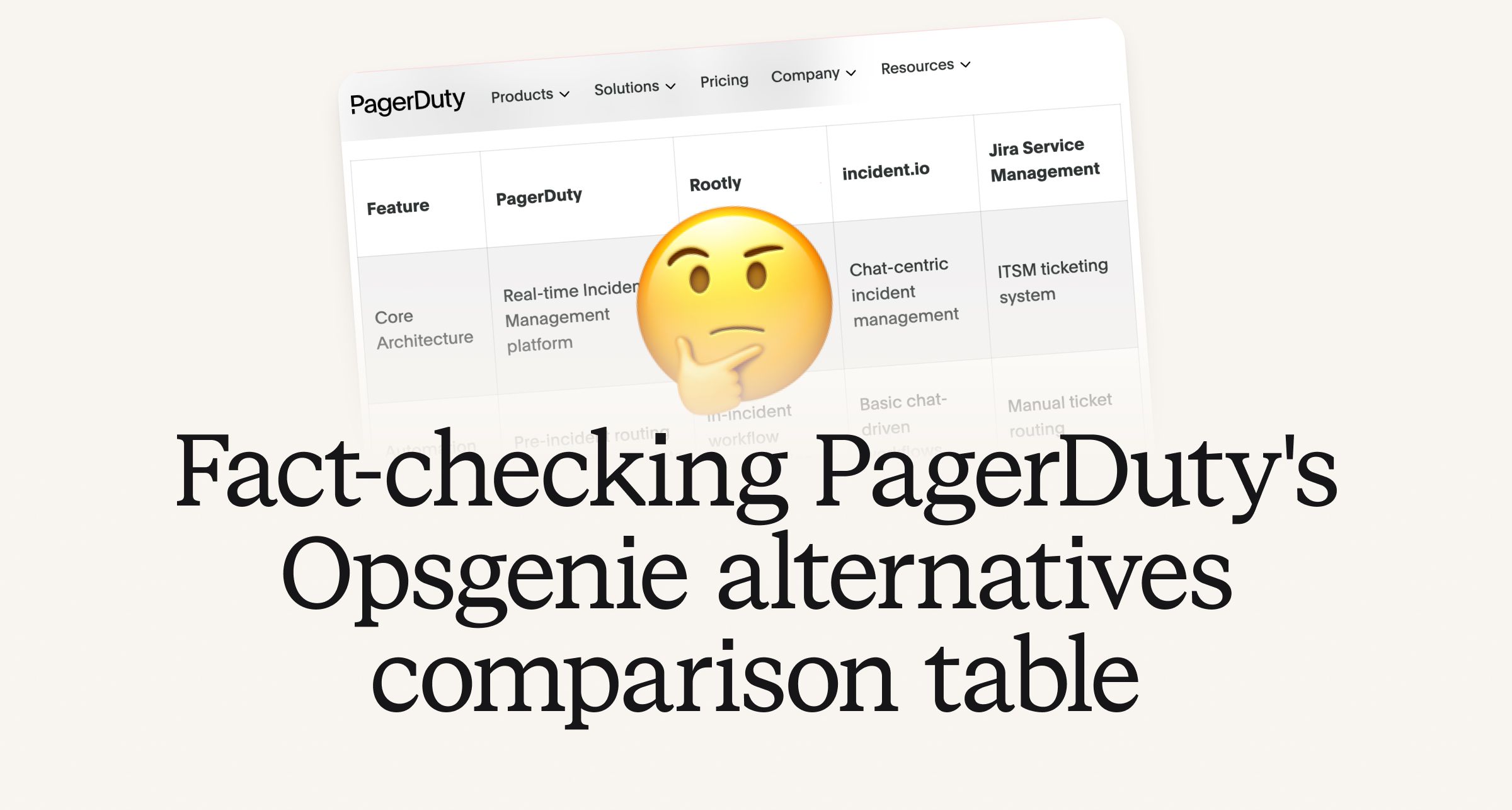
Fact-checking PagerDuty's Opsgenie alternatives comparison table
PagerDuty published a new comparison table about incident.io. Once again, it describes a product we don't recognize. So once again, we're correcting the record, row by row, with receipts.

July 28, 2026

Your genie is vanishing: introducing the Opsgenie rescue program
Today, we're launching the Opsgenie Rescue Program to make that landing soft: simplified migration and free overlap so you never pay two vendors at once.
July 9, 2026
So good, you’ll break things on purpose
Ready for modern incident management? Book a call with one of our experts today.
We’d love to talk to you about
- All-in-one incident management
- Our unmatched speed of deployment
- Why we’re loved by users and easily adopted
- How we work for the whole organization