PagerDuty vs. Rootly: A 2026 comparison for engineering leaders
March 6, 2026 — 15 min read
Updated March 06, 2026
TL;DR: PagerDuty is the industry benchmark for waking people up when production breaks, but it stops short of helping you coordinate the response. Rootly closes that gap with powerful workflow automation, though teams consistently report a steep configuration curve before it pays off. If you want Rootly's automation power and PagerDuty's alerting reliability in a single Slack-native platform your team can use from day one, incident.io is the option most engineering teams are choosing in 2026. One team saved roughly 50% on on-call costs by consolidating from PagerDuty into incident.io while improving their overall response process.
Your phone buzzes at 2 AM. You open Slack, manually create an incident channel, ping teammates one by one, open Datadog, start a Google Doc for notes, and remember to update Statuspage somewhere in between. The tool that woke you up gives you zero help with what comes next.
That gap is exactly where the PagerDuty vs. Rootly debate lives, and it's the reason more engineering teams are asking a sharper question in 2026: which platform actually reduces MTTR, not just mean time to page?
This guide breaks down both tools across four rounds: alerting and on-call, workflow automation, AI and post-incident learning, and pricing. Then we explain why incident.io has become the third option many teams choose instead.
At a glance: the main differences between PagerDuty and Rootly
| Capability | PagerDuty | Rootly | incident.io |
|---|---|---|---|
| On-call management | Multi-layer escalation, live call routing | Native on-call with schedules and overrides | $20/user/mo add-on, bundled in Pro pricing |
| Alert routing | Advanced event orchestration (higher tiers only) | Ownership-based routing, noise reduction | Priority-based routing, deduplication, team routing |
| Slack integration | Notifications piped to Slack, web-first platform | Slack-native incident workflow | True Slack-native: full lifecycle in Slack |
| Workflow automation | Process Automation via Rundeck add-on ($125/user/month) | Extensive configurable workflow engine | Automated workflows included, Catalog-driven |
| AI features | AIOps: noise reduction and alert grouping (add-on) | AI SRE: root cause suggestions, summaries | AI SRE: auto-drafted post-mortems, thread summaries |
| Status pages | Sold separately ($1,068+/year per pack) | Included | Included |
| Post-mortems | Basic, largely manual | Auto-populated from timeline | AI-drafted from captured timeline data |
| Pricing model | Base + multiple add-ons | Lower cost than PagerDuty, published pricing | Transparent per-user pricing, on-call as $20/user/mo add-on |
We see a clear pattern: PagerDuty charges separately for nearly every capability beyond alerting, as confirmed by independent pricing analysis on Vendr. Rootly bundles more into a single product but trades that breadth for configuration complexity. incident.io ships the full stack, from on-call through to post-mortems, in one Slack-native platform.
We see teams fall into a common trap: buying PagerDuty for alerting and Rootly for workflows, paying for both, and still not solving the coordination problem inside Slack where the team actually works.
Round 1: On-call management and alert routing
PagerDuty: the alerting standard
PagerDuty built its reputation on one thing: reliably waking up the right person. Its on-call engine is built around multi-layer escalation policies and live call routing that routes inbound calls through the same escalation policies as alert-triggered pages, and Gartner reviewers consistently cite this operational stability as the primary reason teams stay on it.
The tradeoff is complexity. Setting up Event Orchestration, PagerDuty's most advanced routing capability, requires higher-cost tiers and significant configuration time, and G2 data shows complexity as the second most commonly cited problem among PagerDuty customers.
Rootly: native on-call, catching up fast
Rootly's on-call product now covers schedules, escalation policies, overrides, ownership-based routing, and alert deduplication. For most mid-market use cases, Rootly can replace PagerDuty's core on-call function, though advanced telephony routing remains an area where PagerDuty holds an edge based on independent platform comparisons.
How incident.io handles alert routing
incident.io builds alert routing around your service ownership model. Priority-based routing maps alert severities directly to on-call schedules, and team routing automatically escalates to the right responder based on Catalog ownership, not a manually maintained spreadsheet. Alert deduplication suppresses noise before it creates unnecessary pages, and escalations from alerts flow directly into incident channels without manual intervention. For teams migrating off PagerDuty, our dedicated migration guide covers schedule import, escalation policy mapping, and a parallel-run strategy.
"The recent addition of on-call allowed us to migrate our incident response from PagerDuty and it was very straight forward to setup." - Harvey J. on G2
Round 2: Workflow automation and Slack functionality
PagerDuty: powerful automation locked behind an add-on
PagerDuty acquired Rundeck in 2020 to add runbook automation to its platform. The result, Process Automation, is priced at $125 per user per month plus a platform fee, entirely separate from core incident management licensing. PagerDuty's Slack integration sends notifications and allows basic actions (acknowledge, escalate, resolve), but PagerDuty remains fundamentally web-first by design. Our analysis of PagerDuty's data model explains why this architecture creates friction during fast-moving incidents.
Rootly: the workflow powerhouse with a configuration tax
Rootly's workflow engine is genuinely impressive, triggering automations on incident creation, field changes, status updates, and channel events, and building complex multi-step coordination logic without writing code. The Slashdot comparison of the two platforms confirms Rootly's automation capabilities are a clear differentiator over PagerDuty's base product.
But the power comes with a cost. G2 reviewers of Rootly consistently flag the configuration overhead, describing the Workflows tab as "daunting" with dozens of workflows to manage, noting it "can feel a bit complex to set up initially, especially for smaller teams without dedicated DevOps resources," and observing that "learning all sorts of possibilities takes some time" due to the many dependencies involved in deep customization.
For a 6-person SRE team handling 15 to 25 incidents a month, spending weeks configuring workflow logic competes directly with actual reliability work.
incident.io: Slack-native without the configuration tax
incident.io's approach is different. The entire incident lifecycle, from declaration through resolution to post-mortem, runs in Slack using /inc commands your team learns in minutes. Here's what we've seen work in practice:
- Datadog alert fires. incident.io automatically creates
#inc-2847-api-latency. - On-call engineer is paged. Service owners are pulled in from Catalog automatically.
- Timeline capture begins. Every action is recorded before a human types a single command.
- Responder types
/inc assign @sarah. Sarah becomes incident commander. - Sarah types
/inc escalate @database-team. DB engineer joins immediately. - Fix applied. DB engineer types
/inc resolveand the AI-drafted post-mortem appears.
The Slack App Marketplace listing describes the practical result: declare, coordinate, and resolve incidents without leaving Slack, with role assignment, escalations, metadata updates, and checklists all handled through slash commands.
Round 3: AI features and post-incident learning
PagerDuty AIOps: noise reduction at scale
PagerDuty's AI story is built around AIOps, focusing on reducing alert noise, grouping related events, and ML-assisted triage. The capability is well-suited to large NOC environments processing thousands of alerts daily. For most 50 to 500 person engineering teams it's often overkill, and it requires purchasing AIOps on top of an existing Professional or Business plan.
Rootly AI SRE: contextual suggestions
Rootly's AI SRE module generates incident summaries, surfaces probable root causes, and identifies similar past incidents to inform the current response. The specific performance claims vary, so evaluate any vendor-provided figures against your own incident patterns during a trial.
incident.io AI SRE: practical post-mortem automation
Our AI focuses on the highest-value, lowest-hallucination-risk task: auto-drafting post-mortems from the timeline data captured during the incident. Because we build the timeline from actual Slack activity, commands, escalations, and resolutions, the AI draft is grounded in real context rather than inferred from logs.
Round 4: Pricing and total cost of ownership
This is where PagerDuty's model creates the most friction. The base license is just the starting point.
PagerDuty pricing breakdown for 50 users:
| Plan component | Annual cost (50 users) |
|---|---|
| Professional ($21/user/month) | $12,600 |
| Business ($41/user/month) | $24,600 |
| Status pages (per pack) | $1,068+ |
| AIOps | Add-on (requires Business plan first) |
| Process Automation (Rundeck) | $125/user/month + platform fee |
A 50-user Business team with a single status page pack lands at roughly $25,600 to $27,000 per year before touching AIOps or automation. Vendr's market data on PagerDuty confirms that actual spend typically runs well above advertised base rates once teams add the capabilities they actually need.
The PagerDuty + Rootly combined stack:
Many teams end up running both tools, PagerDuty for alerts and Rootly for workflow coordination. Based on published pricing tiers, that combination breaks down to roughly PagerDuty Business at $24,600 per year plus Rootly at $12,000 to $15,000 per year for a 50-user team, putting the combined total at approximately $36,600 to $39,600 annually, while still requiring two separate tools to manage and integrate.
incident.io Pro plan:
incident.io's Pro plan includes on-call scheduling, alerting, Slack-native incident response, status pages, AI-assisted post-mortems, and advanced Insights dashboards. For 50 users, that is $27,000 per year with status pages and post-mortems already included, no add-ons required. The G2 pricing overview for incident.io confirms the per-user structure, and siit.io's independent review notes the transparent pricing model as a notable contrast to the opaque enterprise pricing common elsewhere in this category.
The consolidation math is direct: replacing PagerDuty Business ($24,600) plus a Rootly subscription with incident.io Pro ($27,000) reduces tool count while the included status pages and post-mortems offset the gap.
The alternative: why teams choose incident.io
PagerDuty is a smoke detector. PagerDuty excels at that job, and we integrate with it rather than dismiss it. But a smoke detector does not organize your fire response. incident.io is the fire response team: it assembles responders, assigns roles, captures every decision in a timeline, and auto-drafts the post-mortem when the smoke clears.
We distinguish ourselves from Rootly through equally practical differences. Rootly gives you the tools to build a sophisticated coordination machine, but you have to build it first. incident.io ships with opinionated defaults that work on day one, and your team can iterate from there.
Teams migrating from PagerDuty describe the same shift repeatedly:
"I'm new to incident.io since starting on a new job, after many years using Atlassian's Statuspage and PagerDuty. Three things that I believe are done very well in incident.io: integration with other apps and platforms, holistic approach to incident alerting and notifications, and customer/technical support. It's on a very different level (much better) from other vendors." - Rodrigo Q. on G2
"The on-call features seamlessly support Pagerduty as well as their internal on-call solution enabling smooth and safe migration if and when we want to do it." - Rui A. on G2
Teams using incident.io can reduce MTTR by up to 80% by eliminating coordination overhead. The incident.io migration tools for PagerDuty make the transition practical through schedule imports, escalation policy mapping, and a PagerDuty integration that lets you run both in parallel until you're confident.
Which platform fits your team
Choose PagerDuty if you're a large enterprise with complex multi-system telephony routing requirements, legacy integrations that depend on PagerDuty's ecosystem, and a dedicated team to manage its configuration and add-on budget.
Choose Rootly if you need deep, customizable workflow automation and have DevOps resources to configure and maintain it over time.
Choose incident.io if you want a modern unified platform your team adopts from day one, with on-call, alerting, Slack-native coordination, status pages, AI-assisted post-mortems, and an Insights dashboard at transparent per-user pricing with a clear migration path.
If your current stack is PagerDuty for alerts plus something else for coordination and you're paying for both, consolidating into incident.io reduces cost, eliminates tool-switching overhead, and gives you MTTR data you can actually show to your VP Engineering.
Book a demo and we'll walk through alert routing, Catalog-driven escalations, and AI post-mortem generation with your actual use case.
Key terminology
MTTR: Mean Time To Resolution, the average time from incident detection to full service restoration and the primary metric SRE teams use to measure incident response efficiency.
Slack-native: Built to run entirely within Slack, not just integrated with it, meaning the full incident lifecycle, from declaration through resolution and post-mortem, happens through Slack channels and slash commands without requiring a separate web interface.
On-call rotation: The schedule defining which engineers are responsible for responding to alerts during a given time period, including primary, secondary, and escalation layers.
Event Orchestration: A routing capability that evaluates incoming alert data and directs it to the appropriate escalation path based on rules, conditions, or service ownership. Available in PagerDuty on higher-cost tiers and built into incident.io's alert routing by default.
Post-mortem: A structured review documenting an incident's timeline, root cause, and follow-up actions. AI-assisted post-mortems auto-populate from captured timeline data rather than requiring manual reconstruction.

Tom Wentworth
Chief Marketing Officer
See related articles
Introducing Investigations, powered by Nexus.
Today we're launching Investigations: agentic root cause analysis that starts the moment you're paged, figures out what broke and why, and works with your team through to resolution. Here's what we built, what's powering it, and why it took some time to get right.

August 5, 2026
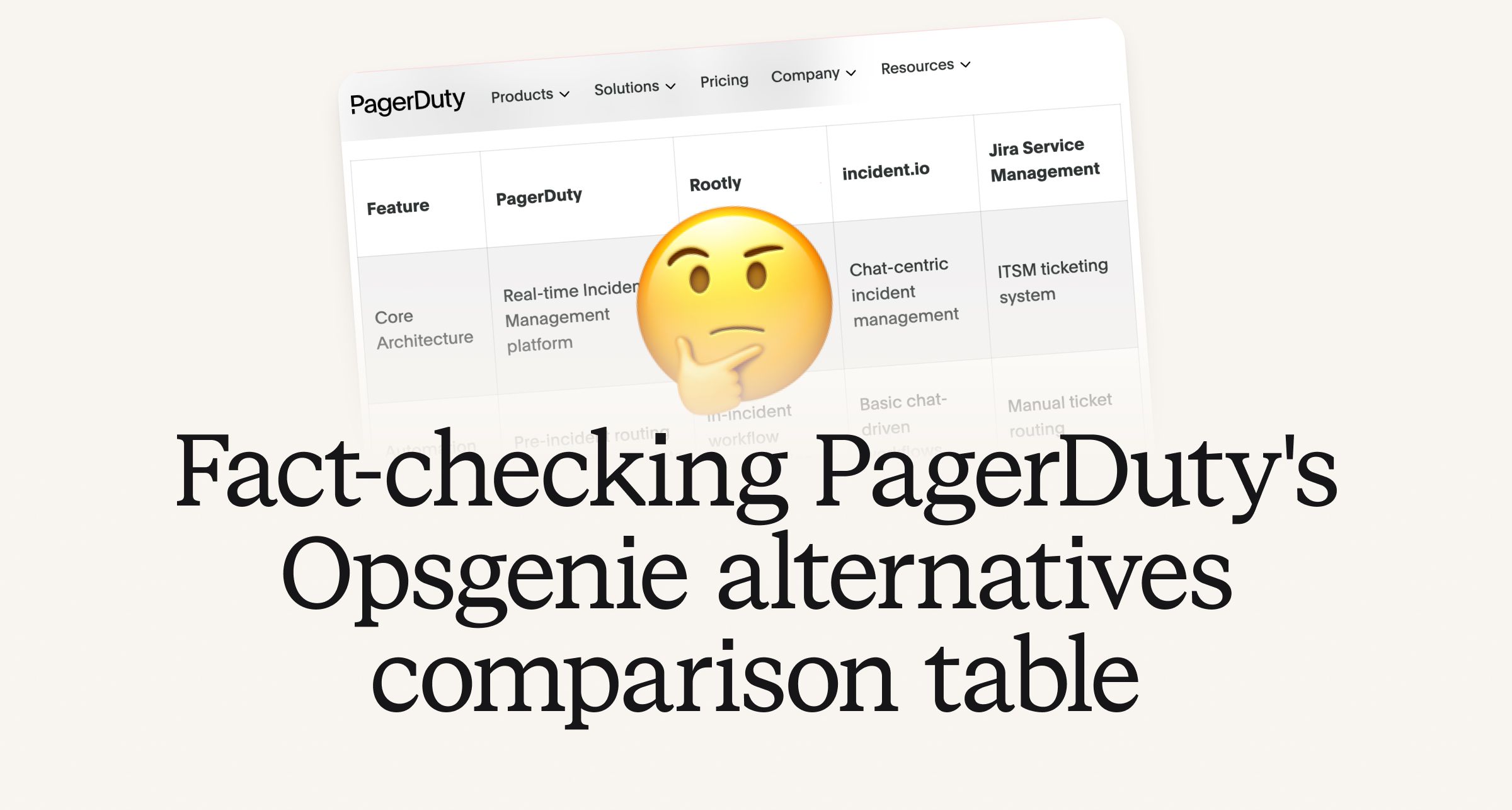
Fact-checking PagerDuty's Opsgenie alternatives comparison table
PagerDuty published a new comparison table about incident.io. Once again, it describes a product we don't recognize. So once again, we're correcting the record, row by row, with receipts.

July 28, 2026
Your genie is vanishing: introducing the Opsgenie rescue program
Today, we're launching the Opsgenie Rescue Program to make that landing soft: simplified migration and free overlap so you never pay two vendors at once.
July 9, 2026
So good, you’ll break things on purpose
Ready for modern incident management? Book a call with one of our experts today.
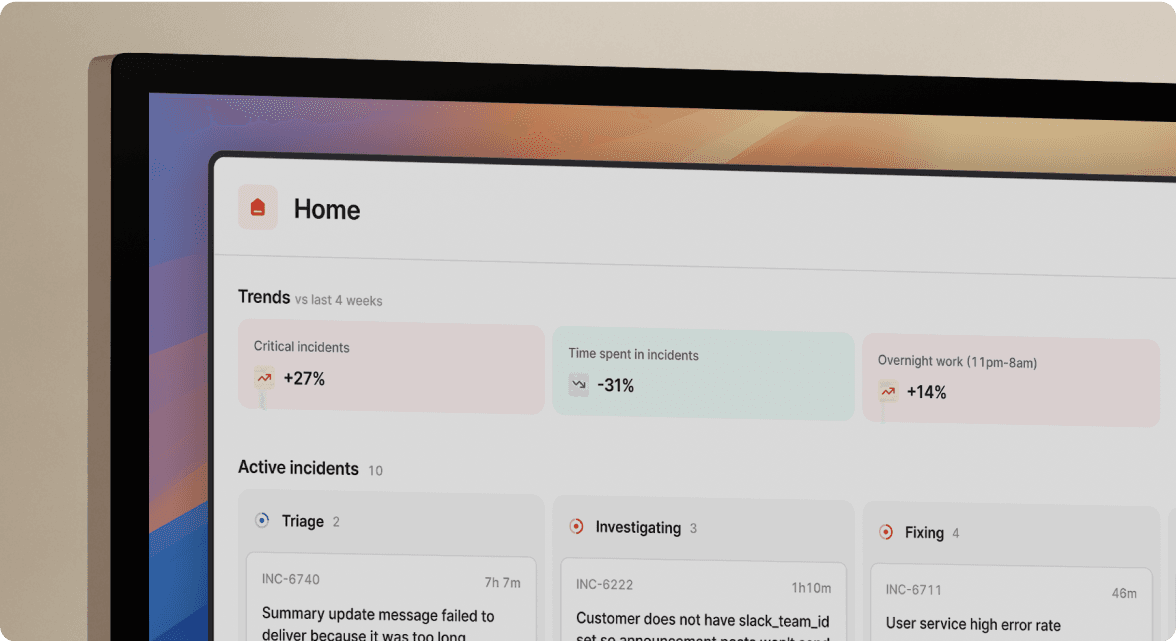
We’d love to talk to you about
- All-in-one incident management
- Our unmatched speed of deployment
- Why we’re loved by users and easily adopted
- How we work for the whole organization