Incident response software pricing 2026: complete guide to costs, models, and total cost of ownership
June 19, 2026 — 21 min read
TL;DR: In 2026, incident response software pricing is defined by total cost of ownership, not per-seat fees. PagerDuty charges $21-$41/user/month and prices AI features (AIOps and Advance AI) as separate add-ons not included in any base tier. Contact PagerDuty sales for current pricing. incident.io offers transparent all-in pricing at $45/user/month on the Pro plan (with on-call included), with a Team plan available at $25/user/month. With Atlassian sunsetting Opsgenie on April 5, 2027, migration planning is urgent in 2026. Consolidating alerting, coordination, and post-mortems into a Slack-native platform eliminates the coordination tax that drives your real operational costs.
In 2026, if you are an Engineering Manager or DevOps Lead evaluating incident response software, the sticker price tells you almost nothing about what your team will actually spend. A $21/user/month platform looks affordable until you add on-call scheduling fees, AIOps add-ons, and professional services for integrations. Then you factor in the operational costs: 15 minutes of coordination overhead per incident, 90 minutes reconstructing timelines for post-mortems, and SLA penalties when high MTTR triggers breach clauses. The subscription fee is a fraction of your true total cost of ownership.
True TCO includes hidden on-call add-ons, integration fees, and the labor cost of manual coordination. This guide breaks down the pricing models of major platforms, exposes hidden costs, and gives you a framework to calculate your actual incident management spend.
Evaluating SaaS pricing for on-call teams
Four pricing models dominate the 2026 incident management market: per-user (seat-based), usage-based, flat-rate, and custom enterprise. Per-user is a common structure for SRE teams because it simplifies annual budget planning. The others create different kinds of budget risk.
Per-seat licensing cost breakdown
Per-seat pricing charges you a flat rate for every user who has access to the platform, regardless of how often they respond to incidents. The predictability is real, but the risk is that base seat costs often exclude critical features like on-call scheduling, forcing you to calculate a true all-in price that can be significantly higher than the advertised headline rate. Always ask vendors: what is the price per user per month with on-call scheduling included? You can review how incident.io structures its billing in the billing methods documentation, which breaks out base seats and on-call add-on costs explicitly.
How responder pricing affects TCO
Some platforms charge a lower base rate for "view-only" users and a higher rate for "full responders." This model looks attractive until a P1 outage pulls in multiple non-SRE engineers who need active access, spiking your per-incident cost exactly when you can least afford friction. The PagerDuty vs incident.io comparison on OpsBrief covers this tradeoff well for teams evaluating both models head-to-head.
Per-incident pricing model
Per-incident pricing charges based on the number of incidents declared rather than the number of users. This model can punish the reliability practices that actually reduce MTTR. When your team knows each declaration costs money, they may hesitate to declare incidents early, which extends outages and increases blast radius. For teams handling significant incident volume, per-incident pricing can scale poorly and create perverse incentives against healthy incident culture.
Optimizing hybrid pricing for SRE teams
You can optimize spend by identifying who genuinely needs full responder access versus read-only. Typically, your core on-call rotation needs full licenses. Product managers and executives who monitor status pages during outages need read access only. Structuring licenses this way reduces your per-seat bill without limiting response capability. Review how incident.io manages seats to understand how this works in practice.
Calculating your 2026 incident management spend
Raw pricing tables only tell part of the story. Here is how costs stack up across team sizes and the build-versus-buy decision.
Build vs. buy: the real cost comparison
Building an in-house incident tool looks cheap on day one because you pay zero in subscription fees. The real cost surfaces fast.
One senior engineer spending 3 months building a Slack bot represents significant opportunity cost at a $150/hour loaded rate, time that cannot go toward reliability work, feature development, or on-call improvements. Then factor in ongoing maintenance: Slack API updates, Datadog schema changes, and authentication reconfigurations each consume engineering hours that compound quarterly. As this build-your-own-tooling reality check makes clear, it is easy to underestimate the complexity of getting the basics right, and almost everyone does.
The result is that maintaining a homegrown system requires ongoing engineering hours in perpetuity, a recurring overhead cost that never appears on any vendor invoice.
"It's tempting to build a Slack-based incident system yourself, don't... incident has a very responsive and competent team. They have built a system with sane defaults and building blocks to customize everything." - Bertrand J. on G2
Pricing tiers for 50-100 engineer teams
For a 50-person on-call team, the annual math on the incident.io Pro plan looks like this:
- 50 users x $45/user/month (Pro with on-call, annual billing) x 12 = $27,000/year
Compare that to a 50-person team on PagerDuty Business: 50 users × $41/user/month × 12 = $24,600/year in base seats, before adding AI features (AIOps and Advance AI), which are separate add-ons not included in any base tier. Contact PagerDuty sales for )
- current AI add-on pricing.
At 100 users on incident.io Pro with on-call: 100 x $45 x 12 = $54,000/year. At 100 users on PagerDuty Business, base seats reach $49,200/year, before AI add-on costs.
Enterprise tier pricing for 500+ engineers
At 500+ engineers, pricing moves to custom contracts. You gain SAML SSO, SCIM provisioning, Slack Enterprise Grid support, sandbox environments, and dedicated Customer Success Managers. SCIM provisioning in 2026 handles automated deprovisioning when engineers leave or change roles, which directly reduces your security audit exposure and is a non-negotiable for SOC 2 compliance reviews.
Hidden costs of incident response software
Your monthly invoice shows the subscription fee. It does not show the 90 minutes your SRE spends reconstructing timelines after every incident, the professional services fee to configure a ServiceNow integration, or the on-call add-on that doubles your quoted price. Here are the line items most sales conversations skip.
On-call scheduling: hidden per-user fees
Most major vendors treat on-call scheduling as a separate add-on, and incident.io is no exception. On the Team plan, on-call adds $10/user/month annually, bringing the true all-in cost to $25/user/month. On Pro, it adds $20/user/month, bringing the all-in cost to $45/user/month. This is a documented pricing decision, not a hidden fee, but many teams only discover it after the initial quote. Always calculate your all-in price before comparing platforms. The incident.io billing documentation lays this out clearly.
"It's a bit expensive although i do understand that a service this good will need this kind of pricing." - Ahmed R. on G2
Integration limits and data retention fees
Legacy vendors often restrict your API access and advanced integrations (ServiceNow, Jira Cloud, custom webhooks) to enterprise tiers. If your team needs bidirectional Jira sync on a mid-tier plan, verify whether that requires an upgrade before signing. Some platforms also impose retention limits on historical incident data and charge for exporting audit logs beyond a certain window.
If you run SOC 2 or GDPR compliance reviews, incomplete incident records can create audit gaps that become costly during compliance reviews. Check the incident.io security FAQs for details on data storage, authentication controls, and SOC 2 compliance. incident.io includes unlimited integrations, API access, and webhooks from the Team plan upward.
Staff training expenses
Training 50 engineers on a web-first tool with a complex UI costs you real money. If onboarding takes even 2 hours per engineer, that's $15,000 in labor cost (50 engineers × 2 hours × $150 loaded rate) before anyone resolves their first incident. Slack-native platforms eliminate most of this because the interface is a Slack command your team already knows. One incident.io customer described their experience:
"Frictionless configuration and onboarding (so easy that our first incident was created/led by a colleague even before the 'official rollout' all by themselves!)" - Luis S. on G2
Support tiers and incident fees
When you file a critical bug during a P1 outage, "we'll respond within 5 business days" amplifies the outage. It does not help you resolve it. PagerDuty's Professional plan offers email-only support. incident.io provides shared Slack channels with direct access to engineering, with bugs fixed in hours. That responsiveness is a recurring theme in customer feedback:
"The customer service team has been incredibly responsive and helpful. The resolution time for the few problems we had was extremely quick." - Igor N. on G2
Calculating the TCO impact of tool silos
Fragmented tooling does not just create frustration during incidents. It converts directly to financial loss at every outage.
Financial impact of incident friction
A single hour of IT downtime costs the average mid-size or large enterprise more than $300,000, according to ITIC's 2024 survey via dotcom-monitor. At those rates, saving 10 minutes of coordination overhead per incident is not a quality-of-life improvement. It is a direct P&L decision that justifies your entire annual software subscription.
Cost impact of manual audit trails
If a senior SRE spends 90 minutes after every incident scrolling Slack threads and Zoom recordings to reconstruct a post-mortem timeline, that burns $225 in engineering time per incident at a $150/hour loaded rate. Across 15 incidents per month, that is $3,375/month ($40,500/year) consumed by administrative reconstruction that adds zero reliability value. incident.io automatically captures the incident timeline (every status update, role assignment, and Slack thread) and Scribe transcribes any calls. Together, the post-mortem arrives 80% drafted without a dedicated note-taker.
"1-click post-mortem reports - this is a killer feature, time saving, that helps a lot to have relevant conversations around incidents (instead of spending time curating a timeline)." - Adrian M. on G2
Quantifying tool-induced productivity loss
During a P1 outage, juggling PagerDuty for alerts, Datadog for metrics, Slack for coordination, Jira for ticket creation, and a Google Doc for notes means your engineers are switching between five tools while the incident actively burns. Every context switch during a live outage translates directly into longer MTTR and worse decisions under pressure. The incident.io in Slack tutorial shows the alternative: the entire incident lifecycle managed through a single Slack channel.
Lowering MTTR via workflow automation
Auto-creating incident channels, paging on-call engineers, and pulling service catalog context drops team assembly time from 15 minutes to 2 minutes. That automation is what the WorkOS incident response transformation demonstrates in practice: faster time to coordinated response, not faster debugging, drives the majority of MTTR improvement for most teams. Favor saw this directly, reducing MTTR by 37% after consolidating incident response into incident.io. Across its customer base, incident.io reduces MTTR by up to 80%.
Calculating TCO for incident response software
Here is the benchmark pricing table and a formula you can drop directly into a spreadsheet.
Comparing direct tool licensing fees
| Vendor | Base price (user/mo) | On-call add-on | True cost (with on-call) |
|---|---|---|---|
| PagerDuty Professional | $21 (annual) | Included | $21/user/month |
| PagerDuty Business | $41 (annual) | Included | $41/user/month |
| incident.io Team | $15 (annual) | $10 (annual) | $25/user/month |
| incident.io Pro | $25 (annual) | $20 (annual) | $45/user/month |
Note: PagerDuty's quoted prices do not include AIOps or Advance AI add-ons. PagerDuty's AI features (AIOps for noise reduction, Advance AI for generative AI in Slack) are not included in any base tier and require separate licensing. Contact PagerDuty sales for current pricing. For a 50-person Business deployment, base seats cost $24,600/year, compared to $27,000/year on incident.io Pro with on-call, status pages, and AI post-mortem generation (beta) included.
Accounting for hidden platform overhead
Every custom integration and API webhook you build on top of a legacy platform requires ongoing maintenance. Slack API changes, Datadog schema updates, and Jira authentication reconfigurations can consume engineering hours that accumulate over time. At a $150/hour loaded rate, even a small number of recurring maintenance hours per month adds thousands of dollars annually in costs that are entirely invisible on your vendor invoice.
Building a custom TCO calculation model
Copy this formula into a spreadsheet and replace the variables with your team's actual numbers:
TCO = (Annual Licenses + On-Call Add-ons) + (Annual Incidents x MTTR in Hours x Loaded Engineer Rate) + (Annual Incidents x Post-Mortem Hours x Loaded Engineer Rate)
How to present the TCO case to your VP or CTO:
Once you have run the numbers above, here is how to frame the consolidation case for your VP of Engineering or CTO:
- Coordination tax today: Annual incidents x estimated coordination overhead per incident x loaded engineer rate = dollar amount burned on tool-switching, not problem-solving.
- Post-mortem reconstruction cost: Annual incidents x estimated manual reconstruction time x loaded engineer rate = dollar amount spent on administrative archaeology.
- SLA exposure: Your estimated annual credit liability if MTTR stays at current levels versus if it drops with a unified platform. These three numbers, presented together, make the business case for consolidation without relying on vendor-provided ROI calculators.
Breaking down 2026 incident management costs
The sections below cover how the major platforms structure their pricing, what to know before you migrate, and how incident.io's tiers map to different team sizes.
Predicting your PagerDuty spend
PagerDuty's Professional plan costs $21/user/month and Business costs $41/user/month on annual billing, both including on-call scheduling. The problem appears when you need AI features: PagerDuty AIOps and Advance AI are separate add-ons not included in any base tier. Pricing for both is not published on PagerDuty's public pricing page. Contact PagerDuty sales for a current quote. PagerDuty contracts also typically include annual price escalation clauses of 3-7%, which compounds significantly over multi-year deals. If your team is evaluating a migration, incident.io provides PagerDuty migration tooling and has documented common migration objections in their de-risking a PagerDuty migration guide.
Opsgenie incident management pricing
This is urgent if you are an Opsgenie customer. Atlassian stopped selling Opsgenie to new customers on June 4, 2025, with end of support on April 5, 2027. Your incident data gets deleted at that point. Teams that delay migration until 2027 will compete for implementation resources during a rush period and risk service continuity. Teams are switching away from Opsgenie for reasons beyond the sunset deadline.
Opsgenie migration checklist (complete in 2026):
- Audit current setup: Export all on-call schedules and routing rules from Opsgenie.
- Map integrations: Document existing connections to Datadog, Prometheus, and Jira.
- Evaluate Slack-native alternatives: Consider platforms that offer direct Slack integration and avoid dependency on Atlassian's ecosystem.
- Estimate migration timeline: Review what can be imported automatically using incident.io's migration tooling and what requires manual setup. Custom integrations will need configuration time, so factor this into your planning.
- Start now: Competing for implementation resources in early 2027 creates delays and risks service continuity. incident.io provides Opsgenie migration tooling to make the transition straightforward.
Understanding incident.io pricing tiers
| Plan | Base price | On-call add-on | All-in price | Best for |
|---|---|---|---|---|
| Basic | Free | $0 (1 schedule) | Free | Simple Slack-native response |
| Team | $15/user/mo (annual) | $10/user/mo (annual) | $25/user/mo | Growing teams (20-100 people) |
| Pro | $25/user/mo (annual) | $20/user/mo (annual) | $45/user/mo | Mature orgs (100-500 people) |
| Enterprise | Custom | Custom | Custom | 500+ engineers |
The Pro plan adds unlimited workflows, custom incident types, private incidents for security issues, Microsoft Teams support, AI-powered post-mortem generation (beta), and 3 custom Insights dashboards. The Enterprise plan adds SAML SSO, SCIM provisioning, Slack Enterprise Grid support, sandbox environments, and dedicated Customer Success Manager access with phone support SLAs.
Tool category matrix
| Category | Primary intent | Key vendor | Pricing model |
|---|---|---|---|
| Software reliability platform | AI-powered incident response | incident.io | Transparent per-user + on-call |
| Workflow automation | SRE automation layer | Rootly | Per-user |
| Enterprise alerting | Alerting and escalation | PagerDuty | High per-seat + AI add-ons |
Tools that engineers hesitate to use create hidden costs regardless of subscription price. If your current platform requires opening a browser, navigating a web UI, and manually copying context into Slack, you will see delayed incident declarations and higher MTTR regardless of how sophisticated the alerting engine is. Consolidating into a Slack-native workflow ensures fast adoption because the interface is already where your team works.
"A true leader in the incident management space. Their data model is incredibly flexible and they continue to improve their core product at a steady pace." - Christopher on Trustpilot
If you want to see the full platform mapped to your team's workflow and incident volume, book a demo of incident.io and see how it works in practice.
Key terms glossary
TCO (total cost of ownership): The comprehensive financial estimate of a software investment, including direct licensing fees, setup costs, administrative overhead, and the labor cost of engineering toil over the full contract period.
Coordination tax: The engineering time wasted on tool-switching, manual channel creation, and timeline reconstruction during incidents rather than solving the underlying technical problem. This typically adds 10-15 minutes per incident in fragmented tooling environments.
MTTR (mean time to resolution): The average time to fully resolve an incident, used as the primary benchmark for incident management effectiveness and a key input in TCO calculations. Definitions vary, with some organizations measuring from alert detection, others from incident declaration, and most SRE teams measuring the full lifecycle including root cause analysis and corrective actions.
AIOps (artificial intelligence for IT operations): The use of artificial intelligence, machine learning, and big data analytics to automate and enhance IT operations tasks. Specifically used here to describe PagerDuty's separate paid add-on for noise reduction and alert correlation. PagerDuty's AIOps add-on pricing is not published on their public pricing page. Contact PagerDuty sales for current figures.
SCIM (system for cross-domain identity management): The protocol used to automate user provisioning and deprovisioning across SaaS tools. SCIM is highly beneficial for enterprise SOC 2 and GDPR compliance because it ensures access is revoked immediately when an engineer leaves or changes roles, serving as a key technical control for compliance audits.
FAQs

Tom Wentworth
Chief Marketing Officer
See related articles
Introducing Investigations, powered by Nexus.
Today we're launching Investigations: agentic root cause analysis that starts the moment you're paged, figures out what broke and why, and works with your team through to resolution. Here's what we built, what's powering it, and why it took some time to get right.

August 5, 2026
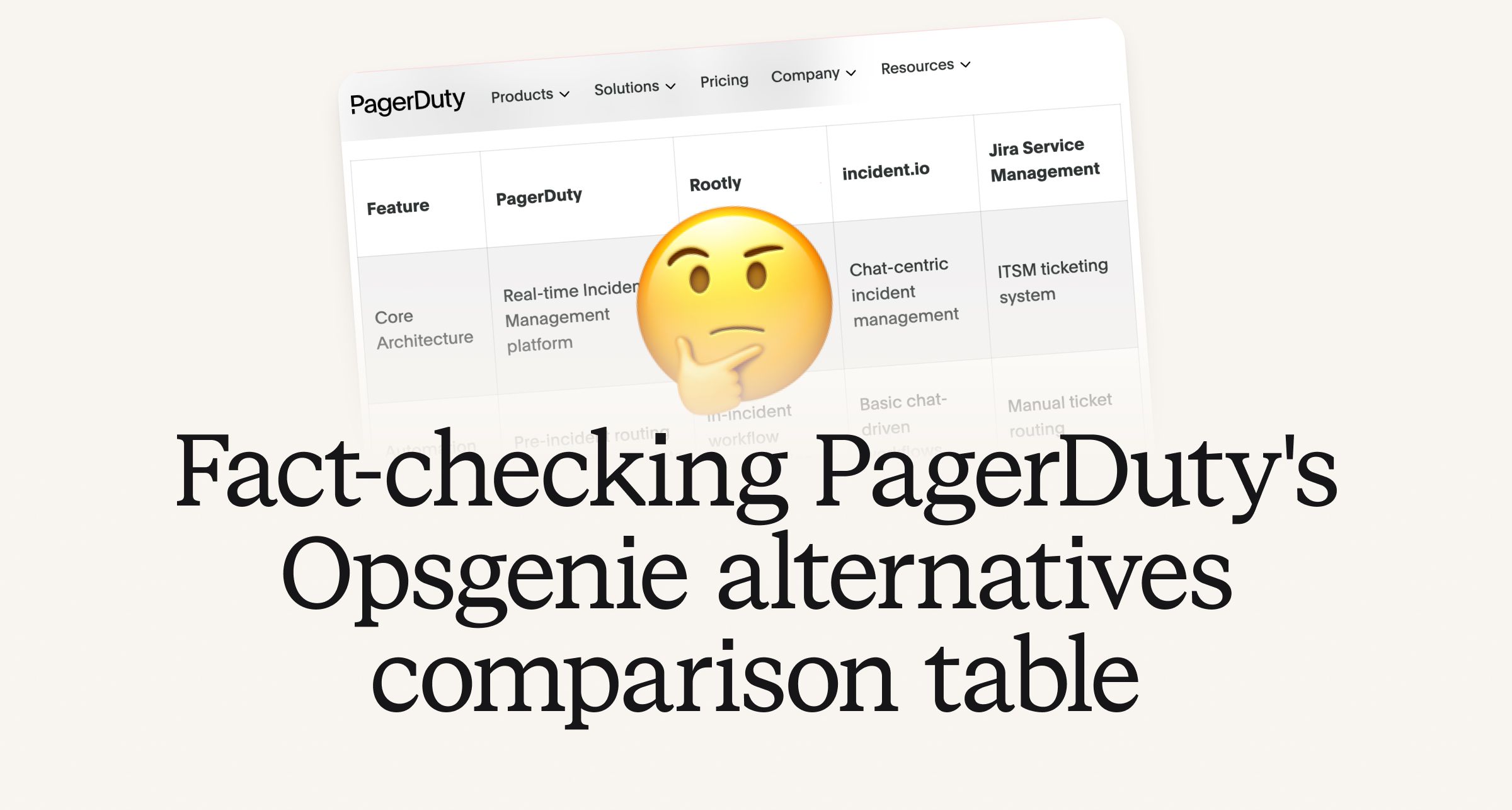
Fact-checking PagerDuty's Opsgenie alternatives comparison table
PagerDuty published a new comparison table about incident.io. Once again, it describes a product we don't recognize. So once again, we're correcting the record, row by row, with receipts.

July 28, 2026
Your genie is vanishing: introducing the Opsgenie rescue program
Today, we're launching the Opsgenie Rescue Program to make that landing soft: simplified migration and free overlap so you never pay two vendors at once.
July 9, 2026
So good, you’ll break things on purpose
Ready for modern incident management? Book a call with one of our experts today.
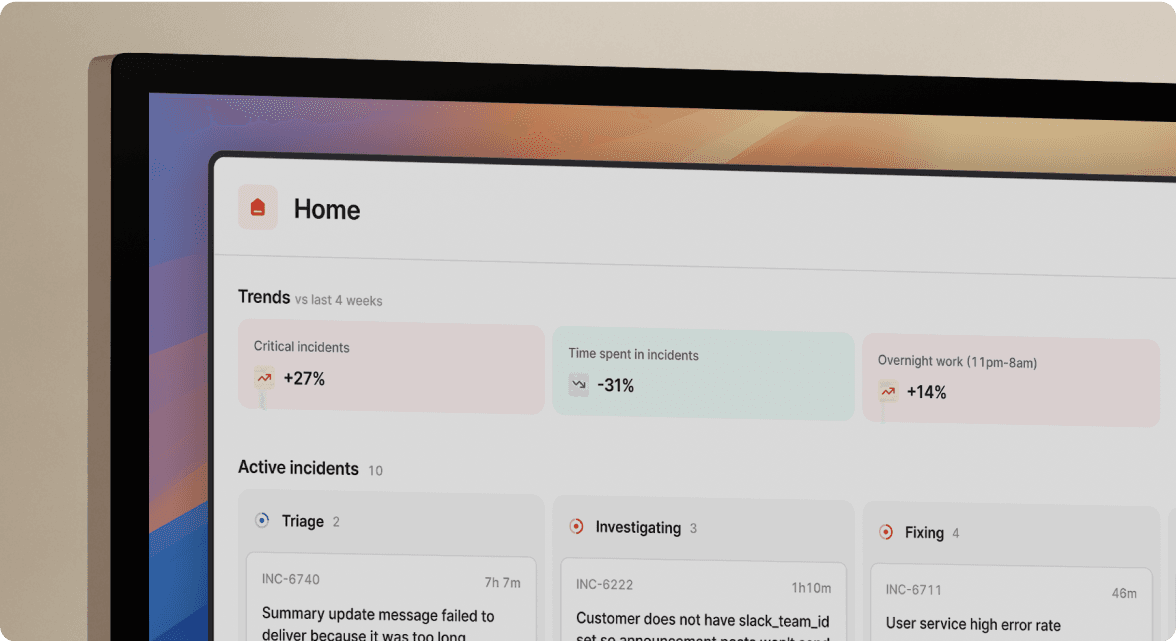
We’d love to talk to you about
- All-in-one incident management
- Our unmatched speed of deployment
- Why we’re loved by users and easily adopted
- How we work for the whole organization