How Rho scaled their incident culture without burning out their team
Managing incidents across five different tools was burning out Rho's engineering team. incident.io unified their workflows, gave Customer Success real-time visibility, and turned postmortems into searchable institutional knowledge – all with zero training required.
Rho is the modern banking platform built for startups. Founders get banking, cards, and treasury set up fast, with real human support behind every dollar. As companies grow, expenses, bill pay, and accounting stay centralized in the same system, so a first-time finance hire can ensure operations scale without adding new tools or new friction.
Processing billions in transaction volume for high-growth companies and enterprises, Rho operates with exceptionally high standards—they'll page engineers for a single delayed payment because best-in-class human support is their competitive edge.
Information scattered across five different places
Branko Ostojić, Site Reliability Engineer at Rho, can list the fragmentation from memory: "All this information was kept in five different places. We managed the incident in PagerDuty and manually created Slack channels. For postmortems, we'd go into Google Drive, create one from a template, and update JIRA.”
This wasn't just inefficient; it was unsustainable for a team with ambitious incident response goals. Rho had always meticulously documented incidents, even those below traditional thresholds, because they viewed postmortems as critical to their engineering culture. But maintaining these high standards across scattered tools meant slower resolution times and an exhausting coordination burden on the team.
Customer Success needed better visibility
The fragmentation created cascading problems across the organization. Customer Success teams would discover incidents when customers called in. It was difficult for Leadership to track progress without interrupting the engineers trying to fix things. Engineering teams sometimes worked in isolation, unaware of what other teams were discovering.
Without systematic communication, every incident became a coordination exercise. Customer-facing teams couldn't provide meaningful updates. Engineers fielded constant interruptions asking for status. And while Rho consistently wrote postmortems as part of their culture, they disappeared into Google Drive, where they were hard to reference and learn from later.
"This is how incident response should work"
Stevan Milic, an Engineering Manager at Rho, had an immediate reaction when he first encountered incident.io.
I watched the incident.io demo videos and was immediately like, okay… This is how incident response should work. Everyone's on the same page from the start.
What clicked wasn't just the features; it was the philosophy. incident.io understood that incident management isn't about alerts or tickets. It's about coordination, communication, and turning every incident into organizational learning; values Rho had always held but struggled to scale.
Rho ran a proof of concept for two months. Real incidents struck during the trial, providing authentic test scenarios. "By the end, it was clear: this was exactly what we needed," Stevan explains.
Natural adoption across the organization: no training required.
"Once we decided to move forward, adoption was natural," Stevan notes. "Engineers saw how much easier their lives became and just started using it."
No forced adoption. No training campaigns. The platform consolidated five separate tools into one coherent system, eliminating the constant context-switching that had plagued their incident response and reducing the coordination burden dramatically.
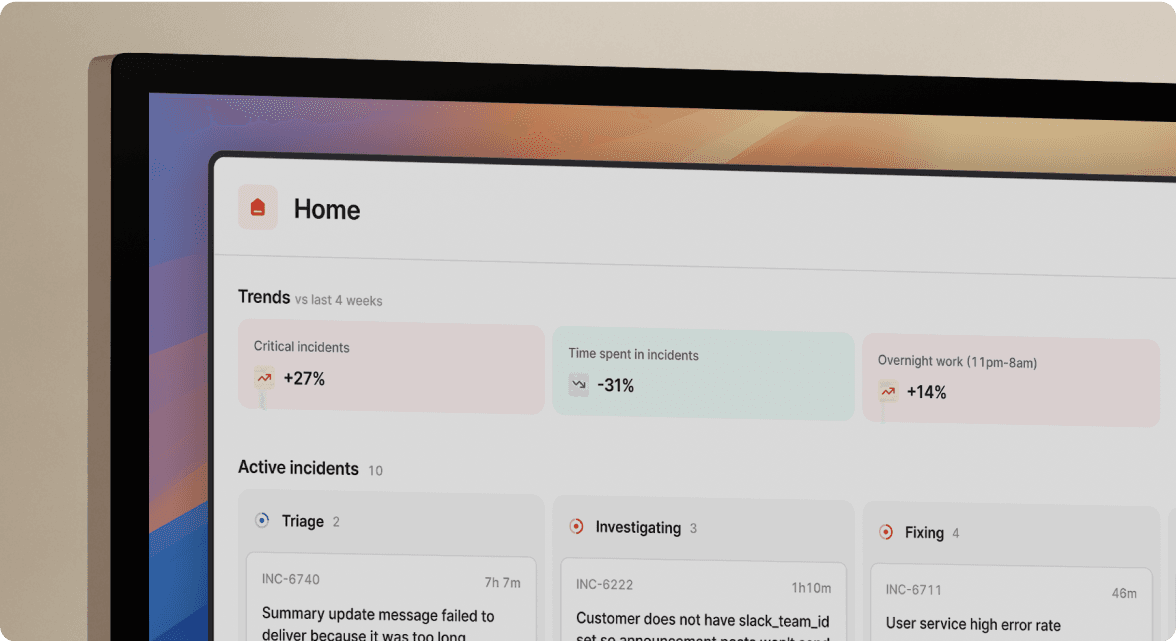
The benefits extended beyond engineering. "Customer Success loves it," Branko shares. "They can see exactly what's happening, understand the impact, and give customers real updates instead of 'let me check with engineering.'"
"One of the things that incident.io does really well is the incident announcement channel," Branko adds. "When something shows up there, everyone's alerted at the same time."
An AI partner for every engineer
One unexpected benefit has been incident.io's Scribe and its AI-generated summaries, which are transforming how the team investigates and learns from incidents. Rather than interrupting colleagues to understand what happened, team members can read through incident summaries and get real context independently.
"I'm personally finding a lot of value in being able to read through incident summaries and get real context without bugging people. I felt this over the holidays more than ever," shares Kim Phifer, CTO at Rho. With Rho actively onboarding new engineers, this capability is proving invaluable. New hires now have an AI agent that helps them get operationally ready faster, building context from past incidents without requiring constant hand-holding from tenured team members.
The AI summaries effectively give every engineer, whether they joined last week or five years ago, access to institutional knowledge that would otherwise require tracking down the right person and hoping they remember the details.
The results: High standards without the burnout
The metrics tell a story of ambitious goals finally achieved at scale. Rho's culture of comprehensive postmortems became sustainable, they could now maintain documentation and follow-up even for lower-tier incidents without exhausting the team. Postmortems that had always been written but often lost in Google Drive became searchable, valuable documents that the team references constantly.
The transformation extended across the organization. Five disparate tools consolidated into one platform. Customer Success gained the real-time visibility essential for best-in-class support. Engineers stopped burning out from constant context-switching and coordination overhead. Most importantly, every incident now adds to searchable institutional knowledge.
"We actually learn from incidents now," Branko reflects. "The postmortems aren't just bureaucracy, they're valuable documents we reference constantly."
Looking forward
For Rho, incident.io represents the scaling of their incident response ambitions. Information no longer lives in five different places. Customer Success has the visibility needed for proactive client communication. Engineers can focus on solving problems rather than managing coordination overhead.
This quarter, they're pushing even further with "proactive observability," coordinating with CS and PMs to notify clients about payment delays even when not directly tied to Rho's systems, like when wire protocol changes caused delays.
If you're still using legacy tools and manual processes, you're living in the Stone Age. incident.io isn't just better, it's what incident management should have been all along.
Stevan Milic, Engineering Manager
The speed of transformation proved remarkable. Within months, a company with already-high incident response standards found a way to maintain them sustainably. For a fintech platform where customer service is the differentiator and reliability is non-negotiable, that evolution from exhausting coordination to confident efficiency has proven invaluable.