PagerDuty pricing breakdown 2026: hidden costs & why teams are switching
September 1, 2026 — 16 min read
TL;DR: Most engineering leaders evaluating incident management for the first time focus on PagerDuty's base per-user rate, only to discover that the features a growing team actually needs sit behind upgrade tiers or separate add-on fees. A 40-person startup with 20 engineers on PagerDuty Business will spend roughly $18,228 annually once you add AIOps ($9,840 base plus PagerDuty's own published AIOps starting price of $8,388/year, which scales up with alert volume since it's billed per accepted event), while modern alternatives like incident.io bundle on-call scheduling, alerting, status pages, and AI-powered post-mortems into a single transparent subscription, with no negotiation required to see the real number.
When you're building out your first formal incident response process, PagerDuty's name recognition makes it feel like the safe default. The per-user pricing looks manageable until you dig into what that base rate actually includes. The features most growing teams need, including useful analytics, workflow automation, and stakeholder communication, sit behind upgrade tiers or add-on fees that don't appear in the initial quote.
This guide breaks down PagerDuty's 2026 pricing tier by tier, shows you the specific add-ons that inflate real invoices, and compares what the same coverage costs on modern, Slack-native alternatives built for teams at your stage.
PagerDuty migration and pricing tier guide
Below is a tier-by-tier breakdown of what each plan includes and where the gaps appear.
PagerDuty structures its pricing across four tiers, and each one gates features that you'll likely consider baseline requirements once you're running a real on-call rotation.
Free plan limits for early teams
PagerDuty's Free plan supports up to five responders and is designed for small founding teams evaluating incident tooling for the first time. For formal on-call rotations or more than one escalation path, you'll need to upgrade to a paid tier. A PagerDuty basics walkthrough illustrates what this setup looks like before you commit to a paid tier.
Professional tier costs
The Professional plan costs $21/responder/month billed annually, or $25/responder/month on a monthly basis, per list pricing. This tier is designed for teams needing more robust scheduling capabilities.
Actual costs of the Business plan
The Business plan sits at $41/responder/month annually ($49/month on monthly billing), per list pricing. This is where more advanced incident response features start to appear, but it's also where add-on fees stack. For a 40-person startup with 20 engineers on Business, the base subscription alone runs $9,840/year before a single add-on.
Enterprise plan costs and limitations
Enterprise uses custom pricing, per list pricing. At startup scale, you're unlikely to need Enterprise, but you'll discover that features you do need for managing MTTR trends and stakeholder communication require Business tier at minimum.
Hidden expenses in your incident response budget
The line items on a PagerDuty invoice are only part of the picture. Several cost categories don't appear on the pricing page but show up reliably once you're running a real incident process.
On-call scheduling add-on fees
Managing leave overrides and multi-team escalations can introduce operational overhead. For a small team without a dedicated SRE function, managing complex scheduling through any web UI adds friction that compounds with every schedule change. Managing complex scheduling through any web UI adds friction that compounds with every schedule change, a pattern several independent reviews on TrustRadius describe as a recurring pain point for PagerDuty's interface specifically.
Advanced analytics and reporting costs
You won't get advanced analytics on the base Professional tier. Without them, you can't show a trend line on incident frequency or MTTR to your board or co-founders, which means you can't justify your engineering investment with data. That missing visibility matters more as deal sizes grow and customers start asking about your uptime posture.
Incident workflows and automation pricing
AIOps sits outside PagerDuty's main per-user tiers and is licensed per accepted event rather than a flat seat rate, so your actual monthly cost depends on alert volume, not headcount. Third-party pricing coverage puts the starting rate at $699/month billed annually ($799/month billed monthly), as of this writing. A team on Business with AIOps should budget for that as a floor, not a fixed line item: duplicate alerts, noisy integrations, and monitoring storms can push consumption well above it while your responder count stays flat.
Evaluating PagerDuty API usage caps
PagerDuty caps its REST API at 960 requests per minute per API token, flat across every plan tier. You may discover these limits only after hitting them in production with your Datadog, Prometheus, or custom event integrations, at which point your options are a tier upgrade or a custom capacity negotiation. Neither is fast, and neither is cheap.
Hidden risks of per-user pricing
Per-user pricing that applies to everyone who needs incident visibility, including passive stakeholders, creates a real incentive to restrict access in ways that hurt incident communication. Teams that can't afford seats for every watcher end up routing status updates through informal Slack threads, which defeats the purpose of a structured incident platform and makes post-mortem reconstruction harder after the fact.
True per-user costs by team size
Here is the math on what PagerDuty actually costs at common startup sizes, using 2026 public pricing. Both vendors price per user with platform access, not just active on-call responders, so the table uses total engineering headcount as the seat count. The "on-call" column is a realistic assumption that about 40% of engineers rotate on-call, useful context for staffing your rotation, but it isn't the number that determines your invoice.
| Company size | Engineers on-call | PagerDuty Business + AIOps (annual) | incident.io Pro (annual) | Net savings |
|---|---|---|---|---|
| 15 people (10 engineers) | 4 | ~$ 13,308 | $5,400 | ~$7,908 (59%) |
| 40 people (20 engineers) | 8 | ~$ 18,228 | $10,800 | ~$7,428 (41%) |
| 75 people (30 engineers) | 12 | ~$ 23,148 | $16,200 | ~$6,948 (30%) |
PagerDuty figures use 2026 list pricing on annual billing, with AIOps at $699/month on annual billing, as of this writing.
If your team doesn't need AIOps yet, the base cost difference narrows, but you also lose the analytics and workflow depth that makes incident data actionable over time. Most teams add AIOps within six months of going live on Business.
incident.io as a PagerDuty alternative
Here is how incident.io compares to PagerDuty across the areas where pricing and workflow differences matter most.
On-call scheduling: included vs. add-on
We price on-call as a transparent, flat add-on rather than a gated tier feature. The Team plan runs $15/user/month on annual billing ($19 monthly), with a $10/user/month on-call add-on (flat for both monthly and annual billing), bringing your all-in cost to $25/user/month annually. The Pro plan is $25/user/month with a $20/user/month on-call add-on, totaling $45/user/month, per our billing documentation.
Pro covers the core of what most teams need: unlimited workflows, AI-powered post-mortem generation, on-call schedules, incident coordination in Slack, unlimited integrations, and API and webhook access. For teams just starting out, our Team plan offers a lower entry point at $15/user/month with a $10/user/month on-call add-on, totaling $25/user/month.
Incident management directly in Slack
With incident.io, your team runs the full incident via /inc commands in Slack, from alert to resolved post-mortem, without toggling between a web UI, a separate alerting tool, a Google Doc, and a status page. When an alert fires, incident.io creates a dedicated channel, pages on-call engineers, and starts capturing the timeline automatically. Our Scribe feature handles real-time call transcription so nobody has to take manual notes during a P1. A talk on shipping faster at re:Invent 2025 covered the cost-of-incident math, showing how coordination overhead is the first and fastest cost to cut.
Our Investigations product automates up to 80% of incident response by triaging alerts and analyzing root causes from telemetry and code changes. This is where the real time savings compound for a small team without a dedicated SRE function.
"It's also super easy to use, allowing anyone to jump in without needing much instruction. Additionally, I think it's the best data management tool I've used in a while, and I can't even compare it to other products like PagerDuty or Opsgenie." - Pedro I. on G2
The incident.io on-call migration tools and our Datadog monitor migration guide cover the technical side of bringing your existing alert setup into the platform without rebuilding from scratch.
FireHydrant as a PagerDuty alternative
FireHydrant is a direct competitor in the Slack-integrated incident management space. The PagerDuty vs incident.io vs FireHydrant comparison from OpsBrief covers this evaluation in detail.
On price, third-party pricing data puts typical FireHydrant annual contracts between $10,000 and $75,000 depending on team size, as of this writing, with Signals (alerting/on-call) billed separately based on alert volume rather than a flat per-seat rate.
FireHydrant includes alerting, on-call, response, status pages, and retrospectives in a single tool, which reduces the add-on stacking problem that inflates PagerDuty costs. incident.io's Investigations product goes further by triaging alerts and surfacing root causes from telemetry and code changes. For teams where engineering time during incidents is the dominant cost, that depth of AI capability matters more than per-seat rate differences between the two alternatives.
PagerDuty vs. Grafana OnCall: cost analysis
Grafana OnCall appears frequently in open-source or budget-constrained evaluations, and the headline free tier looks attractive. The full picture is more complicated.
Grafana Cloud IRM offering a free tier for up to 3 active IRM users, then a Pro tier at $20/active user/month plus a $19/month platform fee, with Enterprise pricing custom and starting around a $25,000/year minimum commit, as of this writing.
The real cost of self-hosting any open-source on-call tool is the engineering time to own the deployment, upgrades, and reliability of the tool itself. For a team without a dedicated SRE function, that shifts the same problem you're trying to solve to the tooling layer. The Opsgenie Is OUT breakdown covers this pattern specifically.
Whether PagerDuty fits your stage
The pricing problem and the complexity problem are connected. PagerDuty built its architecture for organizations with thousands of services, complex multi-team routing, and dedicated SRE functions to manage the configuration. That's genuinely valuable at that scale.
For a 20-50 person startup, you pay for that complexity without getting most of the benefit. According to a third-party report, PagerDuty's DBNR reportedly dropped from 104% (April 2025) to 97% (April 2026). A DBNR below 100% reflects a combination of customer churn, downgrades, and insufficient expansion revenue to offset those losses, a buying-behavior signal worth noting when you're evaluating the platform's trajectory.
Do you actually need this yet?
The honest answer for a team under 15 people: probably not a full incident management platform. PagerDuty's Free plan or a simple PagerDuty-plus-Slack workflow covers basic paging at that size. The tipping point comes when your informal "whoever notices it posts in Slack" process starts breaking, which typically happens as the on-call burden becomes uneven and new hires don't know the unwritten process.
The Fin case study illustrates what fragmentation costs at scale. Fin (formerly Intercom) ran hundreds of engineers on PagerDuty and Atlassian Status Page, and as the Fin customer story documents, managing incidents across Slack, PagerDuty, and GitHub created fragmentation where minor incidents went undocumented. Switching to incident.io consolidated the entire workflow into Slack, with automatic channel creation, automated summaries, and status updates running through /inc commands.
"Incident.io features a lot of integration to most of our tools like Google, Jira and Pagerduty. Their customer support based on Slack is natural and easy with an excellent response rate." - Rui A. on G2
The Inside Investigations webinar covers what AI-assisted incident response delivers in practice, which is a useful filter when evaluating any vendor's AI story. incident.io's on-call guide benchmarks rotation structures and compensation practices, which helps when you're setting up a formal rotation for the first time.
If you want to see what a full incident lifecycle looks like from alert to resolved post-mortem, all inside Slack, book a demo of incident.io and we'll walk through a live scenario with your stack. If you're also evaluating the April 2027 Opsgenie sunset, our Opsgenie migration guide covers that parallel track.
Key terms glossary
MTTR (Mean Time To Resolution): A common metric tracking the average time from incident detection to full resolution. The metric boards and customers ask about when they want to understand your reliability posture.
On-call rotation: A schedule assigning engineers to be available and responsive during specific time windows. Formal rotations replace the informal "whoever sees it first" approach that breaks down as teams grow.
P0/P1/P2/P3: Severity levels for incidents, with P0 being the most critical. Higher-severity incidents typically require immediate response and dedicated incident channels.
DBNR (Dollar-Based Net Retention): A SaaS metric measuring the percentage of revenue retained from existing customers year-over-year, including expansions and contractions. A DBNR below 100% reflects a combination of customer churn, downgrades, and insufficient expansion revenue to offset those losses.
Slack-native: An architecture where the incident workflow runs inside Slack via slash commands and channel interactions, not a web UI that sends notifications to Slack as a side channel.
Timeline capture: Automatic recording of every status update, role assignment, and decision during an incident, used to generate post-mortems without manual reconstruction from memory.
FAQs

Tom Wentworth
Chief Marketing Officer
See related articles
Introducing Investigations, powered by Nexus.
Today we're launching Investigations: agentic root cause analysis that starts the moment you're paged, figures out what broke and why, and works with your team through to resolution. Here's what we built, what's powering it, and why it took some time to get right.

August 5, 2026
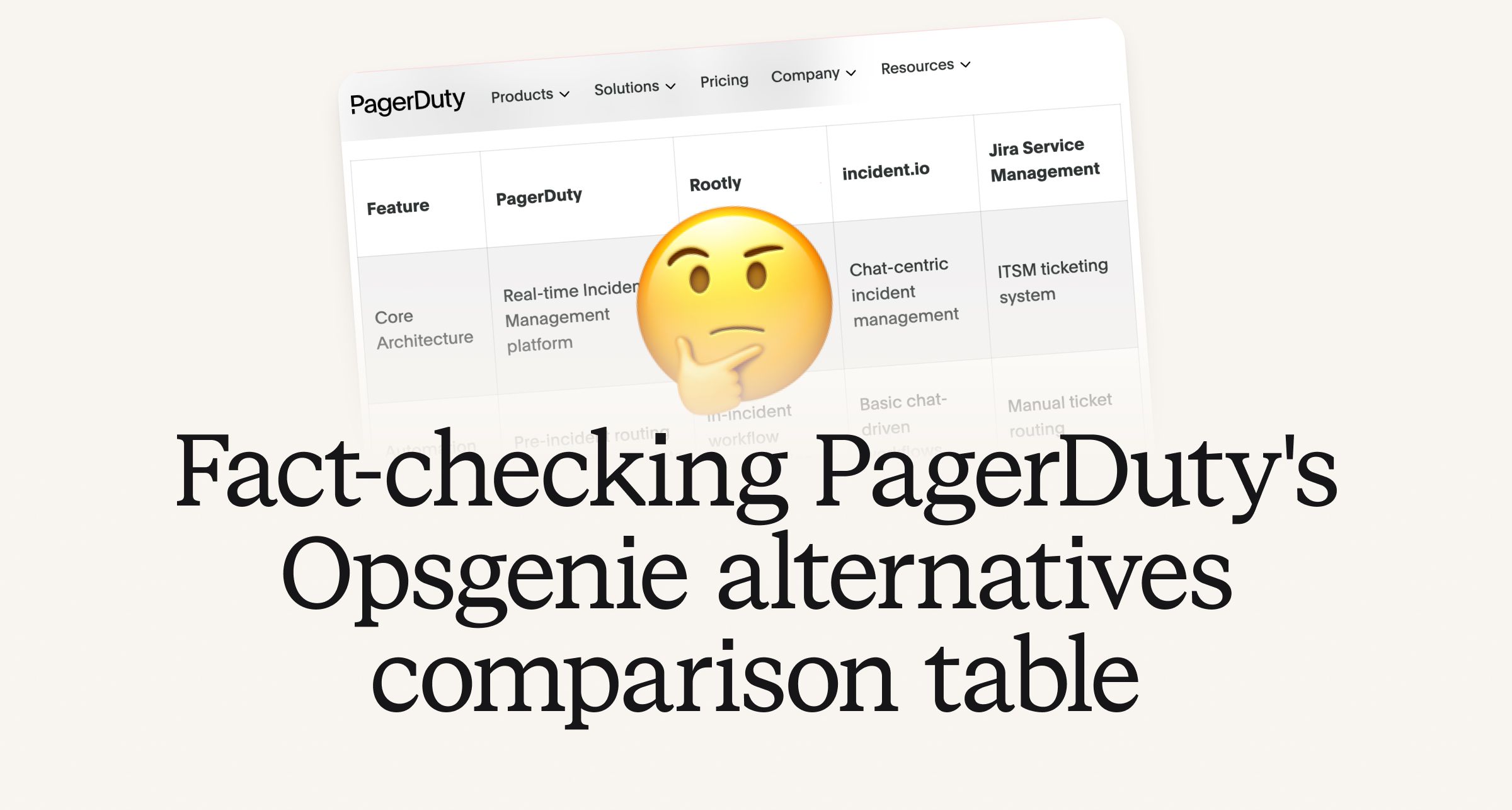
Fact-checking PagerDuty's Opsgenie alternatives comparison table
PagerDuty published a new comparison table about incident.io. Once again, it describes a product we don't recognize. So once again, we're correcting the record, row by row, with receipts.

July 28, 2026
Your genie is vanishing: introducing the Opsgenie rescue program
Today, we're launching the Opsgenie Rescue Program to make that landing soft: simplified migration and free overlap so you never pay two vendors at once.
July 9, 2026
So good, you’ll break things on purpose
Ready for modern incident management? Book a call with one of our experts today.
We’d love to talk to you about
- All-in-one incident management
- Our unmatched speed of deployment
- Why we’re loved by users and easily adopted
- How we work for the whole organization