How Built replaced PagerDuty and got the full incident management lifecycle for the same price
Built is the leading AI-native platform for real estate and construction finance, helping lenders, developers, and contractors save time and money by replacing spreadsheets, email, and manual workflows with a single system for draws, inspections, and payments. The company's engineering team powers a platform handling billions in transactions, where reliability and fast incident response directly affect the people building the places we live and work.
4+hours saved on post-mortems
50+engineers using across the cloud platform team
Full lifecycle for the cost of PagerDuty alerting alone
Built's incident management looked fine on the surface: PagerDuty for paging, Slack automations creating tickets and spinning up channels. But everything after that first alert was manual. A senior SRE was brought in with one constraint: fix it without spending more. They chose incident.io over Rootly and FireHydrant, got the full incident lifecycle for roughly what they'd been paying PagerDuty for alerting alone, and ran it on the first incident that came in.
PagerDuty paged people. It didn't help them respond.
The setup looked reasonable on paper. But everything after the initial alert is where it fell apart.
We had Slack automations that would create a Jira ticket, spin up the incident room, and page the people through PagerDuty who were on call. We built that whole orchestration through Slack.
Paul Bowden, Director of Engineering, Built
Everything after the initial alert (documentation, timelines, follow-ups, post-mortems) was entirely manual. Incident managers had to create Confluence pages from scratch, follow templates from memory, chase action items, and reconstruct what happened by scrolling through Slack history.
The incidents ended. The work didn't.
Jacob Weyer, Manager of the Cloud Platform Team, was spending an hour or two after his workday ended on paperwork after major incidents: manually assembling timelines, logging decisions, following up on actions. Engineering time spent on paperwork isn't neutral. It delays the work that reduces future incidents, and it burns people out.
Everyone pitched in. Nobody owned it.
Built didn't have a dedicated owner for incident management. "It was more of a committee of people doing things on their best effort," Paul explains. When they hired a senior staff SRE to own it properly, the mandate was clear: find a platform that covered the entire incident lifecycle, not just paging, without increasing spend.
The decision
Do more for the same money
The SRE's mandate wasn't to throw budget at the problem. It was to optimize the process.
We brought in incident.io for roughly what we were paying for PagerDuty. Except now we had the full incident management lifecycle. That was the big ROI.
Paul Bowden, Director of Engineering, Built
Jacob led the vendor evaluation, comparing incident.io against Rootly and FireHydrant. Two things separated incident.io: the licensing model and how deeply Slack-native the experience was.
We loved how it managed incidents through Slack, meeting us where we already are.
Jacob Weyer, Manager, Cloud Platform Team, Built
PagerDuty had done its job.But stitching together the rest of the incident lifecycle around it carried a cost, both financially and in tooling complexity, that was too large to ignore.
There were a couple of things that stood out about incident.io compared to the competitors: the licensing model and how Slack-native the process was. We were okay with leaving PagerDuty. It wasn't really special to us.
Jacob Weyer, Manager, Cloud Platform Team, Built
The migration
Day one: they jumped right in
The PagerDuty renewal was coming up. Rather than renew, Built went month-to-month and started using incident.io immediately. The platform was intuitive enough to run incidents out of the box, and they did, from day one.
We essentially just cut over. Whatever the first incident was, we just started using the tool. It wasn't perfectly configured; we had to tinker and figure things out as we went, but we started immediately handling incidents with incident.io.
Jacob Weyer, Manager, Cloud Platform Team, Built
Workflows got refined, configurations got dialed in, and the platform grew with them. The learning happened in production, not in a staging environment. On-call came next, moving across team by team until PagerDuty was no longer needed.
Training happened once. The system handled everything after.
The initial rollout included real training and knowledge transfer. But once the process lived in the tool, it stopped needing to be managed.
Incident managers don't need to know every step. The system prompts them and drives them through it.
Paul Bowden, Director of Engineering, Built
When your process lives in a tool rather than a doc, it actually gets followed. Before, a process change meant an announcement. Now the tool just reflects it. The next incident, the tool reflects it. There's no announcement, no retraining needed. When the process changes, the team doesn't have to stop and absorb it. They just run a better incident.
Before, we were managing all of our incident management responses in Confluence, pretty manual and hard to follow. Now we've been able to codify that with incident.io, centralize it, and automate what actually happens.
Paul Bowden, Director of Engineering, Built
Throughout the rollout, the incident.io team was a message away in Slack. They were answering configuration questions, helping refine workflows, and making sure nothing fell through the cracks.
The impact
Less paperwork, more signal
Ask anyone on the incident manager rotation what changed most: the post-incident paperwork that used to consume hours simply stopped.
As an incident manager, I can focus on the incident and not the paperwork. I can focus on the problem. I don't have to worry about documenting the steps that we did; I can have it auto-generated. That has been just night and day.
Jacob Weyer, Manager, Cloud Platform Team, Built
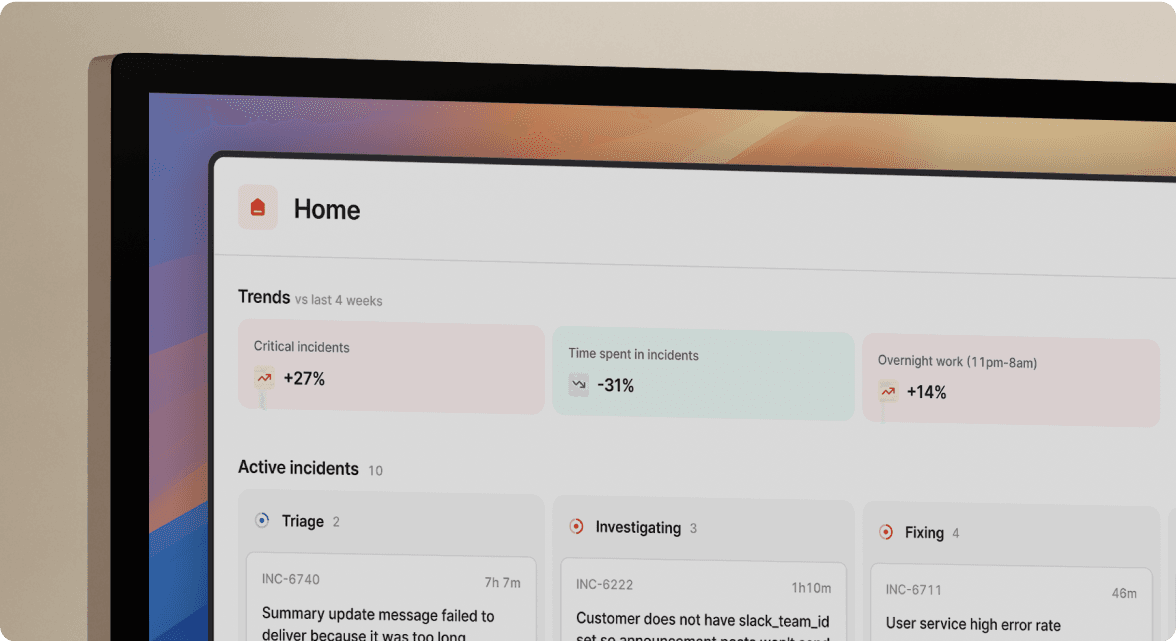
Timeline generation now happens automatically from Slack history and call transcripts. What used to be a post-incident obligation became something that looked after itself. And the same data that freed Jacob gave Paul something he hadn't had before: visibility without presence.
I don't have to join every call to understand what's going on when the team's working it. The reporting gives me visibility into what happened, who was involved, how long it ran.
Paul Bowden, Director of Engineering, Built
Before incident.io, that data was scattered across Jira tickets and Confluence docs. Pulling it together for any meaningful analysis was a manual exercise. Now it's a dashboard.
Almost all of it used to be a manual process: the timelines, the follow-ups, all of it. The platform changed that. Every time a new feature lands, it gets harder to imagine running incidents any other way.
Jacob Weyer, Manager, Cloud Platform Team, Built
What Paul would tell another engineering leader
You need a full incident management suite, not just an on-call and escalation tool. That makes a whole world of difference, being able to build your process around the tool versus just adopting something that manages one part of the lifecycle.
Paul Bowden, Director of Engineering, Built
Looking forward
Built has adopted incident.io's status pages and is evaluating internal status pages for their larger customers. With the reactive side under control, Jacob is already thinking about the next frontier. AI SRE is where he's looking.
We're focused on solving problems before they happen: agentic remediation, removing the human from the loop, keeping our processes and systems running.